Patrice
Beautiful image, great product
Comment from 10 September 2026 — Experience from 30 August 2026
Automatically translated — Show original (French)
Belle image, beau produit
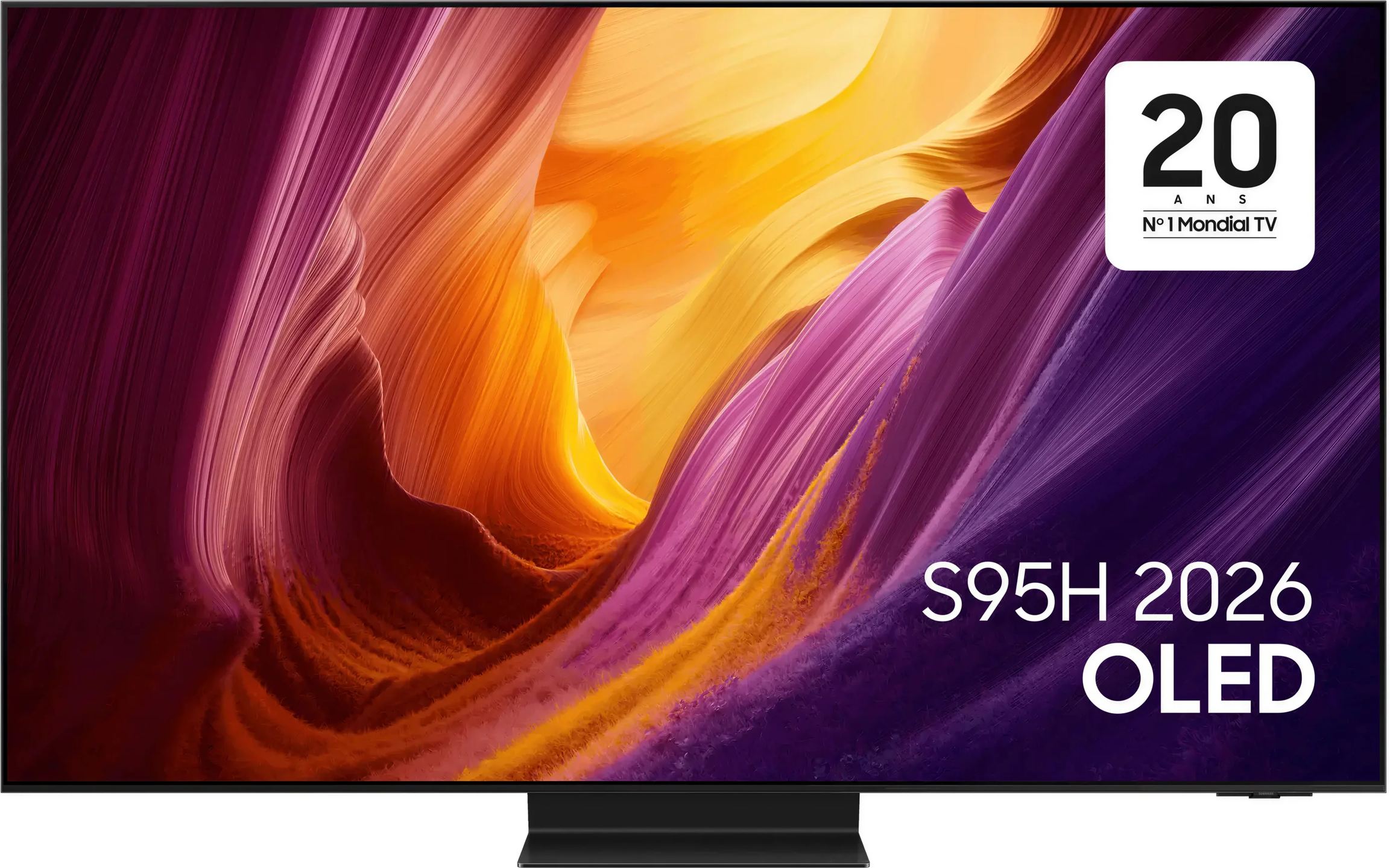


Fourth generation of Samsung’s QD-OLED line, the 65-inch S95H uses the self-emissive quantum dot panel that allowed the S95 series to establish a solid position in the high-end segment. The formula keeps its core strengths (high native contrast, Glare-Free anti-reflective treatment, One Connect box) while increasing brightness and AI-related functions. It is the flagship model in Samsung’s 2026 OLED range.
The 65-inch (165 cm) panel of the TQ65S95H is based on Samsung Display’s QD-OLED technology. The principle remains the same as on the 2022 S95B: self-emissive organic pixels produce their own light, without backlighting, which makes it possible to switch off each pixel individually and achieve absolute black. The quantum dot layer placed in front of the blue emitters converts the light into red and green with high color efficiency, which explains the color saturation and accuracy characteristic of this technology.
The improvement over the 2025 S95F primarily concerns brightness. Samsung announces a gain of around 30 to 35% in HDR peak brightness, and the first published measurements confirm values close to 2,500 nits on a 10% window in Standard mode, a level that rivals some high-end Mini LED TVs. On a full screen, brightness remains more modest (around 250 nits), which is typical for an OLED panel and only marginally affects everyday use.
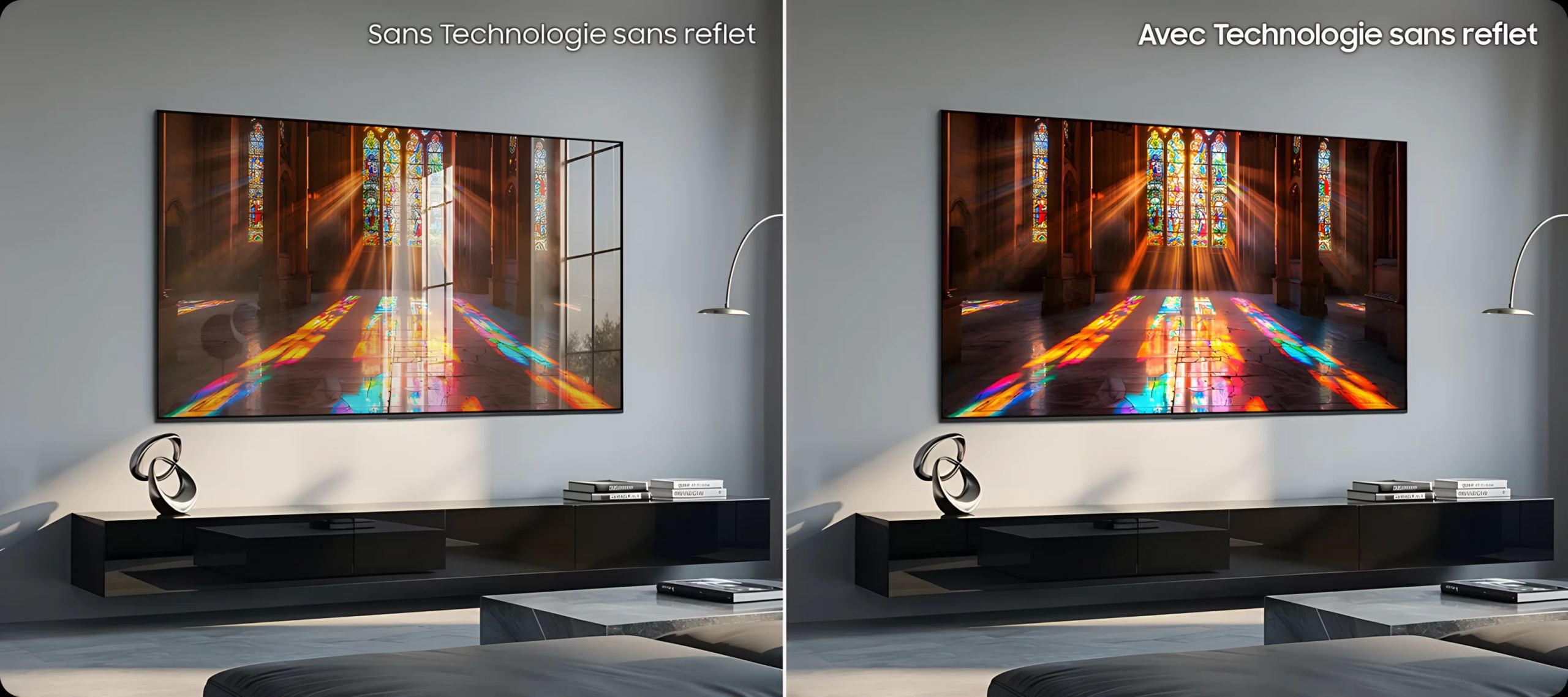
The Glare-Free surface treatment has been retained. This matte finish reduces reflections in bright rooms without degrading image readability. Samsung obtained VDE “Real Black & Real Color” certification for this version of the treatment, which maintains black levels and color accuracy even under strong ambient lighting. The downside of this matte surface, already noted on previous generations, is a slight reduction in perceived contrast in a dark room compared with a glossy panel. It is a deliberate compromise in favor of installation versatility.
Resolution remains Ultra HD 4K (3,840 x 2,160 pixels), and the panel runs natively at 100 Hz with interpolation capability up to 165 Hz via Motion Xcelerator.
The HDR processing of the TQ65S95H relies on the HDR10+ ecosystem in its latest versions: HDR10+ Adaptive dynamically adjusts rendering scene by scene according to the ambient light detected by the TV, while HDR10+ Gaming applies the same principle to video games. The HLG (Hybrid Log-Gamma) format, commonly used on over-the-air HD broadcasts, is also supported.
Samsung continues not to include Dolby Vision. Content encoded in this format on Netflix, Apple TV+, Disney+, or UHD Blu-ray discs is automatically fallback-converted to HDR10 or HDR10+. On a TV with this level of brightness and color coverage, the result remains very high quality, but the absence of Dolby Vision deprives the S95H of the dynamic metadata specific to this format and may be a drawback for users whose library relies heavily on this ecosystem.
The Auto HDR Remastering Pro function attempts to enhance SDR content by applying AI-based HDR processing. The NQ4 AI Gen3 processor handles this conversion, as well as 4K AI Upscaling Pro for lower-resolution sources. Rendering is convincing on 1080p streams (TV channels, streaming), and more variable on 720p or standard-definition sources.
The NQ4 AI Gen3 is the same processor as the one used in Samsung’s high-end 2025 TVs. It handles real-time scene analysis, upscaling, HDR tone mapping management, and automatic adjustments related to the viewing environment. AI mode adapts picture and sound settings according to the type of detected content (movie, sports, video game, news), and AI personalization allows the TV to build a visual preference profile specific to the user.
Color Booster Pro expands the displayed color volume, and Real Depth Enhancer analyzes the depth of each scene to accentuate separation between planes. These processes work in real time, but their aggressiveness varies depending on the selected picture mode. Filmmaker mode, which is more faithful to the director’s intent, disables most of these post-processing effects.

The TQ65S95H features an integrated audio system in a 4.2.2-channel configuration, with a total power output of 70 W RMS. Two height channels complement the four main channels and the two woofers, allowing native vertical spatial reproduction. Dolby Atmos support is included, as is support for the Eclipsa Audio format jointly developed by Samsung and Google.
OTS+ (Object Tracking Sound+) technology uses several speakers distributed throughout the chassis to virtually move sounds according to their position on the screen. The effect is noticeable on dialogue that follows a moving character, and on lateral sound effects. Q-Symphony makes it possible to synchronize the TV’s sound with that of a compatible Samsung soundbar, with both systems then working together rather than one replacing the other.
Adaptive Sound Pro automatically adjusts sound rendering according to the content, and Active Voice Amplifier Pro boosts voices when ambient noise is detected by the built-in microphones. Wireless Dolby Atmos allows an Atmos stream to be received from a compatible device without an HDMI cable, via the Wi-Fi network.
DTS is not supported. Users of Blu-ray players or files encoded in DTS will need to make sure their source can convert the signal to PCM or Dolby before sending it to the TV.
The four HDMI 2.1 ports of the TQ65S95H accept a 4K signal at 165 Hz, placing this TV among the rare models capable of exceeding the usual 120 Hz barrier on all of its inputs. VRR (variable refresh rate) compatibility covers both AMD FreeSync Premium Pro and NVIDIA G-Sync, a new feature for a Samsung OLED TV that removes the limitation that existed on previous generations.
ALLM (Auto Low Latency Mode) automatically switches the TV to game mode when a console or PC is detected, reducing display latency. Gaming Hub centralizes access to cloud gaming services and game settings, while the game bar overlays technical information (frequency, latency, active HDR format). Mini Map Zoom lets you enlarge a portion of the screen during gameplay, and Hue Sync compatibility extends the game’s lighting ambiance to connected Philips Hue bulbs (subject to a subscription and bulbs sold separately).
On consoles, the PS5 and Xbox Series X take advantage of 4K 120 Hz with VRR. The move to 165 Hz mainly concerns PCs equipped with recent graphics cards. The benefit is real for competitive gaming where the additional smoothness provides a noticeable advantage, even if the gain between 120 and 165 Hz remains subtle compared with the jump from 60 to 120 Hz.

The TQ65S95H retains the external One Connect box, an external module that groups together all connectivity. A single cable connects the box to the TV, simplifying wall installation by limiting the number of visible cables behind the screen. This design choice partly explains the TV’s slimness, with thickness reduced to 11 mm without the stand.
The connectivity itself includes four HDMI 2.1 inputs (all compatible with 4K 165 Hz and eARC on one port), three USB-A ports, one USB-C port, one Ethernet port, one optical audio output, and a dual DVB-T2/C/S2 tuner. The dual satellite input allows recording one channel while watching another, without requiring an external splitter.
The Slim OC Stand attaches to the One Connect box and provides a discreet central support point. For wall mounting, the TV is compatible with the VESA 400 x 300 mm standard. In terms of wireless connectivity, Wi-Fi 6E and Bluetooth 5.3 are integrated, and simultaneous dual Bluetooth connection allows pairing two headphones or two Bluetooth speakers at the same time.
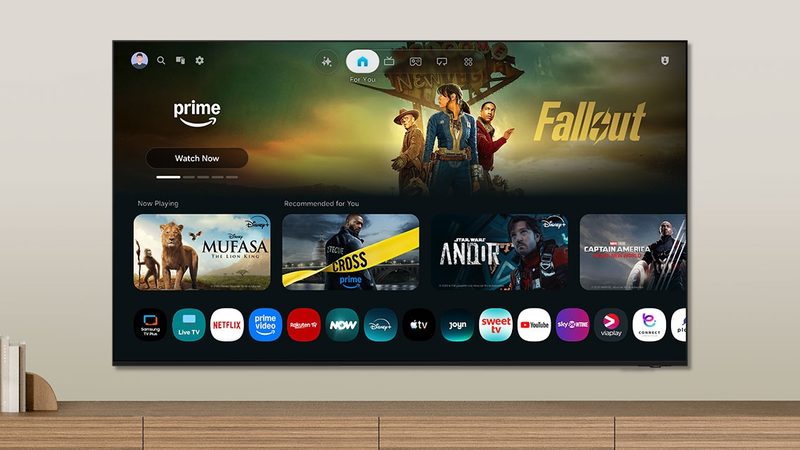
Samsung’s Tizen Smart TV system manages the interface and apps. Common streaming services (Netflix, Disney+, Prime Video, Apple TV+, Molotov, myCanal, etc.) are accessible natively. The Bixby and Alexa voice assistants are integrated with far-field voice recognition, and Google Assistant remains available via an external speaker.
AirPlay compatibility allows content to be streamed from an iPhone, iPad, or Mac. The integrated SmartThings Hub turns the TV into a control point for compatible Matter and SmartThings connected devices. Multi View displays two sources simultaneously on screen.
Vision AI Companion is the new artificial intelligence module that brings together several functions: content recommendations based on viewing habits, instant subtitle translation (Live Translate), and contextual scene analysis to offer additional information. Samsung also integrates Microsoft Copilot and Perplexity AI into its 2026 interface.
Samsung commits to seven years of software updates for Tizen OS, covering security patches and new features until 2033. This is the longest support period in the connected TV market.
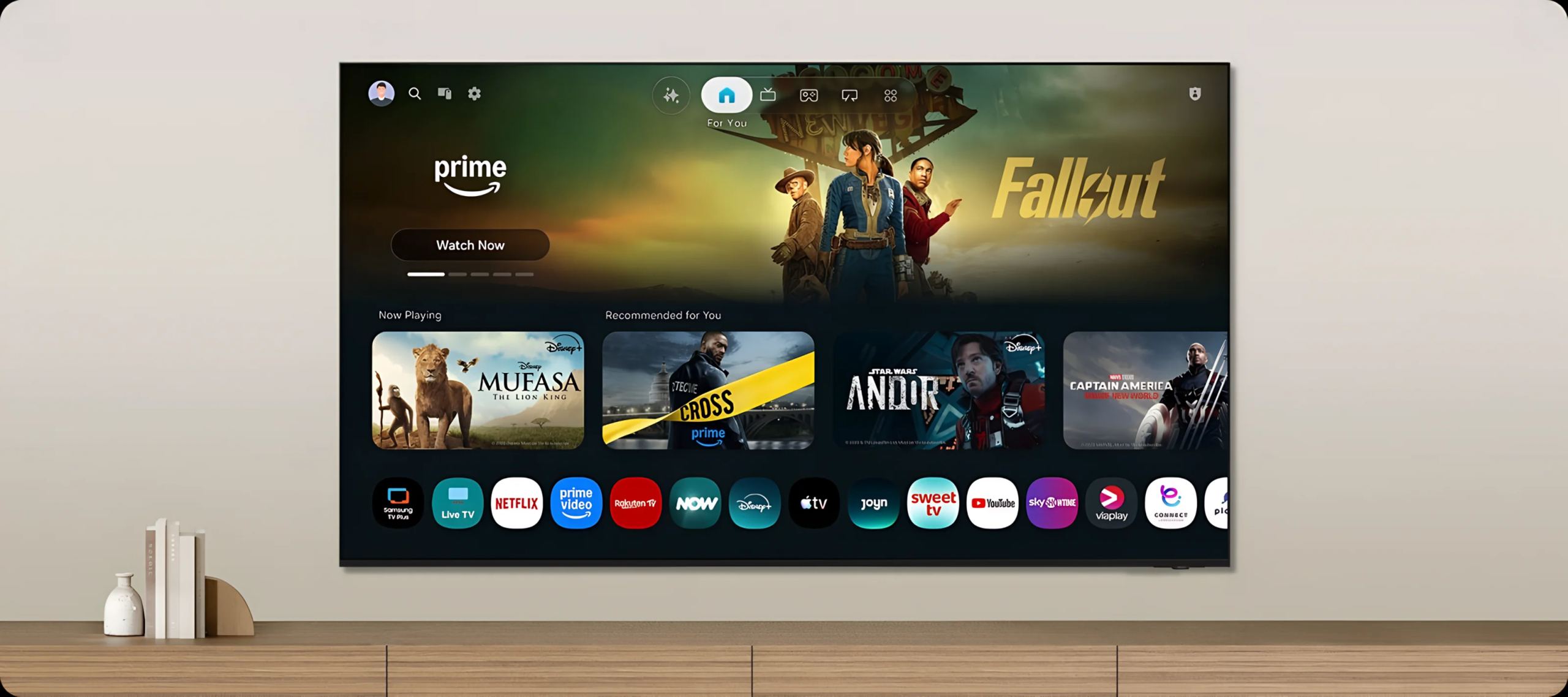
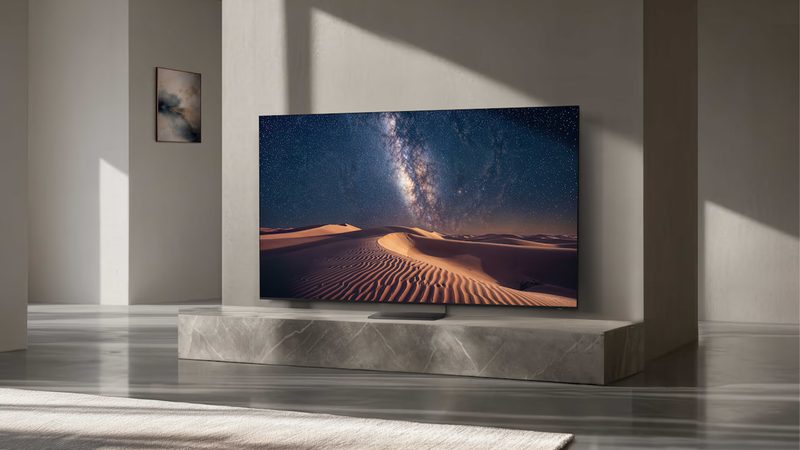
The TQ65S95H adopts the Infinity One design of previous generations, with an ultra-thin frame around the panel that lets the image occupy almost the entire front surface. The Graphite Black finish gives the chassis a understated, uniform look. The 11 mm thickness without the stand allows the TV to sit close to the wall with minimal clearance when wall-mounted.
Dimensions without stand are 1,443.5 x 829.4 x 11 mm, and 1,443.5 x 894.4 x 267.9 mm with the Slim OC Stand. Weight reaches 18.9 kg without stand and 29 kg with stand, a significant mass explained by the presence of the full speaker array and the metal chassis.

The S95H's picture quality is exceptional. It delivers the highest brightness yet for a flagship OLED TV, with vivid, accurate colours, sharp textures and powerful contrast. [...] Some traces of black crush appear in certain content, but the S95H's picture remains among the best on the OLED market. [...] While its design changes, notably the new FloatLayer Design with added frame, may divide opinion, and more capable built-in sound would have been welcome, the S95H remains above all a fantastic television, an elite choice.
The 65-inch model uses a QD-OLED panel supplied by Samsung Display. In the S95H range, the 55, 65, and 77-inch versions use QD-OLED, while the 48 and 83-inch versions receive a Tandem W-OLED panel supplied by LG Display. QD-OLED technology offers higher color saturation and brightness than conventional W-OLED.
No. The One Connect box groups together all of the TV’s connectivity. Without this box, the TQ65S95H cannot receive any external signal. The connection cable is included in the box.
The TQ65S95H does not decode DTS, DTS-HD, or DTS:X streams. If a Blu-ray player or multimedia file sends a DTS stream, the TV will produce no sound. The source must be configured to convert the signal to PCM or Dolby Digital before HDMI output.
Samsung has refined the treatment for the 2026 generation with the “OLED HDR Pro” designation. The principle remains the same (a matte surface reducing reflections), but Samsung claims better preservation of blacks and colors under ambient lighting compared with the previous version. VDE “Real Black & Real Color” certification is new for this generation.
Patrice
Beautiful image, great product
Comment from 10 September 2026 — Experience from 30 August 2026