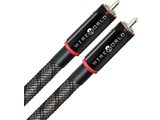
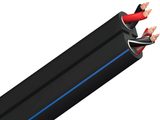
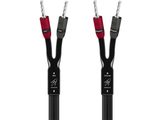
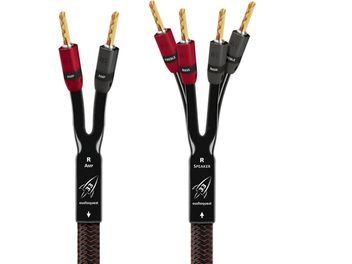
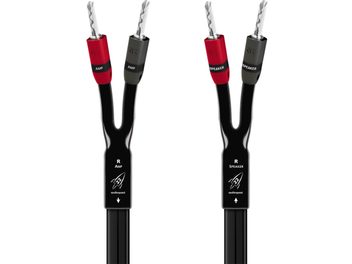
Speaker Cables & Accessories
Speaker cables and accessories are essential components for optimizing your hi-fi or home theater setup. From speaker cable by the meter to banana plugs, forks, and isolation spikes, each component plays a role in sound reproduction quality. Your choice of speaker cable depends on several criteria: the distance between the amplifier and speakers, conductor cross-section, materials used, and the type of available connectors. Learn more
Must-haves
Best sellers
Speaker cables: transmission and quality
The speaker cable carries the amplified audio signal from the amplifier to the loudspeakers. Unlike standard electrical cables, speaker cables are designed with specific capacitance and resistance to faithfully reproduce an audio signal across a 20 Hz to 20 kHz bandwidth.
Cable cross-section is a decisive criterion. For runs under 10 meters, a 2.5 mm² cable is generally suitable. Beyond that, a 4 mm² cross-section becomes necessary to limit conductor resistance and preserve signal integrity. The most common materials include OFC (Oxygen Free Copper), known for its conductivity, and sometimes silver, which favors high frequencies. Some manufacturers offer bi-metal cables to balance treble precision with bass depth.
Connectors: banana plugs and forks
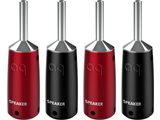
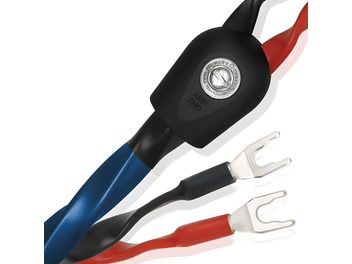
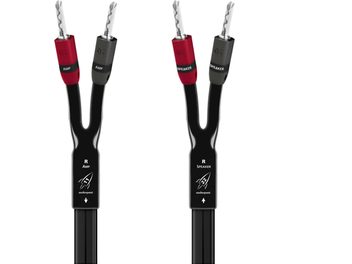
Banana plugs and forks greatly simplify connections between cables and binding posts. These accessories ensure a solid, stable contact, preventing conductor oxidation and the gradual loosening of screw terminals.
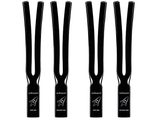
The banana plug inserts directly into the hole provided on the binding post. It allows quick connection and disconnection, which is especially appreciated when changing configurations. Forks, U- or Y-shaped, are placed under the binding post screws and offer a wide contact area along with excellent mechanical stability.
There are several methods for fastening the cable to the connector: screw clamping, cold crimping (notably QED’s Airloc system, which expels air between the cable and connector), or more rarely soldering. Most connectors are gold-plated to resist corrosion without degrading conductivity. The choice depends on the cable cross-section used; standard models generally accept 4 mm² conductors, while reinforced versions can accommodate 6 or 10 mm² cables.
Observing polarity
A fundamental technical point is observing polarity during connection. Speaker binding posts include a positive terminal (usually red) and a negative terminal (usually black). Failing to observe polarity results in phase inversion: the drivers move in opposition, which severely degrades stereo imaging and tonal balance, especially in the bass frequencies.
Isolation spikes and decoupling systems
Isolation spikes and cones help manage the speaker’s mechanical vibrations. Placed under the speaker, these accessories reduce the transmission of vibrations to the support (floor or furniture) and limit unwanted resonances. Counter-spikes protect delicate surfaces from scratches while contributing to vibration isolation.
These systems use different materials: stainless steel, aluminum, silicone, or sometimes mixed compositions. The goal is either to evacuate vibrational energy or absorb it, depending on the design, to achieve tighter bass, more detailed mids, and a better-defined soundstage.
Matching cabling to your setup
Choose a speaker cable according to the quality of your existing setup. A modest system with entry-level speakers may be well-served by standard cables. Conversely, a system built with high-end components will benefit from high-performance cables featuring high-purity copper conductors, shielded jackets, and quality connectors.
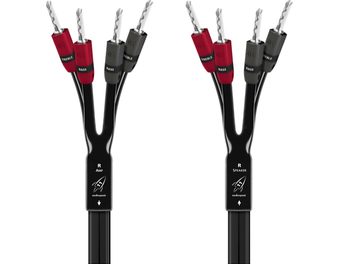
Environmental conditions also influence selection: the proximity of devices that generate electromagnetic interference (TV boxes, Wi‑Fi modules, appliances) or long runs may require suitable cables to maintain optimal transmission. Some amplifiers support bi-wiring, allowing separate feeds for bass and treble drivers to further refine reproduction.
Cables sold by the meter offer the flexibility to create custom lengths, while pre-terminated cables with connectors ensure immediate deployment. In all cases, a cable that is neither too long (risk of parasitic inductance) nor too short (strain on binding posts) will deliver the best performance.