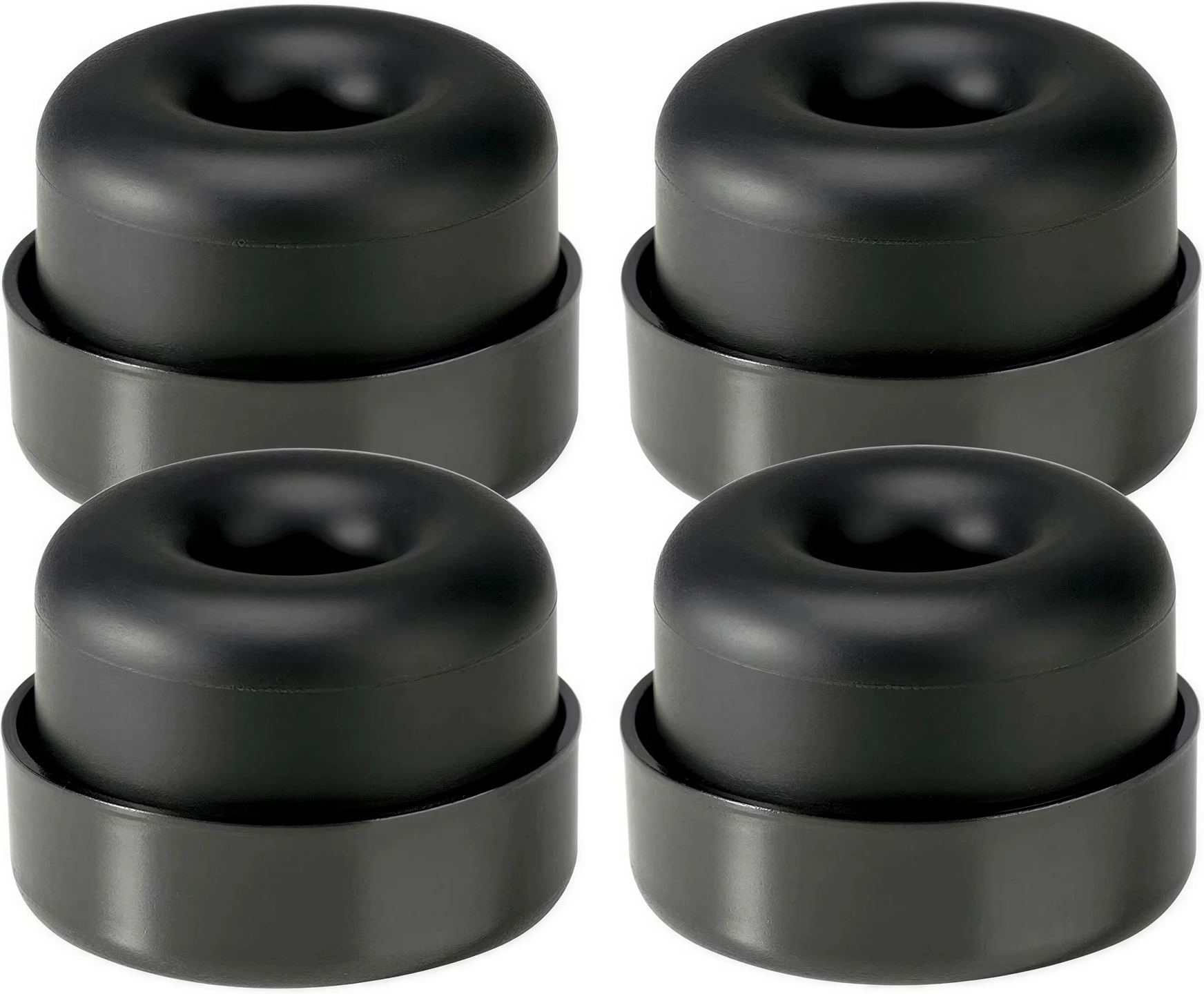
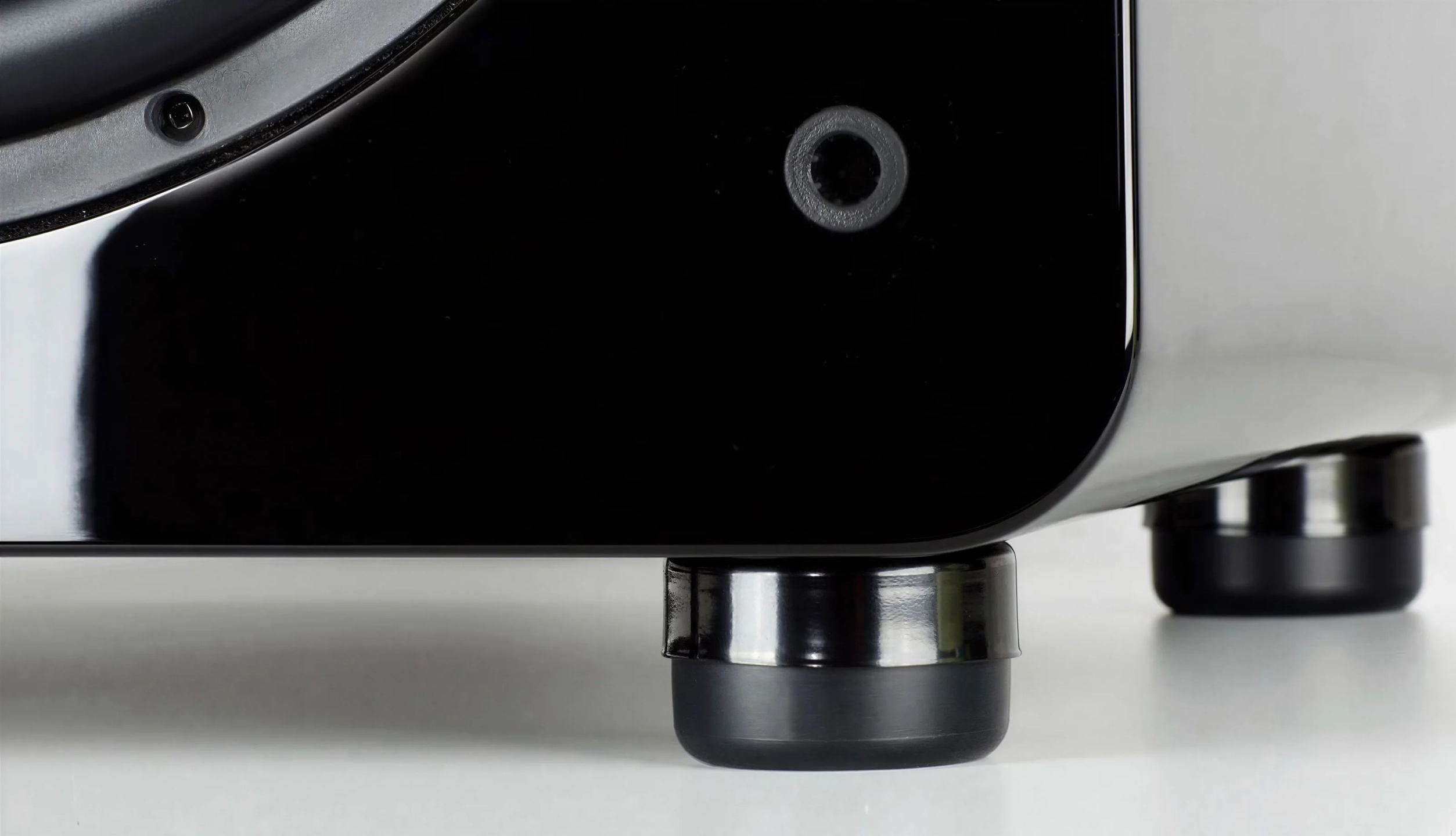
A subwoofer resting on its original feet transfers some of its energy directly to the floor, which carries it into the walls and through to the neighbors. These four elastomer feet screw into place of the feet supplied with the subwoofer and decouple it from the floor. In the room, bass becomes tighter and nearby objects vibrate less. In the apartment below, movie sessions are much less audible.
Why bass travels through floors
When a subwoofer’s driver moves, the cabinet vibrates with it. On rigid feet, this vibration passes directly into the wood flooring or concrete slab, and these surfaces begin radiating sound in turn. This is what causes floor rumble, rattling windows and bass that travels between floors, all the more readily because low frequencies travel very well through rigid materials.
SVS defines decoupling as a connection between the subwoofer and the floor made so weak that almost no energy passes from one to the other. The subwoofer rests on an elastomer cushion instead of a rigid point, and the low-frequency energy stays in the air in the room, where it contributes to listening. The hardness of the elastomer (its Shore value, which English specifications call “durometer”) is the precisely tuned parameter. SVS developed it using accelerometer measurements and acoustic measurements.
Anodized steel, elastomer and a height of 40 mm
Each foot consists of an anodized steel outer shell measuring 58 mm in diameter, surrounding a 53 mm elastomer foot in contact with the floor. The base is flat rather than pointed: it does not pierce carpet or mark wood flooring. The bottom of the subwoofer sits 40 mm above the floor. The foot remains visible, but it is much less bulky than an isolation platform or base, an alternative that SVS itself mentions.
Attachment uses four stainless steel machine screws with a 1/4”-20 UNC thread (a quarter inch, 20 threads per inch) and a length of 20 mm. They engage 13 mm into the subwoofer’s threaded inserts, ensuring a secure hold even under the heaviest subwoofers in the range.
Compatibility with SVS subwoofers and other brands
The set of 4 fits SVS subwoofers with four feet. For sealed subwoofers, these are the SB-1000, SB12-NSD, SB-2000, SB-3000, SB13-Ultra, SB-4000 and SB16-Ultra, as well as their Pro and R|Evolution variants. For bass-reflex subwoofers, these are the PB-1000, PB12-NSD, PB-2000 and PB-3000, also in their Pro and R|Evolution versions. The PB12-Plus, PB13-Ultra, PB-4000 and PB16-Ultra rest on six feet: they require the set of 6.
A subwoofer from another brand accepts SoundPath feet if it has threaded inserts for screw-in feet. The screws in the set have a 1/4”-20 thread, found on many subwoofers. A subwoofer with M6 or M8 metric inserts requires suitable screws, which are not included in this set. Check the thread before ordering.
Wood flooring, carpet or concrete slab: what the feet change
In an apartment with a wooden floor, the effect is most noticeable because this type of floor vibrates easily and transmits vibration over long distances. SVS also mentions carpeted rooms and any room where the subwoofer makes furniture, a shelf or a window shake. On a thick concrete slab, the floor transmits less vibration, and the before-and-after difference is generally smaller. SVS notes that the result depends on the room.
The feet act on vibrations transmitted through the floor, not on sound traveling through the air. A subwoofer played loudly in a room with lightweight partition walls remains audible next door: SoundPath feet eliminate the portion that travels through the floor, without replacing soundproofing.