

Naim Audio NAP 250



Overview
First released in 1975, the NAP 250 has spanned five decades while maintaining its benchmark status in the Naim Audio range. This sixth generation inherits technologies developed for the Statement, the flagship amplifier from the British brand. With its 100 watts per channel in class A/B, its eight custom-designed NA009 transistors, and its Discrete Regulator, this stereo power amp brings together fifty years of expertise in an aluminium chassis manufactured in Salisbury.
Technologies inherited from the Statement
The NAP 250 is built around a toroidal transformer capable of delivering more than 400 VA in transients. The Discrete Regulator, originally developed for the Statement launched in 2014, replaces standard integrated circuits with a fully discrete topology using a sub-surface Zener diode as a voltage reference. This component spreads its junction beneath the surface of the silicon crystal, avoiding defects that generate noise. The regulator operates with a differential pair input stage powered by a constant current source, improving common-mode rejection.
The eight NA009 transistors are divided between the power supply and the output stages. These bipolar components required more than a year of development in collaboration with a manufacturer specialized in military and space-grade semiconductors. Each transistor delivers up to 80 amperes and 350 watts, eliminating the need for parallel configurations. The use of non-ferrous materials reduces internal mechanical noise, while mounting on ceramic insulators reduces parasitic capacitance by a factor of nine.
A new triple-transistor constant current source equips the input stage. The circuit incorporates an eddy-current splitter between the speaker outputs, a technique derived from the Statement. The amplifier remains stable regardless of the load and can drive a 2-ohm impedance for extended periods. Peak current reaches ±28 amperes, with a transient power of 300 watts into 2 ohms and a peak power of 780 watts for 1 millisecond.
Thermal design and construction
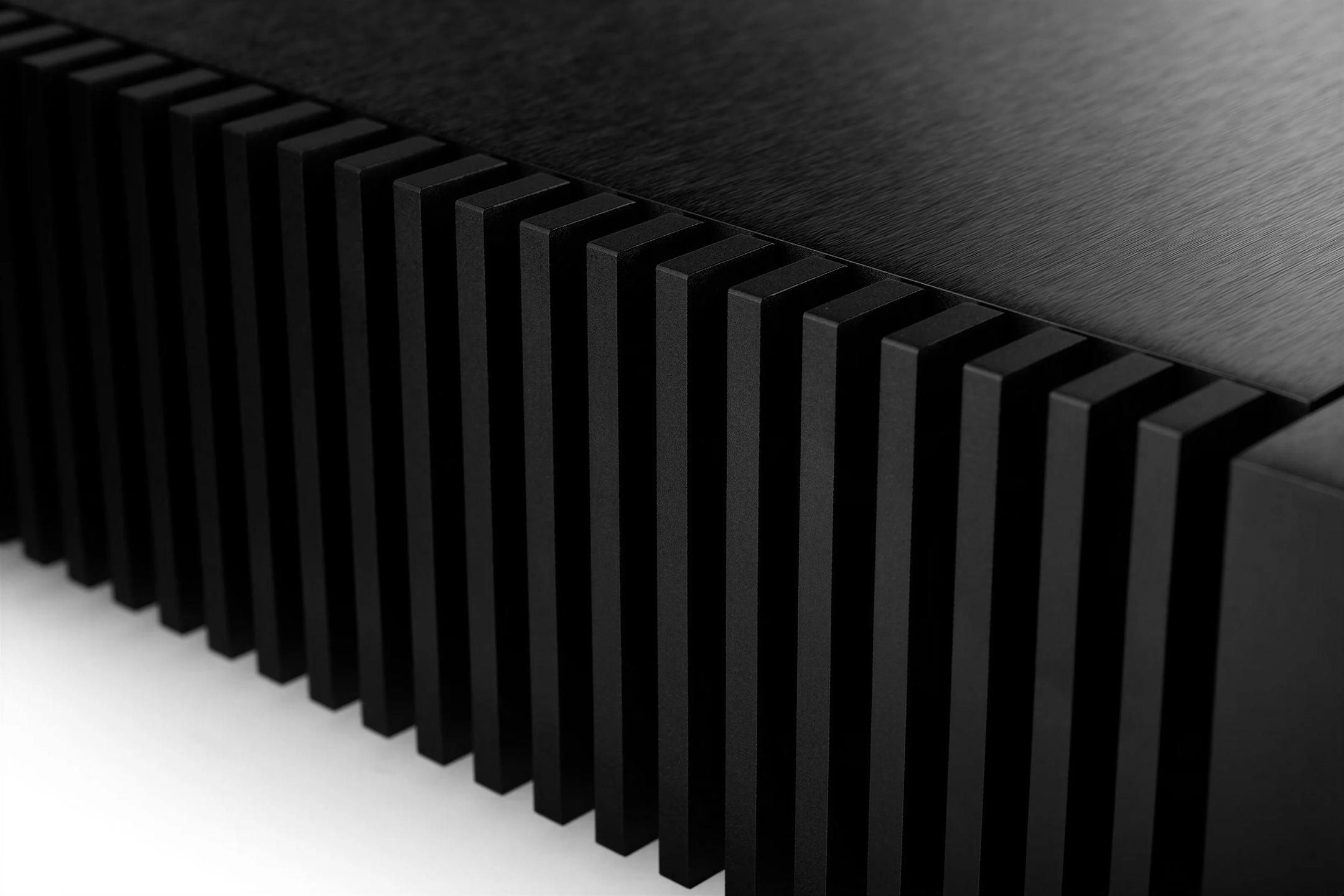
The new side heatsinks respond to temperature variations by adapting their dissipation, keeping the components within their optimal operating range even during long listening sessions at high volume. This dynamic solution prevents overheating without resorting to forced ventilation.
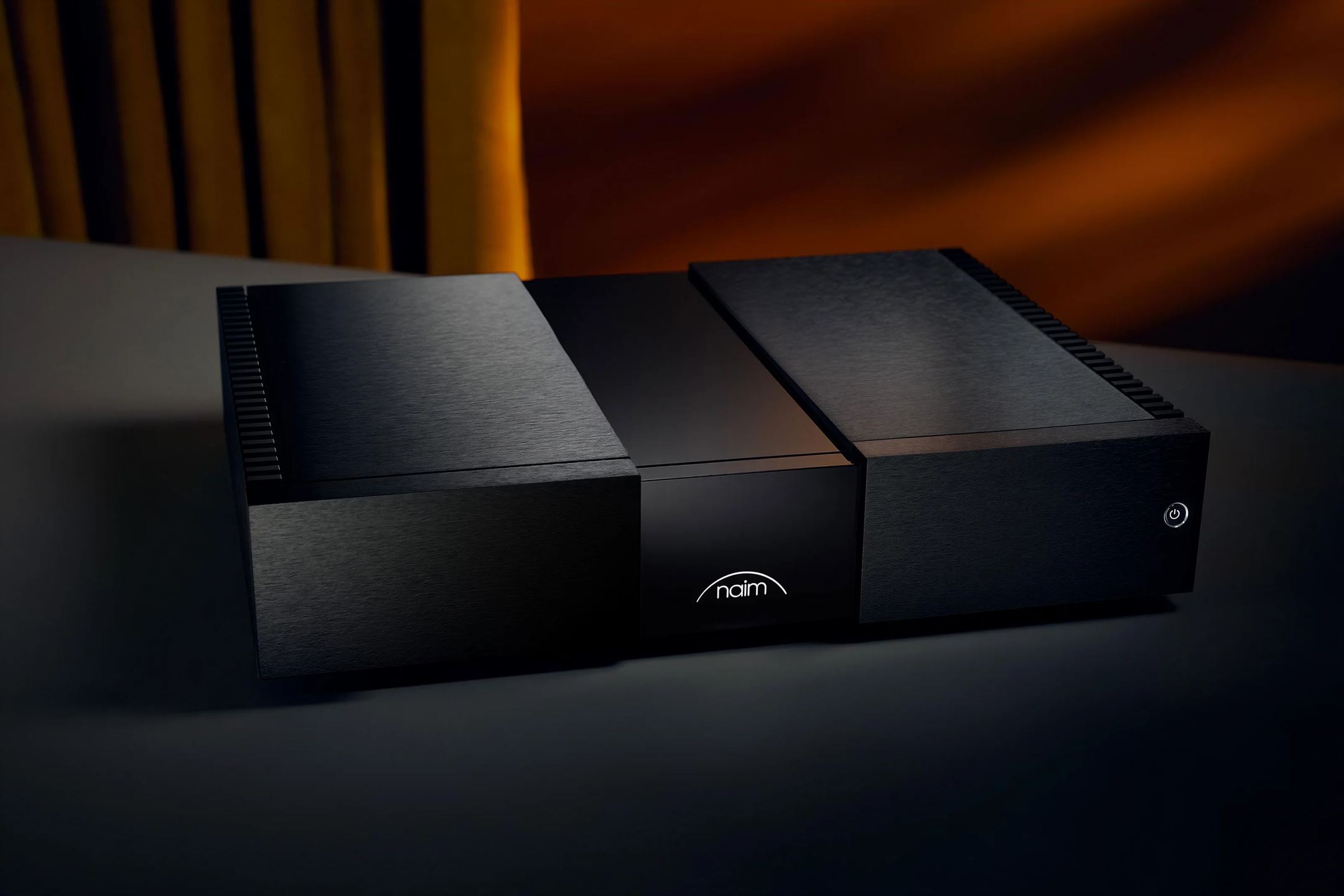
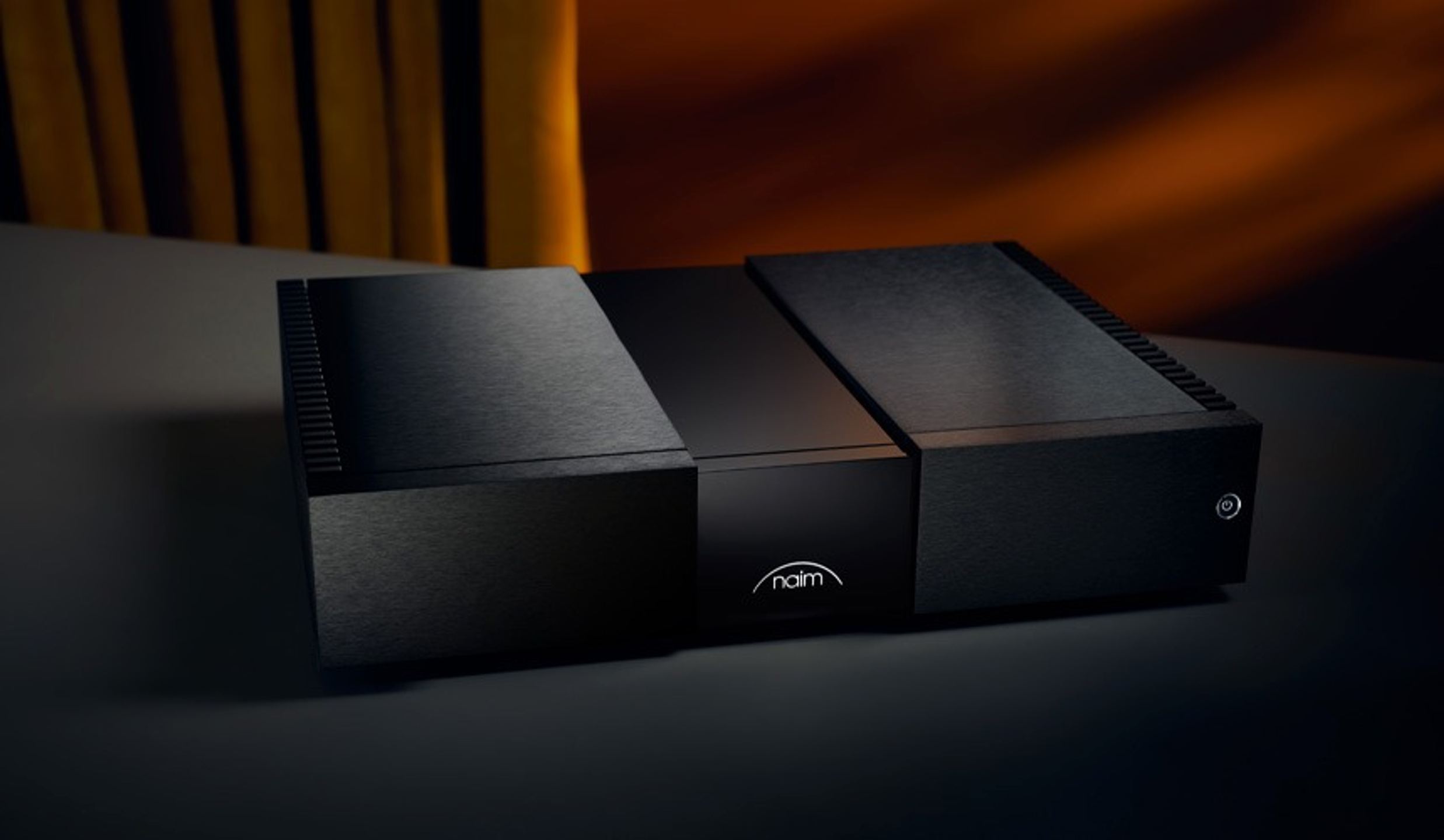
The chassis retains the approach introduced by Vereker: thick aluminium plates surround the electronics to block magnetic fields, stabilize temperature, and absorb vibrations. This heavy-duty construction contributes to a weight of 16.8 kg for a form factor of 432 × 317.5 × 91.5 mm. The black anodized finish follows the aesthetic language of the New Classic range.
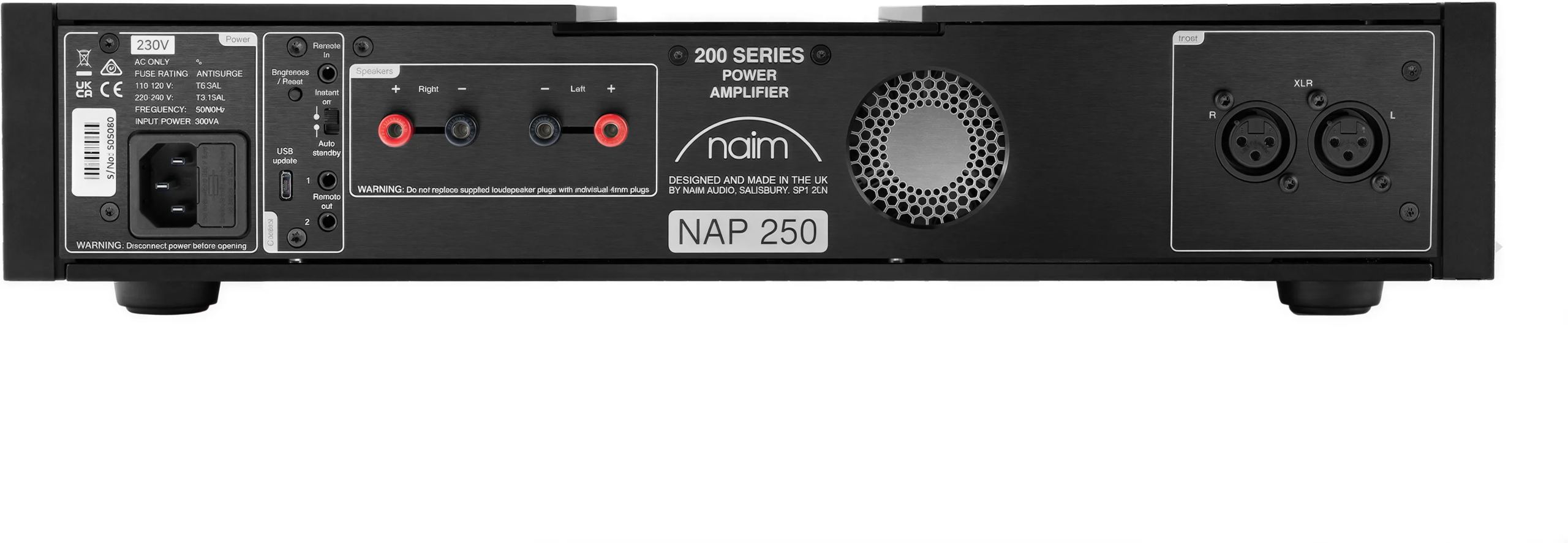
The front-panel logo features white LED backlighting with three adjustable brightness levels. A multifunction button on the rear allows you to adjust this brightness or reset the unit. A switch determines whether the amplifier remains permanently on or goes into standby after 20 minutes, waking automatically when it detects a signal. Standby consumption is less than 0.5 watts.

Connections and system integration
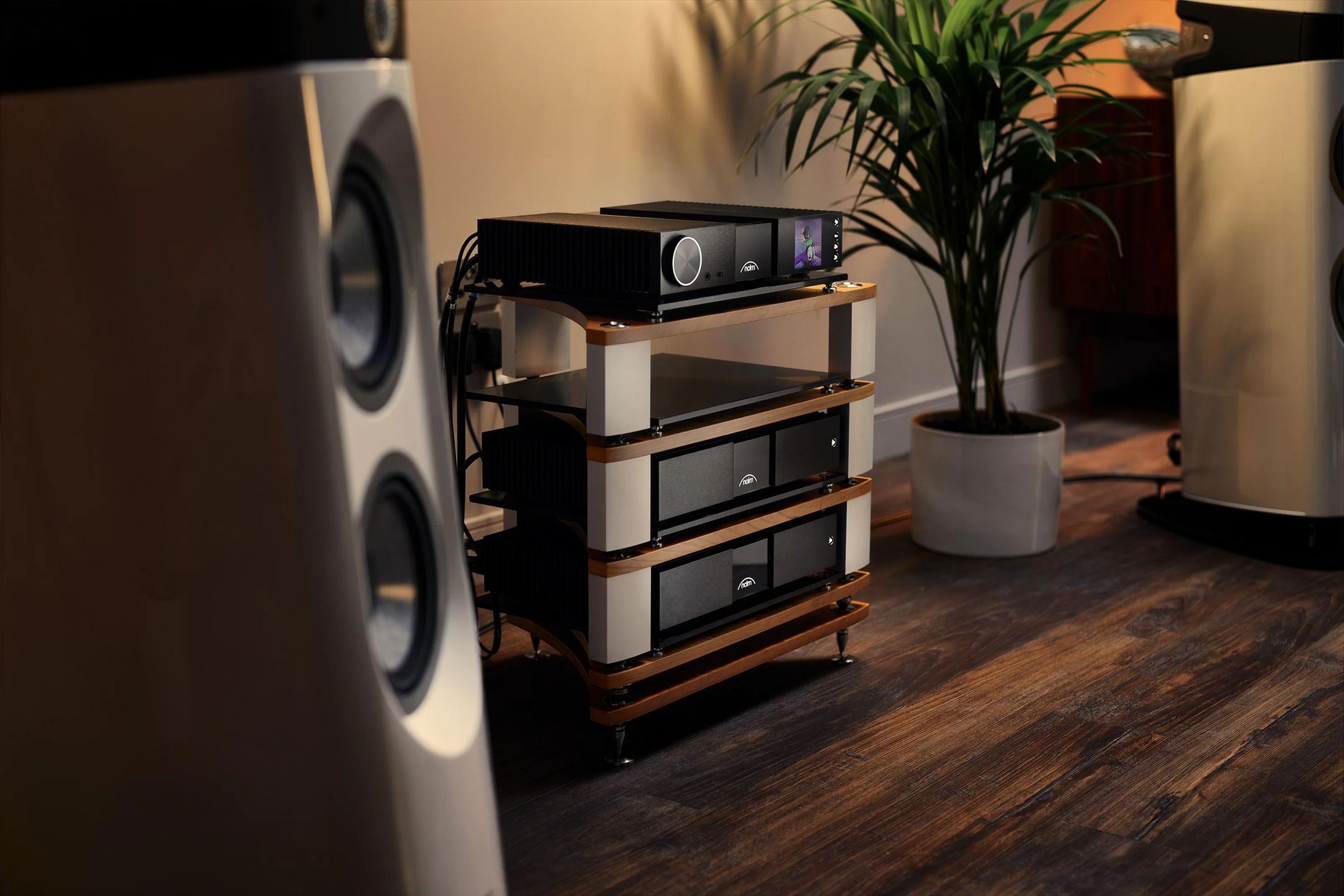
The NAP 250 favours balanced connections with two XLR inputs with an impedance of 47 kΩ. An optional adapter allows unbalanced connection with an impedance of 34 kΩ. This configuration makes it easy to pair with the NSC 222, a preamplifier and streamer designed as its natural partner. The amplifier also connects to New Classic products as well as previous Classic series via specific cables.
An optical system automation cable allows power-on synchronization with other Naim components. The box includes a Power-Line Lite mains cable and two XLR–XLR interconnect cables. The progressive power-up sequence protects the electrical installation from the initial inrush current of the toroidal transformer.
Technical specifications
Architecture and design
- Type: Class A/B power amplifier
- Configuration: Stereo
- Power supply: Dual separate rectification
- Power transistors: 8 Naim NA009 transistors
- Current source: New constant current source (CCS)
- Heat dissipation: New heatsink design
Power performance
- Output power
- 100 W into 8 Ω at 0.1% THD+N
- 190 W into 4 Ω at 1% THD+N
- Transient power: 300 W into 2 Ω at 1% THD+N (1 kHz for 20 ms, 500 ms repetition IHF)
- Peak power: 780 W at 1 kHz 1 ms
- Peak current: ± 28 A
- Gain: + 29 dB
- Frequency response: -3 dB from 1.4 Hz to 100 kHz
- Input signal at clipping: 1 V RMS
Signal quality
- Total harmonic distortion + noise (THD+N): 0.013% at 2/3 of maximum power into 8 Ω at 1 kHz
- Signal-to-noise ratio
- 91 dB (reference 1 W into 8 Ω, A-weighted)
- 111 dB (reference 100 W into 8 Ω, A-weighted)
- Crosstalk: 60 dB
- Damping factor: 36 into 8 Ω
Connectivity
- Balanced inputs: 2 XLR, 47 kΩ
- Unbalanced input: 34 kΩ via adapter
Physical characteristics
- Dimensions (H × W × D): 91.5 × 432 × 317.5 mm
- Weight: 16.8 kg
Power supply
- Mains voltage: 115 V or 230 V, 50 / 60 Hz
- Power consumption
- In use: 26 W
- Standby: < 0.5 W
- Auto standby: After 20 minutes of inactivity
Included accessories
- Power-Line Lite mains cable
- 2 balanced XLR-XLR audio interconnect cables
- Optical system automation cable
Frequently Asked Questions
What is the difference between this sixth generation and the previous DR version?
The sixth generation increases power from 80 to 100 watts per channel into 8 ohms. It revises the heatsink for more responsive thermal management, changes the logo backlight (white LED instead of green), and refines the chassis design in line with the New Classic aesthetic. Technically, circuit layout has been optimized and transistor mounting improved, while retaining the NA009 transistors and DR regulation.
Why use a separate power amplifier instead of an integrated amplifier?
Separating preamplification and power amplification physically isolates the sensitive circuits handling low-level signals from the power stages that generate high currents and magnetic fields. This modular approach also makes it easier to upgrade the system and adapt to specific needs, such as bi-amping or choosing a preamplifier according to preferred sources.
Can the NAP 250 drive any speakers?
The amplifier remains stable under all loads and can handle a 2-ohm impedance for long periods. Its peak current capability of ±28 amperes allows it to drive demanding speakers effectively. Naim suggests pairing it with Focal Utopia (Maestro, Scala) or Sopra ranges, but the NAP 250 works well with a wide variety of high-end floorstanding and standmount speakers.
- Eco-contribution included in the sale price.
- GTIN / EAN: 5056351704338