
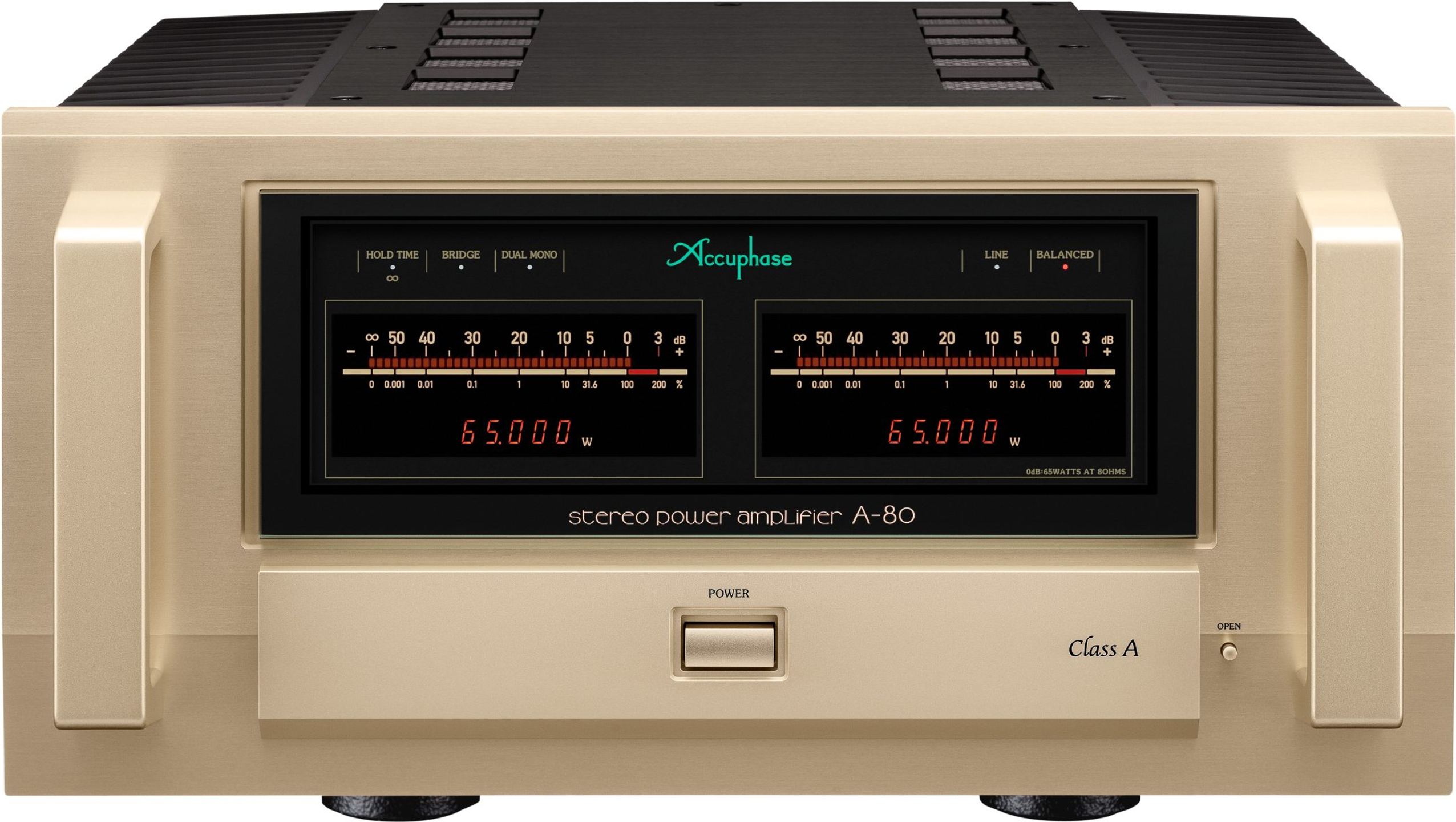
Accuphase A-80
This product is no longer available for sale!
Other stereo solid-state hi-fi integrated amplifiers
Accuphase A-80 Stereo Amplifier: Power and Precision in Class A
The Accuphase A-80 is a Class A stereo power amplifier that succeeds the A-75 model launched in 2018. It incorporates technology from the prestigious A-300 mono amplifier, designed for the brand’s 50th anniversary, and further enhances the sound and electrical performance of its predecessor. The A-80 represents the culmination of decades of research and development at Accuphase, offering an unparalleled listening experience for the most discerning audiophiles.
Design and Construction
The design of the A-80 remains true to Accuphase’s iconic aesthetic while introducing subtle improvements. The front panel features a more powerful design, with repositioned VU meters and enlarged elements such as the handles, power switch, and sub-panel. The chassis, slightly heavier than that of the A-75, is constructed with meticulous attention to detail.
The amplifier rests on high-carbon cast iron isolator feet, providing superior damping characteristics. The brushed finish aluminum top plate adds a touch of elegance while contributing to heat dissipation.
Innovative Technologies
- The A-80 employs the principle of an instrumentation amplifier in its input section. This configuration balances the input impedances on the + and - sides, offering excellent external noise suppression while providing an optimal circuit for a high-end audio amplifier.
- The use of current feedback topology achieves an extended frequency response and reduced distortion, contributing to sound clarity and precision.
- Accuphase’s exclusive MCS+ circuit (Multiple Circuit Summing-up) enhances the noise performance of analog amplification circuits.
Technical Architecture
The A-80 stands out with its dual-mono symmetrical architecture, ensuring complete separation of the left and right channels for precise stereo imaging and an immersive soundstage. This design helps minimize channel interference and maintain audio signal integrity throughout the amplification process.
Output Stage and Power
At the heart of the A-80 is a sophisticated output stage, consisting of 10 MOS-FET power transistors in a parallel push-pull configuration. This optimization allows the amplifier to deliver an impressive 65 W into 8 Ω in pure Class A. The power doubles to 130 W into 4 ohms, demonstrating the A-80’s ability to efficiently drive a wide range of speakers, even the most demanding ones.
Connectivity
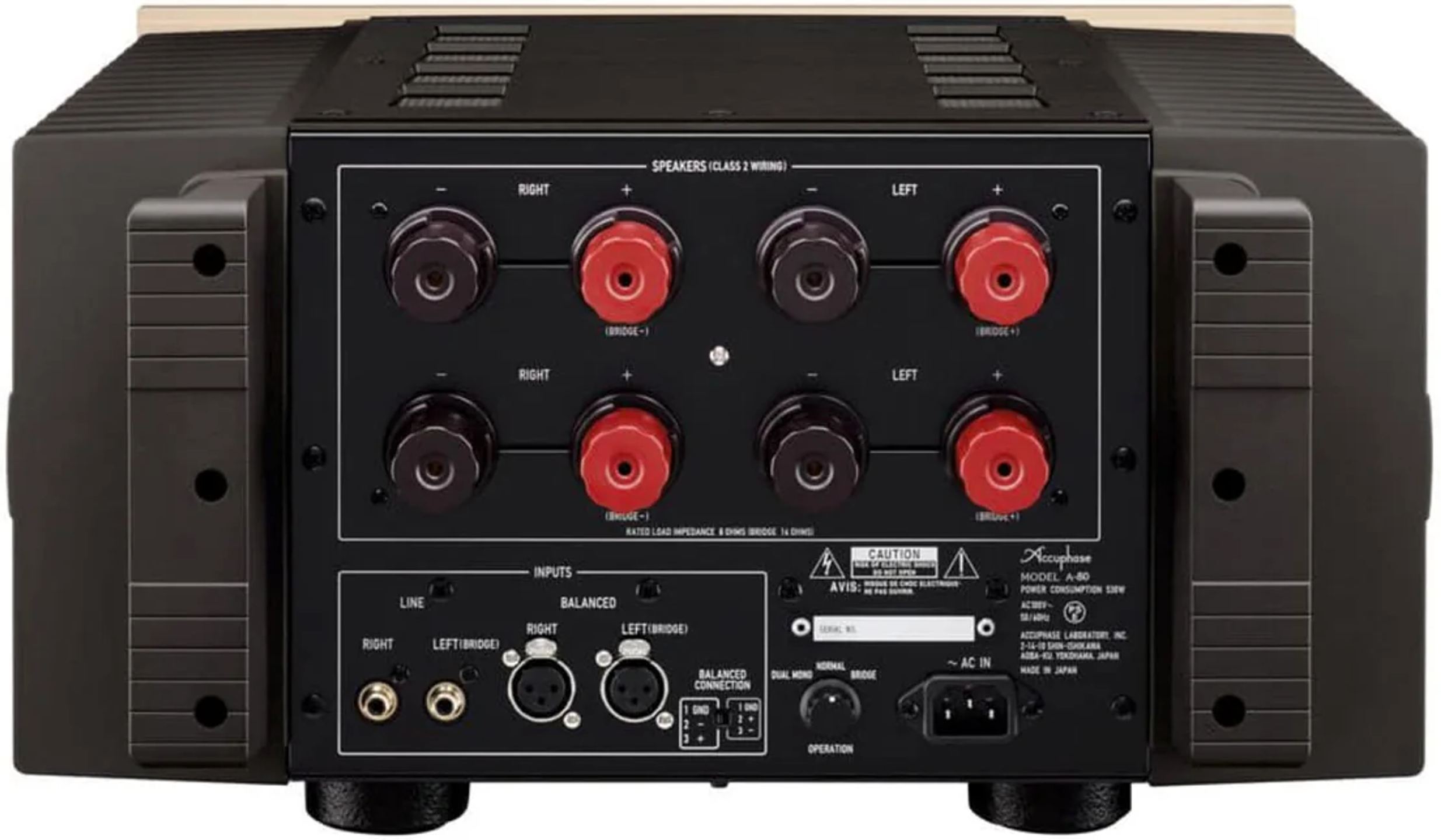
The Accuphase A-80 offers versatile connectivity to accommodate different audio configurations. It features a stereo RCA input and a stereo XLR input, allowing compatibility with a variety of high-end audio sources. For speaker connection, the amplifier is equipped with dual binding posts, offering the possibility of bi-wiring to further enhance sound quality.
Sound Performance
The pure Class A of the A-80 ensures an exceptionally pure sound reproduction, characterized by extremely low distortion and remarkable linearity. Audiophiles will appreciate the transparency, dynamics, and richness of detail that this amplifier is capable of delivering. The wide and deep soundstage, combined with precise stereo imaging, offers an immersive and realistic listening experience.
Usage and Versatility
Although designed for high-end audio systems, the A-80 adapts to various configurations. It can be used as the main amplifier in a high-quality stereo system or as a power block in a sophisticated home theater setup. Its generous power and stability under different impedance loads make it an ideal partner for a wide range of speakers.
Power and Amplification
- Nominal Power:
- Normal Mode: 65 W (8 Ω), 130 W (4 Ω), 260 W (2 Ω), 520 W (1 Ω)
- Bridged Mode: 260 W (8 Ω), 520 W (4 Ω), 1,040 W (2 Ω)
- Class A 10-parallel push-pull MOS-FET output stage
- Current feedback amplification topology
- Damping factor: 1,000
Components and Circuit
- Discrete configuration instrumentation amplifier for low noise
- Balanced remote sensing
- MCS+ circuit
- High-performance toroidal transformer
- Filtering capacitors: 120,000 µF
- Fluorocarbon resin printed circuit boards on glass cloth
- MOS-FET switches without mechanical resistance
Features
- Peak display time adjustment
- 4-level gain control
- Bi-amplification and bridging mode
- High-capacity speaker terminals with integrated protection circuit
- Short-circuit protection
Construction
- Brushed aluminum top plate
- High-carbon cast iron feet with damping properties
Technical Specifications
- Frequency response: 0.5 Hz – 160 kHz (0, -3 dB)
- Intermodulation distortion: < 0.01%
- Damping factor: > 1,000 (JEITA, 8 Ω load at 50 Hz)
- Signal-to-noise ratio: 123 dB (max gain), 129 dB (gain -12 dB), A-weighted
- Input sensitivity: 0.91 V
Connectivity
- Line and balanced inputs with polarity selection
- Dual speaker outputs (simultaneous)
General Characteristics
- Display:
- Digital and bar graph VU meters
- Display modes: off / full / dB / W
- Ranges: auto / 10 W / 100 W / 1,000 W
- Dimensions (W × H × D): 465 × 240 × 515 mm
- Weight: 44.6 kg
- Accessories: power cable (2 m)
Frequently Asked Questions
What is the main difference between the A-80 and its predecessor, the A-75?
The A-80 offers 8% more output power compared to the A-75, with a significant improvement in signal-to-noise ratio and damping factor. It also incorporates more advanced technologies derived from the A-300 model.
What is the difference between a Class A amplifier and other classes?
A Class A amplifier, like the Accuphase A-80, operates with its output transistors constantly active, resulting in extremely low distortion and superior sound quality. However, this design leads to higher energy consumption and significant heat production compared to Class AB or D amplifiers.
Is the Accuphase A-80 compatible with all types of speakers?
Thanks to its generous power and ability to double its power under 4 ohms, the A-80 can effectively drive a wide range of speakers, including those with challenging loads. However, it is always recommended to check specific compatibility with your speakers to achieve the best performance.
What are the advantages of the A-80's dual-mono symmetrical architecture?
The dual-mono symmetrical architecture ensures complete separation of the left and right channels, minimizing channel interference and enhancing stereo image precision. This results in a wider, deeper, and more precise soundstage, offering a more immersive and realistic listening experience.
- Eco-contribution included in the sale price.