T+A HA 200

Overview
The HA 200 marks T+A’s entry into the world of high-fidelity headphone amplification, with the German brand’s characteristic approach: no technical compromises, exemplary build quality, and integration of the best proprietary technologies. This amplifier-DAC combines a pure Class A power stage based on proven HV technology with a reference-grade digital-to-analog converter, offering a complete solution for the most demanding audiophiles.
Technical Heritage and Positioning
T+A brings to the HA 200 the expertise accumulated from its high-end HV series amplifiers and the conversion technologies of its DAC 200. This methodical approach allows tried-and-tested solutions to be applied to headphone amplification, a field where technical constraints differ significantly from loudspeaker amplification. The dual-mono architecture ensures perfect channel separation, eliminating any crosstalk that could degrade stereo precision.
T+A’s construction philosophy is evident in every aspect: over 2,300 carefully selected components, a chassis machined from solid, non-magnetic aluminum, and a front panel milled from a single block to HV series standards. This build quality explains the substantial weight of 6.5 kg, a tangible testament to the technological density within.
Class A Analog Architecture
The power stage operates entirely in Class A with a high bias current, ensuring perfect linearity and the absence of crossover distortion. This approach, energy-intensive but optimal for sound quality, allows effortless driving of the most demanding headphones, including low-efficiency planar or electrostatic models.
The HA 200’s originality lies in its three headphone outputs with different connectors: classic 6.3 mm jack, balanced 4.4 mm Pentaconn, and professional 4-pin XLR. Even more remarkable, the output impedance can be precisely adjusted according to the headphones used—a rare optimization that allows the amplifier to adapt to the specific characteristics of each transducer.
Reference Digital-to-Analog Conversion
The DAC section features two distinct architectures optimized for the format being processed. The proprietary T+A True 1-Bit converter natively handles DSD streams up to DSD 1024 (49.2 MHz), while the quadruple PCM converter manages signals up to 32 Bit/768 kHz. This architectural separation, characteristic of T+A’s approach, avoids the compromises inherent in universal solutions and optimizes processing for each format.
Synchronous oversampling offers four selectable algorithms (short FIR, long FIR, Bézier/IIR, Bézier) plus a NOS (No OverSampling) mode for purists. This flexibility allows the sound character to be tailored to preferences and the musical material being played.
Galvanic Isolation and Power Supply
Complete galvanic isolation between digital and analog sections eliminates electrical interference that could degrade sound quality. Two separate toroidal transformers power the digital and analog circuits respectively, preventing any mutual contamination. This approach, costly in terms of components and space, demonstrates the uncompromising design philosophy.
Analog filtering uses a linear-phase Bessel filter, switchable between 60 and 120 kHz cutoff frequencies according to listening preferences. This solution preserves the signal’s temporal coherence, a crucial aspect for reproducing depth and spatialization.
Connectivity and Supported Formats
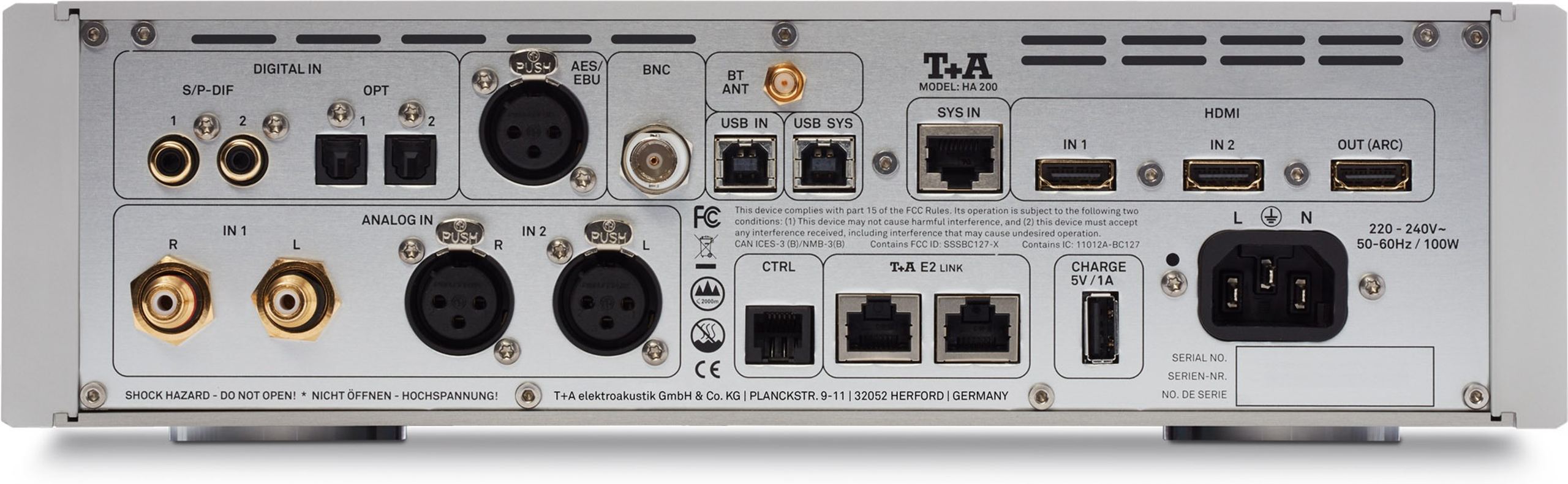
Comprehensive connectivity covers all modern needs: balanced XLR and unbalanced RCA analog inputs, digital AES-EBU, coaxial and optical S/PDIF, BNC, two USB ports, and even Bluetooth with aptX HD codec. Optional HDMI inputs extend possibilities to video sources.
Extensive format support includes all PCM standards up to 768 kHz/32 bits and DSD up to DSD 1024 in native mode. This universal compatibility ensures future-proofing as high-definition formats evolve.
Ergonomics and Instrumentation
The user interface borrows from professional standards with QPPM meters and a large information display. This instrumentation, unusual on a headphone amplifier, allows precise control of levels and operating parameters. The FM8 remote centralizes all functions, including input selection, volume adjustment, and advanced parameter configuration.
The crossfeed function, available on request, artificially recreates natural spatialization by introducing controlled crosstalk between channels. This option, especially appreciated for extended listening, reduces listening fatigue caused by the perfect separation of headphones.
Construction and Design
The design continues the aesthetic of the T+A range with clean lines and anodized aluminum finish. The generous dimensions (32 × 34 × 10 cm) and substantial weight reflect the technological density, though they may raise integration questions in some environments. The non-magnetic construction eliminates parasitic interactions with nearby sensitive components.
The front panel prioritizes readability with a central display, essential controls within easy reach, and three clearly identified headphone outputs. Ergonomics remain intuitive despite the wealth of features—a delicate balance successfully achieved by T+A.
Technical Specifications
Analog Section
- Frequency response: +0 / −3 dB
- 0.1 Hz – 200 kHz
- Signal-to-noise ratio: 110 / 114 dB
- Total harmonic distortion / Intermodulation: < 0.001% / < 0.001%
- Channel separation: > 108 dB
- Class A operation: up to 700 mA
- Loudness compensation: switchable, adjustable according to speaker efficiency
- Tone control: switchable, channel separation. Bass and treble from −6 dB to +8 dB
Inputs and Outputs
- Headphone outputs
- 6.3 mm connector, 4.4 mm Pentaconn, 4-pin XLR
- Impedances: 8, 12, 18, 25, 40, 80 ohms
- Analog inputs
- High level (RCA) / balanced (XLR)
- 250 mVeff … 4.5 Veff / 10 kOhms | 500 mVeff … 9 Veff / 20 kOhms
- Channel separation: 110 dB
Digital Inputs and Connectivity
- Digital inputs
- 1 × AES-EBU 32…192 kHz / 16-24 bits
- S / P-DIF: 2 × standard coaxial, 2 × optical TOS-Link 32…192 kHz / 16-24 bits
- 1 × BNC 32…192 kHz / 16-24 bits
- 2 × USB DAC: device mode 44.1 … 768 kHz (PCM) and up to DSD1024*, supports asynchronous data transfer
- Bluetooth: A2DP (audio), AVRCP 1.4 (control) / aptX® HD, SBC, AAC
- 2 × HDMI IN, 1 × HDMI OUT with ARC (optional)
Digital-to-Analog Converter
- PCM
- Quadruple dual-differential converter with four 32-bit Sigma-Delta DACs per channel
- Conversion rate 705.6 / 768 kHz
- DSD
- T+A-True-1Bit DSD DAC, up to DSD 1024 (49.2 MHz), native bitstream
- Oversampling
- T+A signal processor – synchronous oversampling with four selectable oversampling algorithms
- Short FIR, Long FIR, Bézier / IIR, Bézier, NOS (no oversampling)
- Analog filter: 3rd order linear-phase Bessel filter, switchable with cutoff frequency of 60 or 120 kHz
Power Supply and Physical Characteristics
- Power supply: 100 – 120 V or 200 – 240 V, 50 – 60 Hz, 100 watts
- Standby: < 0.5 watts
- Dimensions (H × W × D): 10 × 32 × 34 cm
- Weight: 6.5 kg
- Accessories: FM8 remote control, power cord, USB cable for charging the remote, USB 2.0 cable for DAC, RCA cable
- Finish: silver anodized aluminum (43)
*DSD 512 and DSD 1024 with Windows PC and appropriate driver installed or Linux PC with kernel 4.4 or higher only. Supports DoP up to DSD 256 (marker 0x05/0xFA).
Frequently asked questions
Why are there three different headphone outputs on the same device?
Each connector offers specific advantages: the 6.3 mm jack remains the universal standard, the 4.4 mm Pentaconn provides a compact balanced connection, while the 4-pin XLR meets professional requirements. This diversity ensures optimal compatibility with all types of headphones without the need for adapters.
Does the crossfeed function really change headphone listening?
The crossfeed function introduces controlled crosstalk between channels, partially recreating the natural spatialization of loudspeaker listening. This option reduces listening fatigue during long sessions and provides a more natural soundstage, especially appreciated on older recordings with pronounced stereo separation.
Is adjustable output impedance practically useful?
Impedance matching optimizes the damping factor according to the headphones used. High-impedance headphones benefit from a high-impedance output to maximize power, while sensitive models prefer a low impedance for optimal control and a linear frequency response.
- Eco-contribution included in the sale price.