NAD MDC AM17
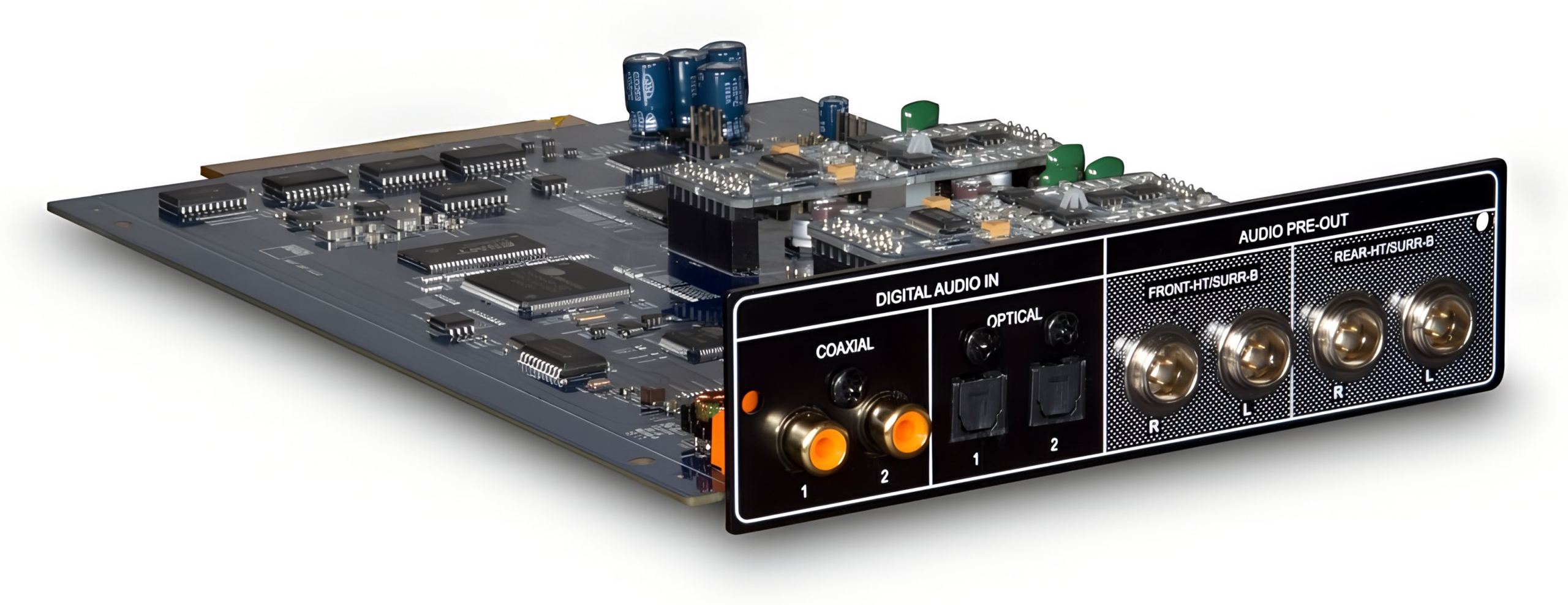
Overview
The MDC AM17 expansion module is designed for NAD M17 and M15HD preamplifiers. It adds decoding for Dolby Atmos and DTS:X audio formats, enabling configurations of up to 11 channels. The module also integrates Dirac Live acoustic processing. This extension allows you to enhance your home theater features without replacing your existing equipment.
A Modular Design Born from NAD’s Vision
The AM17 module perfectly embodies the MDC (Modular Design Construction) philosophy developed by NAD since 2006. This unique modular architecture allows NAD equipment owners to keep their systems at the cutting edge of technology without having to replace their entire processor. Unlike traditional approaches that render equipment obsolete as technology evolves, the MDC system offers a gradual and economically sensible upgrade path.
The history of this innovation dates back to the early days of digital high definition. NAD initially equipped its processors with HDMI 1.2 modules, then offered successive upgrades to HDMI 1.3, 1.4, and finally HDMI 2.0. This evolutionary approach has protected users’ investments for over fifteen years, allowing them to adopt each new technological generation at the right time.
The AM17 module represents the culmination of this philosophy with the integration of Dolby Atmos, considered the most significant evolution in surround sound since the introduction of Dolby Digital in the 1990s. This technology adds a vertical dimension to the sound field, creating a three-dimensional acoustic bubble where each sound object can be precisely positioned in space.
Technical Architecture and Module Features
The AM17 board fits into the chassis of the M17 and M15HD processors via the dedicated MDC slot. Its installation, while recommended to be performed by a qualified technician, remains relatively straightforward thanks to NAD’s standardized modular design. The module integrates several essential components that work together to deliver an immersive audio experience.
At the heart of the system, 24-bit/192 kHz digital-to-analog converters process each channel with remarkable precision. This high resolution ensures faithful reproduction of high-resolution soundtracks found on modern media, whether UHD Blu-ray or streamed content. The resulting dynamic range far exceeds human hearing capabilities, creating an almost perfect background silence from which the subtlest sound details emerge.
Digital signal processing relies on dedicated processors capable of real-time decoding of the most complex audio formats. Beyond Dolby Atmos, the module supports DTS:X via software update, as well as DTS TrueHD, DTS-HD Master Audio, and DTS Neo:6 formats. This versatility ensures compatibility with all content available on the market, both present and future.
The module’s connectivity deserves special attention. Two Toslink optical inputs and two RCA coaxial inputs allow connection of additional digital sources. Even more remarkable, four balanced Mini-XLR outputs deliver the signals for additional Atmos channels to external amplifiers. These professional-grade connections, usually reserved for commercial installations, ensure perfect signal transmission over long distances without degradation or interference.
Configurations and Installation Possibilities
The flexibility of the AM17 module allows for various configurations depending on needs and available space. In its simplest setup, the module transforms the M17 into a 5.1.2 processor, using the internal amplification to power two height channels. This configuration is ideal for medium-sized rooms where adding two ceiling speakers is enough to create the desired vertical immersion effect.
For more ambitious installations, the four Mini-XLR outputs allow for a full 7.1.4 configuration. This approach requires the addition of external amplifiers, such as the four-channel NAD CI 940, specifically designed for this application. The included Mini-XLR to standard XLR adapters make integration easy with any professional or audiophile amplifier equipped with balanced inputs.
Speaker placement in an Atmos configuration follows precise recommendations to optimize the three-dimensional effect. Height channels can be installed in the ceiling or use indirect-radiating speakers placed on top of the main speakers. The processor automatically analyzes the detected configuration and adapts processing accordingly, ensuring optimal spatialization regardless of the chosen layout.
Dirac Live: Next-Generation Acoustic Correction
The integration of Dirac Live truly sets the AM17 module apart from its competitors. This acoustic correction technology, developed by Swedish company Dirac Research founded in 2001, represents a major advance over traditional room correction systems. Unlike classic approaches that only correct frequency response, Dirac Live simultaneously processes both frequency and impulse response.
The calibration process begins with a series of acoustic measurements taken at different positions within the listening area. A supplied measurement microphone captures each speaker’s response to test signals generated by the system. The Dirac algorithm then analyzes this data to create a three-dimensional acoustic model of the room, identifying unwanted reflections, modal resonances, and phase cancellations.
The corrections applied go far beyond simple equalization. The system temporally realigns the different frequencies that make up each sound, restoring phase coherence often degraded by room reflections. This temporal correction greatly improves stereo imaging accuracy, dialogue clarity, and transient definition. Instruments regain their natural timbre, voices gain presence and intelligibility, and the soundstage expands with surgical precision in the positioning of each source.
The Dirac Live software, available for Windows, macOS, iOS, and Android, offers an intuitive interface to guide users through the calibration process. Several target curves predefined by NAD are available, optimized for different content types and listening preferences. Advanced users can customize these curves, finely adjusting tonal balance to their personal taste or the specific characteristics of their system.
Technical Specifications
MDC Compatibility and Technology
- Compatible with: NAD M17, NAD M15HD
- MDC Platform (Modular Design Construction)
- Allows for hardware upgrades without replacing the entire system
- Prevents obsolescence by adding the latest audio/video technologies
- Upgrade history: HDMI 1.2 → HDMI 2.0, Dolby Atmos, Dirac Live
Supported Audio Technologies
- Dolby Atmos (up to 7.1.4 or 5.1.2 depending on configuration)
- DTS:X
- DTS-HD Master Audio
- DTS Neo:6
- DTS TrueHD
- Dirac Live (advanced room correction)
Dirac Live Acoustic Correction
- Corrects frequency response and impulse response
- Optimizes stereo imaging, sound clarity, resonance reduction, and transient reproduction
- Professional-grade results for home installations
Technical Specifications
- Internal DAC: 24-bit / 192 kHz audiophile-grade
- Dynamic range: very wide
- Noise and distortion levels: virtually inaudible
- Sound quality: designed to meet high-resolution cinema soundtracks
Connectivity
- Digital inputs
- 2 x Toslink optical
- 2 x RCA coaxial
- Outputs for additional Atmos channels
- 4 x balanced Mini-XLR line outputs
- For connection to external amplifiers (e.g., NAD CI 940)
Supported Configurations
- 7.1.4 Atmos: with external amplifiers via Mini-XLR outputs
- 5.1.2 Atmos: using the M17’s internal amplification
- Flexible according to system and room requirements
Frequently Asked Questions
Is the AM17 module compatible with all NAD processors?
No, the AM17 module is specifically designed for NAD Masters Series M17, M15HD, and M15HD2 processors. These models have the required MDC architecture and chassis to accommodate the module. A firmware update of the host processor is required before installation.
What is the difference between a 5.1.2 and a 7.1.4 configuration?
The 5.1.2 configuration uses five main channels, one subwoofer, and two height channels. The 7.1.4 configuration adds two rear surround channels and two additional height channels, creating a more complete and precise sound bubble. The choice depends on room size and the desired level of immersion.
Does Dirac Live require an additional license?
The AM17 module includes a full Dirac Live license, unlike some competing products that only offer a limited version. This license allows correction across the entire frequency range without restriction, maximizing the benefits of the technology.
How do the Mini-XLR adapters work?
Four Mini-XLR to standard XLR adapter cables are included with the module. These adapters convert the compact Mini-XLR format used on the module to the standard XLR connections found on most professional amplifiers, preserving the balanced nature of the signal.
Does the module affect pure stereo sound quality?
The AM17 module can potentially enhance the entire listening experience thanks to Dirac Live, including stereo playback. The 24-bit/192 kHz converters and advanced digital processing can even improve the quality of traditional stereo sources.
- Eco-contribution included in the sale price.