PSB CS810
Overview
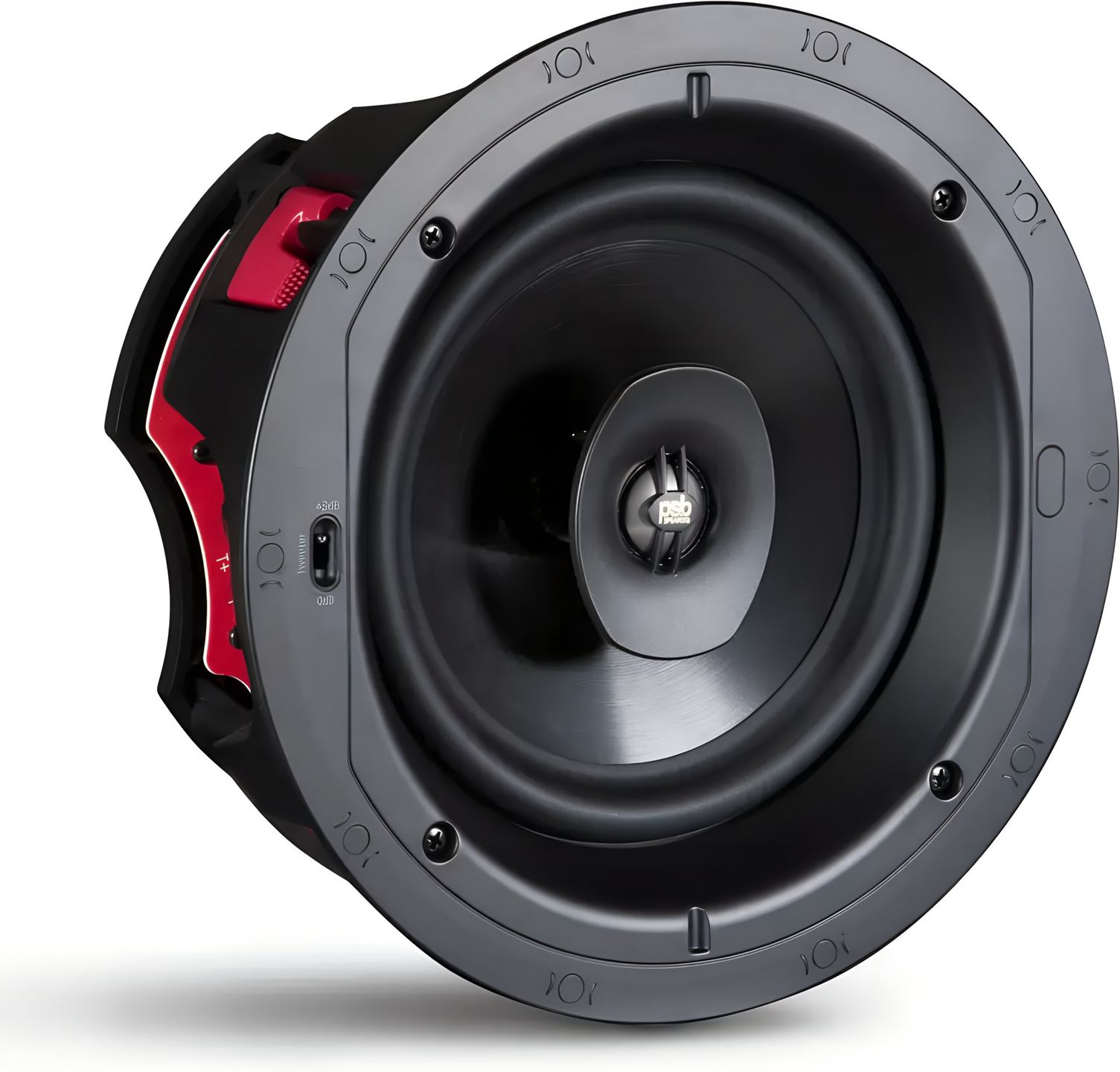
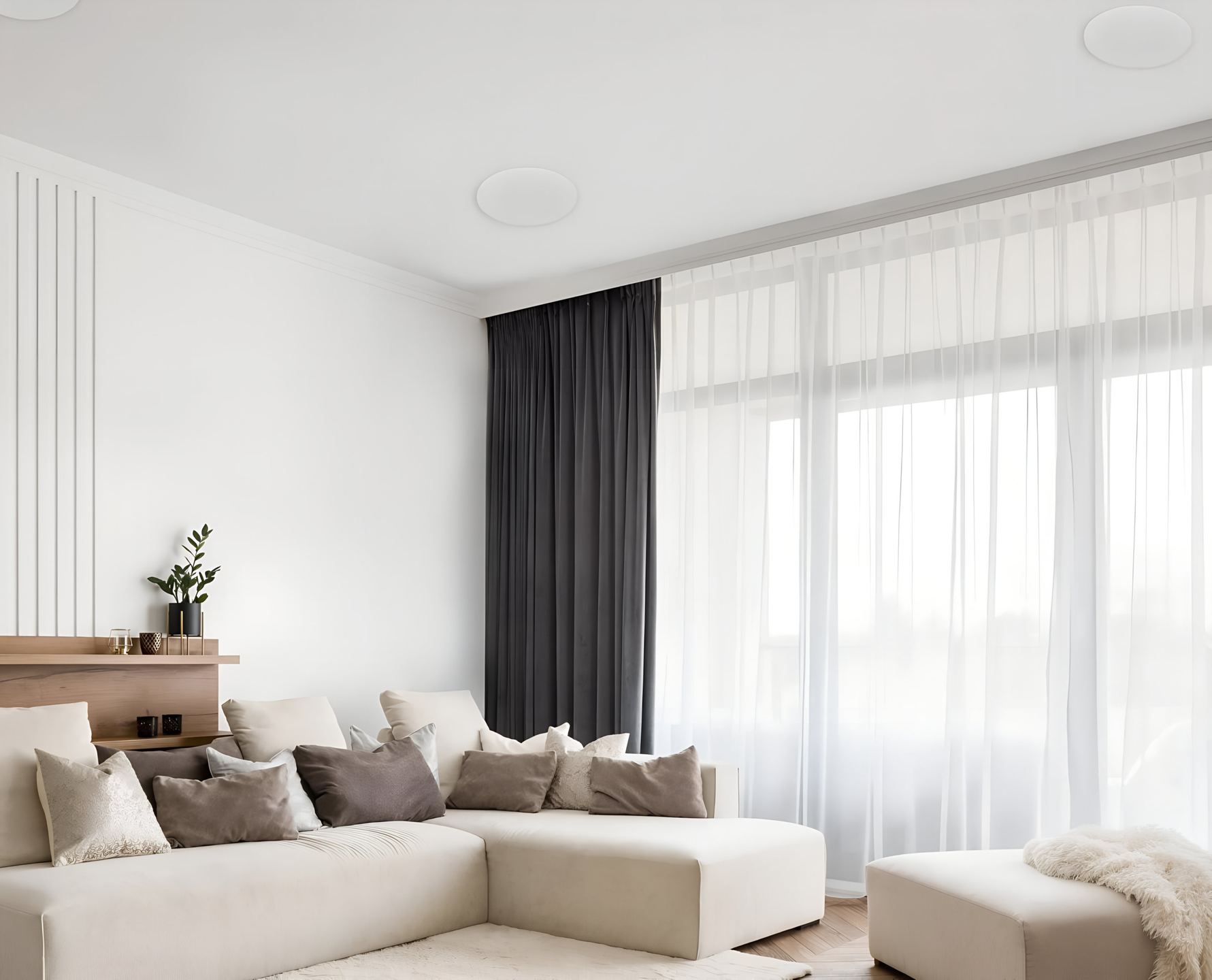
In-ceiling speakers are often a compromise between visual discretion and acoustic performance. The PSB CS810 upends that equation by offering a technical solution that combines near-total disappearance within interior architecture with sound reproduction worthy of the best traditional speakers. This creation by Paul Barton and his team embodies more than five decades of acoustic research applied to a demanding architectural format.
Uncompromising technical design
The CS810 is built on a design philosophy where each component is selected and optimized to create remarkable acoustic synergy. The 8-inch (203 mm) woofer uses a carbon-infused polypropylene cone, a formulation initially developed for PSB’s prestigious Imagine series. This composite material offers mechanical characteristics particularly well-suited to reproducing bass and midrange frequencies: its high rigidity minimizes cone deformation during large excursions, while the carbon integrated into the polypropylene matrix increases the Young’s modulus without penalizing the moving mass.
The woofer’s cast steel chassis provides a stable foundation that eliminates stray vibrations likely to color the sound. The foam surround, rather than rubber, offers linear compliance over a wide excursion range, ensuring a fast, precise transient response. The high-temperature voice coil allows the speaker to handle significant power without thermal compression, a phenomenon that progressively degrades dynamics during extended high-volume listening.
The 1-inch (25 mm) aluminum tweeter deserves special attention. Unlike the titanium used in the higher model CS850, aluminum here offers a subtle balance between rigidity and internal damping. The aluminum dome’s primary resonance lies well beyond the useful bandwidth while maintaining wide, uniform dispersion. The ferrofluid surrounding the voice coil serves a triple function: thermal dissipation, mechanical damping, and magnetic centering. This technology, inherited from professional studio monitors, ensures detailed, non-fatiguing highs even during complex musical passages.
The art of acoustic integration
Mounting the tweeter concentrically at the center of the woofer is more than an aesthetic or practical choice. This configuration creates a temporally coherent sound source, which is especially crucial for a ceiling-installed speaker where early reflections can disturb stereo imaging. The carefully contoured waveguide around the tweeter controls its directivity to align with that of the woofer in the crossover region.
The tweeter’s ball-and-socket pivot system is an essential feature for optimizing coverage according to the room layout. This joint allows precise aiming of the acoustic axis toward the listening area, compensating for the constraints of ceiling installation. The two-position high-frequency level switch (+3 dB or 0 dB) provides fine-tuning to the acoustic characteristics of the environment. In heavily damped rooms with thick carpeting and absorbing furnishings, the +3 dB position restores natural sparkle. Conversely, in reverberant spaces with hard surfaces, the neutral position preserves tonal balance.
The fourth-order (24 dB/octave) passive crossover centered at 3100 Hz reflects a rigorous design approach. This crossover frequency, located in a critical zone for vocal clarity, was chosen after numerous listening sessions in the anechoic chamber of the National Research Council of Canada in Ottawa. The steep slope minimizes interference between the two transducers in the overlap region, thus preserving the phase coherence essential for precise spatial reproduction.
Installation and optimal deployment
The CS810’s mounting system reflects attention to practical details. The four robust mounting tabs use a rotating cam mechanism that ensures a solid anchor in walls with a minimum depth of 127 mm (5 inches). These high-strength “doglegs” distribute pressure evenly across the backside of the ceiling, preventing deformation or cracks in drywall. The supplied cutout template guarantees a precise 245 mm diameter opening, a size calculated to offer an optimal balance between radiating surface and visual discretion.
Spring-loaded terminals accept cables up to 12 AWG, enabling long runs without significant loss. The press-fit connection avoids loosening over time, a common issue with screw terminals subjected to vibration. Acceptance of mono banana plugs facilitates professional installations where wiring speed and reliability are paramount.
The two supplied grilles—270 mm round and 272 mm square—adapt to different architectural aesthetics. Their magnetic attachment uses powerful neodymium magnets concealed in the chassis, eliminating any visible fasteners. The perforated steel grilles, treated against corrosion and painted white, accept acrylic or alkyd paints for perfect chromatic integration. Spray application, rather than roller or brush, preserves the acoustic transparency of the perforations.
Real-world acoustic performance
With a sensitivity of 87 dB in typical listening conditions, the CS810 pairs well with modest amplification while revealing the qualities of high-end electronics. The impedance curve, nominally 6 ohms with a 4-ohm minimum, remains benign for the majority of current home theater amplifiers. The recommended power range of 10 to 100 watts reflects versatile design: sensitive enough for entry-level multichannel amps, yet capable of harnessing the dynamics of more generous amplification.
The frequency response, extending from 48 Hz to 20 kHz (±3 dB), rivals many traditional bookshelf speakers. This low-end extension, remarkable for an open-back in-ceiling speaker, results from meticulous tuning between the woofer’s Thiele-Small parameters and the air volume of the ceiling plenum. The open-back design intelligently leverages the space above the drop ceiling as an acoustic load, avoiding the colorations of sealed enclosures while preserving bass articulation.
In a multichannel home theater configuration, the CS810 excels particularly as a ceiling speaker for Dolby Atmos or DTS:X effects. Its wide, controlled dispersion creates an enveloping sound bubble without coverage gaps. The ability to aim the tweeter allows optimization of vertical effect localization, critical to the credibility of a three-dimensional soundstage. In distributed stereo, a pair of CS810 can effectively cover a 30 to 40 square meter room with remarkable uniformity.
Technical Specifications
Acoustic Performance
- On-axis frequency response at 0° ±3 dB: 48–20,000 Hz
- Sensitivity
- Anechoic chamber: 85 dB
- Listening room: 87 dB
- Impedance
- Nominal: 6 Ω
- Minimum: 4 Ω
- Recommended input power: 10–100 W
Acoustic Design
- Tweeter: 25 mm titanium dome with ferrofluid and pivotable waveguide
- Woofer: 203 mm polypropylene/carbon cone with cast basket and foam surround
- Crossover: 3100 Hz, LR4 for smooth transitions and cohesive sound
- Type: open-back
- High-frequency adjustment: two-position switch for room tuning
Installation and Dimensions
- Ceiling cutout: 245 mm
- Mounting depth: 127 mm
- Round grille: 270 mm diameter
- Square grille: 272 x 272 mm
- Net weight: 2.25 kg per speaker
- Weight with packaging: 3.7 kg per speaker
- Easy installation with robust mounting tabs and included templates
Finish and Accessories
- Finish: white
- Magnetic round and square grilles included, paintable
- Discreet design that integrates seamlessly into the ceiling
Frequently Asked Questions
Which minimum depth is required in the drop ceiling to install the CS810?
An installation depth of 127 mm (5 inches) is required to accommodate the CS810’s chassis and components. This dimension, measured from the lower face of the ceiling, should be verified before any cutting. It’s also advisable to allow extra clearance for connections and cable routing, ideally bringing the total free space to around 150 mm.
Can the CS810 operate in a bathroom or humid environment?
While robust, the CS810 is not designed for high-humidity environments. The polypropylene/carbon cone is more moisture-resistant than traditional paper, but the crossover electronics and metal parts remain susceptible to corrosion with prolonged exposure. For bathrooms, choose models specifically treated for humidity or install the speaker in a ventilated area away from direct steam sources.
How do I choose between the tweeter switch’s 0 dB and +3 dB positions?
Start with the neutral position (0 dB) and listen to various content. If voices lack presence or cymbals seem muted, switch to +3 dB. This boost compensates for excessive high-frequency absorption in heavily furnished rooms or those with acoustic ceilings. Conversely, if the sound seems bright or fatiguing, keep the neutral position.
Can the grilles be painted without degrading sound quality?
The grilles can be painted without significant acoustic impact, provided certain precautions are taken. Use spray paint applied in thin coats to avoid clogging the perforations. Before painting, temporarily cover the mounting holes with masking tape to prevent paint buildup. Two or three light coats are preferable to one thick coat that could create an acoustic barrier.
Is the CS810 compatible with all home theater amplifiers?
The nominal 6-ohm impedance with a 4-ohm minimum makes the CS810 compatible with virtually all modern amplifiers. Amplifiers rated for 4-ohm loads will deliver the best performance. However, avoid wiring multiple CS810s in parallel on the same channel, which could drop impedance below the amplifier’s capability.
What distance should be maintained between two CS810s for optimal stereo installation?
For traditional stereo listening, space the speakers 2 to 3 meters apart, forming an equilateral triangle with the main listening position. In multiroom or ambient configurations, spacing can be increased to 4–5 meters depending on room acoustics. Aiming the tweeters toward the listening area partially compensates for non-optimal spacing.
- Eco-contribution included in the sale price.