NAD D3020 V2
Buy as a bundle and save
- NAD D3020 V2
- Klipsch CS-16-C II Sky Hook (set of 2)
Specifications and features

Overview
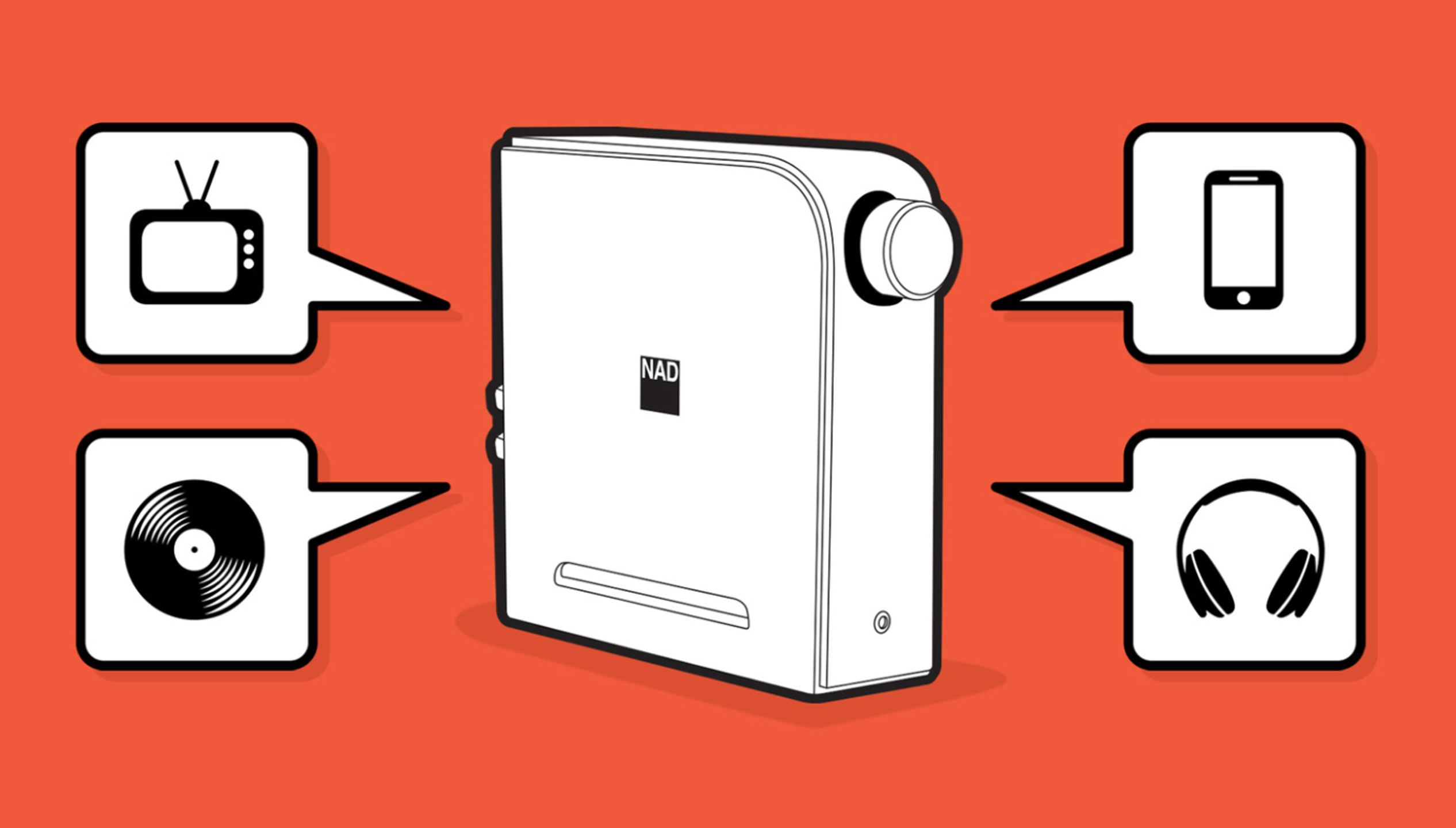
The NAD D3020 V2 is an evolution of a line of amplifiers that began more than forty years ago. This compact integrated amplifier delivers 30 watts per channel and blends modern digital technologies with up-to-date connectivity. It features a phono input for vinyl, high-resolution digital inputs, and Bluetooth aptX streaming.
A design tailored for modern spaces
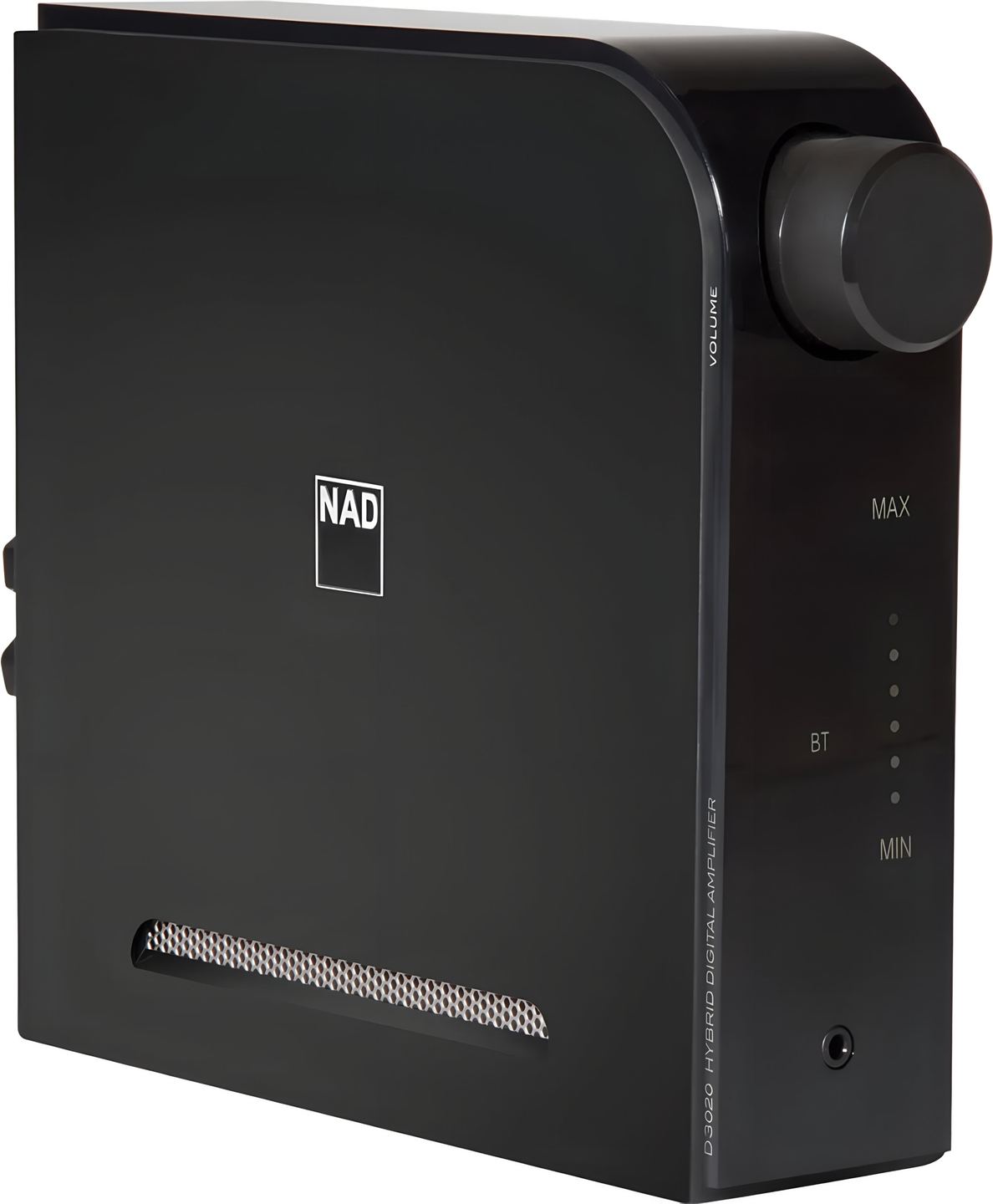
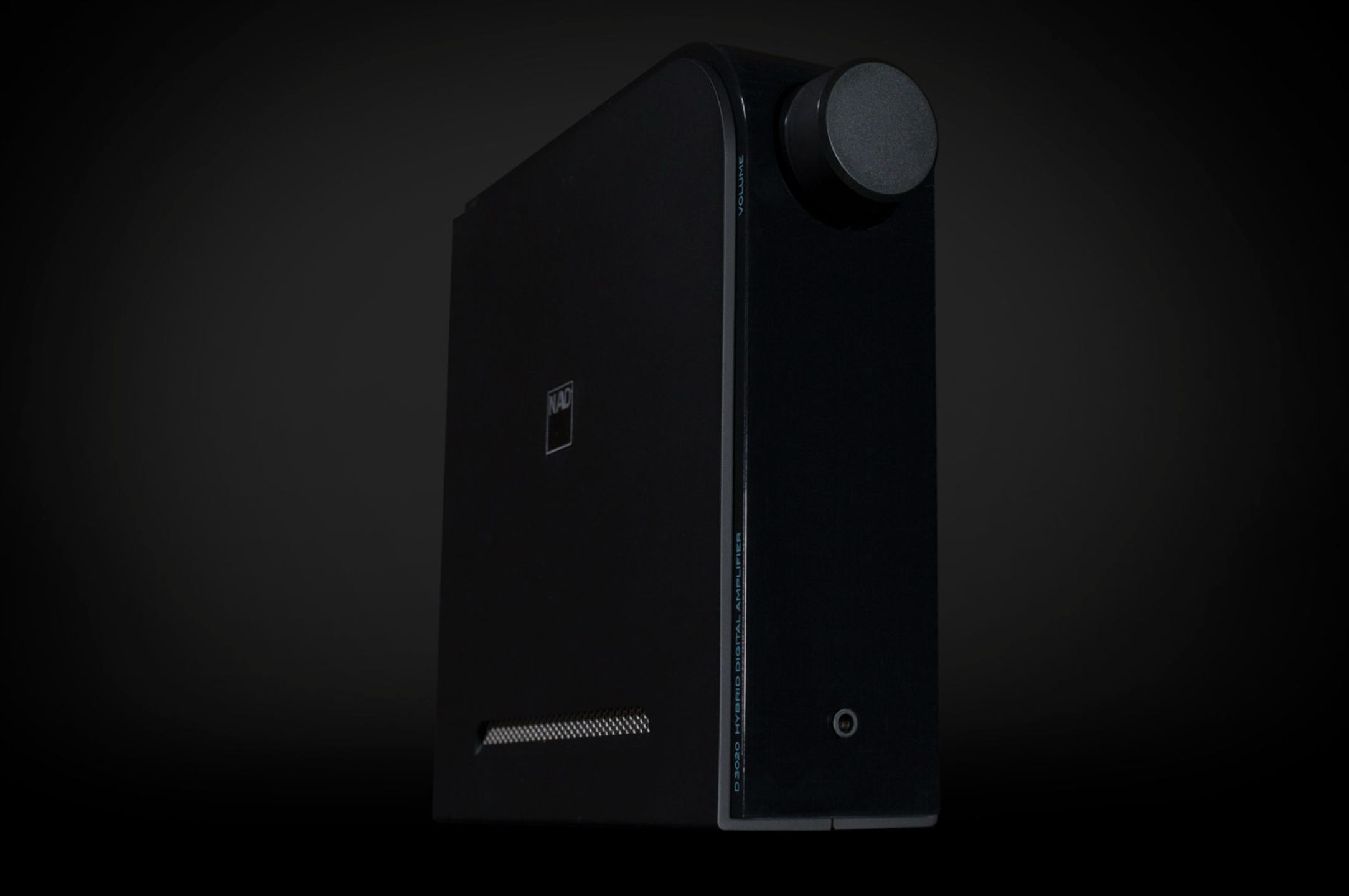
The D3020 V2 stands out with an uncommon form factor in the hi-fi world. With compact dimensions of 58 x 186 x 219 mm, it can be placed upright like a book on a shelf or laid flat depending on available space. The matte black plastic chassis, topped by a large front-mounted volume knob, looks more like a contemporary decorative object than a traditional amplifier. This minimalist approach hides careful construction, with internal metal shielding separating the audio circuits from the switch-mode power supply.
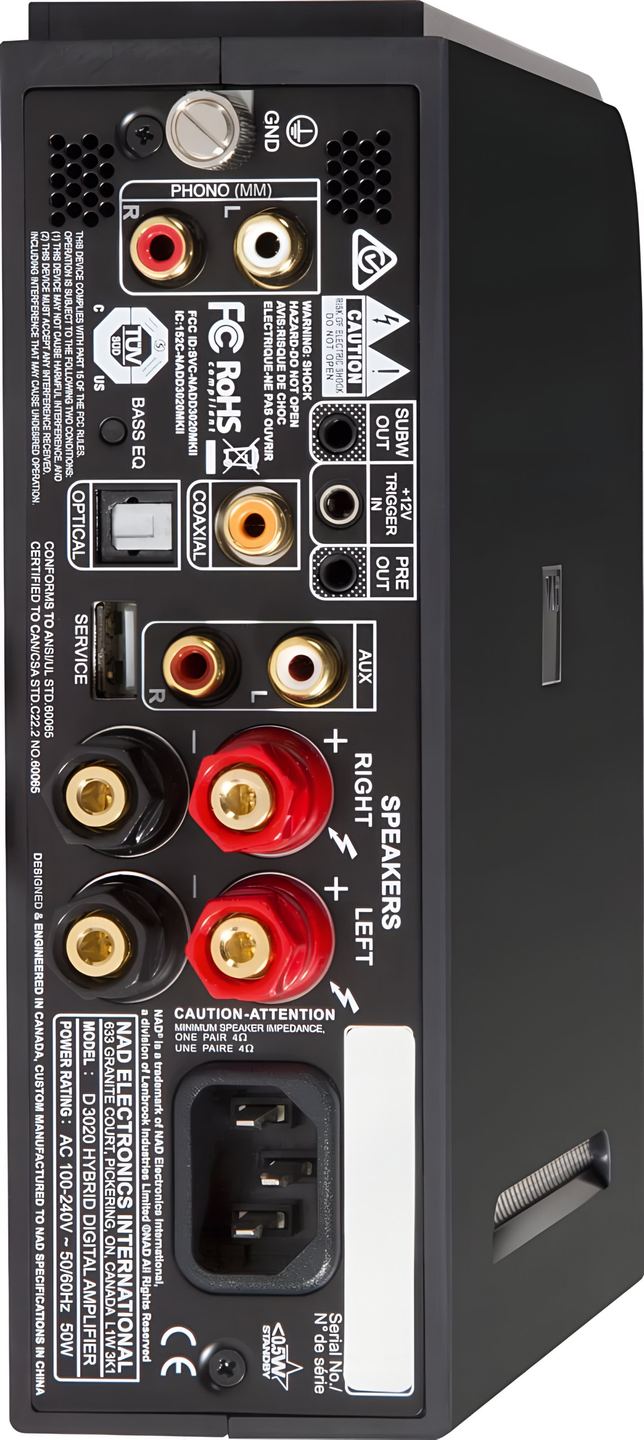
The rear-panel connectivity reflects current usage while preserving key fundamentals. You’ll find an MM phono input for moving-magnet turntables, a line input on RCA, two digital inputs (coaxial and optical Toslink) accepting signals up to 24-bit/192 kHz, as well as Bluetooth with aptX codec. Outputs include speaker terminals accepting banana plugs and bare wire, a stereo preamp output on RCA, and a subwoofer output on mini-jack. A 12V trigger completes the package for integration into home control systems.
The supplied credit card–sized remote provides full control, including the Bass EQ function that boosts bass by 6 dB at 80 Hz. This is particularly useful for compensating the limitations of compact speakers without risking driver damage, thanks to the built-in protection circuitry.
Technical design backed by decades of expertise
At the heart of the D3020 V2 lies the signature of Bjorn Erik Edvardsen, the engineer who created the original 3020 in 1978. This continuity of design philosophy translates into a modern implementation of NAD’s PowerDrive technology, enabling the amplifier to handle complex loads and real-world speaker impedance variations effectively.
The Hypex UcD102 amplification module, renowned for its musicality in the world of class D amplification, delivers a rated power of 30 watts per channel into 8 ohms. Modest on paper, this masks impressive dynamic capabilities: 60 watts into 8 ohms, 100 watts into 4 ohms, and up to 150 watts into 2 ohms on peaks. Output current can reach 18 amperes for one millisecond, explaining the D3020 V2’s ability to drive speakers known to be demanding.
The digital section incorporates a 24-bit/192 kHz converter using a particular architecture with 8 channels summed to 2, improving resolution and reducing noise. The A-weighted signal-to-noise ratio exceeds 98 dB, while harmonic distortion remains below 0.01% at 1 watt. A damping factor greater than 300 between 20 Hz and 6.5 kHz ensures precise control over driver motion.
The high-frequency switch-mode power supply, while controversial among some purists, delivers remarkable energy efficiency here. Standby consumption remains below 0.5 watt, and the amplifier uses only about 20% of the energy of a traditional class AB amplifier of equivalent power. This efficiency also results in minimal heat, eliminating the need for bulky heat sinks.
The phono preamp: a calculated return to roots
The addition of an MM phono input is the main change compared to the first version of the D3020, replacing the previously available USB input. This choice reflects the resurgence of vinyl while preserving digital connectivity via S/PDIF inputs and Bluetooth.
The built-in phono preamp exceeds expectations for a device in this price range. With a signal-to-noise ratio of 82 dB (200-ohm source) and a sensitivity of 1.15 mV, it comfortably handles most MM cartridges on the market. The RIAA curve is accurate to ±0.3 dB over 20 Hz–20 kHz and includes a subsonic filter to eliminate spurious frequencies caused by warped records. An overload margin of 90 mV at 1 kHz prevents clipping during dynamic passages.
A warm, engaging sonic signature
The D3020 V2 favors musical emotion over absolute neutrality. Its gently contour-tilted balance, with full-bodied bass and lively yet non-aggressive treble, makes for fatigue-free listening over long sessions. The midrange maintains a strong presence, particularly flattering to vocals.
Soundstage stability between the speakers is remarkable, offering precise imaging without lateral compression. Depth is respectable, if not at the level of pricier amplifiers, but overall coherence more than makes up for it.
In terms of dynamics, the D3020 V2 surprises with its ability to render contrasts without apparent compression up to high levels. Transients retain their impact, and the Soft Clipping circuit intervenes progressively in case of overload, avoiding the harsh distortion typical of basic digital amplifiers.
Listening via the digital inputs yields a presentation that’s slightly smoother and rounder than with a high-end external DAC, yet perfectly consistent with the device’s overall philosophy. Bluetooth aptX provides surprisingly good quality for wireless streaming, without the compression artifacts audible with the standard SBC codec.
Documentation
Technical Specifications
Product Type and Applications
- Compact integrated stereo amplifier
- Suitable for hi-fi systems, small speakers, and multi-source setups
- Powerful, detailed sound despite compact form factor
- Able to drive demanding speakers without distortion
- High-resolution digital playback and precise analog performance
- Very low, environmentally friendly power consumption
- Versatile: Bluetooth streaming, MM phono, optical and coaxial inputs
Audio Performance
- Rated power
- 8 Ω: 2 × 30 W RMS
- IHF dynamic power
- 8 Ω: 2 × 60 W
- 4 Ω: 2 × 100 W
- 2 Ω: 2 × 150 W
- Signal-to-noise ratio: 90 dB (A-weighted, ref. 1 W)
- Channel separation: 1 kHz: 75 dB, 10 kHz: 65 dB
- Channel balance: 0 ± 0.3 dB
- Frequency response: 20 Hz – 20 kHz (0 dB to -0.3 dB)
- Total harmonic distortion (THD): ≤ 0.005%
- SMPTE intermodulation distortion: 0.02%
- CCIF intermodulation distortion: 0.003%
- Maximum input level: 5 V
MM Phono Input
- Signal-to-noise ratio: > 82 dB (200 Ω source), 76 dB (MM cartridge source, IHF)
- Sensitivity: 1.15 mV (ref. 500 mV, maximum volume)
- Maximum input signal at 1 kHz: 90 mV RMS
- Frequency response: 20 Hz – 20 kHz (0.3 dB)
Connectivity
- Digital inputs: coaxial, optical (up to 24/192)
- Analog inputs: line and MM phono
- Outputs: preamp out for extended connectivity
- Wireless streaming: Bluetooth aptX
Power Consumption
- Standby power: < 0.5 W
- Highly efficient design, consumes about 20% of the energy of a conventional hi-fi amplifier
Built-in Technologies
- Built-in 24/192 digital-to-analog converter (DAC)
- NAD PowerDrive for efficient driving of low-impedance speakers
- Innovative bass equalization circuit for small speakers
- Soft protection circuit to prevent overloading of woofers
- Bluetooth with aptX for high-quality wireless streaming
- Compact, modern design true to the NAD 3020 heritage
Dimensions and Weight
- Dimensions (W × H × D): 147 × 472 × 556 mm
- Net weight: 1.38 kg
- Shipping weight: 2.1 kg
Frequently asked questions
Can the D3020 V2 drive medium-sized floorstanding speakers?
Despite its rated 30 watts, the D3020 V2 comfortably drives entry- and mid-range floorstanders thanks to its high dynamic power (100 W/4 Ω, 150 W/2 Ω) and strong output current. Models with sensitivity above 87 dB and nominal impedance of 4 to 8 ohms are ideal partners. For very demanding speakers or rooms exceeding 30 m², a more powerful amplifier is still advisable.
What’s the main difference from the first D3020?
The V2 replaces the USB-B input with an MM phono input for turntables, adds a full preamp output (the V1 only had a subwoofer output), and benefits from a revised power supply. The price has also dropped by about €100. The chassis features slightly improved finishes with a higher-quality volume knob.
How do I connect a computer without an S/PDIF output?
Without a USB input on the V2, several options exist: use the computer’s headphone output to the RCA line input (with a 3.5 mm jack–to–RCA cable), opt for a USB audio interface with S/PDIF output, or use Bluetooth streaming if the computer supports aptX. An external USB DAC feeding the line input is the optimal solution for sound quality.
Is the built-in phono preamp suitable for high-output MC cartridges?
In theory it accepts high-output moving-coil cartridges (>2 mV), but it’s optimized for MM. Gain and input impedance are not adjustable. For a standard MC cartridge, an external phono preamp is still required, then connected to the line input.
Can the D3020 V2 be used as a standalone DAC or preamp?
The preamp output lets you use only the D3020 V2’s preamp and digital-to-analog conversion section with an external power amplifier. This setup leverages the built-in 24/192 DAC and digital inputs while providing more powerful amplification if needed.
Is the Bass EQ function useful with quality bookshelf speakers?
The 6 dB boost at 80 Hz effectively compensates for the physical limits of small speakers without introducing overhang. With well-designed bookshelf speakers it’s generally left off, but it can positively transform entry-level compact speakers or improve low-volume listening by compensating for the Fletcher–Munson curve.
- Eco-contribution of €1 included in the sale price.
- GTIN / EAN: 5703120234571