NAD D3045
Buy as a bundle and save
- NAD D3045
- Triangle Solstice 3 ash black × 2
Specifications and features


Overview
The D3045 has followed NAD’s philosophy since 1972, aiming to deliver sonic performance in a simple, straightforward way. This approach, inherited from the 3020—an integrated amplifier that achieved major commercial success—is carried forward in this digital model, which blends contemporary technologies with the company’s classic expertise.
A vertical form factor designed for modern spaces
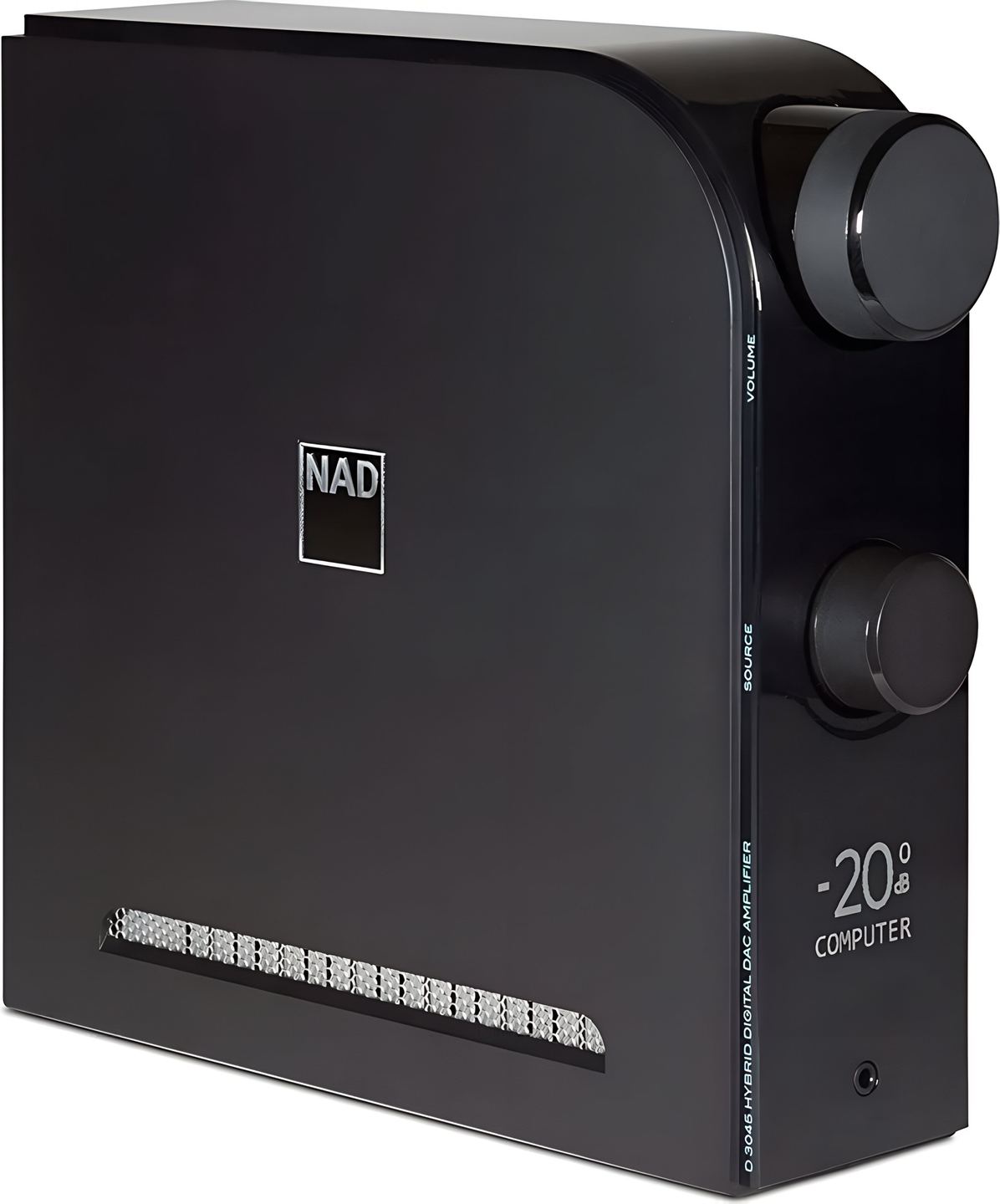
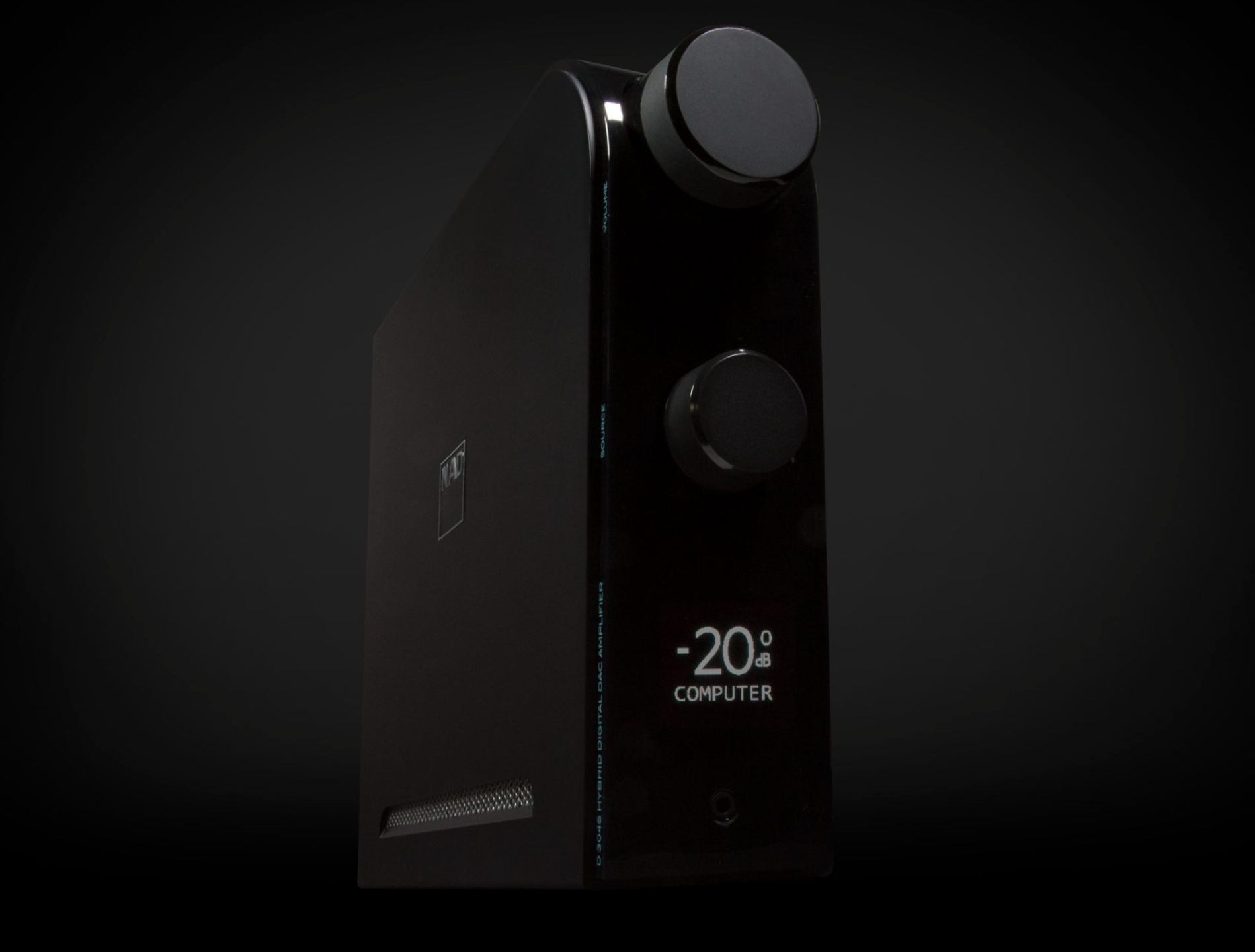
The D3045 adopts a vertical format, with dimensions of 70 mm wide, 235 mm high, and 265 mm deep. This design, used in NAD’s D series, allows for upright placement, horizontal positioning, or mounting behind a screen. Eight adhesive feet are provided to ensure stability in all positions.
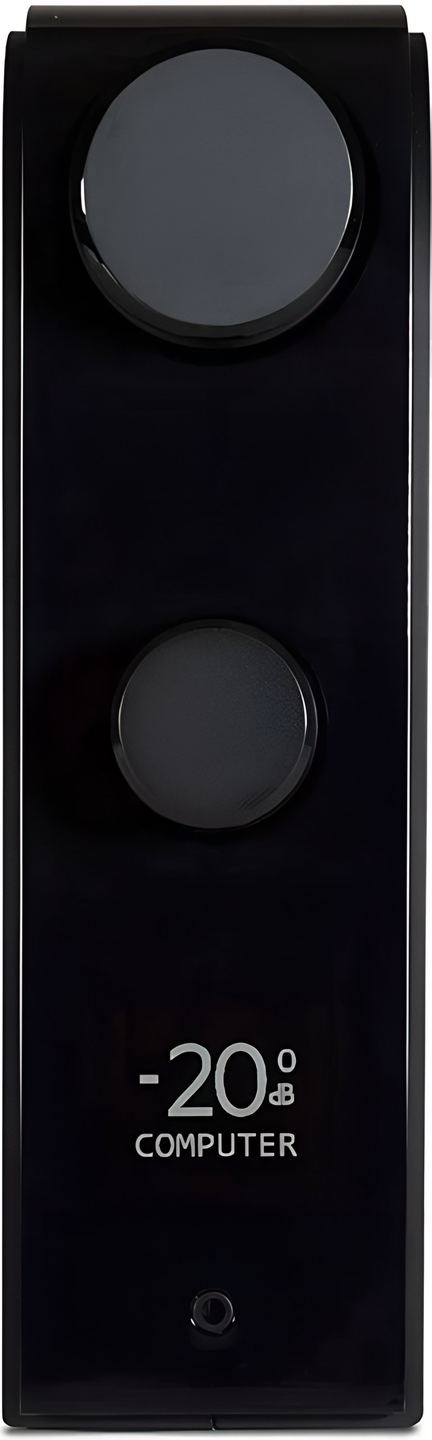
The front panel includes two rotary knobs for source selection and volume, topped by a small display that automatically rotates information according to orientation. The touch-sensitive capacitive power-on interface, located on the curved top, can sometimes be a bit unresponsive—something several users have noted—who therefore prefer to use the included remote control. Weighing 3.6 kg, the unit remains compact enough to fit into setups where space is at a premium.
HybridDigital and PowerDrive amplification technologies
At the heart of the D3045 is NAD’s HybridDigital technology, a sophisticated class D amplification implementation developed in collaboration with Dutch company Hypex. This approach uses a variable modulation frequency that adapts its operation according to load conditions and musical content. Unlike conventional class D amplifiers that can sometimes sound analytical or cold, the HybridDigital circuit preserves natural tonal qualities while maintaining remarkable energy efficiency.
PowerDrive, originally developed by Bjørn Erik Edvardsen (the engineer behind the original 3020), constitutes the other technical pillar of the D3045. This circuit detects in real time the operating conditions of the output stage—voltage, current, temperature—and intelligently switches between two power rails as needed. When the speaker presents a difficult load requiring current, the circuit prioritizes current delivery. With easier loads, it switches to a higher-voltage rail to maximize available power. This approach allows the D3045 to deliver its continuous 60 watts with dynamic headroom reaching 200 watts peak into 2-ohm loads.
Cutting-edge digital conversion and high-resolution formats
The D3045 features an ESS Sabre digital-to-analog converter at the core of its decoding capabilities. This DAC natively handles PCM streams up to 24-bit/192 kHz via traditional digital inputs, and up to 24-bit/384 kHz via the asynchronous USB input. The latter uses the D3045’s internal precision clock rather than the source computer’s, significantly reducing jitter—those timing variations that degrade sound quality.
Support for MQA (Master Quality Authenticated) enables playback of Tidal Masters files and streams. This technology, developed by Meridian Audio and now owned by the Lenbrook group (which also owns NAD), uses a “folding” technique to encapsulate high-resolution information into files comparable in size to standard CDs. While controversial in some audiophile circles that question its lossy nature, MQA aims to address time-domain issues inherent to digital audio while authenticating that the file matches exactly what the artist approved in the studio.
DSD (Direct Stream Digital), an alternative to traditional PCM, uses single-bit delta-sigma modulation sampled 2.8 million times per second. Developed by Sony and Philips for Super Audio CD, the format has found a second life in high-resolution downloads. Classical and jazz enthusiasts particularly appreciate its natural rendering of timbre and soundstage. The D3045 natively decodes DSD files via its USB port, providing compatibility for the most demanding music libraries.
Extensive connectivity and bidirectional Bluetooth
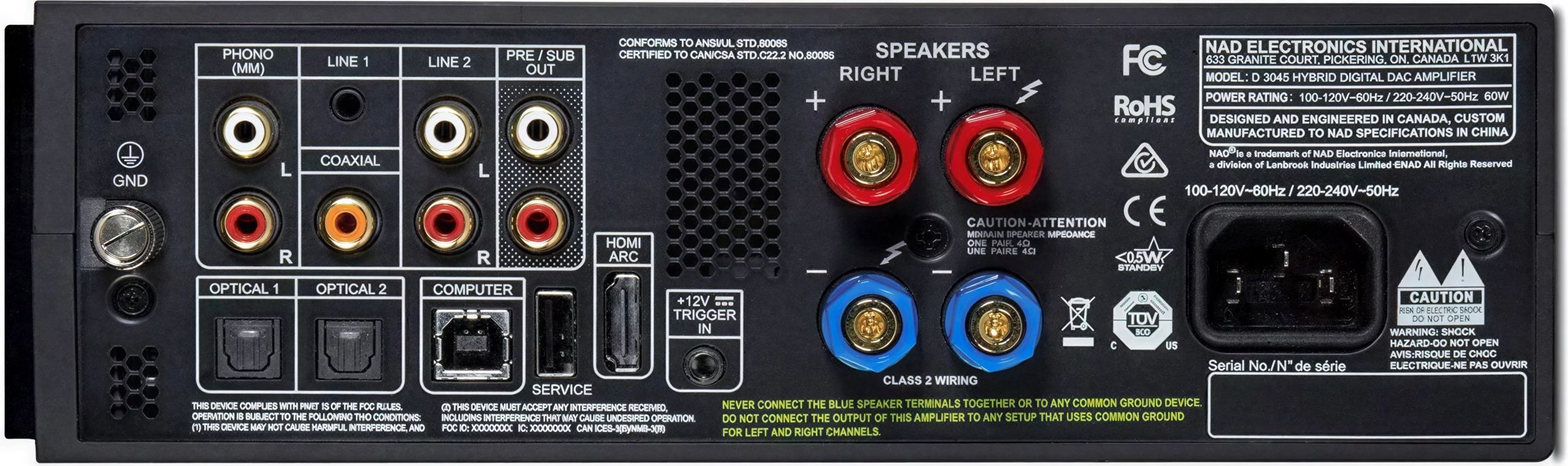
The D3045’s connectivity reflects a desire to embrace modern sources without abandoning traditional formats. The MM (Moving Magnet) phono input marks the return of NAD’s RIAA preamp, known for its precision and generous overload margin. With a sensitivity of 1.35 mV and a signal-to-noise ratio above 76 dB, this phono stage faithfully extracts the information etched into vinyl grooves, meeting the resurgence of the analog format.
Bidirectional Bluetooth aptX HD is a distinctive feature of the D3045. Not only can the unit receive audio streams from smartphones and tablets with near-CD quality (576 kbps for aptX HD versus 328 kbps for standard Bluetooth), but it can also transmit to Bluetooth headphones or speakers. This bidirectional functionality, developed by Qualcomm, allows, for example, listening to vinyl over wireless headphones or routing the sound from a connected CD player to a Bluetooth speaker in another room.
The HDMI ARC (Audio Return Channel) input simplifies integration into a home theater system. It automatically retrieves audio from the TV without needing an extra audio cable, allowing volume control with the TV remote. Two optical inputs and one coaxial input round out the digital options, while the analog line input accommodates traditional sources. Preamp and subwoofer outputs expand system upgrade possibilities.
Built-in low-impedance headphone amplifier
The D3045’s headphone stage deserves special attention. With an output impedance of just 2 ohms and the ability to deliver up to 8 volts into a 32-ohm load, it drives the majority of headphones on the market effectively, including notoriously demanding planar magnetics. NAD claims performance on par with dedicated amplifiers, a claim that technical measurements partially confirm.
However, the 90 dB signal-to-noise ratio lags behind the best standalone headphone amplifiers. Some users have noted a faint hiss with very sensitive in-ear monitors. For occasional headphone listening or with medium- to high-impedance models, performance remains entirely satisfactory, avoiding the need for an additional dedicated amplifier.
Comparison with the D3020 V2: a justified step up
The D3045 brings several technical improvements over the previous model. Its signal-to-noise ratio increases from 92 dB to 98 dB, and total harmonic distortion is reduced. It supports MQA and DSD high-resolution audio formats, absent from the lower model.
Its DAC offers a signal-to-noise ratio and distortion level exceeding 100 dB, which aligns with performance generally expected from current converters. The D3045 also includes bidirectional Bluetooth, an HDMI ARC input, and a second optical input. These additions account for a price difference of around 300 dollars compared to the D3020 V2.
Documentation
Technical Specifications
General Information
Product Type
- Hybrid digital integrated amplifier
- Suitable for modern, multi-source Hi-Fi systems
- High-performance built-in headphone amplifier
Highlights
- Studio-accurate high-resolution sound with MQA support
- Exceptional versatility: analog, digital, Bluetooth, and vinyl sources
- Compact yet powerful, low-noise amplifier
- Compatible with high-performance headphones and subwoofer
Advanced Features
- High-resolution playback up to 24/192 digital, 24/384 via computer
- Built-in high-resolution digital-to-analog converter
- Precision phono preamplifier for vinyl records
- Low-impedance, high-current headphone amplifier
- Soft protection circuit
- NAD PowerDrive technology for optimal drive of low-impedance speakers
Audio Performance
Main Amplifier
- Continuous output power: 60 W per channel (4 and 8 Ω, 20 Hz–20 kHz, 0.03% THD)
- IHF dynamic power:
- 8 Ω: 80 W
- 4 Ω: 150 W
- 2 Ω: 200 W
- Peak current: > 18 A (1 Ω, 1 ms)
- Total harmonic distortion (20 Hz–20 kHz): < 0.005%
- Signal-to-noise ratio: > 98 dB (A-weighted, 500 mV input, ref. 2.828 V output)
- Damping factor: > 300 (8 Ω, 20 Hz to 6.5 kHz)
- Frequency response: ±0.3 dB (20 Hz–20 kHz)
- Channel separation: > 75 dB (1 kHz), > 70 dB (10 kHz)
Line Input / Preamplifier
- Total harmonic distortion: < 0.003%
- Signal-to-noise ratio: > 100 dB
- Input impedance: 47 kΩ + 220 pF
- Maximum input signal: > 5.5 Vrms
- Sensitivity: 82 mV
- Frequency response: ±0.2 dB (20 Hz–20 kHz)
Moving-Magnet Phono Input
- Total harmonic distortion: < 0.015%
- Signal-to-noise ratio: > 82 dB (200 Ω source), > 76 dB (MM cartridge)
- Sensitivity: 1.35 mV
- Maximum input signal: > 90 mVrms
- Frequency response: ±0.3 dB (20 Hz–20 kHz)
Headphone Output
- Total harmonic distortion: < 0.003% (at 120 mW)
- Signal-to-noise ratio: > 90 dB (32 Ω load)
- Output impedance: 2 Ω
- Maximum headphone output (32 Ω): < 8 V
Connectivity and Inputs/Outputs
Digital Inputs
- Asynchronous USB 24/192
- Digital coaxial
- Digital optical
- HDMI ARC for TV
- Supported formats: MQA, DSD
Analog Inputs
- Line input
- Moving-magnet phono input
Outputs
- Preamplifier output
- Subwoofer output (Sub Out)
- Built-in headphone amplifier
Wireless Connectivity
- Qualcomm aptX HD bidirectional Bluetooth
Power Consumption
- Standby power consumption: < 0.5 W
- Compact, efficient design for minimal heat and power draw
Dimensions and Weight
- Dimensions (W × H × D): 71.4 × 236.5 × 265.1 mm
- Net weight: 3.6 kg
- Shipping weight: 2.6 kg
Frequently asked questions
Can the D3045 really drive difficult speakers despite its compact size?
Thanks to PowerDrive technology, the D3045 handles complex loads effectively. Its continuous 60 watts may seem modest, but the ability to deliver 150 watts dynamically into 4 ohms and 200 watts into 2 ohms allows it to control demanding speakers in medium-sized rooms. A damping factor above 300 ensures tight bass control. Nevertheless, for particularly insensitive speakers (below 85 dB) in large rooms, a more powerful model remains preferable.
What’s the audible difference between using the internal DAC and an external DAC?
The built-in ESS Sabre DAC offers solid technical performance with a SINAD exceeding 100 dB. However, the D3045 applies DSP (digital signal processing) to all incoming signals to optimize HybridDigital amplification performance. Using an external DAC bypasses this processing via the analog line input. Some users prefer the optimized sonic signature of the internal DAC, while others appreciate the flexibility of a high-end external DAC.
How exactly does bidirectional Bluetooth work?
The Qualcomm aptX HD module enables two distinct modes. In receive mode, the D3045 decodes Bluetooth streams from any compatible source (smartphone, tablet, computer) with quality up to 24-bit/48 kHz at 576 kbps. In transmit mode, activated via a specific procedure described in the manual, the amplifier can send the signal from any connected source to a Bluetooth headset or speaker. Both modes cannot operate simultaneously.
Does the HDMI ARC input have advantages over optical for TV connection?
HDMI ARC simplifies cabling and allows volume control via the TV remote through the CEC protocol. However, several users report preferring the optical connection for its reliability and auto power-on upon signal detection. Optical theoretically limits the signal to 24-bit/96 kHz, but this restriction has no practical impact on TV audio streams, which are generally encoded in Dolby Digital stereo.
Does the DSD format really bring an audible improvement?
DSD uses a fundamentally different approach from traditional PCM, sampling the signal 2.8 million times per second with a single bit rather than 44,100 times at 16 bits for CD. Proponents praise its natural rendering and tonal smoothness, particularly on acoustic recordings. Skeptics point out that most DSD productions undergo conversion to PCM for mixing and mastering. Appreciation remains subjective and largely depends on the quality of the original recording.
Can the digital circuits be completely disabled for purely analog listening?
No, all signals pass through a digital processing stage in the D3045, even those entering via the phono or line inputs. This architecture allows performance optimization via DSP but means a purely analog chain is not possible. Vinyl purists wishing to avoid any digitization will need to look to traditional amplifiers. NAD stands by this technical choice, which enables superior performance in a compact format.
Are firmware updates possible, and how are they performed?
NAD does not offer a user-accessible firmware update system for the D3045. The device uses a fixed hardware architecture without a general programmable processor. This approach guarantees total stability but prevents adding new features after purchase. NAD’s higher-end models with MDC (Modular Design Construction) technology offer greater upgradability via interchangeable modules.
- Eco-contribution of €0.84 included in the sale price.