Michell Engineering Cusis E
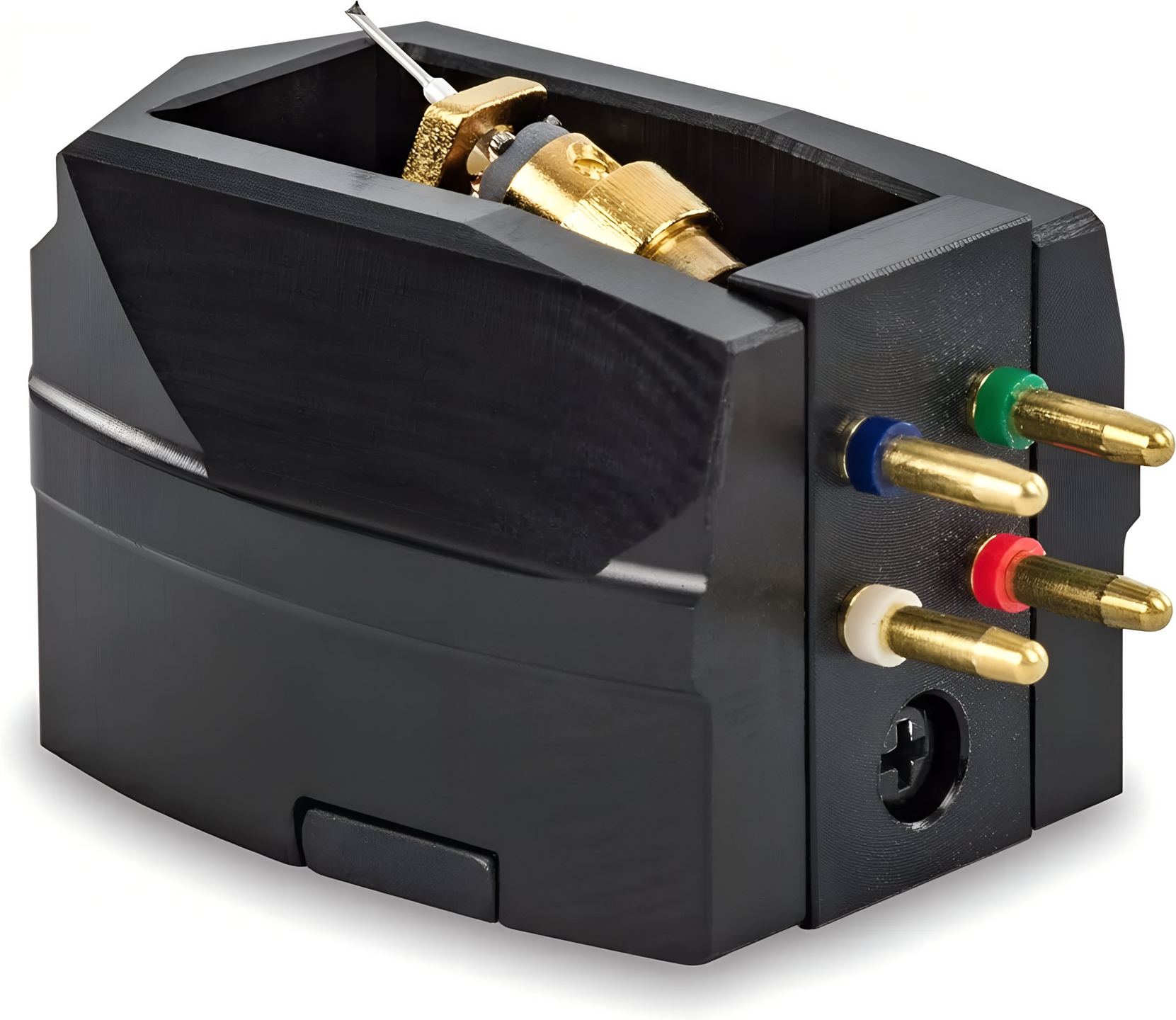
Overview
The Cusis E is the entry point into Michell Engineering’s moving-coil cartridge range. This entry-level MC cartridge shares the fundamental architecture of the higher models in the Cusis family, featuring a samarium-cobalt magnetic circuit and pure copper coils. Its robust aluminum chassis and high-density acetal body ensure a solid construction for detailed, neutral musical reproduction.
Moving-coil technology: precision and musicality
Moving-coil cartridges invert the principle of traditional MM cartridges. Instead of moving magnets oscillating between fixed coils, MC cartridges use microscopic coils attached to the cantilever that move within the magnetic field of permanent magnets. This configuration drastically reduces moving mass, allowing the stylus to track with greater precision the complex modulations engraved in the groove.
The reduced mass of the coils—made from copper wire only 30 microns in diameter in the case of the Cusis E—significantly improves transient response and the ability to reproduce fine details. This lightness results in better high-frequency definition and a more faithful rendering of instrumental textures.
The development of the Cusis range represents several years of research conducted in collaboration with a partner specialized in high-end cartridges. Michell began with the flagship Cusis M, developed without budget constraints, before rolling out the technology to the S and E models to deliver reference-class performance at different price points.
Technical architecture and carefully selected materials
At the heart of the Cusis E is a sophisticated magnetic circuit combining samarium-cobalt and pure iron. Samarium-cobalt belongs to the rare-earth family and offers characteristics particularly suited to audio applications. Its exceptional magnetic stability remains constant over time and resists temperature variations, unlike more common ferrite or even neodymium magnets.
Pairing with pure iron focuses and stabilizes the magnetic flux around the coils. This configuration generates a perfectly stable and homogeneous magnetic field, an essential condition for linear signal transduction. The choice of samarium-cobalt over neodymium, despite the latter’s higher strength, is explained by its specific tonal properties: the way the magnetic field recovers after inducing a signal in the coils directly influences the sound.
The coils use 30-micron pure copper wire, precisely wound on an ultra-light armature. Each winding is calibrated to achieve an output voltage of 0.35 mV—relatively low but characteristic of quality MC cartridges. This low voltage requires a suitable phono preamplifier or a step-up transformer, but in return ensures a very low internal impedance of 4.5 ohms, favoring optimal signal transfer.
The damper, a critical yet often overlooked component, has undergone specific development. Its design ensures perfect support of the cantilever–stylus assembly while allowing the lateral and vertical movements necessary for groove tracking. The balance between stiffness and compliance directly determines the cartridge’s ability to follow modulations without distortion.
Mechanical construction: eliminating parasitic resonances
The large aluminum chassis absorbs unwanted vibrations and provides a rigid platform for mounting the internal elements. Its substantial mass of 8.9 grams may require counterweight adjustment on some lightweight tonearms, but contributes to the overall mechanical stability.
The high-density acetal body completes this anti-resonance architecture. This engineering polymer offers internal damping properties that dissipate parasitic vibrations rather than transmitting them. The shape and exterior patterns of the body have been designed to minimize resonance modes, a technique borrowed from architectural acoustics.
The aluminum cantilever is a pragmatic choice for this entry-level cartridge. While less exotic than the boron or beryllium found in the higher models, aluminum offers a good compromise between rigidity, mass, and cost. Its response remains linear across the specified 20 Hz to 25 kHz bandwidth.
The elliptical stylus improves contact with the groove walls compared to a spherical tip. Its shape allows better high-frequency retrieval and reduces distortion, particularly noticeable on inner grooves where linear velocity decreases. The recommended tracking force of 2 grams ensures optimal contact without premature wear of vinyl or stylus.
Positioning within the range and design philosophy
The Cusis range comprises three models sharing the same core architecture but differentiated by materials and refinements. The Cusis E uses an aluminum cantilever and an elliptical stylus; the Cusis S adopts a nude elliptical stylus with an extended response up to 35 kHz; while the flagship Cusis M features a boron cantilever and a microline stylus reaching 45 kHz.
This modular approach allows Michell to optimize each element—number of turns, output voltage, body material—according to each model’s stylus profile. The Cusis E thus benefits from the same technical fundamentals as its bigger sisters, tailored to its price positioning.
Professional reviews highlight the balanced character of the Cusis E, capable of reconciling precision and smoothness. This sonic signature allows less-than-perfect pressings to reveal their strengths without emphasizing their flaws—a trait appreciated by vintage vinyl collectors. The cartridge avoids analytical coldness while maintaining a fundamental neutrality aligned with Michell’s philosophy.
Technical Specifications
Physical Construction
- Type: Moving Coil (MC) cartridge
- Stylus tip: Elliptical
- Cantilever: Aluminum
- Chassis: Large aluminum chassis
- Body: High-density acetal
Audio Performance
- Tracking force: 2.0 g
- Frequency response: 20 Hz – 25,000 Hz
- Channel separation: 23 dB
- Channel balance: < 1 dB
- Tracking ability: 70 µ / 2.0 g
- Compliance: 8 × 10⁻⁶ cm / dyne
Electrical Characteristics
- Output voltage: 0.35 mV
- Recommended load: 100 Ω
- Internal impedance: 4.5 Ω
- Coil: 30 μm pure copper, precision-wound
Technical Design
- Magnet: Samarium-cobalt combined with pure iron for a stable magnetic field
- Damper: Designed for precise groove tracking
- Optimization: Each element (number of turns, output, body) is tailored to the stylus profile for optimal rendering
General Information
- Mass: 8.9 g
- Recommended break-in: > 40 hours
Frequently asked questions
Does this cartridge require a specific phono preamp?
With its 0.35 mV output, the Cusis E requires an MC phono preamplifier or a switchable MM/MC model. The recommended load of 100 ohms should be observed for optimal performance. Many modern preamps offer variable impedance settings to fine-tune matching with the cartridge.
What is the stylus lifespan, and can it be replaced?
As with all MC cartridges, the Cusis E’s stylus cannot be replaced separately. Lifespan depends on use and maintenance, but you can expect 1,500 to 2,000 hours of listening with clean, well-maintained records. A minimum run-in of 40 hours is required to reach optimal performance.
- Eco-contribution included in the sale price.