Michell Engineering Cusis S
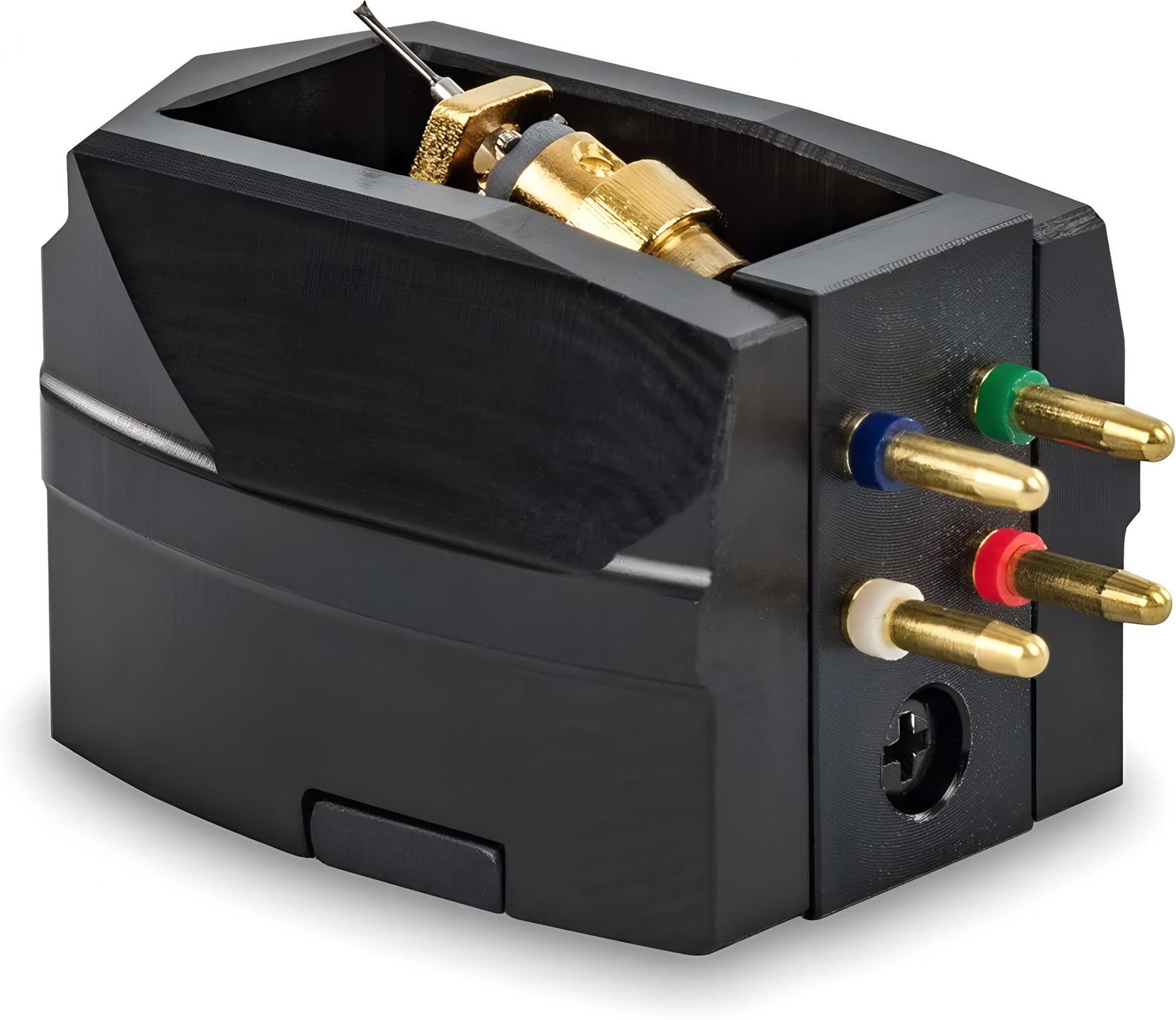
Overview
The Cusis S represents the sweet spot in the moving-coil cartridge trilogy developed by Michell Engineering, the British manufacturer renowned for its iconic turntables for over half a century. This MC cartridge combines a Shibata stylus mounted on a boron cantilever with a sophisticated magnetic circuit, delivering remarkably refined sound for its price category.
Mechanical and magnetic construction: an obsession with detail
The Cusis S is based on a magnetic generator common to the entire Cusis range, but optimized specifically for its characteristics. At the heart of the system, a samarium-cobalt magnet pairs with pure iron to create a particularly stable magnetic field. This magnetic stability forms the foundation for precise, consistent groove tracking, minimizing parasitic variations that could degrade the signal.
The coil uses 30-micron pure copper wire, wound with meticulous precision onto an ultra-light armature. This armature is mounted on a custom-developed damper, engineered specifically to provide the ideal support for the moving assembly. The number of turns, the resulting output voltage, and even the body material have been tuned to match the Shibata stylus’s requirements, creating a technical synergy where each component amplifies the qualities of the others.
The large-format aluminum chassis absorbs unwanted vibrations while providing a rigid platform for mounting the internal components. The main body, machined from high-density acetal (also known as Delrin or polyoxymethylene), combines lightness with acoustic damping properties. This carefully considered material pairing eliminates parasitic resonances that could color the sound reproduction.
The Shibata stylus: a profile cut for excellence
The Shibata stylus fitted to the Cusis S deserves special attention. Initially developed in the 1970s for quadraphonic playback, this hyperelliptical diamond cut has a contact area with the groove walls that is significantly larger than standard conical or elliptical tips. This extended contact surface not only extracts more information from microgrooves—particularly at high frequencies—but also reduces record wear thanks to optimal pressure distribution.
The Shibata profile follows the most minute groove modulations with surgical precision, revealing sonic details that remain hidden with conventional tips. This exceptional tracking ability translates to 25 dB channel separation and a frequency response extending up to 35,000 Hz. The boron cantilever on which the stylus is mounted provides rigidity and lightness—two essential qualities for faithfully transmitting the captured vibrations to the generator system.
Strategic positioning within the Cusis range
The Cusis S occupies a central position in the Cusis trilogy, between the entry-level Cusis E and the flagship Cusis M. This middle position is not a compromise but rather a carefully calculated balance between performance and accessibility.
Compared to the Cusis E, which features an elliptical stylus on an aluminum cantilever, the Cusis S benefits from substantial upgrades. Its frequency response extends from 20 Hz to 35,000 Hz versus 20–25,000 Hz for the E model, while channel separation improves from 23 to 25 dB. The boron cantilever replaces aluminum, bringing a notable improvement in tracking complex groove modulations.
Against the higher-end Cusis M, equipped with a MicroLine stylus and a carbon-loaded acrylic body, the Cusis S retains the essential sonic qualities while remaining more affordable. The Cusis M pushes performance to a 15–45,000 Hz response with 28 dB separation, but the audible difference remains subtle on most systems and recordings.
Setup and compatibility
With an output voltage of 0.40 mV, the Cusis S falls into the category of relatively low-output MC cartridges, requiring a suitable phono preamplifier or a quality step-up transformer. The recommended load impedance of 100 ohms and internal impedance of 4.5 ohms make it compatible with the majority of MC phono stages on the market.
The 2.0-gram tracking force, standard for this type of cartridge, makes setup straightforward on most tonearms. The total weight of 8.9 grams is within the norm, although some ultra-light arms may require counterweight adjustment. The threaded inserts integrated into the chassis and the selection of screws of various lengths supplied by Michell greatly simplify mounting.
A minimum break-in of 40 hours is recommended for the suspension to reach its optimal characteristics. During this period, the cartridge’s sonic qualities gradually refine, particularly in terms of smoothness and openness in the mid-to-high frequencies.
Technical Specifications
Physical Construction
- Type: moving coil (MC) cartridge
- Stylus: Shibata
- Cantilever: boron
- Chassis: large aluminum chassis
- Body: high-density acetal
Audio Performance
- Tracking force: 2.0 g
- Frequency response: 20 Hz – 35,000 Hz
- Channel separation: 25 dB
- Channel balance: < 1 dB
- Tracking ability: 70 µ / 2.0 g
- Compliance: 8 × 10⁻⁶ cm / dyne
Electrical Characteristics
- Output voltage: 0.40 mV
- Recommended load: 100 Ω
- Internal impedance: 4.5 Ω
- Coil: 30 μm pure copper, precision-wound
Technical Design
- Magnet: samarium-cobalt + pure iron for optimal magnetic stability
- Damper: custom-developed for perfect groove tracking
- Optimization: output, number of turns, and materials adapted to the Shibata stylus
General Information
- Weight: 8.9 g
- Recommended break-in: > 40 hours
Frequently asked questions
Is the Shibata stylus really superior to an elliptical stylus for all types of music?
The Shibata excels at reproducing fine detail and high frequencies, which is especially beneficial for classical music, acoustic jazz, and audiophile recordings. For worn or average-quality records, it can sometimes reveal more of the medium’s flaws. However, contrary to popular belief, a well-set-up Shibata stylus wears records less than an elliptical thanks to its larger contact area that distributes pressure more evenly.
What is the concrete difference between the Cusis E’s 0.35 mV and the Cusis S’s 0.40 mV?
This 0.05 mV difference may seem small but represents about 14% more signal. In practice, this translates into a better signal-to-noise ratio, particularly appreciable with entry-level phono preamps that may introduce hiss with very low-output cartridges. The Cusis S therefore offers more flexibility in choosing a preamplifier.
Is the Cusis S suitable for medium-mass tonearms?
With a compliance of 8 × 10⁻⁶ cm/dyne, the Cusis S has relatively low compliance, typical of MC cartridges. It pairs perfectly with tonearms of medium to high effective mass (10 to 25 grams). Rega arms, SME M series, Michell TecnoArm, or similar models are ideal partners for this cartridge.
- Eco-contribution included in the sale price.