Michell Engineering Cusis M
Overview
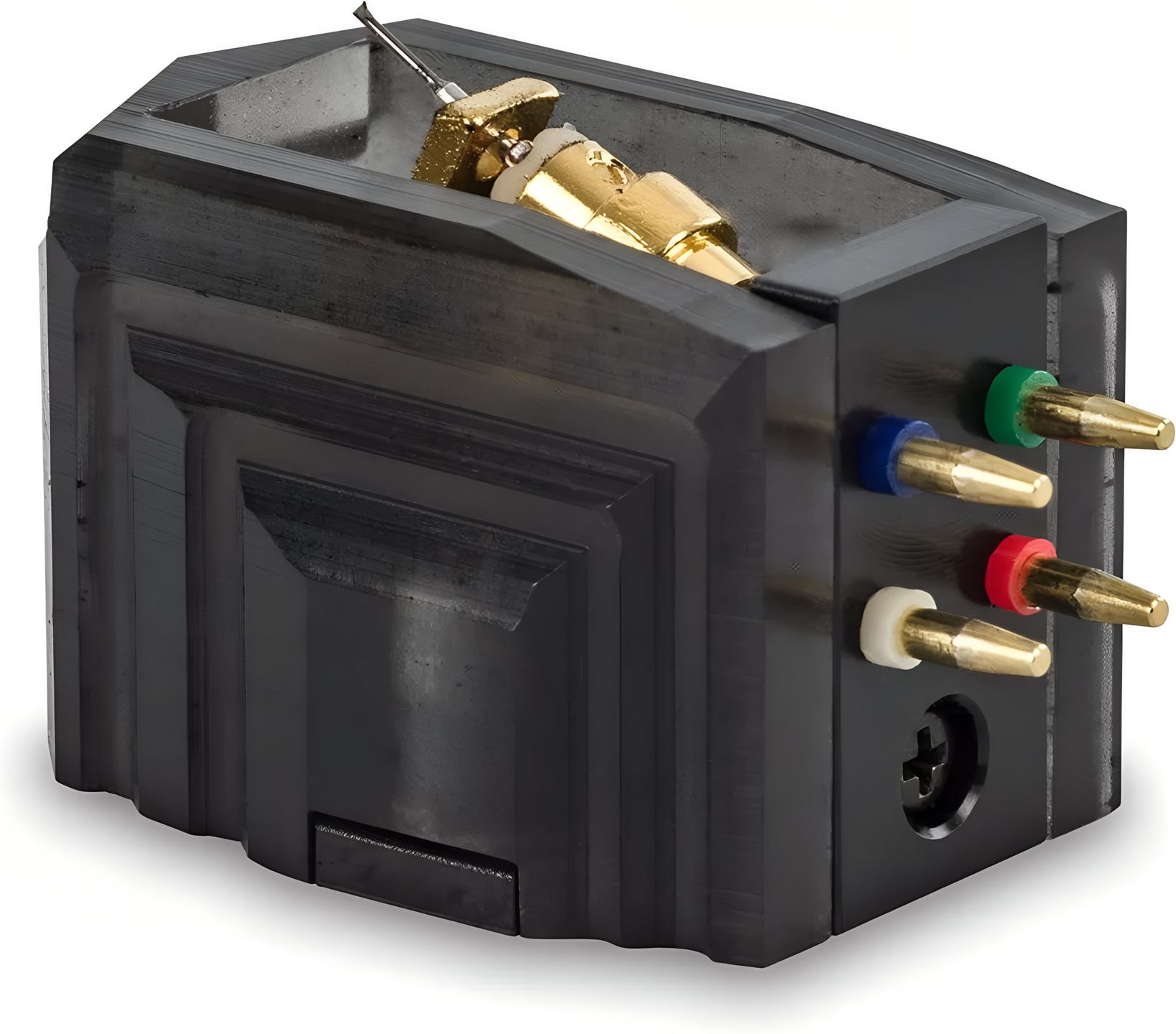
The Cusis M represents the culmination of five years of development at Michell Engineering, a British manufacturer renowned for over fifty years for its turntables. This moving-coil cartridge combines an ultra-precise microline stylus, a boron cantilever, and a carbon-loaded acrylic body to deliver particularly detailed groove tracing. With an output voltage of 0.25 mV and a frequency response extending from 15 Hz to 45 kHz, it is aimed at music lovers with an MC phono preamp capable of leveraging its resolving power.
Sophisticated construction in the service of neutrality
The Cusis M’s body stands out for its composite material: acrylic loaded with carbon particles. This formulation, which Michell has used for years in its turntable platters, offers remarkable damping properties. Unlike the Cusis E and S models, which use acetal (polyoxymethylene), this material absorbs and dissipates unwanted vibrations while maintaining high structural rigidity. The large aluminum chassis serves as a stable base for assembling the generator, creating a mechanical platform that isolates sensitive elements from undesirable resonances.
The magnetic circuit relies on a samarium-cobalt magnet paired with pure iron. This combination generates a particularly stable magnetic field, an essential condition for the precise conversion of mechanical movements into an electrical signal. The coils are made from pure copper wire with a diameter of 30 micrometers, precisely wound on a lightweight armature. The number of turns has been specifically optimized for the stylus’s microline profile, enabling an output voltage of 0.25 mV with a mobile mass kept to a minimum.
The cartridge incorporates a damper specifically designed to maintain the optimal suspended equilibrium of the moving system. This component supports the cantilever while allowing fast, controlled movement in all directions. With a compliance of 8 × 10⁻⁶ cm/dyne, the cartridge suits medium to high-mass tonearms, offering broad compatibility with various turntables.
The microline stylus: surgical precision in the groove
The microline stylus is the defining element of this high-end model. Unlike the elliptical or Shibata styli of the Cusis E and S models, the microline profile faithfully replicates the shape of the cutter head used to engrave master discs. This complex geometry, produced through computer-aided design, maximizes the contact area with the groove walls, around 115 µm² according to industry standards.
This extended contact area provides several measurable technical advantages. The pressure on the vinyl is spread over a larger zone, reducing record wear despite the 2-gram tracking force. Tracking ability reaches 70 micrometers, allowing it to navigate highly modulated passages without losing contact. Distortion remains minimal even on inner grooves, where reduced linear speed typically challenges less sophisticated styli.
The microline profile excels particularly in high-frequency reproduction. The response extends up to 45 kHz, well beyond the audible spectrum, ensuring linear phase within the useful bandwidth. This extension captures subtle harmonics and fast transients that give acoustic instruments their natural timbre. Channel separation of 28 dB ensures a stable and precise stereo image, with interchannel balance within 1 dB.
The boron cantilever: optimal rigidity and lightness
The boron cantilever is a deliberate technical choice to maximize vibration transmission. This crystalline material, with a hardness of 9.5 on the Mohs scale, combines exceptional rigidity with low mass. These physical properties push the cantilever’s resonant frequency well beyond the audio band, eliminating colorations that affect less rigid materials.
The speed of sound propagation in boron exceeds that of aluminum by a significant factor, ensuring instantaneous transmission of stylus movements to the generator. This responsiveness translates into better definition of note attacks and decays, particularly noticeable on percussive instruments and string pizzicatos. Boron also resists mechanical fatigue better than metal alloys, maintaining its characteristics throughout the cartridge’s lifespan.
Mounting the cantilever in the damper follows tight tolerances to ensure perfect alignment with the generator. This assembly precision, combined with the reduced moving mass of the coils, enables a fast impulse response. Complex transients, such as explosive consonants or crash cymbals, retain their dynamic character without compression or temporal smearing.
Compatibility and practical implementation
At 8.1 grams, the Cusis M requires a tonearm capable of balancing this mass while maintaining the recommended 2-gram tracking force. Tonearms with an effective mass between 10 and 25 grams are ideal, encompassing most quality current models. The 3-ohm internal impedance and recommended 100-ohm load simplify matching with modern MC phono preamps.
The 0.25 mV output places the cartridge in the “low output” category, requiring a phono preamp with substantial gain and low noise. A minimum of 60 dB of gain is recommended to achieve a comfortable output level to the amplifier. Preamps using step-up transformers or low-noise active circuits are both suitable; the choice depends on the user’s sonic preferences.
Michell recommends a break-in period exceeding 40 hours to stabilize the mechanical characteristics of the suspension. During this phase, electrical and mechanical parameters gradually evolve toward their nominal values. Compliance increases slightly, damping optimizes, and frequency response refines. Once broken in, the cartridge maintains its performance for several thousand hours of use under normal conditions.
Technical Specifications
Construction and Design
- Type: Moving Coil (MC) cartridge
- Stylus: ultra-precise MicroLine
- Cantilever: boron
- Chassis: large aluminum chassis
- Body: carbon-loaded acrylic with damping effect
- Magnet: samarium–cobalt + pure iron for optimal magnetic stability
- Damper: engineered to ensure perfect groove tracking
- Anti-resonance design: carbon-loaded acrylic body and aluminum chassis for optimal rigidity and vibration absorption
Audio Performance
- Tracking force: 2.0 g
- Frequency response: 15 Hz – 45,000 Hz
- Channel separation: 28 dB
- Channel balance: < 1 dB
- Tracking ability: 70 µ / 2.0 g
- Compliance: 8 × 10⁻⁶ cm / dyne
Electrical Characteristics
- Output voltage: 0.25 mV
- Recommended load: 100 Ω
- Internal impedance: 3 Ω
- Coil winding: 30 μm pure copper, precisely wound
- Reduced coil mass: for fast response and improved linearity
- Optimization: number of turns and internal structure tailored to the MicroLine profile
General Information
- Weight: 8.1 g
- Recommended break-in: > 40 hours
Frequently asked questions
Is the Cusis M compatible with all phono preamps?
No, it requires an MC phono preamp capable of handling its low 0.25 mV output. At least 60 dB of gain is recommended, with an input impedance adjustable around 100 ohms. Standard MM preamps are not suitable without an additional step-up transformer.
Is the 40-hour break-in really necessary?
Yes, this period allows the suspension to stabilize and the materials to gradually loosen up. Performance improves noticeably during this phase, particularly dynamics and low-frequency definition. It is advisable to avoid final adjustments until break-in is complete.
How can I distinguish the Cusis M from other models in the range?
Visually, the smoked carbon-loaded acrylic body immediately differentiates it from the E and S models with opaque black acetal. Technically, it stands out with its microline stylus (versus elliptical for the E, Shibata for the S), boron cantilever, and lower output voltage.
Can the cartridge be used with lightweight tonearms?
With a compliance of 8 × 10⁻⁶ cm/dyne and a mass of 8.1 g, the Cusis M is better suited to medium to high-mass arms. On a very light arm (less than 10 g effective mass), the resonance frequency may fall within the audio band, causing tracking issues.
- Eco-contribution included in the sale price.