

Audioquest RJ/E Diamond 3m
This product is no longer available for sale!
Similar products from Audioquest
Overview
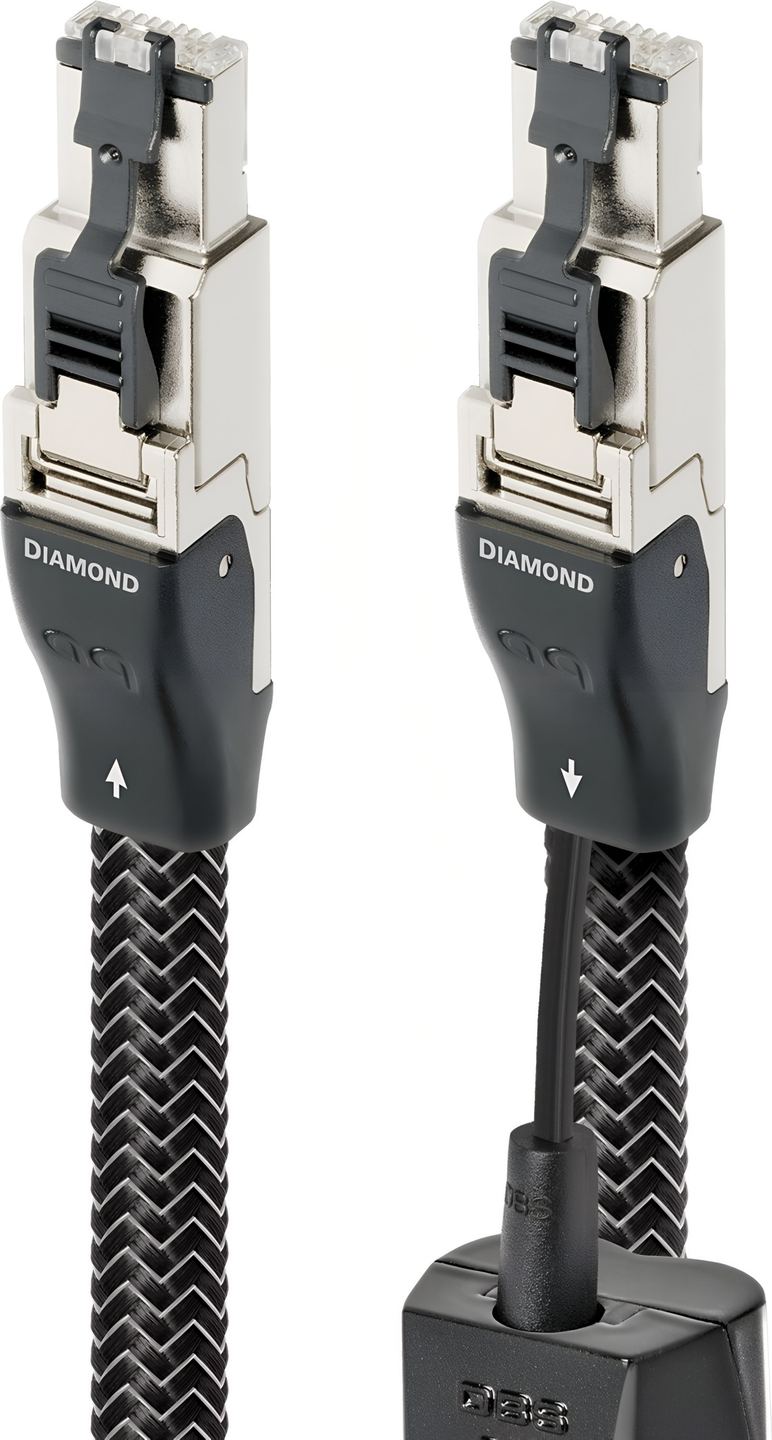
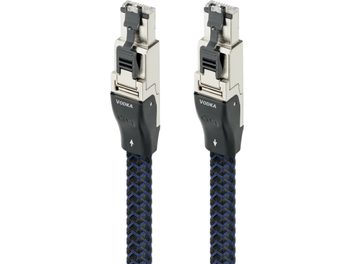
AudioQuest RJ/E Diamond is a Category 7 Ethernet cable. It uses 100% Perfect-Surface Silver (PSS) conductors, a 72-volt dielectric-bias system, and Telegärtner connectors. It is designed for digital data transmission and can be used at lengths of up to 100 meters. Its construction aims to limit electromagnetic interference and maintain signal stability.
Physical construction and material choices
The Diamond RJ/E is built around solid Perfect-Surface Silver (PSS) conductors, a material obtained through a proprietary manufacturing process developed by AudioQuest. This surface treatment creates a particularly homogeneous crystalline structure, minimizing grain boundaries where signal distortions typically concentrate. Unlike conventional multi-strand conductors, this solid structure completely eliminates strand-to-strand interactions, a phenomenon identified by William E. Low as early as 1980 as a primary source of dynamic degradation in cables.
The diameter and geometry of the conductors strictly comply with CAT 7 specifications, enabling 10 Gigabit Ethernet transmission. Each twisted pair benefits from individual shielding, a configuration that reduces crosstalk between transmission channels. The twist itself follows a calculated pitch to maintain a stable characteristic impedance of 100 ohms along the entire length of the cable.
High-density polyethylene (HDPE) insulation surrounds each conductor. This material features a particularly low dielectric constant and a molecular structure that limits the absorption of energy from the electromagnetic field generated by the passing signal. This characteristic helps preserve the waveform of high-frequency signals transmitted through the cable.
The Telegärtner connectors chosen to terminate the Diamond represent a technical solution developed specifically for critical applications. These connectors use a patented geometry that compensates for the inevitable misalignment created when the four twisted pairs are arranged in a straight line in the RJ45 configuration. The die-cast zinc housing, with hardened finish, provides 360-degree shielding and superior mechanical protection compared to standard connectors.
Noise dissipation technologies and DBS system
The Diamond RJ/E’s noise-dissipation system employs three alternating layers of conductive and carbon-loaded synthetic materials. This multilayer structure works like a radio-frequency trap: the metallic layers reflect part of the electromagnetic radiation, while the carbon layers absorb residual energy. This system prevents RF interference captured by the shielding from modulating the ground plane of connected equipment.
The Dielectric-Bias System (DBS) is AudioQuest’s most distinctive innovation. Patented under USPTO #7,126,055 and #7,872,195 B1, this system maintains a 72-volt electrostatic field across the cable’s insulation. A conductive wire runs through the center of the insulating jacket, connected to the negative pole of an external battery pack. The shield is connected to the positive pole, creating a field that polarizes and organizes the dielectric’s molecules.
This permanent polarization changes the behavior of the insulator in response to rapid variations in the digital signal. Without DBS, each signal transition triggers a molecular reorganization in the insulator, a phenomenon that generates non-linear delays that vary with frequency. The electrostatic field keeps the molecules in a stable, organized state, reducing these multiple time-domain delays that particularly affect multi-octave audio signals.
The DBS Level-X module also incorporates an RF filter originally developed for AudioQuest’s Niagara power conditioners. This filtering network prevents radio-frequency interference from being induced into the signal conductors from elements of the DBS field. The system’s batteries, testable via a push-button and indicator LED, retain their charge for several years according to users’ measurements.
Directionality and signal optimization
AudioQuest applies a controlled directionality concept to the Diamond RJ/E, indicated by arrows on the cable jacket. This directionality stems from the asymmetric conductor structure created during the metal drawing and casting process. Although the Ethernet protocol is bidirectional, AudioQuest determines the optimal orientation of each batch of conductors through comparative listening to minimize distortions.
The recommended orientation follows the main data flow: from the NAS to the router, from the router to the network player, from the server to the DAC. This approach, while controversial in the field of digital transmission, aligns with AudioQuest’s philosophy of treating every element of the transmission chain as potentially critical to final quality.
The cable’s CAT 7 compliance ensures a 600 MHz bandwidth and 10 Gbps throughput over 100 meters. These specifications far exceed the current needs of high-resolution audio streaming, but this technical headroom ensures error-free transmission even in electromagnetically disturbed environments. The cable maintains its performance with audio files up to 24-bit/192 kHz and beyond.
Applications and integration in digital audio systems
The Diamond RJ/E fits into configurations where high-resolution streaming is the primary source. Critical connections include the NAS-to-router link for local music libraries, the router-to-streamer link to optimize data flow, and particularly the streamer-to-DAC link in systems using proprietary protocols that transmit audio over Ethernet.
Users report perceptible gains in several aspects: a wider soundstage, better instrument separation, and reduced perceived digital background noise. These observations, though subjective and debated within the technical community, align with AudioQuest’s design goals of minimizing any form of signal modulation by electromagnetic disturbances.
The cable suits both home and professional installations, supporting DLNA, UPnP, and proprietary systems from brands such as Linn (Exakt) or Naim. CAT 7 certification ensures compatibility with standard network equipment while offering performance headroom for future applications.
Available lengths range from 0.75 meters for short connections between adjacent devices up to 20 meters for complex installations. AudioQuest recommends using the minimum necessary length to preserve signal integrity, although CAT 7 specifications ensure stable performance up to 100 meters.
Frequently Asked Questions
What’s the difference between a standard CAT 7 cable and the Diamond RJ/E? Beyond meeting CAT 7 specifications, the Diamond integrates specific technologies: solid silver PSS conductors, the DBS system, multilayer noise dissipation, and optimized Telegärtner connectors. These elements aim to reduce temporal distortions and RF interference which, according to AudioQuest, affect audio reproduction quality even in the digital domain.
How do I correctly orient the cable according to its directionality? The arrows on the jacket indicate the optimal direction of data flow, from source to destination. For a NAS-router-streamer-DAC chain, orient the arrows from the NAS to the router, then from the router to the streamer, and finally from the streamer to the DAC. This orientation follows the primary flow of musical data in the system.
Does the Diamond RJ/E work with any network equipment? The cable fully complies with CAT 7 standards and works with any standard Ethernet equipment. Optimal performance is achieved in audio systems where transmission quality directly influences sonic results, particularly with high-quality network streamers and DACs.
Is the cable suitable for long distances in a home installation? CAT 7 specifications guarantee 10 Gbps up to 100 meters. AudioQuest offers the Diamond in lengths up to 20 meters for home installations. For longer distances, using high-quality intermediate switches helps maintain signal integrity.
How does the Diamond compare to cables from other specialized manufacturers? The Diamond is positioned in the premium segment of audio Ethernet cables, alongside products from brands such as Nordost or Synergistic Research. Its technical features—PSS silver conductors, patented DBS system, Telegärtner connectors—make it a unique proposition, particularly for users already familiar with AudioQuest’s philosophy.
Technical Specifications
Conductors and Materials
- 100% solid Perfect-Surface Silver (PSS) solid conductors
- Eliminates strand interaction, a major source of dynamic distortion
- AudioQuest’s highest-quality metal
- Minimizes grain-boundary distortion
- Optimized for linear RF noise dissipation
- High-density polyethylene insulation
- Low energy absorption
- Clearer, more natural signal
Noise Management
- 3-layer carbon/metal noise dissipation
- Alternating layers absorb and reflect the majority of RF energy
- Protection before energy reaches ground
- Directional control of conductors
- Effective routing of RF noise
Network Performance
- Category: CAT 7
- 10 Gigabit Ethernet
- Range: up to 100 m
- Guaranteed top-tier network performance
Applications and Compatibility
- High-performance networks
- High-resolution audio/video streaming
- High-end hi-fi systems
- High-end home cinema systems
- Eco-contribution included in the sale price.
- Manufacturer reference: RJEDIA03
- GTIN / EAN: 92592003040