Thorens MC 1600

Overview
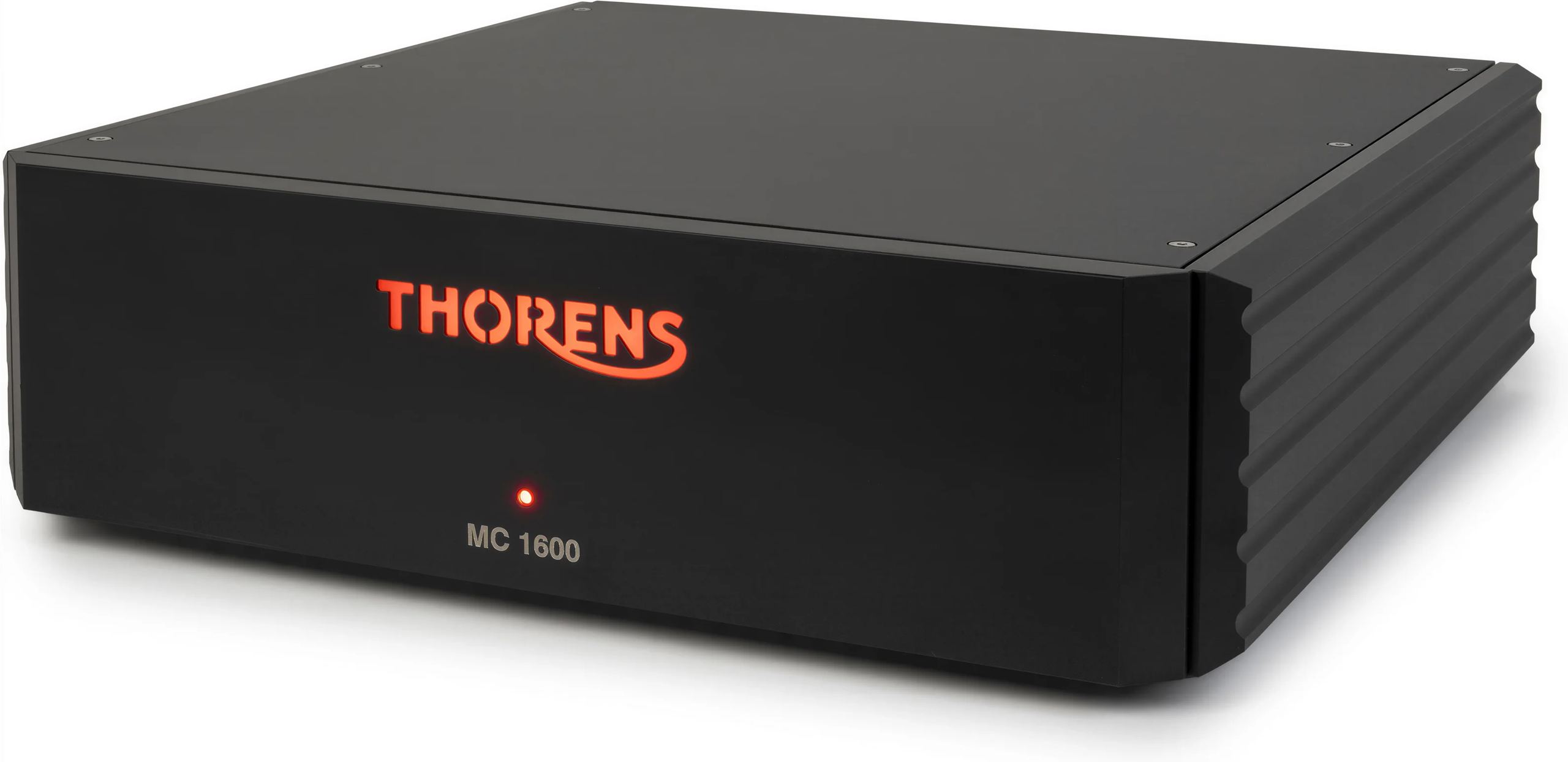
The MC 1600 is a phono preamplifier developed by Thorens. Fully balanced, it supports moving magnet (MM) and moving coil (MC) cartridges. Handmade in Germany, it offers more than 60 impedance adjustment steps for MC cartridges, allowing the preamplifier to be matched to different phono cartridge models.
Fully balanced design from end to end
The MC 1600 stands out for its completely balanced architecture, ensuring optimal audio signal processing. This technical approach is not just a simple connectivity option, but a design philosophy that runs through the entire circuit. The signal path remains balanced from the inputs to the outputs, eliminating multiple conversions that could degrade the purity of the musical message.
This approach ensures an extremely low noise floor and outstanding channel separation, both crucial for phono signals whose amplitude is particularly low. The voltages delivered by a phono cartridge are only a few millivolts for MM models and sometimes fall below half a millivolt for certain MC cartridges. At these levels, the slightest interference or the tiniest electromagnetic coupling can contaminate the signal. The balanced configuration naturally rejects these disturbances by exploiting the common-mode principle: any noise picked up identically on the two conductors of a balanced connection is cancelled out during differential signal processing.
The low-resonance chassis also contributes to this pursuit of purity. The massive black metal structure absorbs mechanical vibrations that could couple into the electronic circuit. Each component has been selected for its intrinsic qualities, in an artisanal approach that prioritizes the coherence of the whole rather than the accumulation of individual specifications.
Settings with watchmaker-like precision
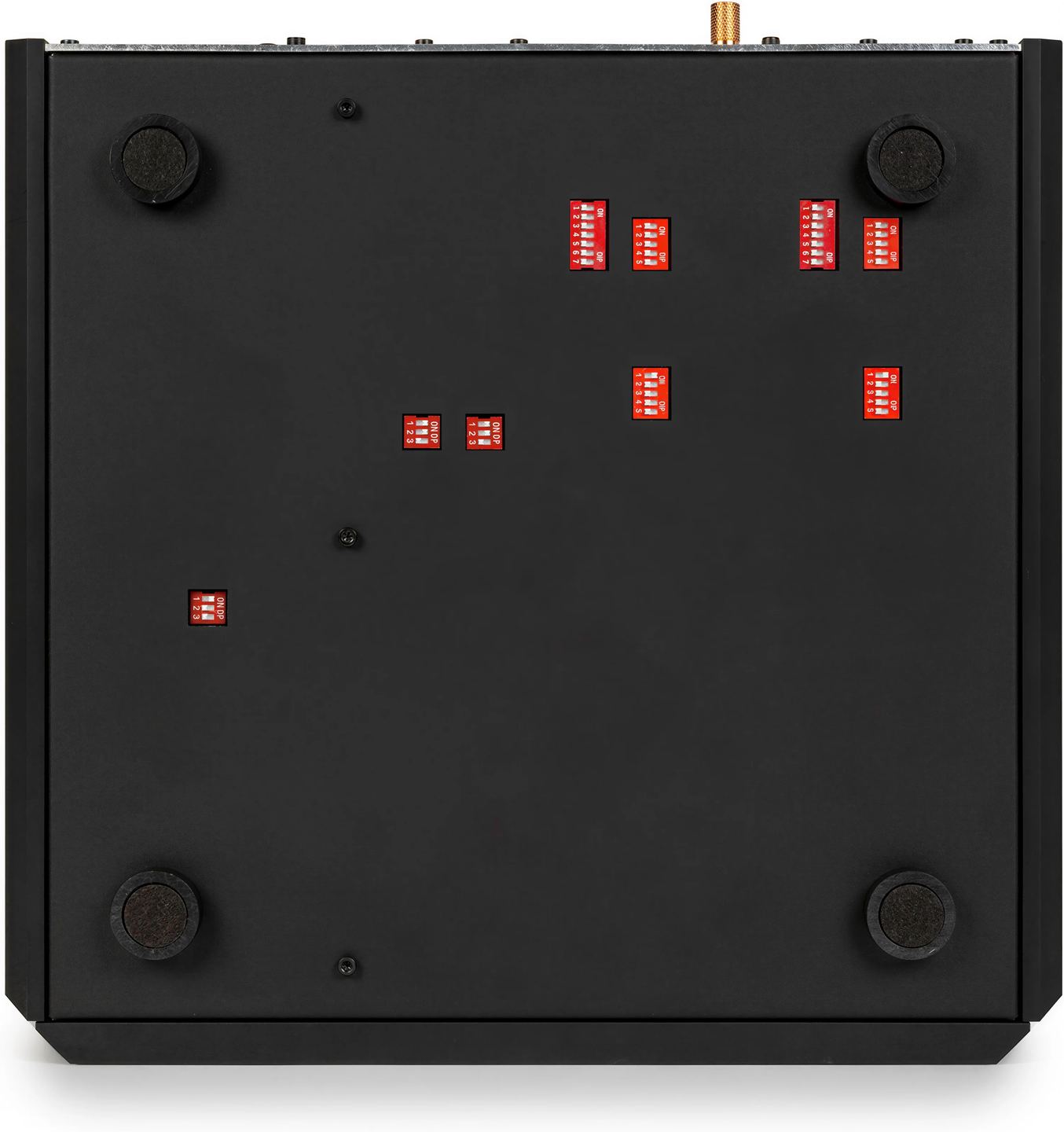
The adaptability of the MC 1600 is one of its major assets. For MC cartridges, the input impedance is adjustable between 20 and 1280 ohms across more than 60 distinct steps. This granularity makes it possible to adapt the preamplifier to the electrical characteristics of any MC cartridge, whether of recent design or a vintage model with particular specifications. For MM cartridges, the input impedance is fixed at the standard value of 47 kΩ.
Gain is adjustable in nine steps of around 4 dB each, covering a range from +34 dB to +66 dB. This flexibility allows the use of cartridges with very different output voltages, from generous MM types to very low-output MC designs. The input capacitance, adjustable from 50 to 600 pF in 50 pF steps, fine-tunes the match to the inductive characteristics of MM cartridges, influencing the high-frequency response.
The RIAA equalization curve, the international standard that defines how vinyl records are cut and played back, is implemented with active precision. The term “active” means that equalization is carried out by dynamic electronic circuits rather than by simple passive networks of resistors and capacitors. This approach offers finer control of the turnover points at 50, 500 and 2120 Hz while maintaining remarkably stable frequency response: 10 Hz to 20 kHz with a tolerance of only ±0.1 dB.
Connectivity and system integration
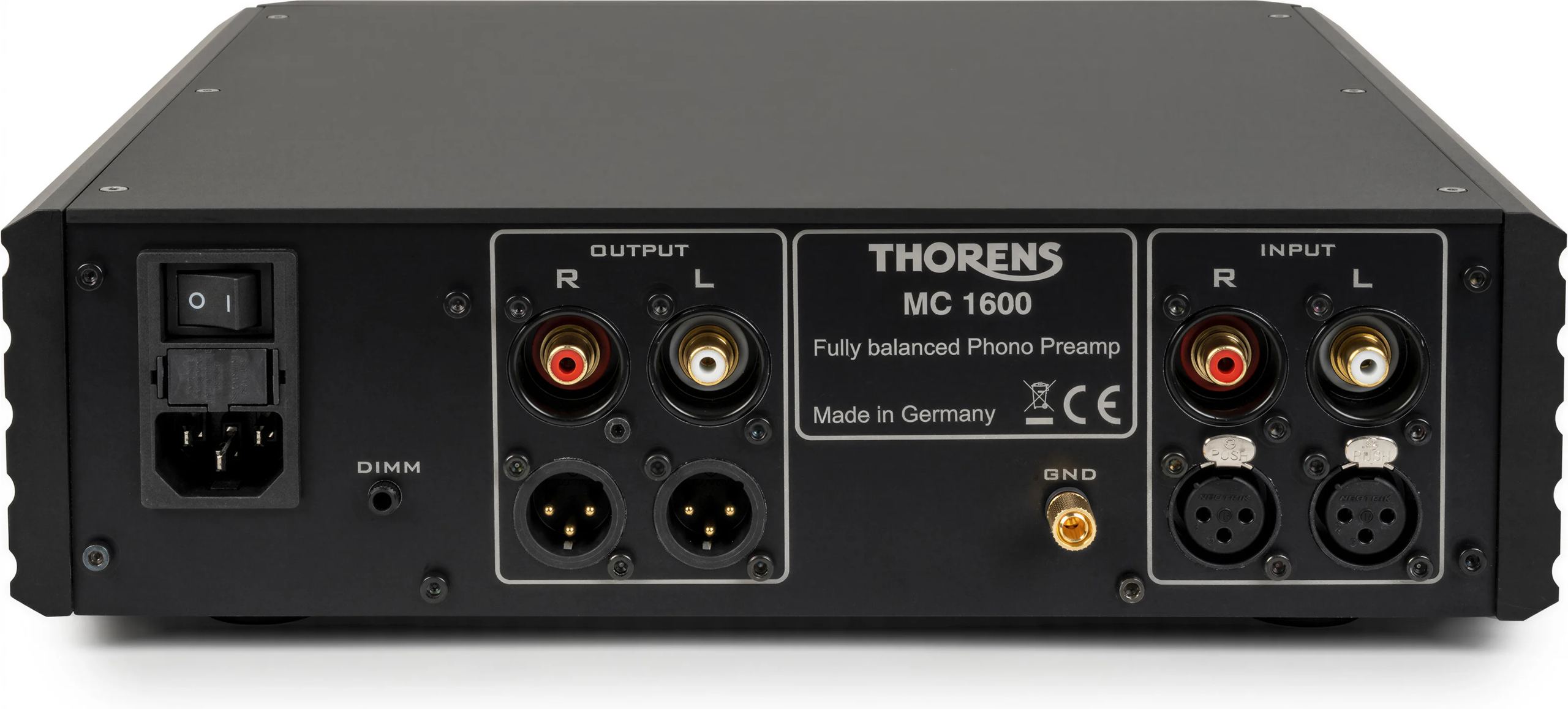
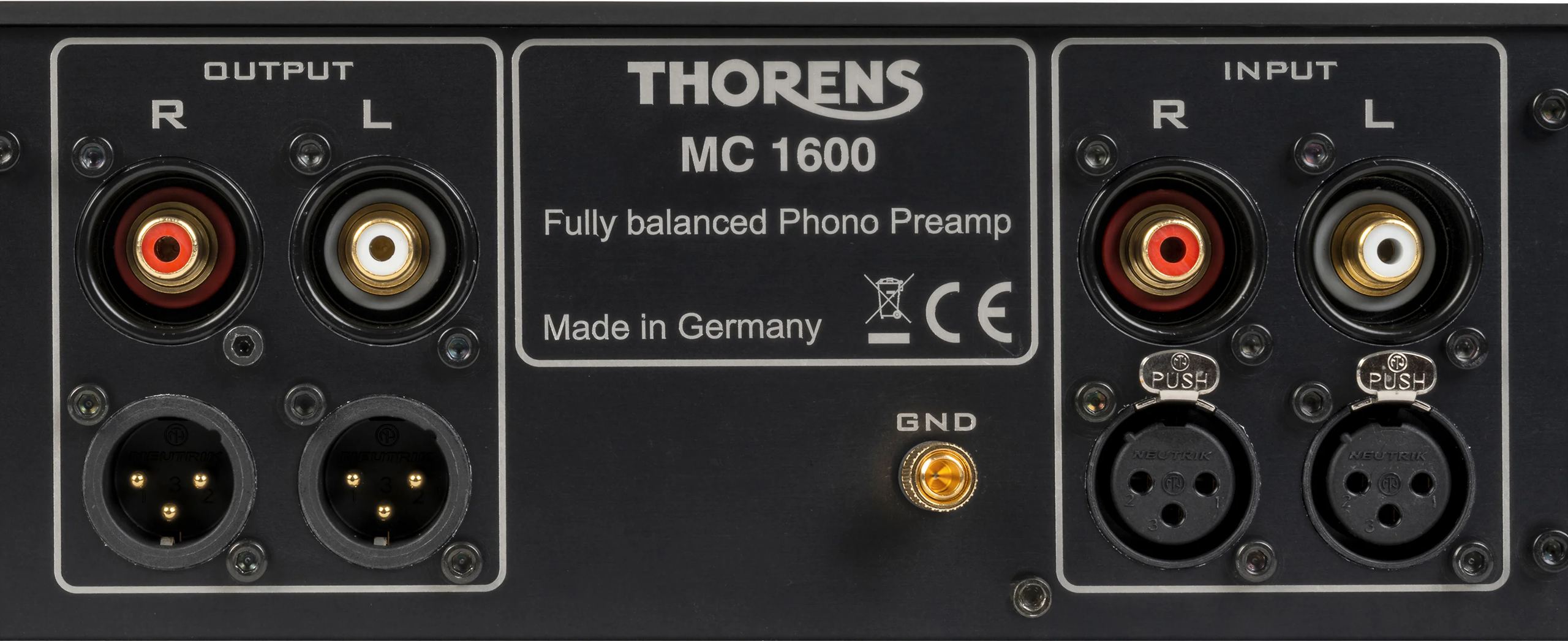
True to its philosophy of versatility, the Thorens MC 1600 offers comprehensive connectivity with balanced (XLR) and unbalanced (RCA) inputs and outputs. This duality allows integration into any system, from a fully balanced high-end setup to a more conventional installation using RCA connections.
The outputs can deliver up to 10 Vrms with a current of 100 mA, ensuring ample headroom to drive cables and subsequent stages without dynamic compression. The output impedance, set at 50 Ω on RCA and 110 Ω on XLR, ensures optimal matching with the vast majority of preamplifiers and integrated amplifiers on the market.
While the MC 1600 can of course be paired with any quality turntable, it forms a particularly harmonious combination with high-end Thorens turntables such as the TD 1600. This synergy is evident both technically, with XLR outputs that can be used directly, and aesthetically, as the design lines naturally complement each other. The Thorens TAS 1600 cartridge, a Japanese-made MC cartridge with an output voltage of 0.4 mV at 5.5 cm/s and an internal resistance of 12 ohms, fully benefits from the MC 1600’s matching capabilities.
The built-in power supply simplifies installation by avoiding bulky external power blocks. This approach also eliminates the risk of poor connections or unsuitable cables that could introduce noise. The internal design of this power supply has been given particular attention to minimize leakage into the sensitive audio circuits.
Technical specifications
Compatibility and settings
- Compatibility: MM / MC cartridges (switchable)
- RIAA accuracy: active
- Gain: +34 dB to +66 dB, adjustable in nine steps of approximately 4 dB each
Input characteristics
- MM input impedance: 47 kΩ
- MC input impedance: 20 - 1280 Ω
- Adjustable in more than 60 steps
- Input capacitance: 50 to 600 pF
- Additional capacitance: 100 pF to 600 pF, adjustable in 50 pF steps
Output characteristics
- Maximum output voltage: 10 V rms
- Output current: 100 mA rms
- Output impedance: 50 Ω (RCA), 110 Ω (XLR)
Audio performance
- Total harmonic distortion: < 0.005%
- Frequency response (linear): 10 Hz - 20 kHz ± 0.1 dB
- Signal-to-noise ratio: 100 dBA to > 76 dBA
- Relative to an output voltage of 2 V, depending on gain
- Measured with a 100 Ω load
Connectivity
- Inputs: RCA, XLR
- Outputs: RCA, XLR
General information
- Power supply: integrated
- Finish: black, backlit Thorens logo (customizable in 3 colors)
- Dimensions (W × H × D): 300 × 200 × 301 mm
- Weight: 5 kg
Frequently asked questions
What is the difference between MM and MC cartridges, and why does the MC 1600 require so many settings for MC?
Moving magnet (MM) cartridges generate a relatively high signal (a few millivolts) thanks to a magnet fixed to the stylus assembly that moves within fixed coils. Moving coil (MC) cartridges reverse the principle: tiny coils move in a fixed magnetic field, producing a much weaker signal (often less than one millivolt). This design reduces moving mass for better groove tracking, but requires more amplification and precise impedance matching. The MC 1600 offers more than 60 impedance steps because every MC cartridge has a specific internal resistance (from a few ohms to several hundred), and the optimum load impedance depends directly on this value to achieve a linear frequency response.
What does a fully balanced configuration really bring compared to a classic unbalanced design?
A balanced connection carries the signal on two conductors in opposite phase, plus a ground. Any interference picked up identically on both conductors (mains hum, radio interference) is cancelled during differential processing. For very low-level phono signals, this immunity to noise becomes crucial. The MC 1600 goes beyond simple XLR inputs and outputs: the entire internal signal chain remains balanced, avoiding multiple balanced-to-unbalanced conversions that introduce noise and distortion. The result is a lower noise floor and better channel separation, revealing the most subtle details of recordings.
How do I correctly set the input impedance for my MC cartridge?
MC cartridge manufacturers generally specify a recommended load impedance. This value is typically between 10 and 100 times the internal resistance of the cartridge. Start by setting the MC 1600 to the recommended value. If no specific value is given, begin with a load of around 100 Ω for cartridges with very low internal resistance (less than 10 Ω), or around 470 Ω for cartridges with higher internal resistance. Then fine-tune by ear: too low an impedance can darken the sound and compress dynamics, while too high an impedance may emphasize the treble and introduce some harshness. The optimum value provides a natural tonal balance with coherent extension across all frequencies.
Why does the RIAA curve require active rather than passive equalization?
The RIAA equalization curve defines three turnover points at precise frequencies (around 50 Hz, 500 Hz and 2120 Hz). Passive equalization, using only resistors and capacitors, is subject to component tolerances and interactions with the surrounding circuit impedances. Active equalization uses electronic circuits (operational amplifiers, controlled feedback) to impose an exact response, independent of variations in the passive components within their tolerance range. This approach guarantees superior accuracy, particularly at low frequencies where deviations translate into audible tonal imbalances. The MC 1600 maintains a response of ±0.1 dB between 10 Hz and 20 kHz, a tolerance difficult to achieve with purely passive equalization.
Is the MC 1600 suitable for turntables from brands other than Thorens?
Absolutely. The MC 1600 works with any turntable equipped with an MM or MC cartridge, regardless of brand. The RCA inputs accept standard unbalanced signals, while the XLR inputs allow you to take advantage of balanced outputs on turntables that provide them. Universal compatibility is ensured by the extensive impedance, capacitance, and gain settings. However, pairing it with Thorens TD 1600 or TD 1601 turntables offers particular aesthetic and technical coherence: harmonized design, full use of the XLR outputs on these turntables, and specific optimization for the Thorens TAS 1600 cartridge when fitted.
What gain level should I select for my cartridge?
The optimal gain depends on your cartridge’s output voltage and your amplifier’s input sensitivity. MM cartridges typically delivering 3 to 5 mV need around 40 dB of gain. For these cartridges, start with the intermediate gain settings on the MC 1600. Medium-output MC cartridges (0.3 to 0.5 mV) generally require 55 to 60 dB of gain, while very low-output MC cartridges (less than 0.2 mV) may need the maximum gain of 66 dB. Excessive gain will overload the following stages and compress loud passages, while insufficient gain will result in too low an output level, forcing you to crank up the amplifier volume and emphasizing its background noise. The ideal setting gives a level comparable to your system’s other sources (CD player, streamer), so you can listen without constantly adjusting the volume when switching sources.
- Eco-contribution included in the sale price.
- Manufacturer reference: 9202-MC-1600
- GTIN / EAN: 4260623591293