

Bryston 7B³

Overview
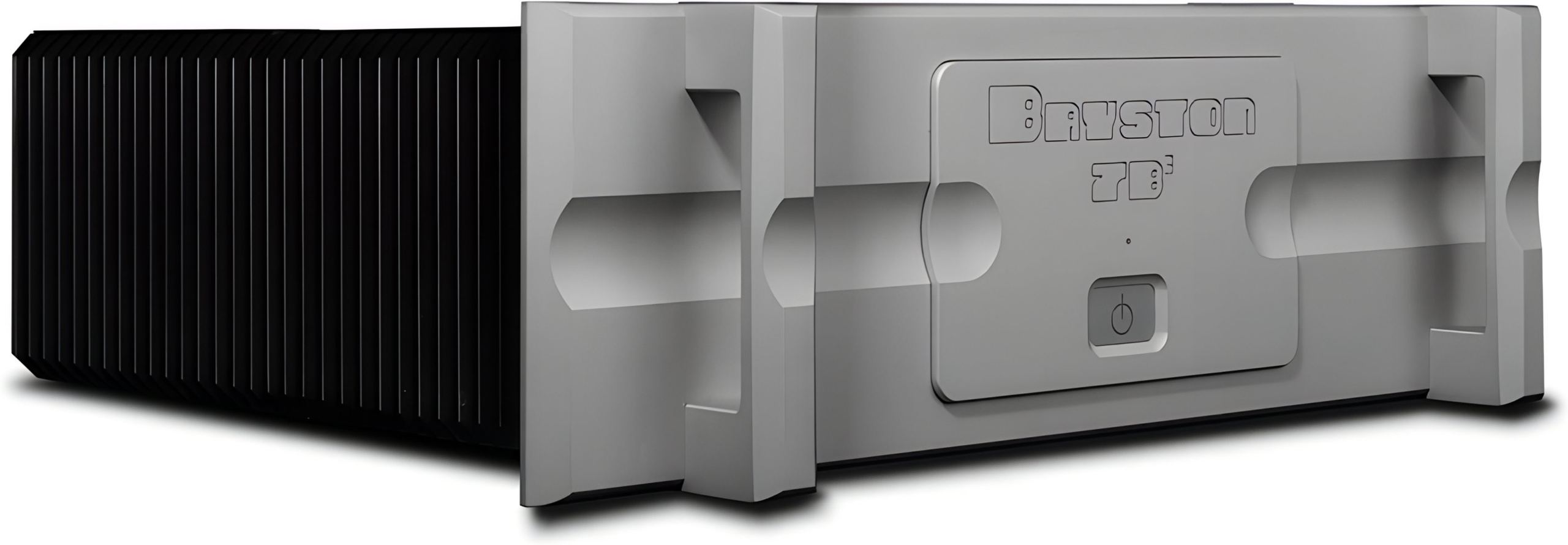
Two completely separate channels, two independent power supplies, zero compromise on loudspeaker control: this is the philosophy that has driven Bryston’s Cubed series since its introduction in 2016. The 7B3 embodies this approach in its most accomplished form, with a specially wound toroidal transformer that provides a generous power reserve of 600 watts into 8 ohms. Each unit leaves the factory in Peterborough, Ontario, after 100 hours of burn-in and individual quality control documented by a measurement certificate.
A redesigned input stage with the Salomie circuit
The main technical evolution of the Cubed series lies in its patented input circuit, the result of a collaboration between the engineering team led by Christopher Russell and Dr. Ioan Alexandru Salomie. This architecture uses twelve active components arranged in a novel configuration that provides the first 6 dB of gain while matching the input impedance to virtually any preamplifier.
The result is measurable: distortion at the input stage drops below 0.0001%, i.e. less than one-thousandth of a percent. This linearity leads to effective rejection of electromagnetic and radio-frequency interference, a valuable advantage in environments where digital equipment and wireless networks coexist.
Quad-Complementary topology and optimized class AB
The output stage uses the Quad-Complementary topology developed by Bryston for the SST² generation. This circuit improves linearity by eliminating the harsh harmonics often associated with solid-state amplifiers. The distribution of residual harmonics is similar to that of a class A amplifier, but with total distortion (THD+N) below 0.005% across the entire audible spectrum at full power.
Class AB operation keeps temperatures moderate thanks to the passive heatsinks integrated into the chassis. The absence of a fan guarantees complete silence, an important criterion for nearfield listening where monoblocks naturally find their place.
Power supply and current capability
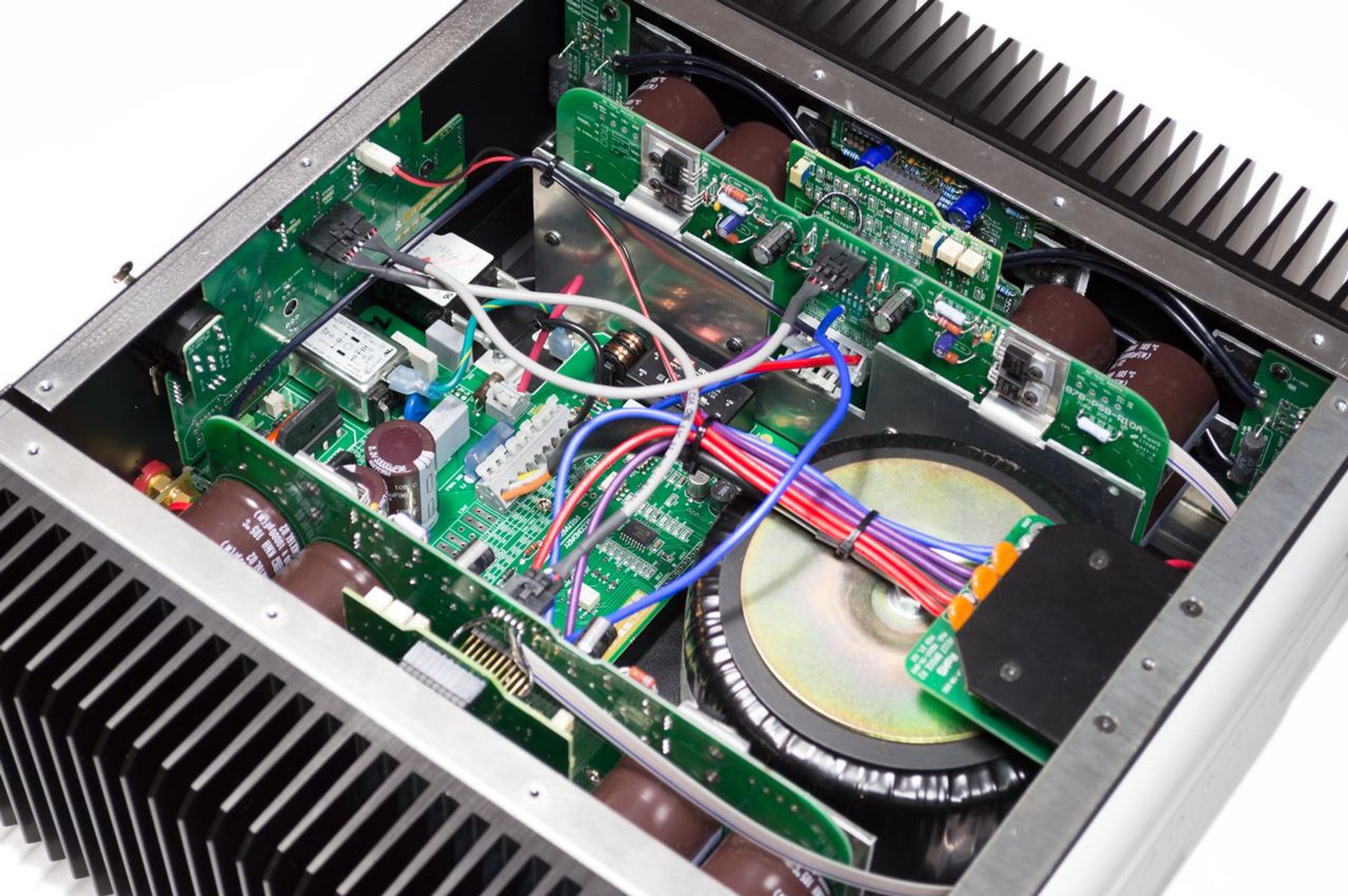
The 7B3 differs from the stereo 4B3 through its power supply dedicated to a single channel. Its toroidal transformer, wound to specifications unique to this model, delivers higher efficiency that allows for larger instantaneous current draws. Power climbs to 900 watts into 4 ohms, a ratio that attests to its ability to maintain voltage under complex loads.
This energy reserve proves useful with speakers that have varying impedance or low sensitivity, and also for reproducing the dynamic peaks of orchestral or percussive recordings without audible compression. The signal-to-noise ratio reaches -117 dB on the unbalanced input and -119 dB on the balanced input—figures that place the noise floor well below the threshold of audibility in most setups.
Integration and implementation
The rear panel includes a switchable XLR input and RCA input, as well as a two-position gain setting (23 dB or 29 dB). The higher sensitivity of the 29 dB mode suits sources with modest output levels or passive preamplifiers, while the 23 dB setting is better matched to home theater processors whose outputs often reach 2 volts or more.
A 12-volt DC trigger allows automatic power-on from a preamplifier or home automation system. The microprocessor-controlled SoftStart circuit staggers current inrush at power-up to prevent nuisance tripping of circuit breakers, even when several monoblocks share the same electrical circuit. In standby, power consumption drops below 500 milliwatts.
Construction and finishes
The machined and anodized aluminum chassis provides both electromagnetic shielding and heat dissipation. The output binding posts accept banana plugs, spades, and bare wire; their upward orientation makes it easier to connect cables from the sides. The 24 kg weight reflects the generous power supply and the overall mechanical solidity.
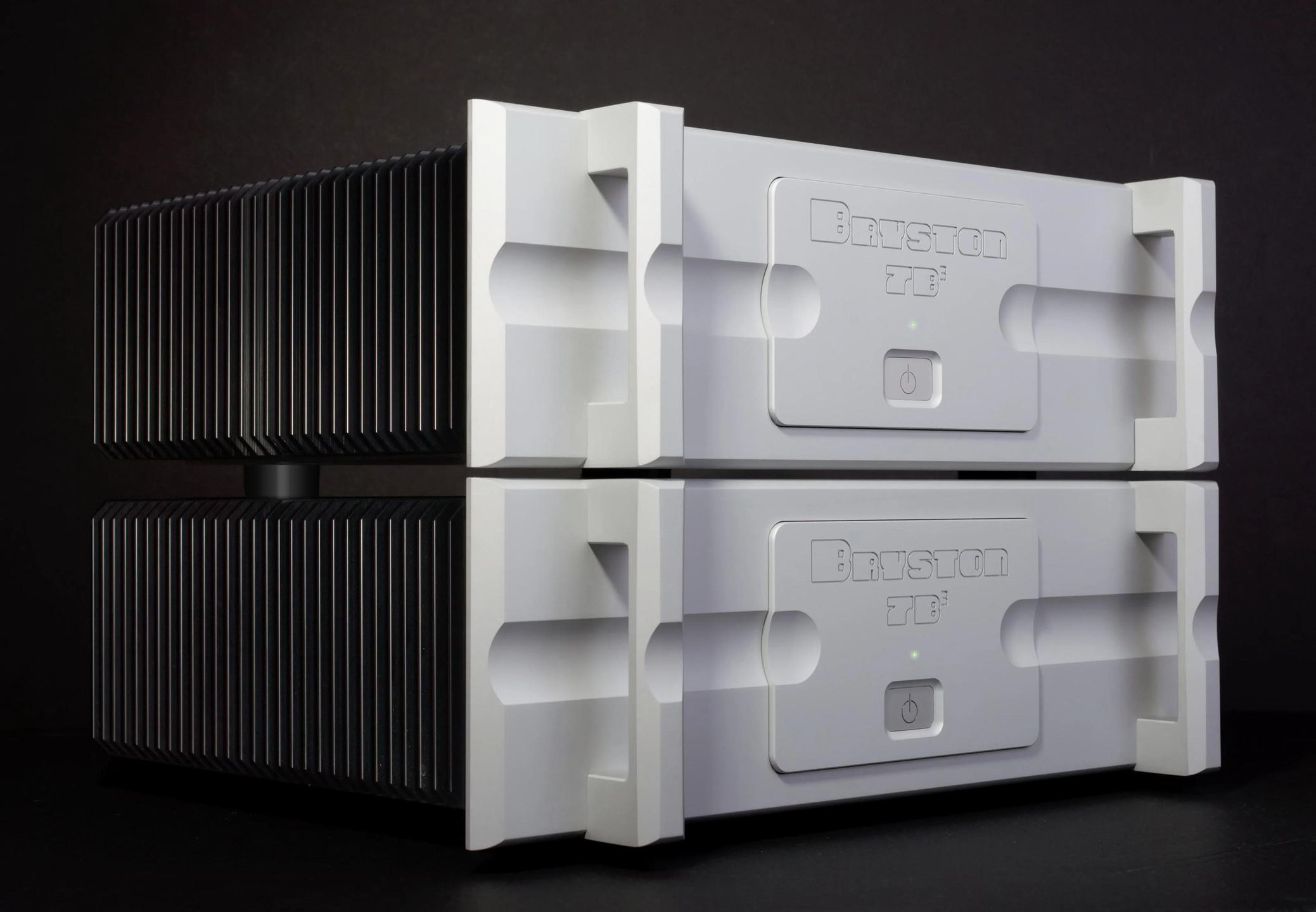
Two front panel widths are available: 17 inches for discreet installations, or 19 inches with integrated front handles for easier handling, though not intended for rack mounting. Silver and black finishes cover the most common aesthetic preferences.
Warranty and long-term support
Bryston offers a twenty-year parts and labor warranty on its analog amplifiers, transferable in the event of resale. This coverage reflects a design philosophy focused on durability and reparability: accessible discrete circuits, documented components, and after-sales service provided directly by the manufacturer in Canada. The measurement certificate supplied with each unit makes it possible to check any potential performance drift later on.
Documentation
Technical specifications
Power and performance
- Output power
- 600 W into 8 Ω
- 900 W into 4 Ω
- Switchable gain selection: 23 dB, 29 dB
Audio characteristics
- Frequency response: below 1 Hz – 100 kHz (–3 dB)
- Total harmonic distortion + noise: less than 0.005% (20 Hz – 20 kHz at 600 W into 8 Ω)
- Signal-to-noise ratio
- RCA input: –117 dB
- XLR input: –119 dB
Connectivity and inputs
- Input impedance
- Unbalanced: 7.5 kΩ
- Balanced: 5 kΩ per phase
Design and construction
- Machined and anodized aluminum chassis
- Natural convection cooling (silent operation)
- Patented Salomie circuit for absolute control and detailed sound
Features
- Extremely low standby consumption: less than 500 mW
- SoftStart progressive startup prevents circuit breaker tripping
- DC trigger for automated power on / off
- Legendary 20-year Bryston warranty
Dimensions and weight
- Dimensions (W x H x D)
- 43.2 cm version: 43.2 x 14.7 x 39.4 cm
- 48.3 cm version: 48.3 x 14.7 x 45.2 cm (with front handles)
- Weight: 24 kg
Available options
- Front panel width: 43.2 cm, 48.3 cm (not rack-mountable, 48.3 cm version with front handles)
Frequently Asked Questions
Does the 7B3 work with any preamplifier?
The input impedance of 5 kΩ per leg in balanced mode and 7.5 kΩ in unbalanced mode accommodates virtually all preamplifiers on the market, including passive models. The gain selector simplifies level matching according to the source.
What’s the difference compared with the 14B3?
The 14B3 incorporates two circuits identical to the 7B3 in a single chassis. It offers the same power per channel with the advantage of a shared power supply and a smaller footprint, but is significantly heavier (around 35 kg). Two separate 7B3 units allow each block to be placed close to its corresponding speaker, thereby shortening speaker cables.
Is additional burn-in required after purchase?
Bryston performs 100 hours of burn-in at the factory before shipping. A few dozen additional hours of use may slightly refine the sound, but the unit delivers its rated performance right out of the box.
Can the XLR and RCA inputs be used simultaneously?
No. A switch on the rear selects one input or the other. This design avoids ground issues and preserves signal integrity.
Is the 7B3 suitable for electrostatic or planar speakers?
Its current capability and stability with reactive loads make the 7B3 compatible with electrostatic panels and ribbon transducers, whose impedance varies significantly with frequency. The extended frequency response from below 1 Hz to 100 kHz also meets the requirements of these technologies.
Can I start with just one 7B3?
A single monoblock can power a subwoofer or serve as a center-channel amplifier in a multichannel system. For stereo, however, two units are required. Adding a second unit later poses no compatibility issues.
Does the DC trigger work with systems from other brands?
Yes, provided the source delivers a DC voltage between 3 and 30 volts. Most preamplifiers and processors equipped with a trigger output comply with this standard.
- Eco-contribution included in the sale price.




