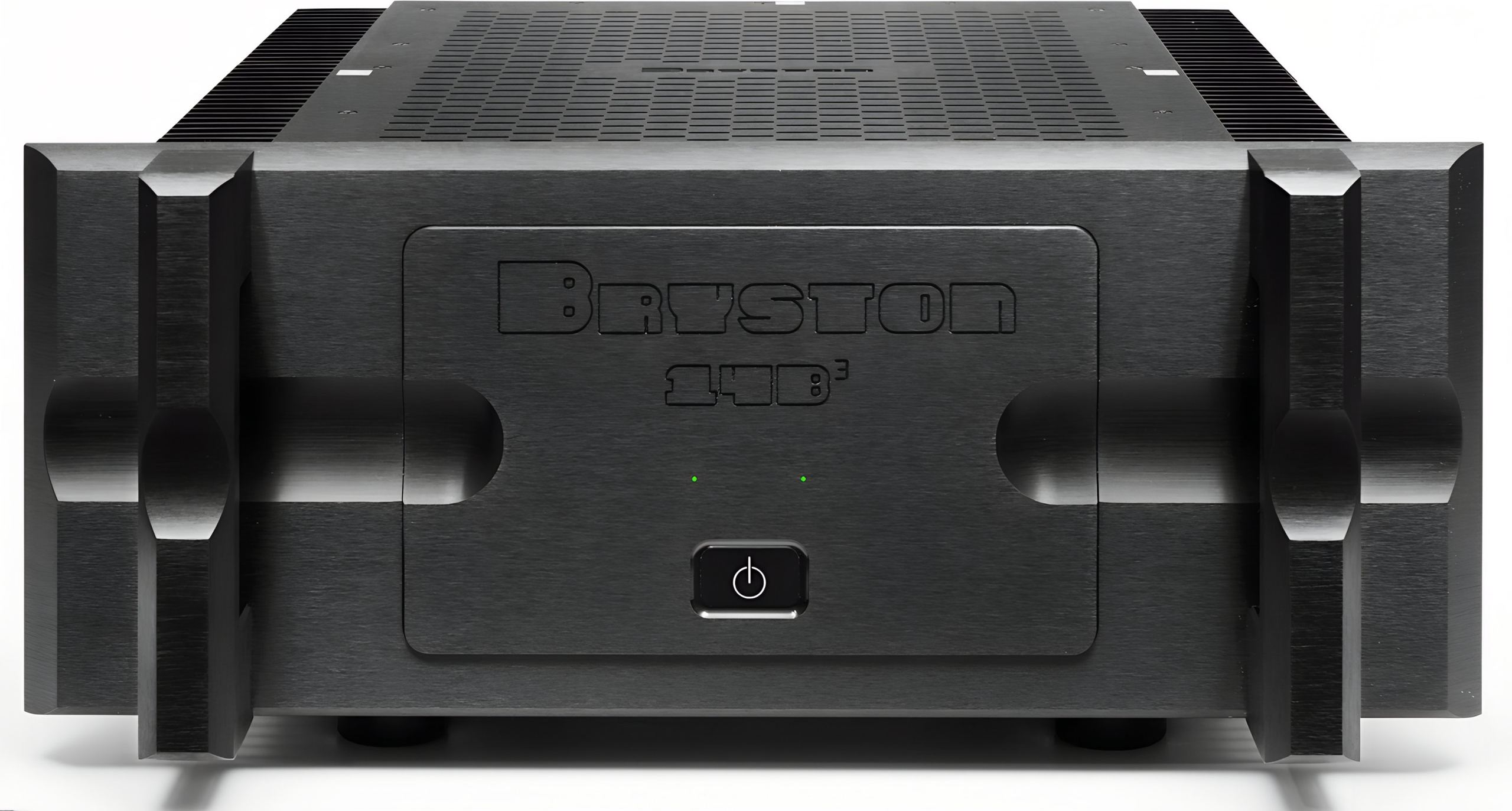
Bryston 14B³
Awards

Diapason d'Or
The number 1 in classical music and hi-fi. It is a benchmark in the field of classical music and hi-fi, as well as the distinction it awards to the best devices each year
Overview
Direct heir to the SST² series, this amplifier from the Cubed range incorporates the patented Salomie circuit, the result of a collaboration between Bryston’s engineers and the late Dr. Ioan Alexandru Salomie. The outcome: an exceptionally low noise floor, distortion measured at less than one-thousandth of a percent right from the input stage, and the ability to drive the most demanding speakers without ever breaking a sweat.
Two monoblocks in a single chassis
The 14B3 is based on the architecture of the 7B3 monoblocks, assembled in a dual-mono configuration in the strictest sense of the term. Each channel has its own 850 VA toroidal transformer, its own bank of filtering capacitors (six elements of 15,000 µF), and its own regulation stages. The two sections of the amplifier share only the chassis and the main power switch. This complete separation eliminates any interaction between channels and guarantees a stable power supply, even during asymmetrical musical passages where one channel demands more current than the other.
The available power of 600 W into 8 Ω and 900 W into 4 Ω per channel places the 14B3 among the most powerful stereo amplifiers on the market. These figures are not mere momentary peaks: the unit maintains these levels continuously, with total harmonic distortion below 0.005% across the entire audible spectrum. The bandwidth extends from under 1 Hz up to 100 kHz (–3 dB), a range that comfortably exceeds the requirements of any high-resolution digital recording.
The Salomie circuit and Quad-Complementary topology
The input stage of the 14B3 is one of the major advances of the Cubed series compared to the SST² generation. The Salomie circuit uses twelve active components arranged in a novel architecture to provide the first gain stage (6 dB) while matching the input impedance to the preamplifier. Its measured distortion is below 0.001%, ten times less than conventional input circuits. This ultra-linear buffer also improves common-mode interference rejection as well as filtering of electromagnetic and radio-frequency disturbances.
The output stage uses Quad-Complementary topology, a design Bryston has been refining since the 1970s. This architecture employs fast bipolar transistors to eliminate a specific type of crossover distortion inherent to class AB amplifiers. The behavior of the output stage thus approaches that of a class A amplifier, renowned for its linearity around the zero-crossing point, while retaining the energy efficiency of a class AB design. Higher-order harmonics, often perceived as aggressive or metallic, are virtually eliminated.
Construction and passive cooling
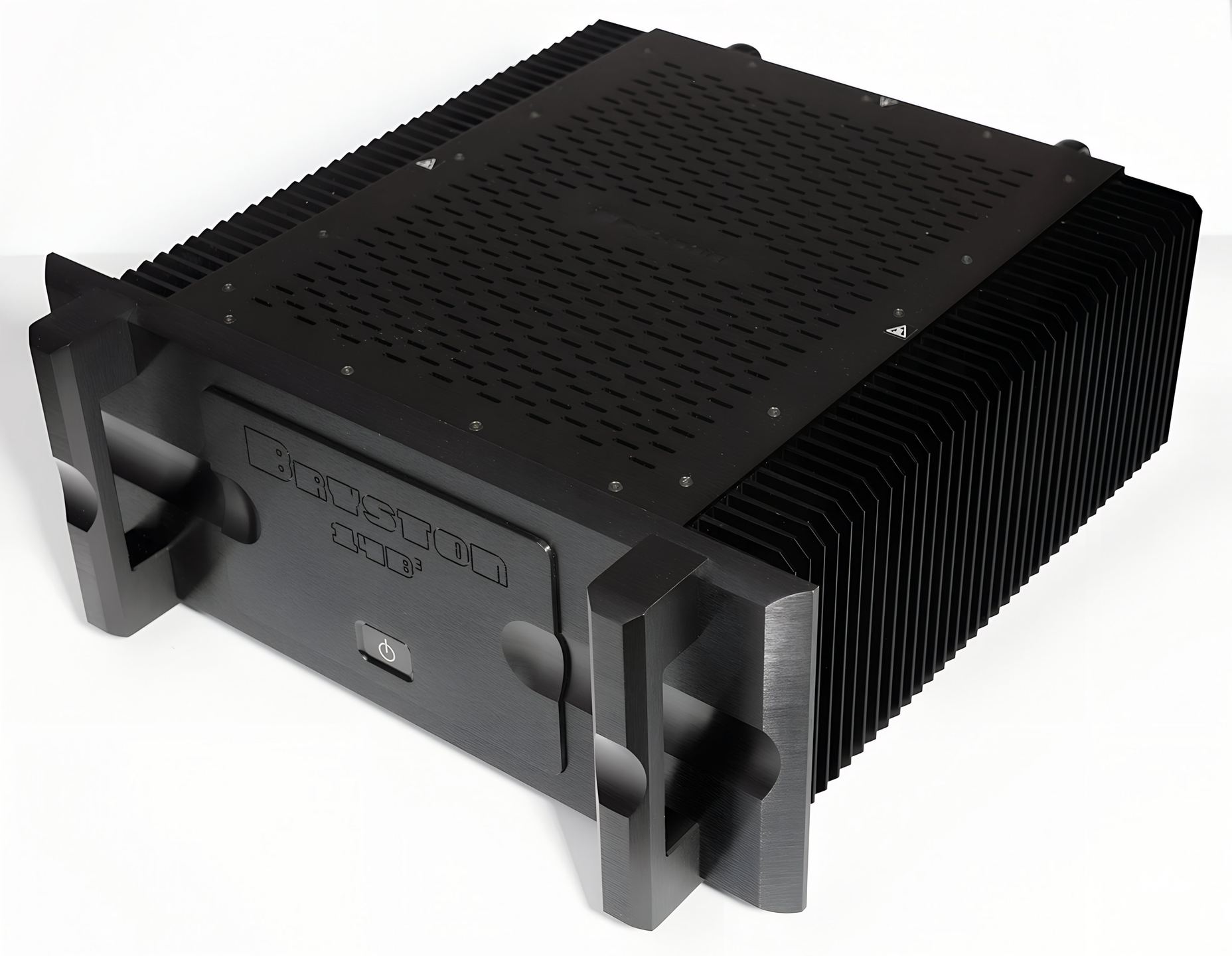
The 14B3 weighs 41 kg, a mass that reflects the generosity of its power supplies and the care taken with the chassis. The latter, fully machined from solid aluminum blocks and then anodized, provides both mechanical rigidity and thermal dissipation. The amplifier uses natural convection and has no fan. Even when driven hard, it remains quiet and only produces moderate heat, provided adequate ventilation is allowed around the unit.
The understated front panel, available in black or silver, comes in two widths: 17 inches for discreet home integration, or 19 inches with front handles for rack mounting. The PRO version adds individual gain trim pots for each channel (–14 dB to 0 dB) on the rear panel, a useful option in professional environments or for finely balancing speakers with different sensitivities.
Connectivity and system integration
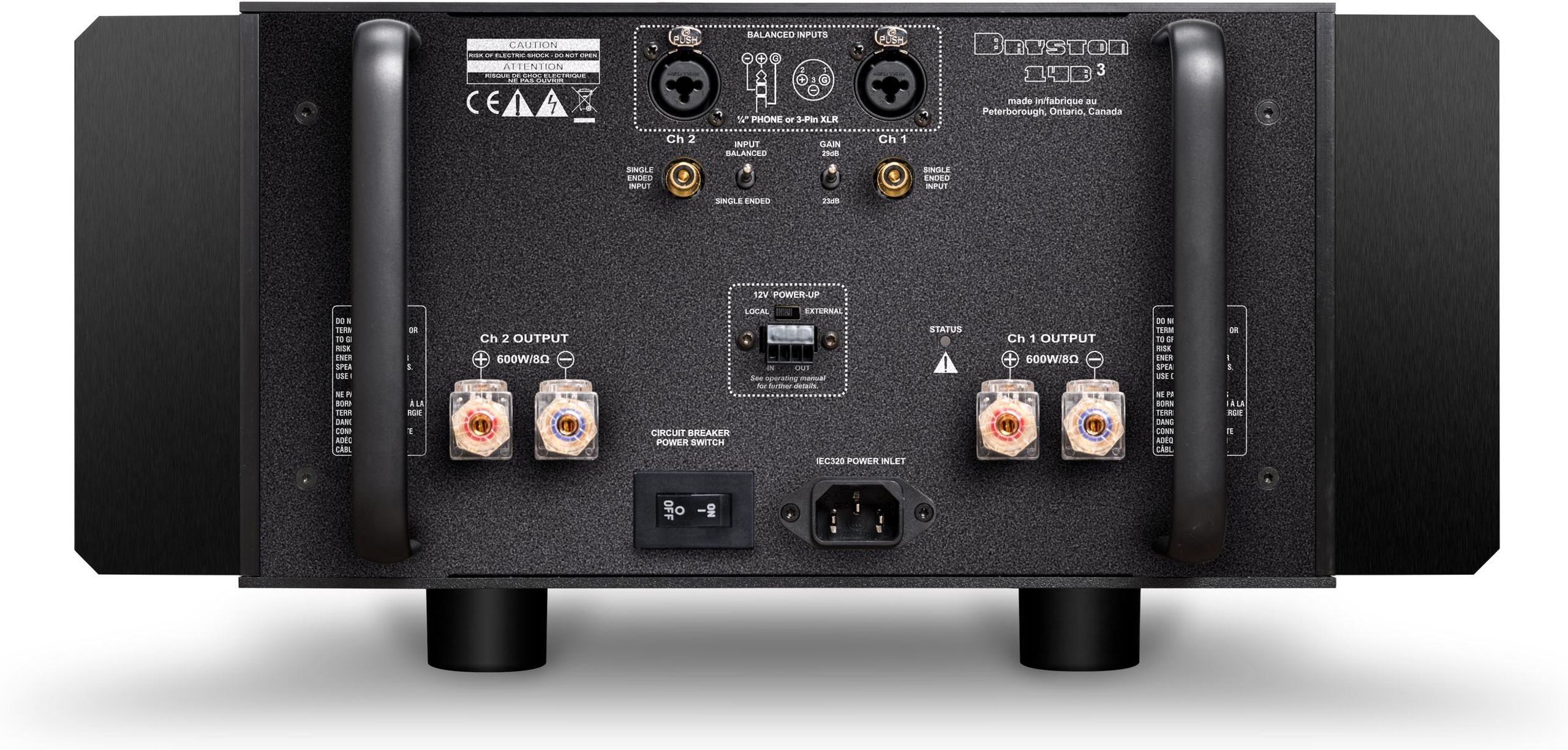
The rear panel offers balanced inputs on XLR connectors (standard pinout with pin 2 hot) and unbalanced inputs on RCA jacks. A selector switch allows you to switch between the two types of sources. The five-way binding posts accept banana plugs, spades, or bare wire.
A DC Trigger enables automatic power-up of the 14B3 by a compatible preamplifier or processor. The microprocessor-controlled SoftStart circuit staggers power-up to avoid sudden inrush currents that could trip a domestic electrical installation. In standby, power consumption drops below 500 mW.
The input gain, switchable between 23 dB and 29 dB via a rear-panel toggle, allows you to match the output level to the preamplifier in use. The 23 dB setting is generally suitable for home setups, while the higher gain may be required with low-output sources or to achieve maximum power in professional contexts.
Quality control and extended warranty
Every 14B3 leaves the Peterborough, Ontario factory with an individual measurement sheet. The unit is identified there by its serial number, and the results of its bench tests (distortion, noise, power) are recorded. This transparency reflects Bryston’s confidence in the consistency of its production.
Before shipping, each amplifier undergoes a one-hundred-hour burn-in at the factory, alternating thirty-minute cycles at full power and at idle. This procedure thermally stresses the components and helps detect any early failures.
The twenty-year warranty, transferable to a second owner, covers parts and labor. Bryston has been manufacturing its amplifiers in Canada since 1973, initially as a supplier of medical equipment, then in the audio field from the late 1970s onward. This industrial longevity underpins the credibility of such an extensive commitment.
Documentation
Technical specifications
Power and performance
- Output power per channel
- 600 W into 8 Ω
- 900 W into 4 Ω
- Frequency response: < 1 Hz – 100 kHz (–3 dB)
- Total harmonic distortion + noise: < 0.005% (20 Hz – 20 kHz at rated power, 8 Ω)
- Signal-to-noise ratio
- RCA input: –118 dB
- XLR input: –122 dB
- Switchable gain: 23 dB / 29 dB
Connectivity
- Balanced XLR and unbalanced RCA inputs
- Input impedance
- Unbalanced: 7500 Ω
- Balanced: 5000 Ω per phase
- DC Trigger
Architecture and design
- Two channels with completely independent power supplies
- Dedicated transformers per channel
- Patented Salomie circuit (Cubed series)
- 100% passive, fanless cooling
- Precision-machined, anodized aluminum chassis
- SoftStart progressive power-up
- Ultra-low standby power consumption: < 500 mW
Features
- Extreme power comparable to two monoblocks
- Total control of any type of loudspeaker, even high-sensitivity or complex loads
- Quiet, stable operation in all circumstances
Dimensions and weight
- Dimensions (W × H × D)
- 43.2 cm front panel: 43.2 cm × 20.6 cm × 42.7 cm
- 48.3 cm front panel: 48.3 cm × 20.6 cm × 46.7 cm (with front handles)
- Weight: 41 kg
Options and versions
- Silver or black front panel
- Front panel width 43.2 cm or 48.3 cm (non-rackmount version – 48.3 cm with front handles)
- PRO version
- 48.3 cm black rack front panel
- Rear gain adjustment potentiometers per channel (–14 dB to 0 dB)
Frequently asked questions
What is the difference between the 14B3 and a pair of 7B3 monoblocks?
Both configurations share the same electronics and offer identical power. However, the pair of 7B3s has slightly greater filtering capacity (doubled capacitors) and allows each amplifier to be placed close to its respective speaker to reduce signal cable length. The 14B3, on the other hand, simplifies installation and takes up less floor space.
Can the 14B3 operate in bridged (mono) mode?
No. Unlike the 3B3 and 4B3 models, which offer a bridged mode, the 14B3 is designed exclusively as a stereo amplifier with a dual-mono architecture. Each channel is optimized for independent operation and cannot be combined with the other.
What type of power cable should be used?
The 14B3 accepts a standard IEC power cable. The internal power supply is designed to filter out mains-borne disturbances, which reduces the influence of the power cable on performance. In most cases, a decent-quality cable with a cross-section suitable for the unit’s power rating (2.5 mm² minimum recommended) is sufficient.
Do the XLR and RCA inputs offer identical performance?
The balanced XLR input has a slightly better signal-to-noise ratio (–122 dB versus –118 dB for RCA) thanks to its common-mode interference rejection. In a noisy electrical environment or with long cable runs, the balanced connection provides a measurable advantage. In typical home conditions with short interconnects, the difference is often marginal.
Can the 14B3 be left powered on continuously?
Its low standby consumption (less than 500 mW) allows continuous operation without any significant impact on the electricity bill. The amplifier reaches its optimal thermal operating point after a few minutes, but the sonic differences between a cold start and a fully stabilized state remain subtle.
- Eco-contribution included in the sale price.