

Bryston BDA-3
Specifications and features


Overview
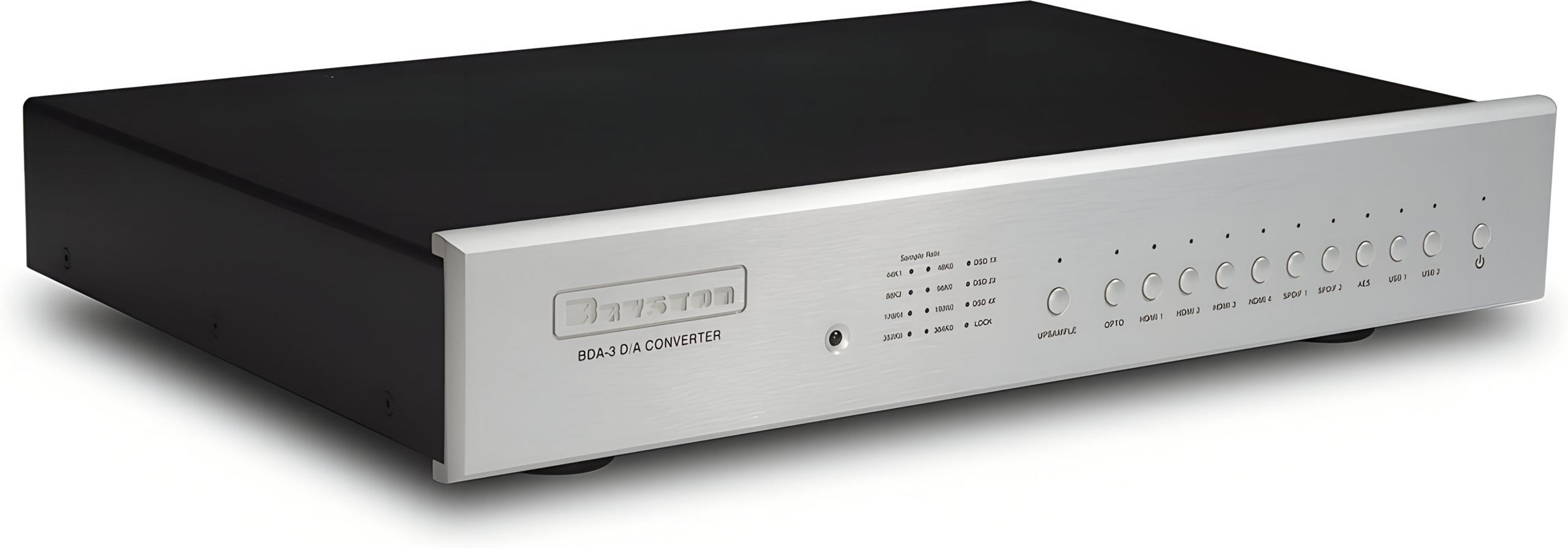
Third generation of the BDA series from the Canadian manufacturer, this converter carries forward the philosophy of uncompromising digital signal processing while vastly expanding the range of possibilities. The transition from the BDA-2 to the BDA-3 marks the arrival of DSD in the Bryston ecosystem, with extended compatibility to HDMI sources that notably opens the way to extracting native SACD streams from a universal player.
An architecture designed for transparency
The BDA-3 is based on two AKM AK4490EQ converter chips operating in a dual mono configuration: each channel has its own converter, which reduces crosstalk and improves the signal-to-noise ratio. Upstream, an Altera FPGA circuit receives the digital data and resynchronizes it to the high-precision internal clocks (22.579 MHz and 24.576 MHz) in order to minimize jitter. This re-clocking stage strips out the timing information embedded in the original stream and imposes a more stable time base.
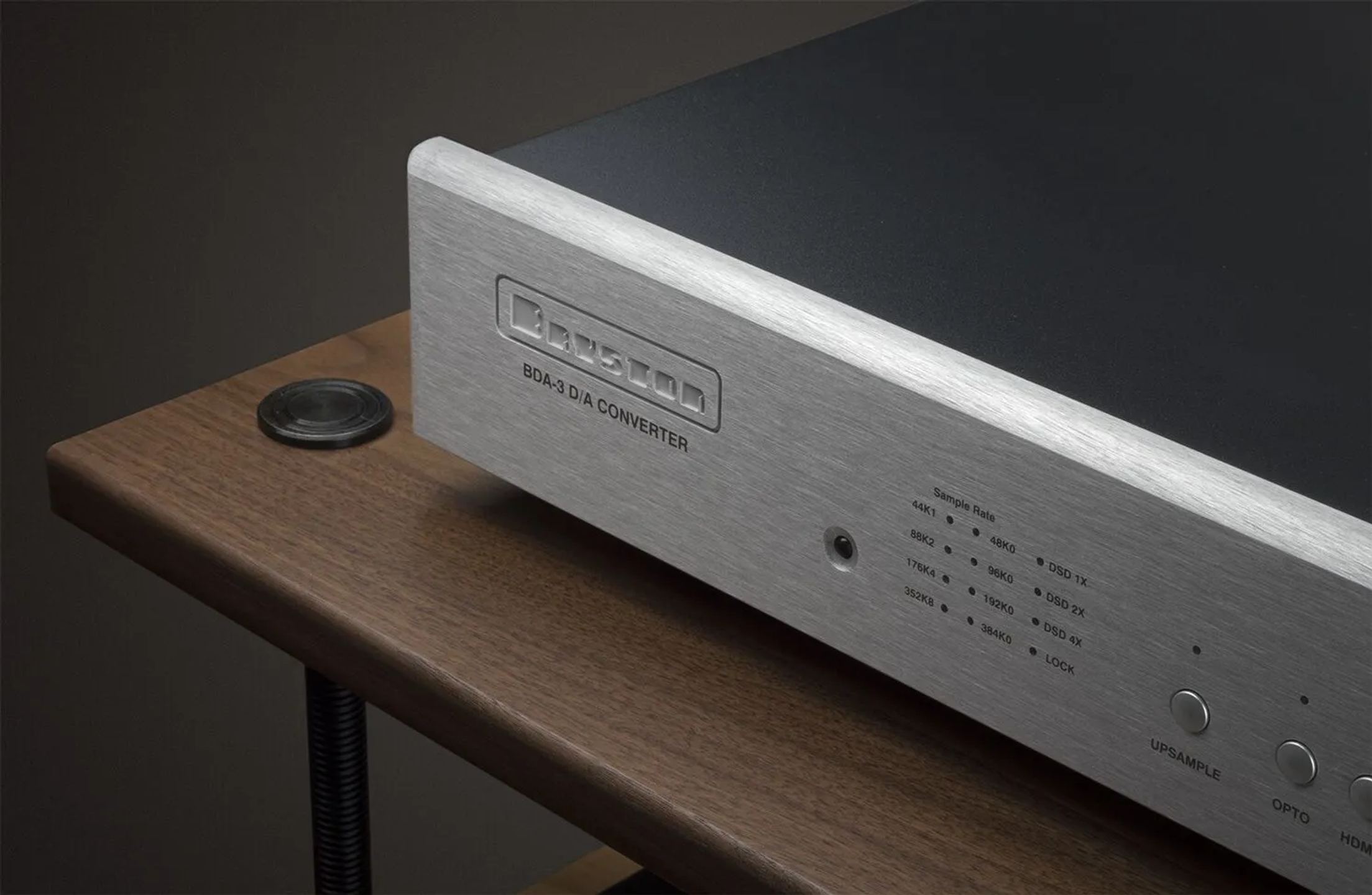
PCM and DSD are processed along separate paths up to the converter chips: there is no conversion from one format to the other, thereby preserving the integrity of the original signal. The only exception to this no-alteration rule is the oversampling function, which the user can activate on the S/PDIF and AES/EBU inputs, allowing 44.1 and 88.2 kHz streams to be upsampled to 176.4 kHz, and 48 and 96 kHz streams to 192 kHz.
The discrete-component Class A analog stage
It is on the analog side that Bryston showcases its electronics expertise. The output stage uses no integrated circuits: it relies exclusively on bipolar transistors, resistors, and capacitors assembled into discrete operational amplifiers. This design choice, more costly and complex to implement, allows every circuit parameter—bandwidth, linearity, output impedance—to be optimized without the constraints inherent to monolithic components.
Class A operation guarantees a constant bias on the output transistors, avoiding the switching artifacts that can occur when active elements move from a conducting to a non-conducting state. The balanced XLR outputs deliver 4 V while the RCA outputs provide 2 V, with a noise floor rated at -140 dB in balanced mode and -134 dB in unbalanced mode.
Ten inputs to unify all your digital sources
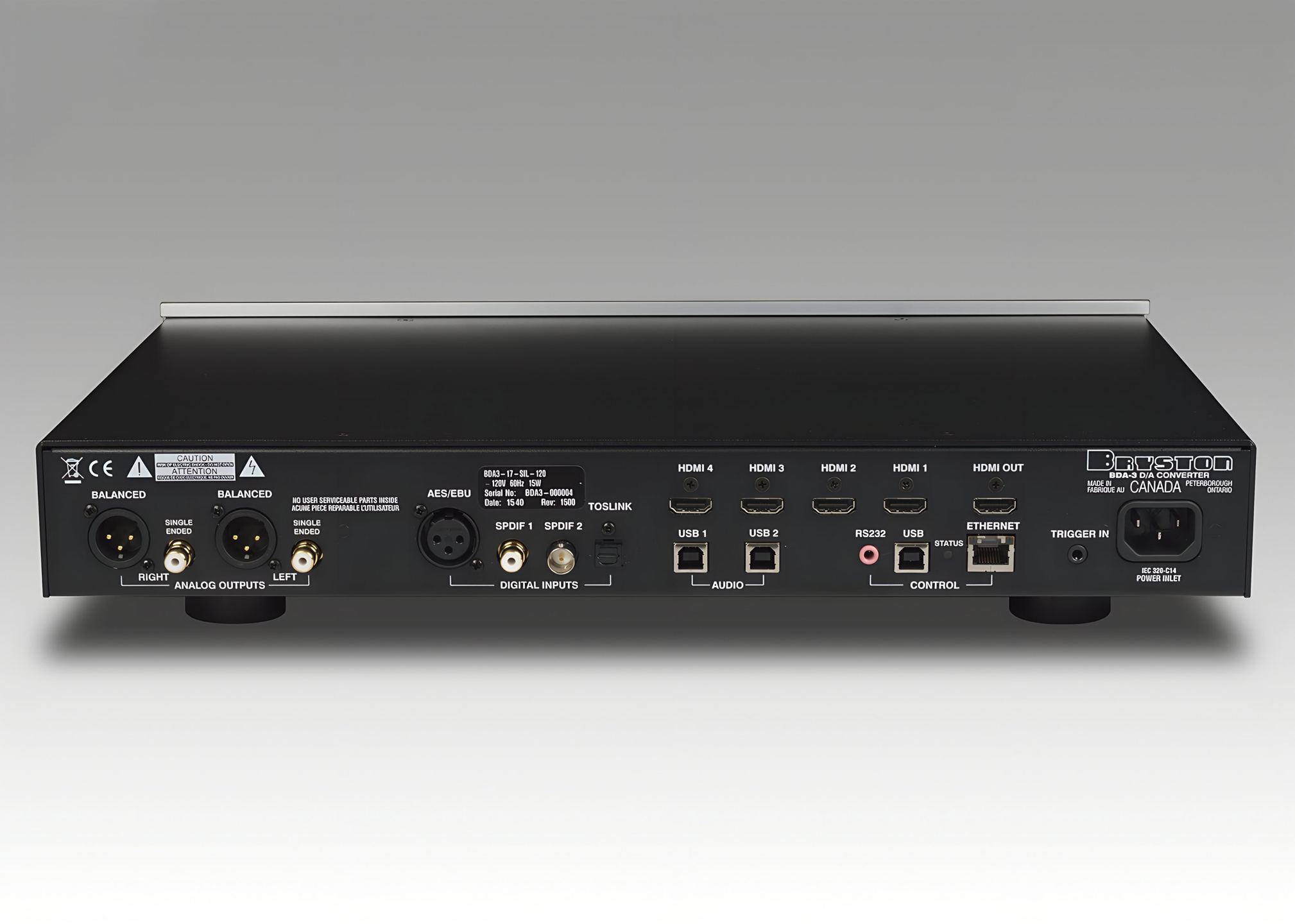
The wealth of connectivity sets the BDA-3 apart from many converters. The four HDMI inputs (one of them HDCP 2.2 compatible) allow you to connect Blu-ray players, game consoles, or video boxes, with 4K signal pass-through to the HDMI output for display on a TV or projector. These inputs are also how native DSD streams from an SACD player equipped with an HDMI output are carried—a fairly rare feature that extends the life of physical collections by offering superior conversion quality compared with entry-level players.
The two asynchronous USB ports (type B) accept the highest resolutions: PCM up to 384 kHz in 32 bits and DSD up to DSD256. Asynchronous mode means the BDA-3 itself controls the data flow from the computer, eliminating timing irregularities associated with conventional USB interfaces. An XMOS 8U6C5 controller manages this link. AES/EBU, coaxial S/PDIF (RCA and BNC), and Toslink optical inputs complete the picture to accommodate CD transports, streamers, or professional equipment. Each electrical input benefits from transformer-based galvanic isolation, preventing stray ground currents from contaminating the audio signal.
Separate power supply and robust construction
The separation of analog and digital power supplies is another pillar of the design. A toroidal transformer powers the entire unit, with high-current Texas Instruments LMZ12003 regulators and a bank of capacitors totaling several thousand microfarads. Each sensitive circuit has its own regulation, reducing interactions between stages.
The aluminum chassis with machined and anodized front panel is available in silver or black finish, and in two widths: 43.2 cm (standard format) or 48.3 cm. The modest weight of 4 kg makes it easy to integrate into a rack or on a dedicated shelf. Bryston digital products are covered by a five-year warranty.
Control and home automation integration
Beyond the infrared remote control, the BDA-3 integrates into centralized control systems via its RS-232 and Ethernet interfaces. A web page accessible from any browser mirrors the front panel display and allows you to select inputs, view the sampling rate, and update the firmware. Bryston’s BDP series network players automatically detect a BDA-3 connected to the same network and display a direct link to its control interface. A 12 V trigger allows synchronized power-on with an amplifier or automation system.
Supported formats and technical limits
PCM compatibility extends from 32 kHz to 384 kHz with resolutions up to 32 bits, while DSD covers DSD64, DSD128, and DSD256. The S/PDIF and AES/EBU inputs are limited to 192 kHz at 24 bits; the optical input is limited to 96 kHz. The HDMI inputs accept PCM up to 192 kHz and DSD64 from SACDs. The MQA format is not decoded: Tidal MQA files require prior decoding by third-party software (Roon, Audirvana) to benefit from the first unfold. The BDA-3 also does not handle Dolby Digital or DTS multichannel streams: it is a two-channel stereo converter.
Technical specifications
Connectivity
- 10 digital and analog inputs
- 4 HDMI inputs
- 2 USB inputs
- AES/EBU input
- S/PDIF RCA input
- S/PDIF BNC input
- Toslink input
Supported audio formats
- PCM support: up to 384 kHz / 32-bit
- DSD support: up to DSD-256 (x4)
- User-selectable upsampling for certain inputs
Audio performance
- Frequency response: 20 Hz – 20 kHz ± 0.1 dB
- THD+N (20 Hz – 20 kHz): < 0.002%
- Output voltage: XLR 4 V, RCA 2 V
- Noise level: RCA -134 dB, XLR -140 dB
Architecture and design
- Separate power supplies for analog and digital circuits
- Fully discrete Class A balanced analog outputs
- Aluminum chassis with machined and anodized front panel
Control and operation
- Full control via infrared, RS232, IP or 12 V trigger
General information
- Dimensions: 43.2 cm or 48.3 cm W x 8.6 cm H x 30.5 cm D
- Weight: 4 kg
- Front panel options: silver or black
- Available width: 43.2 cm or 48.3 cm (not rack-mountable)
Frequently Asked Questions
Can the BDA-3 play SACDs in native DSD?
Yes, provided you use an SACD or Blu-ray player with an HDMI output capable of transmitting the DSD stream (and not a PCM downmix). The BDA-3 was one of the first converters to offer this feature, enabling an affordable universal player to serve as a high-quality source for SACD discs.
What is the difference between the two USB inputs?
The two USB ports are technically identical: asynchronous, USB 2.0 Class Audio compatible, and able to handle the same PCM and DSD resolutions. Having two inputs simply allows you to connect two computers or USB sources without having to swap cables.
Is a driver required to use the USB input under Windows or macOS?
On macOS and Linux, the BDA-3 works natively without additional drivers. On Windows, installing the Bryston driver (downloadable from the manufacturer’s website) is necessary to access high resolutions and DSD playback.
Is oversampling recommended?
This function is a matter of personal preference. It can slightly smooth the presentation of some 44.1 kHz CD recordings, but other listeners prefer to keep the signal at its native sampling rate. Oversampling is not available on the USB and HDMI inputs.
Can the BDA-3 be used as a preamplifier?
No, the BDA-3 does not have volume control or variable outputs. It must be paired with a preamplifier or an integrated amplifier to adjust listening level.
Which HDMI cables should be used for audio transfer?
A standard good-quality HDMI cable is sufficient. High Speed or Premium High Speed certified cables are perfectly suitable. Cable length has no significant impact on audio transmission in typical home setups (under 5 meters).
Does video pass-through work when another input is selected?
Yes, the video signal from the last HDMI input used continues to be sent to the HDMI output even if you then select a non-HDMI input (USB, coaxial, etc.). This feature lets you keep the Blu-ray player’s picture on screen while listening to another audio source.
Does the BDA-3 support MQA?
No, the BDA-3 does not decode the MQA format. To listen to Tidal Masters in MQA, you can perform the first unfold via compatible software (Roon, Audirvana), with the BDA-3 then receiving a PCM stream at 88.2 or 96 kHz.
- Eco-contribution included in the sale price.




