

Tonewinner AD2 Pro +
This product is no longer available for sale!
Other stereo solid-state hi-fi integrated amplifiers


Specifications and features

Overview
Tonewinner, a Chinese manufacturer founded in 1992 by Li Zhi, has long worked behind the scenes as an OEM for well-known Western brands. The AD-2 Pro+ represents the culmination of twenty years of development around the AD-2 range, a model that has evolved over successive generations by integrating user feedback and technical advances in the field. This “+” version notably adds a USB-B input that was absent from previous iterations.
A power supply sized for difficult loads
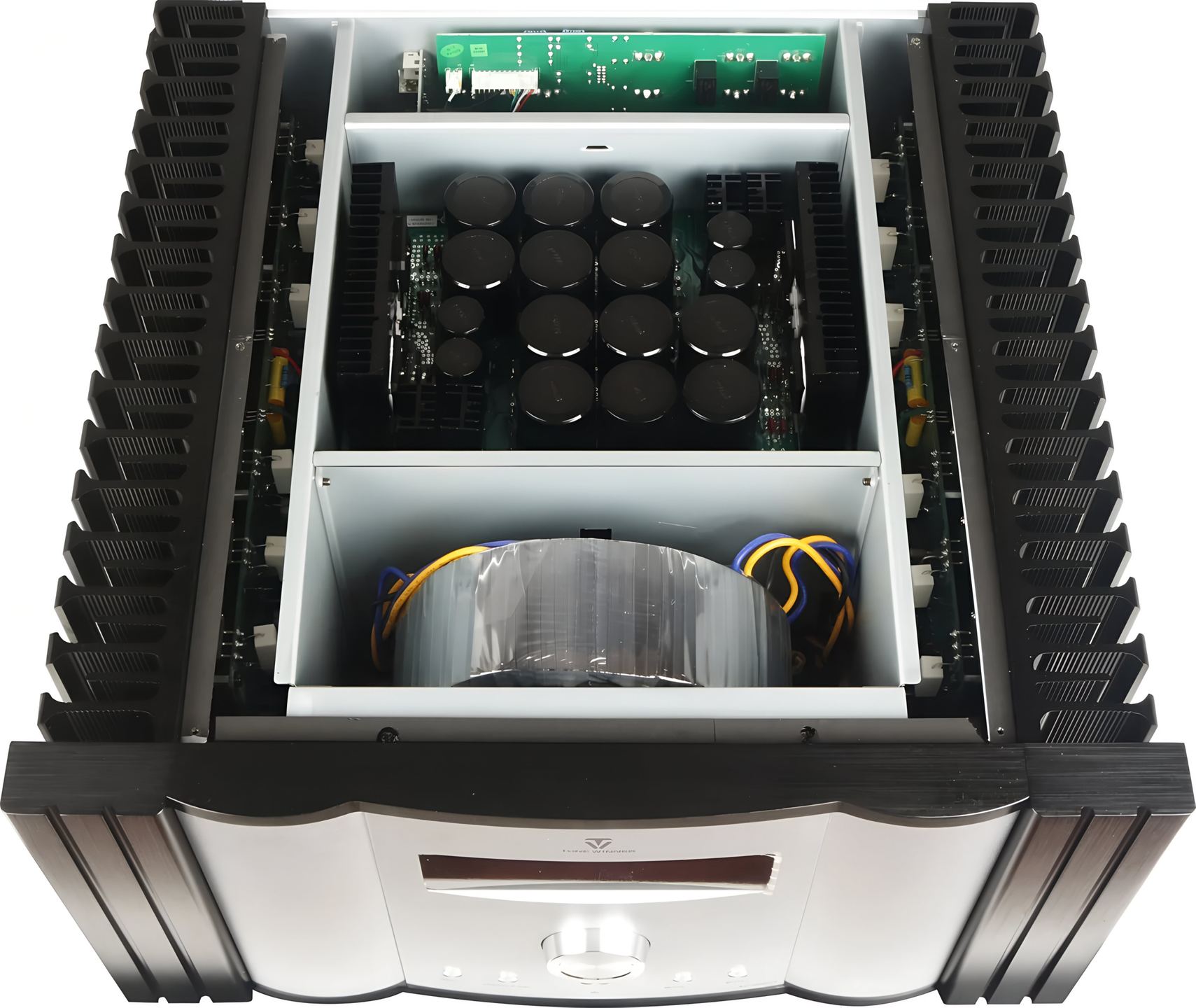
The heart of the device is built around an 860 W toroidal transformer, coupled with sixteen filter capacitors totaling 120,000 µF of capacity. This energy reserve allows the amplifier to maintain a stable voltage during brutal current demands, typical of fortissimo orchestral passages or percussive transients. The 24 Toshiba TTC5200/TTA1943 transistors, matched and mounted on two independent modules (one per channel), deliver 2 × 240 W RMS into 8 Ω.
Power consumption varies depending on the selected mode: between 260 and 320 W in pure Class A, and from 70 to 110 W in Class AB. The device heats up noticeably when operating in Class A or Auto mode, which is normal for this topology, but the aluminum side heatsinks efficiently dissipate heat so that the chassis never becomes scorching hot.
Three amplification modes to tailor the sound
The AD-2 Pro+ offers three operating modes, selectable from the remote control:
Class A keeps the transistors working permanently in their linear zone, with no switching. Efficiency is low (hence the high power consumption), but crossover distortion is non-existent. The midrange gains in presence and smoothness, with voices more forward in the soundstage.
Class AB switches between positive and negative transistors depending on the signal. Efficiency increases, heat output decreases, and the bass becomes tighter and more authoritative. This is the mode to favor for long listening sessions or in hot weather.
The Auto mode dynamically switches between the two according to output level, seeking a compromise between sound quality and power consumption.
An integrated DAC that’s more than just an add-on
The digital section features an ESS Sabre ES9038 chip, the same found in standalone converters. It supports PCM streams up to 32-bit / 768 kHz and DSD up to DSD512 via the USB-B input, managed by a CT7601PR controller. The optical (×2) and coaxial inputs round out the offering for traditional sources such as CD players or TV boxes.
This integration avoids having to add an external DAC and the cables that go with it, but nothing prevents you from using the analog RCA or XLR inputs if you already have a preferred converter.
Comprehensive connectivity and phono preamplification
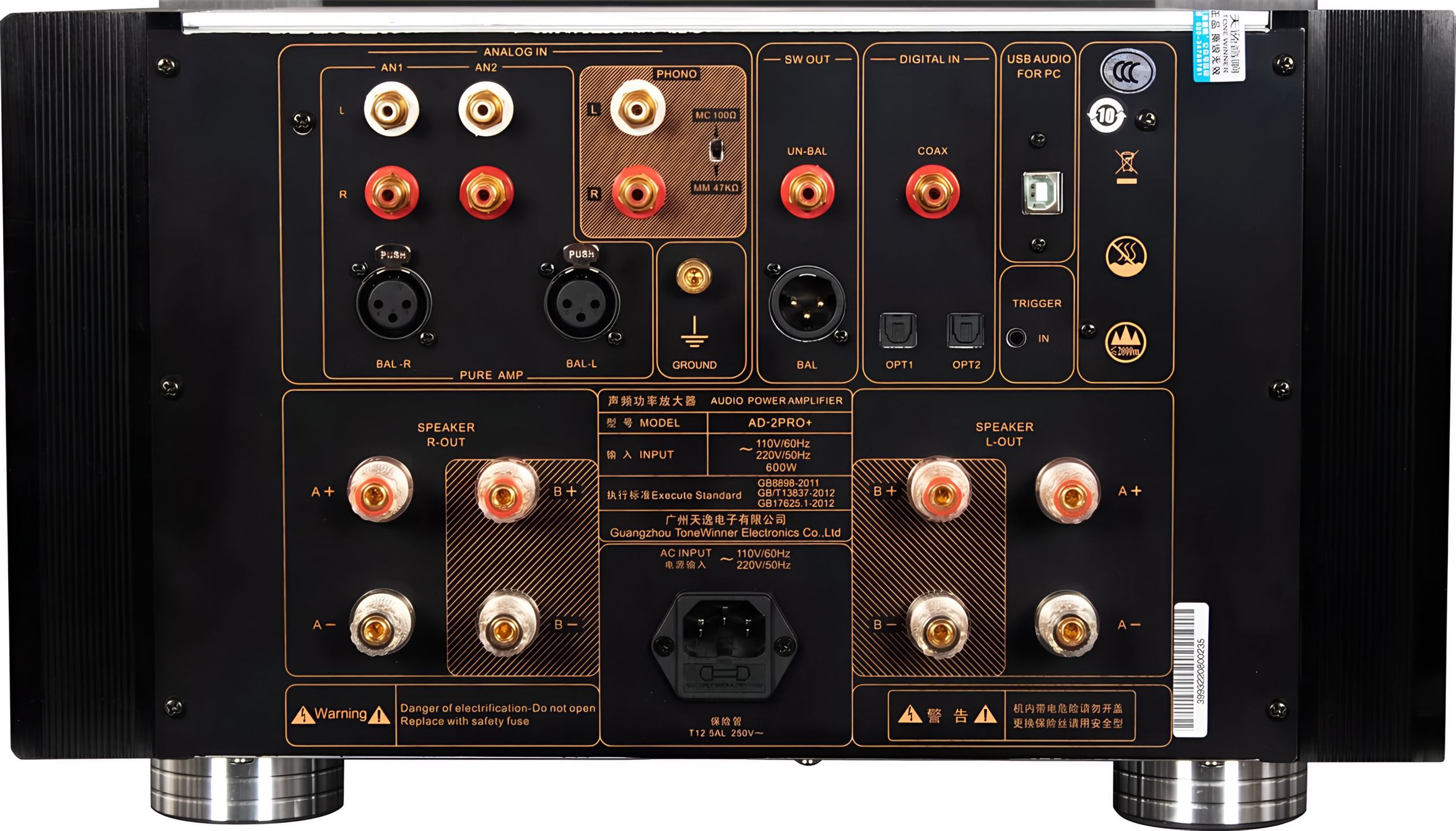
The rear panel features an unusually high density of connectors for an integrated amplifier. You’ll find:
The phono input with MM/MC selection meets the needs of vinyl enthusiasts. However, the gain of the phono preamp seems calibrated for medium- or high-output MC cartridges; very low-output cartridges (less than 0.5 mV) may require a high volume setting.
The two pairs of binding posts accept bi-wiring or the simultaneous connection of two pairs of speakers. The subwoofer outputs (RCA and XLR) allow you to integrate the unit into a 2.1 system without using a separate preamp.
The trigger input allows automatic power-on from another device, convenient in an integrated setup.
Build and ergonomics
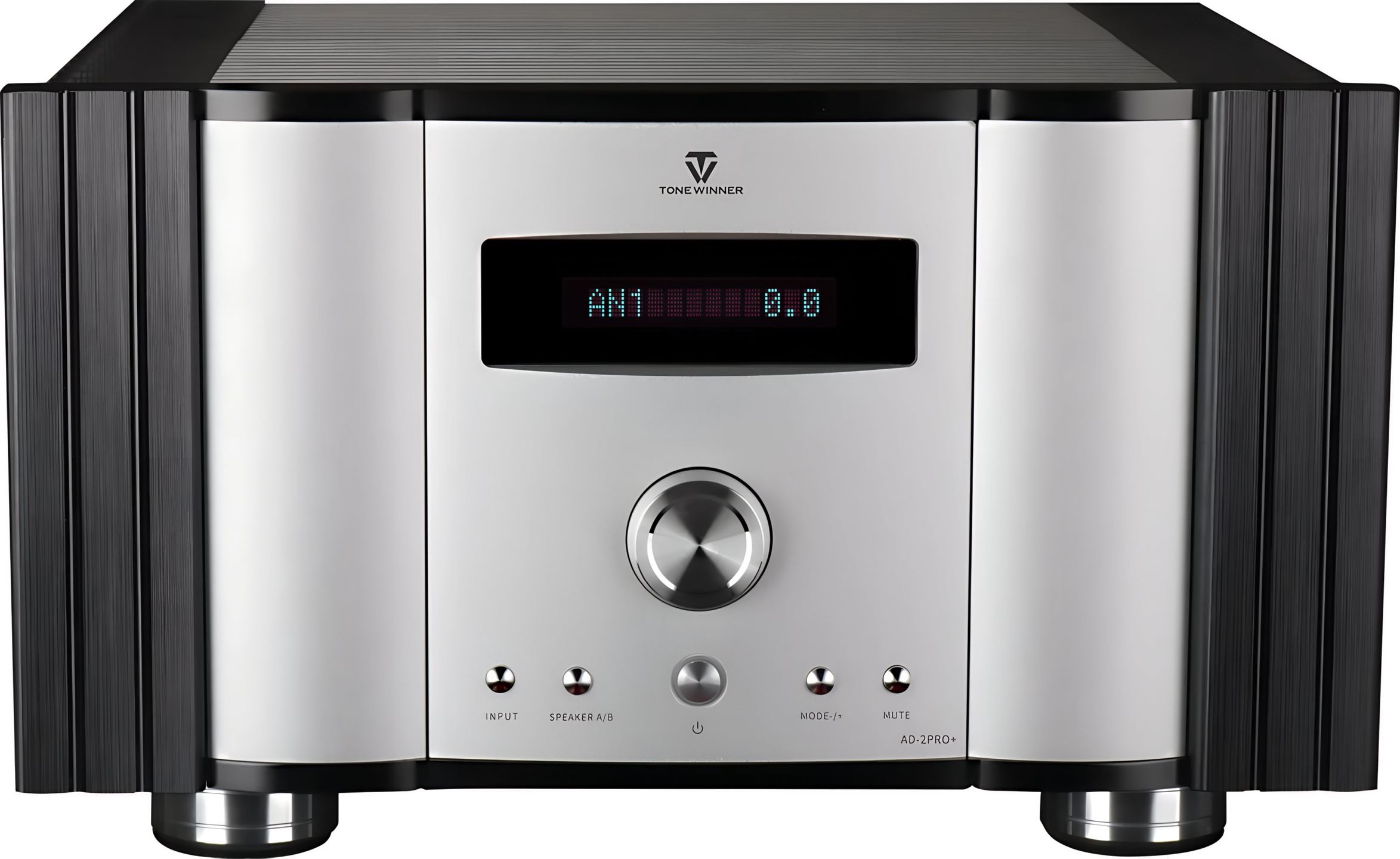
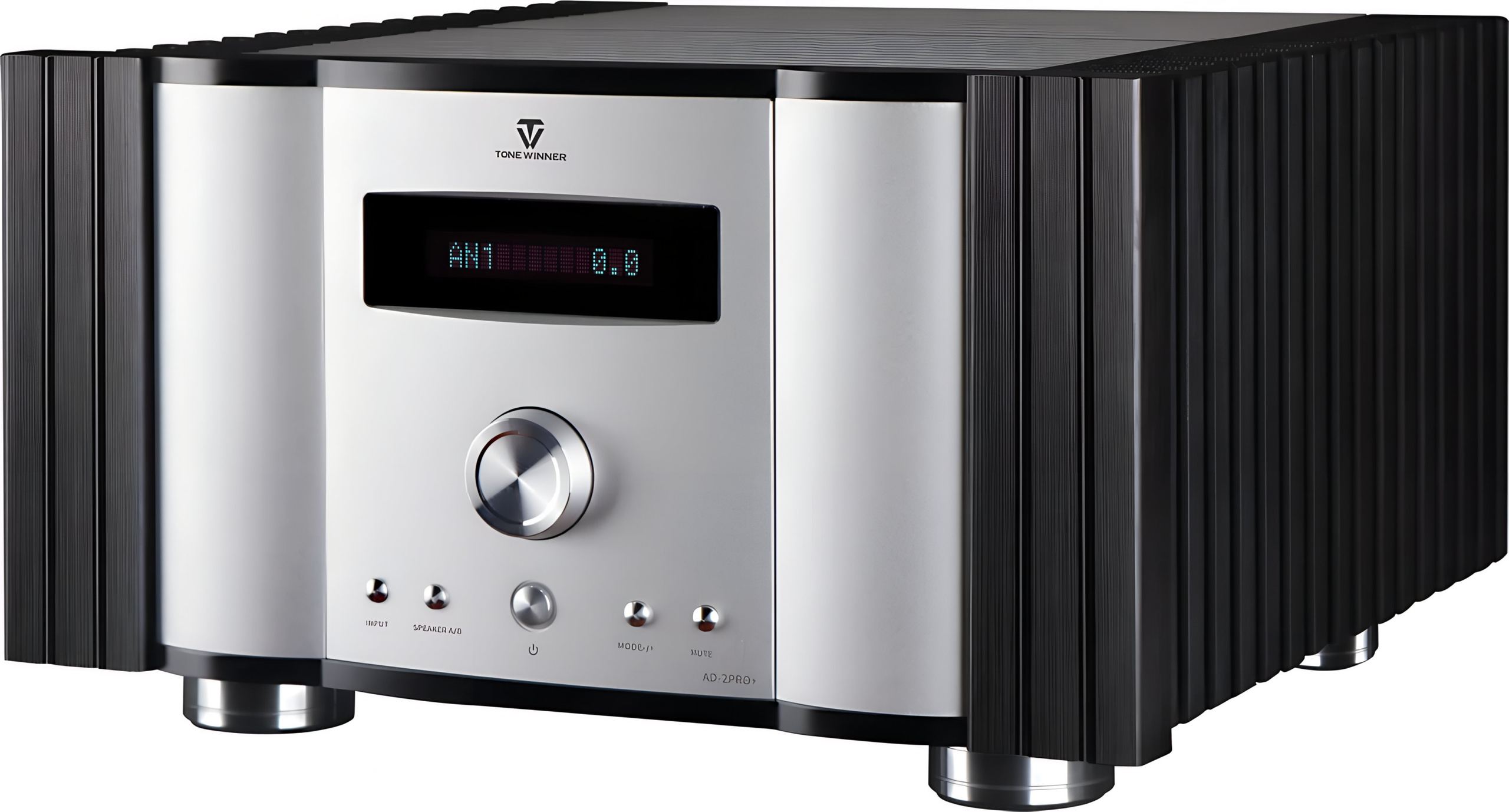
At 35.9 kg, the AD-2 Pro+ requires two people for installation. The dimensions (444 × 254 × 460 mm) call for furniture capable of supporting this weight and accommodating this depth.
The aluminum chassis is divided into five shielded sections: the power supply, the energy storage, the left amplification, the right amplification, and the digital section are physically isolated to limit interference. The front-panel VU meter displays the output level, a visual element that either pleases or annoys depending on taste.
The supplied remote control provides access to all functions, including source selection and changing the amplification mode.
What to expect in terms of sound
The reproduction is transparent, with a soundstage that favors depth rather than width. The sonic texture leans toward lightness and air rather than density; it’s more watercolor than thick oil paint. Transients are fast, and the bass is controlled without being overpowering.
Speakers with low sensitivity will find in this amplifier the power reserves they need to express themselves without compression. Demanding floorstanders or planar speakers such as Magnepan are logical pairings.
Technical specifications
Amplification and power supply
- Type: Class A / AB stereo amplifier
- Amplification modes: Class A, Class AB, Auto
- Output power: 2 × 240 W RMS into 8 Ω
- Gain: 40 dB
- High‑power toroidal transformer: 860 W
- Filtering capacity: 120,000 μF
- Power consumption
- Class A: 260 to 320 W
- Class AB: 70 to 110 W
Audio performance
- Frequency response: 15 Hz – 95 kHz (±3 dB)
- Signal‑to‑noise ratio: ≥ 100 dB
- Total harmonic distortion (THD): 0.05%
Digital‑to‑analog conversion
- DAC chip: ESS Sabre ES9038
- Resolution: 32‑bit / 768 kHz
- DSD compatibility: up to DSD512
Connectivity
- Digital inputs: 1× USB‑B, 2× optical, 1× coaxial
- Analog inputs: 2× stereo RCA, 1× stereo XLR
- Phono input: 1× MM / MC
- Subwoofer outputs: 1× RCA, 1× XLR
- Speaker outputs: bi‑wiring capable binding posts
- Control: trigger input
Construction
- Solid aluminum chassis, shielded against interference
- Front‑panel VU meter
Dimensions and weight
- Dimensions (W × H × D): 44.4 × 25.4 × 46 cm
- Weight: 35.9 kg
Frequently Asked Questions
What is the difference between the AD-2 Pro and the AD-2 Pro+?
The “+” model adds a USB-B input that allows direct connection to a computer and decoding of high-resolution streams up to DSD512. The non-“+” model only offered optical and coaxial inputs for digital sources.
Can 4 Ω speakers be used with this amplifier?
Yes, the recommended minimum impedance is 4 Ω per channel. The available power increases under this load, which is suitable for low-impedance speakers.
Does Class A consume much more than Class AB?
The difference is significant: around 260–320 W in Class A versus 70–110 W in Class AB. In Class A, the unit runs hotter and your electricity bill will reflect this during prolonged use.
Is the phono preamp suitable for all MC cartridges?
The gain seems optimized for medium- or high-output MC cartridges. Very low-output cartridges (below 0.5 mV) may require an external phono preamp to reach a comfortable listening level without cranking the volume.
How does Auto mode work?
The amplifier analyzes the signal in real time and switches between Class A (at low level) and Class AB (at high level). This mode offers a compromise between the sound quality of Class A and the energy efficiency of Class AB.
Are the subwoofer outputs filtered?
The AD-2 Pro+ provides RCA and XLR subwoofer outputs. Filtering is handled by the subwoofer; the amplifier sends a full-range signal.
- Eco-contribution included in the sale price.
- Manufacturer reference: TONAD2PROPLUS
- GTIN / EAN: 6942550310724




