Mofi Electronics StudioDeck +

Overview
When Mobile Fidelity Sound Lab, a label specializing since 1977 in remastering vinyl records from the original master tapes, decided to produce its own turntables, the question was not about sticking a logo on an existing product. The brand entrusted the design to Allen Perkins, founder of Spiral Groove, whose turntables sell for several tens of thousands of euros. The result is the StudioDeck, the first model in the MoFi Electronics range, presented here in the “+” version with the StudioTracker cartridge pre-mounted.
A turntable designed by a very high-end designer
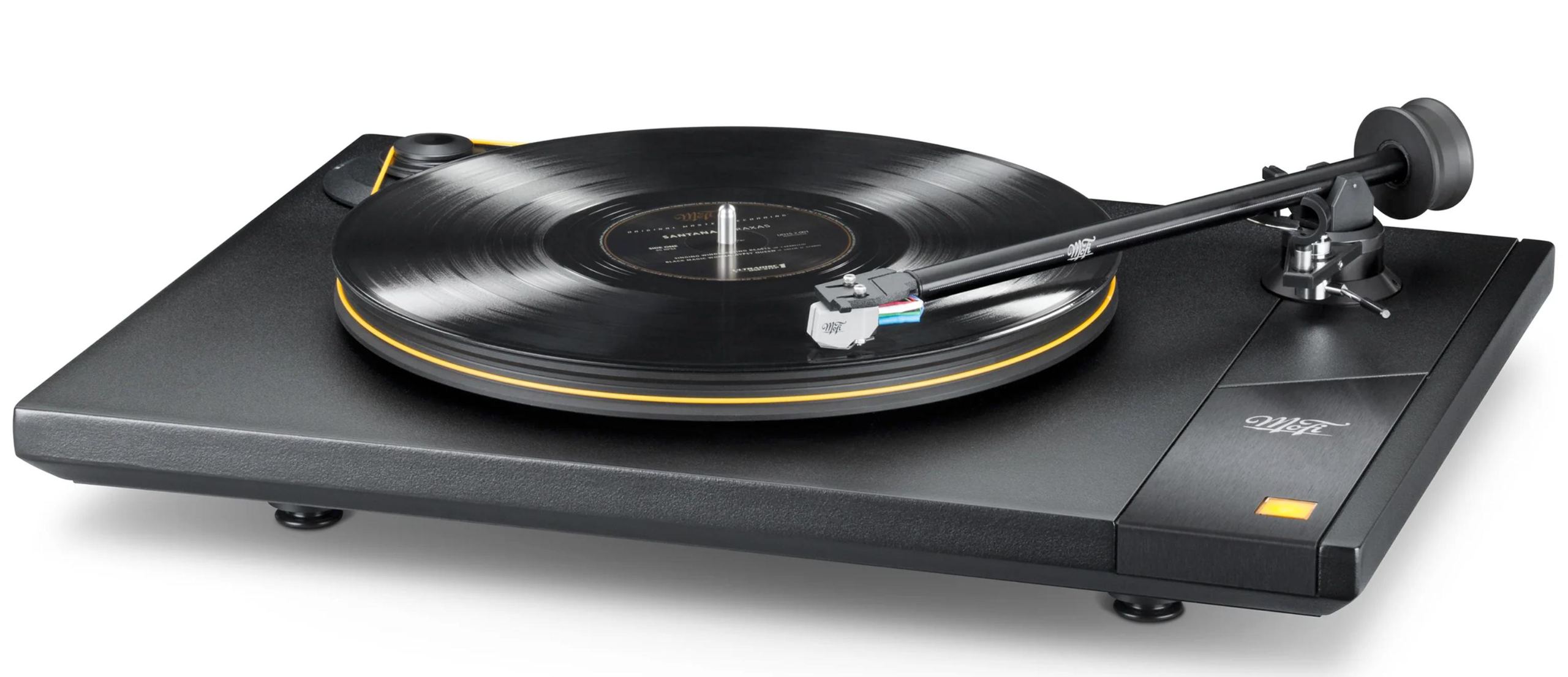
Allen Perkins applied to the StudioDeck the design principles he uses on his Spiral Groove models, adapting them for series production and more accessible positioning. The turntable is hand-assembled at the MoFi factory in Ann Arbor, Michigan.
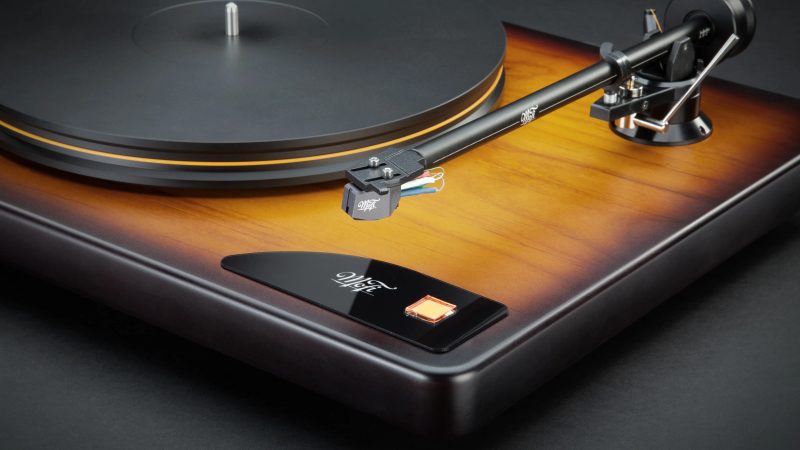
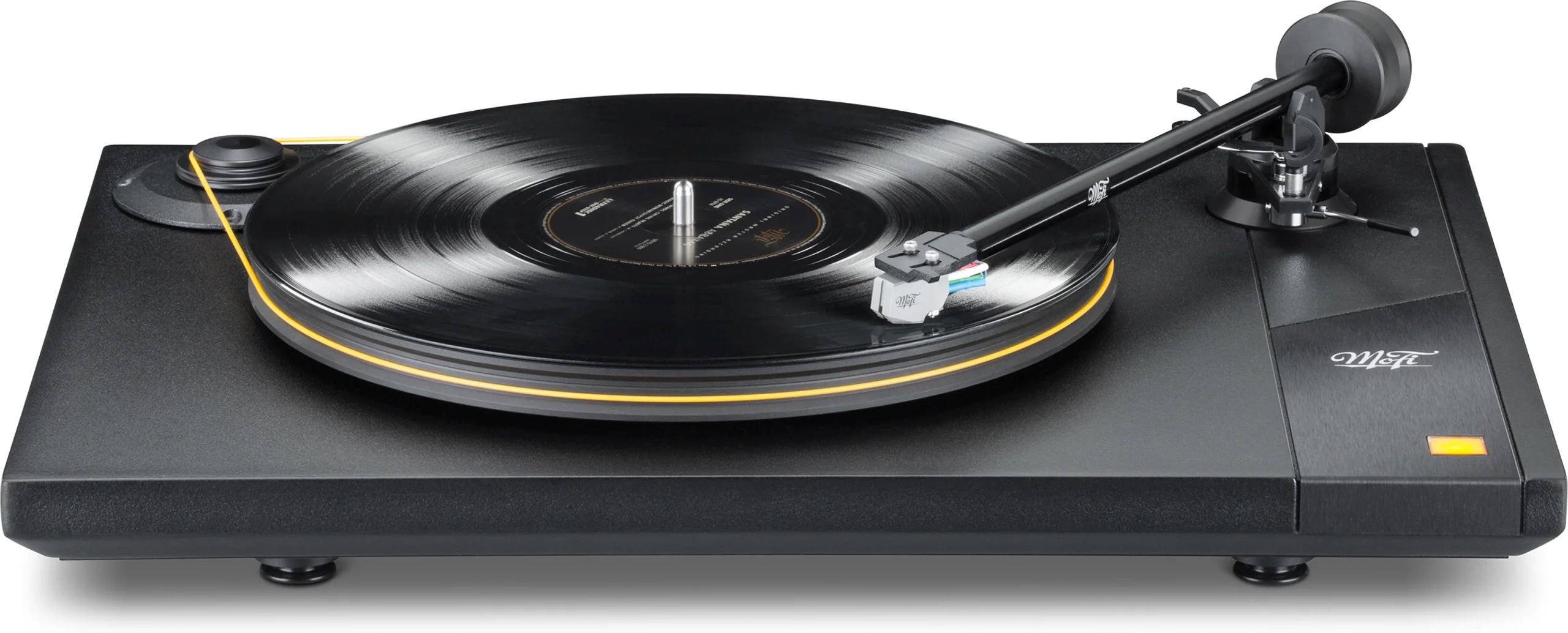
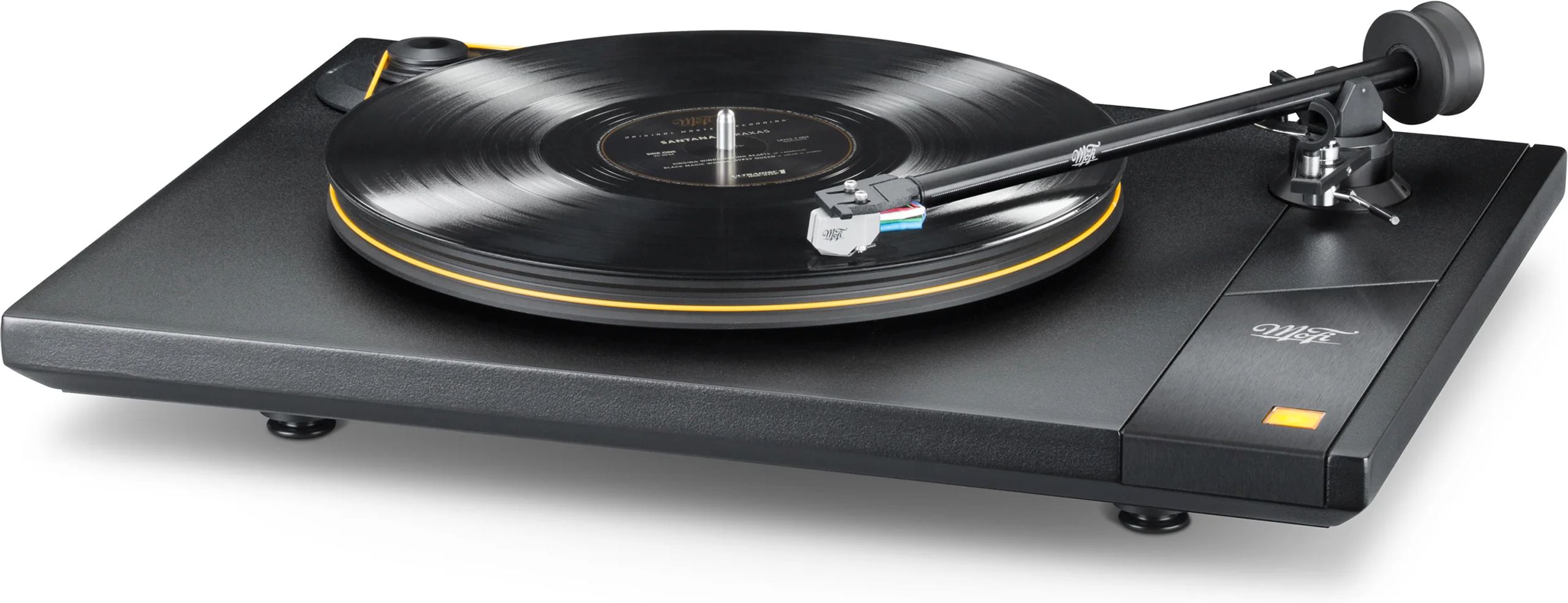
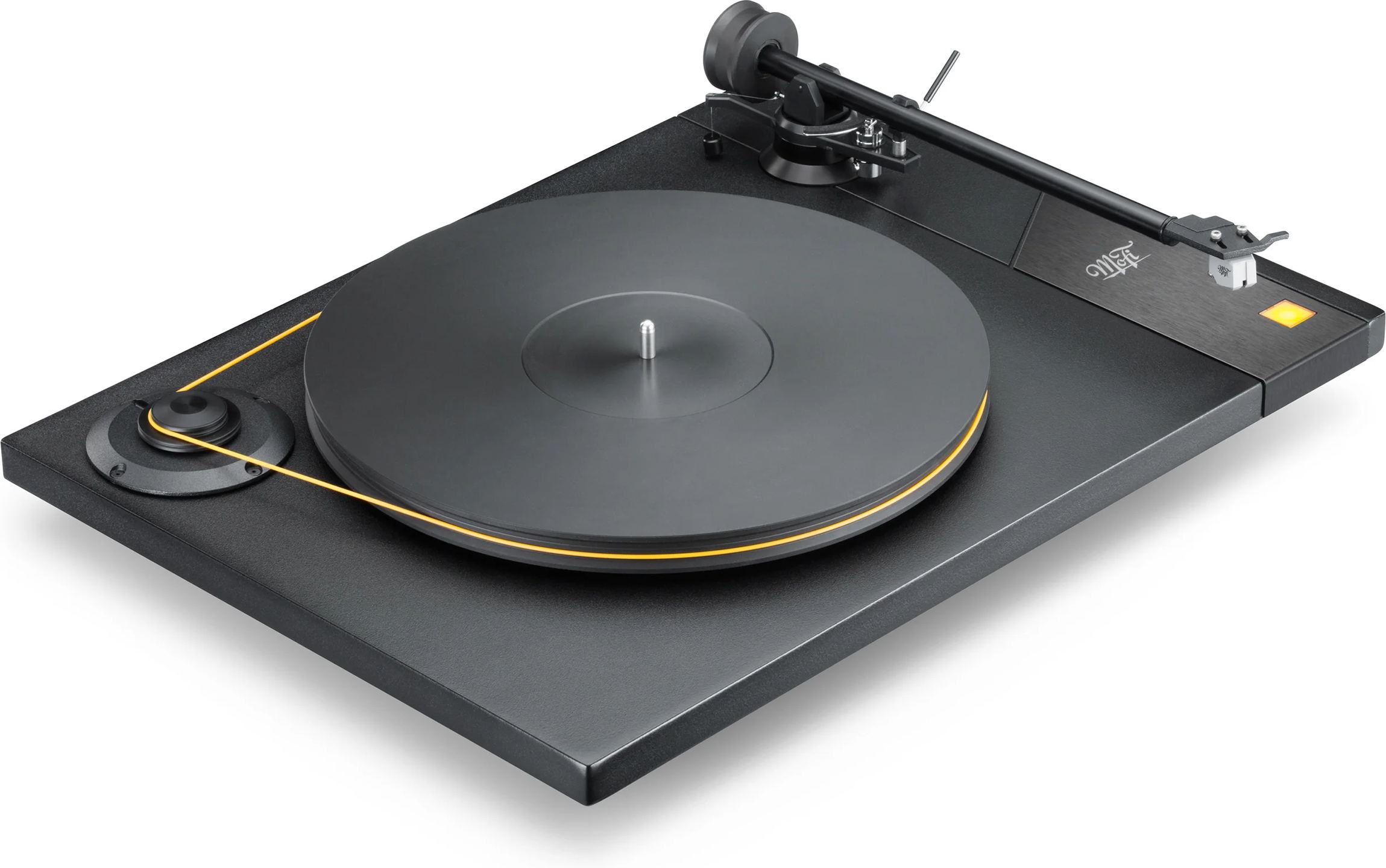
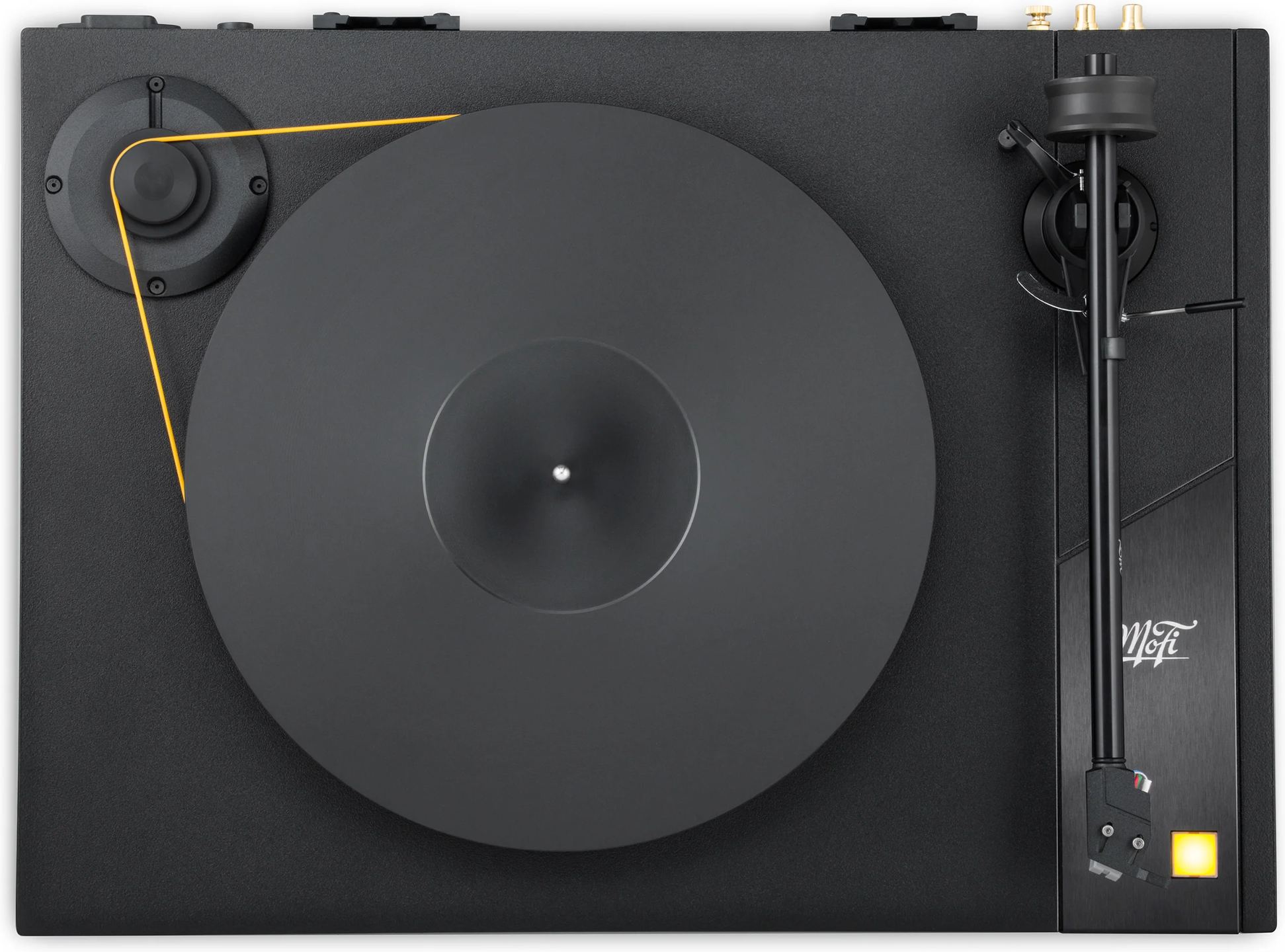
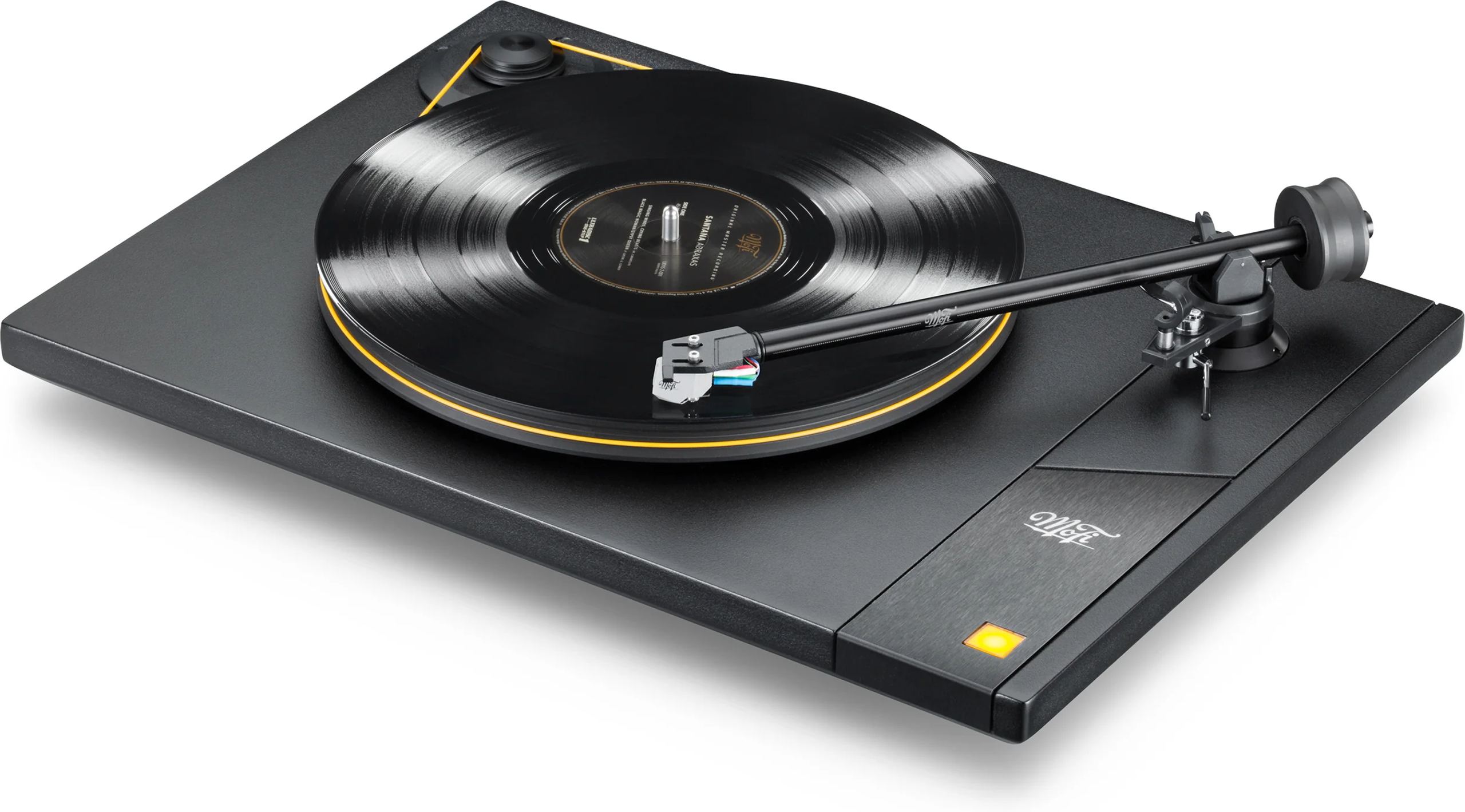
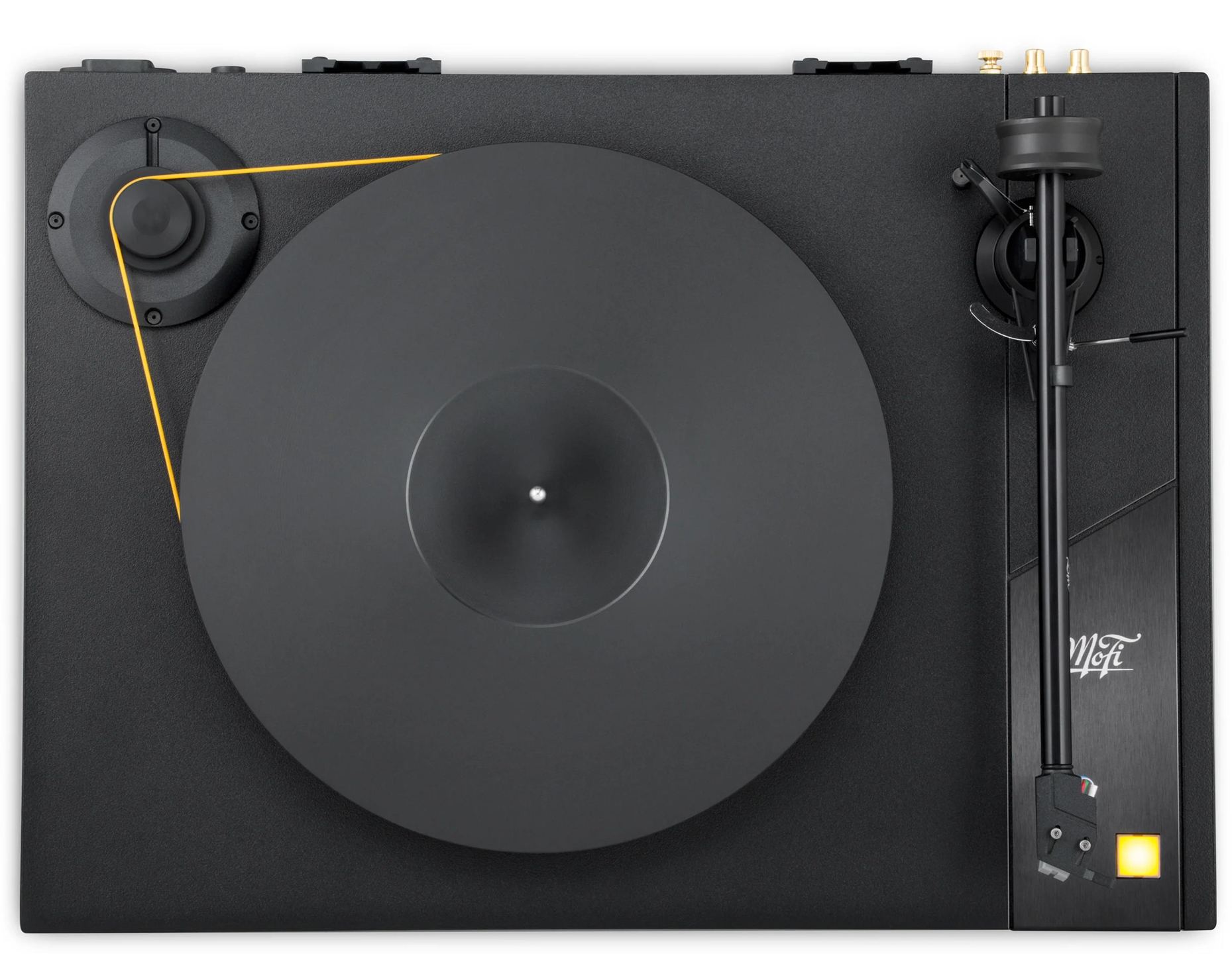
The plinth is based on a so-called “Constrained Layer Dampening” structure: a brushed aluminum plate is bonded to a 35 mm thick MDF body. The aluminum adds mass and rigidity, while the MDF absorbs resonances. This combination of materials with different mechanical properties limits sonic coloration, a principle also found on much more expensive turntables. The square on/off button lights up orange, a discreet detail that gives the whole unit a “studio” character consistent with the product’s name.
The dimensions (50.0 × 36.2 cm) are generous for this price range, a direct consequence of the 10-inch tonearm. At 8.66 kg, the StudioDeck remains light enough not to require reinforced furniture, while offering enough mass for good stability.
A 10-inch tonearm made in the United States
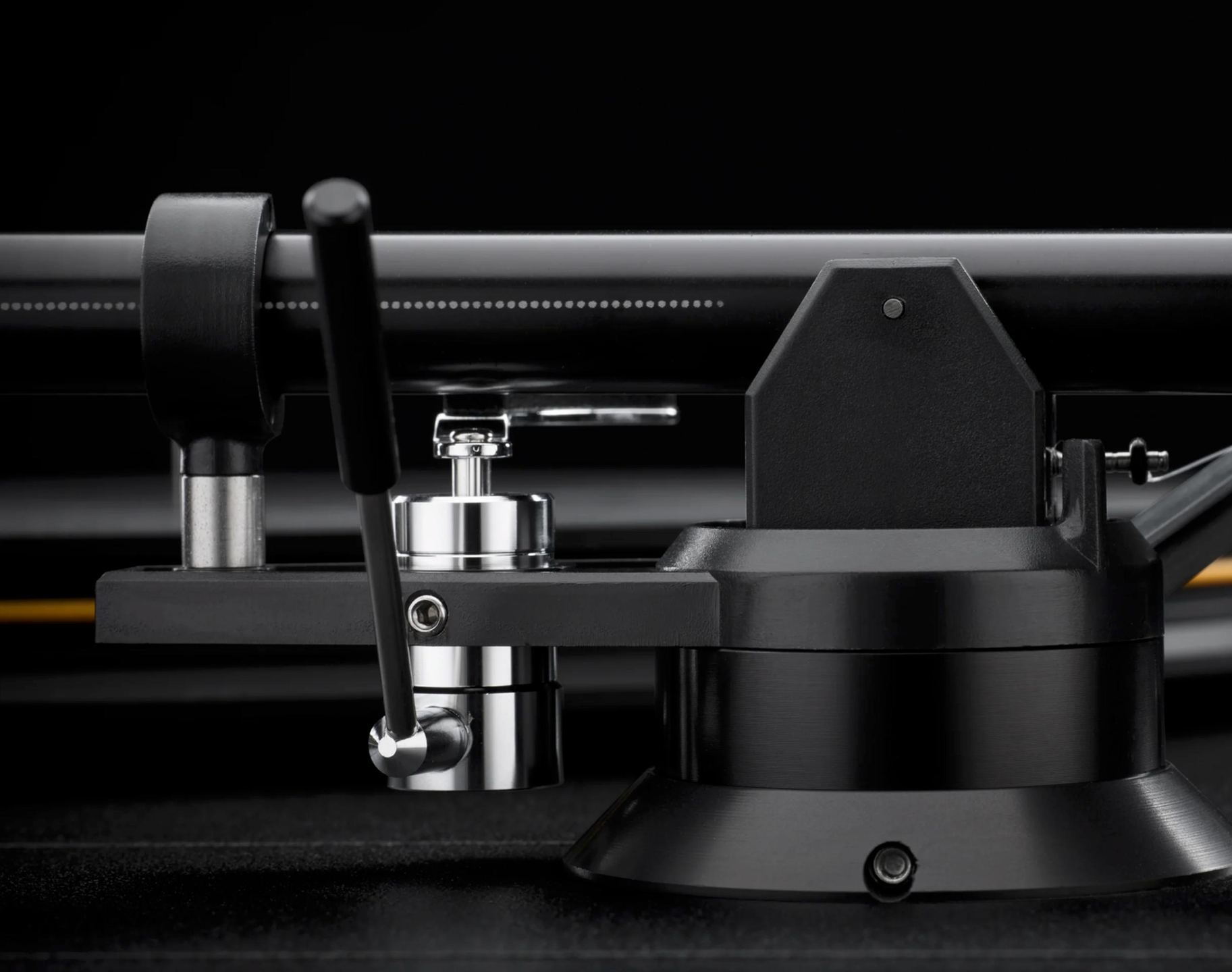
Most turntables in this category use a 9-inch tonearm. MoFi chose a 10-inch tonearm (254 mm effective length), a format usually reserved for more expensive models. The advantage of a longer tonearm is geometric: the greater distance between the pivot and the stylus reduces tracking error, meaning the angular deviation between the stylus and the groove. Less tracking error means less distortion, especially on the inner tracks of the record where the grooves are tighter.
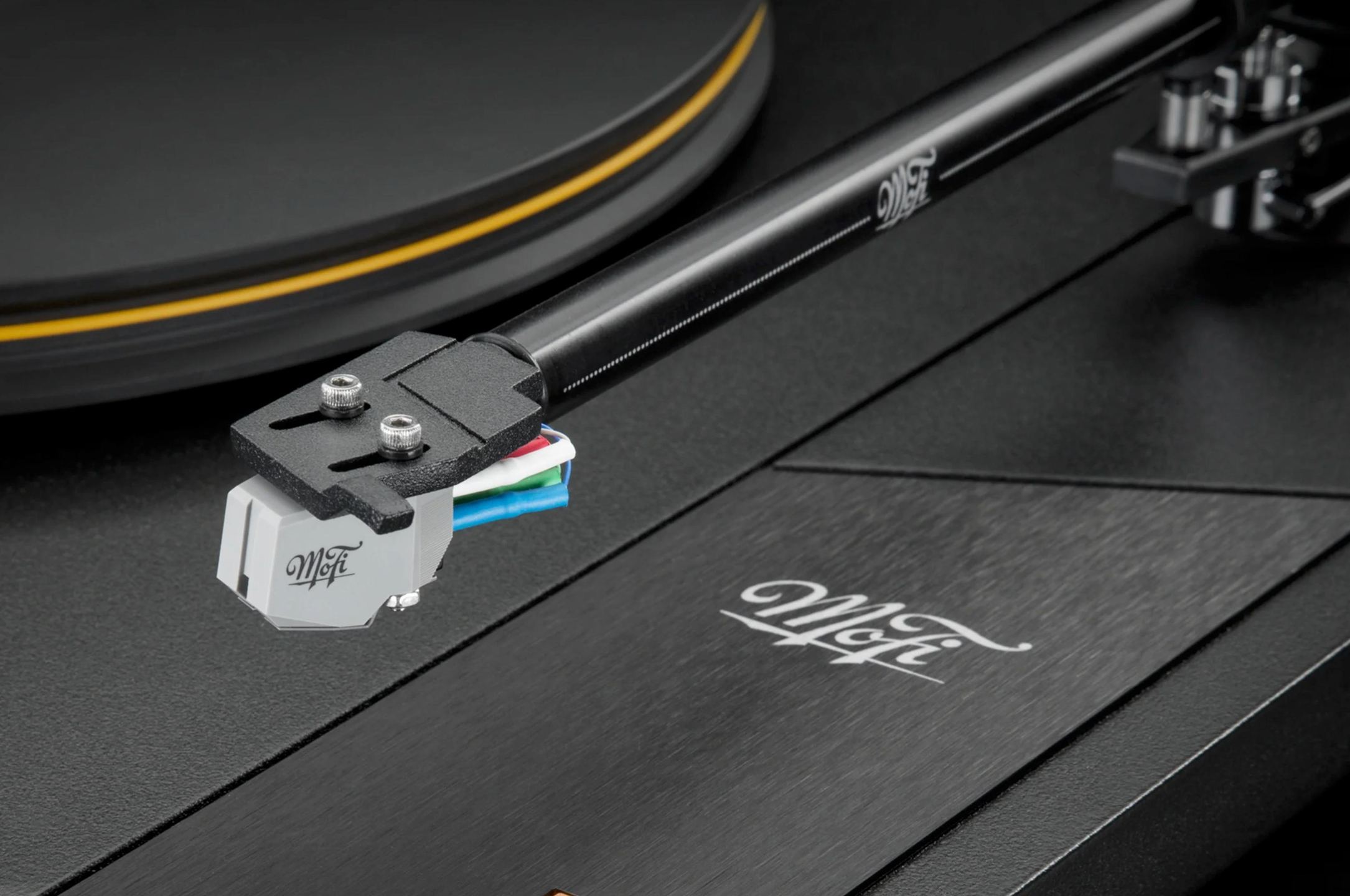
The Studio tonearm is a straight aluminum tube mounted on high-precision gimbal bearings. The headshell is fixed, with a damping O-ring between the tube and the shell. The internal wiring is oxygen-free copper (OFC). The available adjustments cover the essentials: tracking force, height (VTA), azimuth, and anti-skate. The anti-skate is conventional, using a thread and counterweight. The offset angle is 22.8°, adjustable by ± 2°, and the overhang is 18 mm. The tonearm accepts cartridges from 5 to 10 g, covering the vast majority of moving magnet and moving coil cartridges on the market.
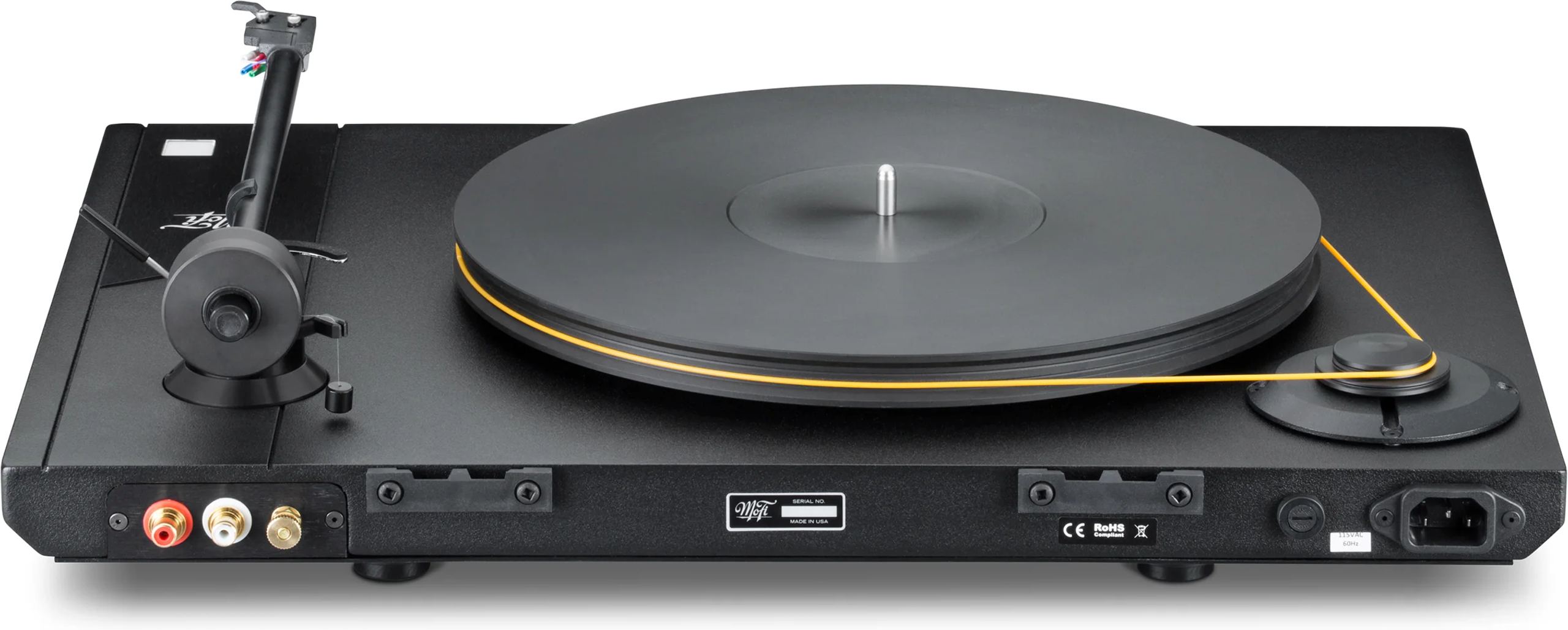
Outputs are via gold-plated RCA connectors at the rear of the turntable, protected by copper foil shielding against radio interference. The user chooses their own interconnect cables, a welcome detail that leaves the door open to gradual upgrades.
A Delrin platter and an inverted bearing
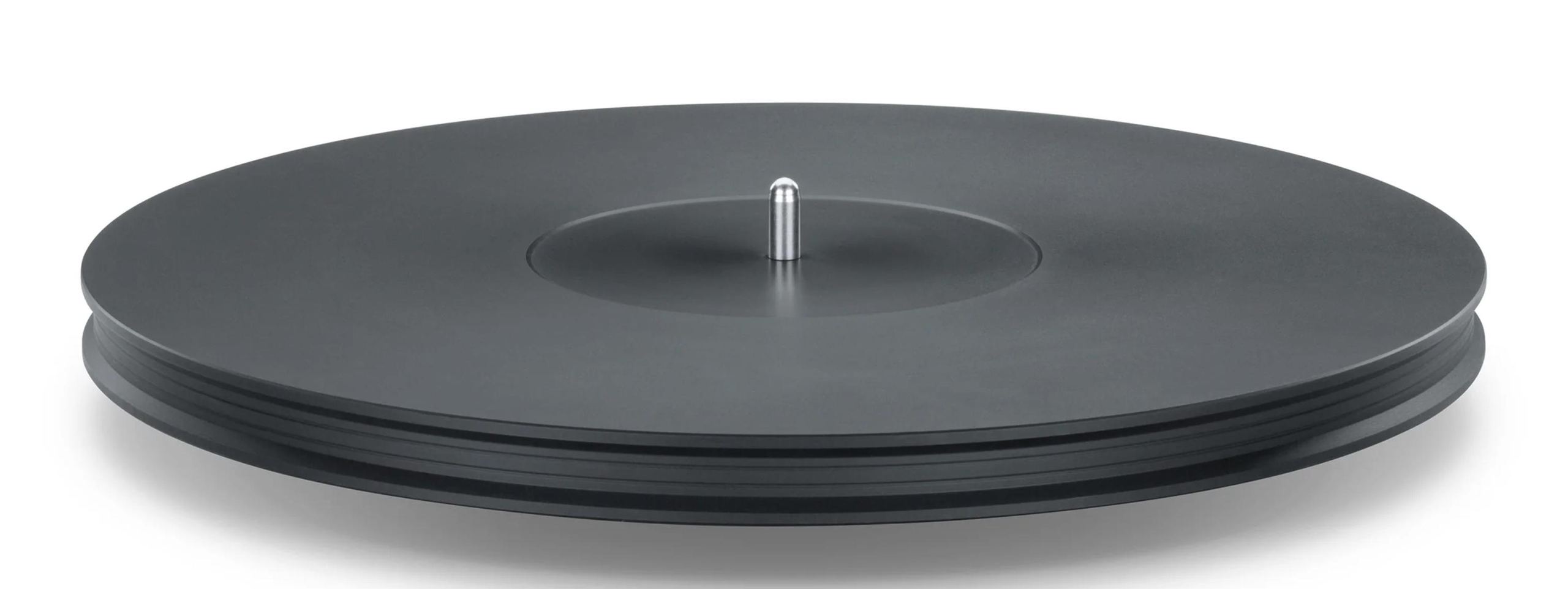
The platter is made of Delrin, an engineering polymer developed by DuPont, with a thickness of 19 mm (3/4 inch) and a mass of about 1.8 kg. The choice of Delrin is not incidental: its crystalline structure presents a mechanical impedance close to that of vinyl, which helps absorb unwanted vibrations at the point of contact with the record. The platter offers good inertia while remaining easy to machine, a compromise Perkins also uses on his high-end models.
The main bearing is of the inverted type: a fixed hardened steel shaft enters a bronze sleeve, with a Teflon thrust pad. This type of bearing, common on more expensive turntables, ensures quiet and stable rotation over time. On the UltraDeck (the upper model), the thrust pad is sapphire; here, Teflon does the job at lower cost, with no notable compromise in rotational smoothness.
Isolation as a guiding principle
At MoFi, the reasoning is simple: any stylus vibration that does not come from the groove is distortion. The StudioDeck addresses this problem on several levels.
The AC synchronous motor runs at 300 rpm and drives the platter by belt, via a two-step Delrin pulley (33 ⅓ and 45 rpm, manual switching by moving the belt). Damping materials decouple the motor from the rest of the chassis. Power consumption remains modest, below 5 watts.
The four anti-vibration feet were developed with Harmonic Resolution Systems (HRS), a specialist in isolation supports for high-end audio equipment. These spring-loaded feet absorb vibrations transmitted by the furniture or the floor, a critical point if the turntable is installed near speakers or in an urban environment.
Measurements confirm the effectiveness of this approach: wow and flutter are between 0.017% and 0.025%, and the signal-to-noise ratio reaches 72 dB.
The StudioTracker cartridge: a V-Twin generator made in Japan
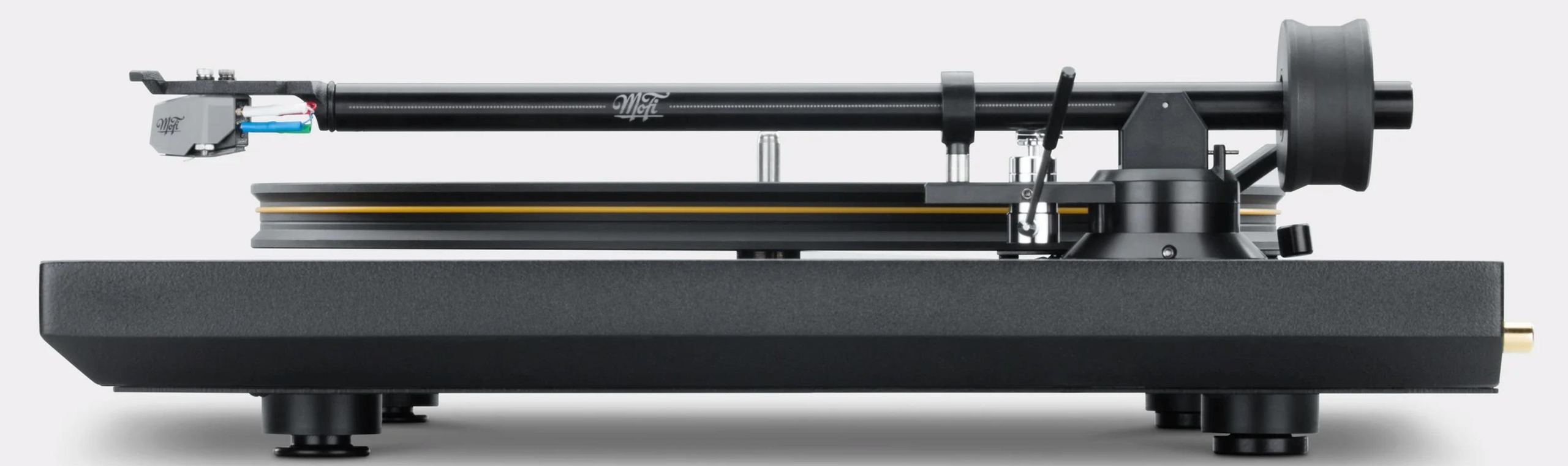
The “+” version of the StudioDeck includes the StudioTracker cartridge, mounted and adjusted at the factory. It is a dual moving magnet (MM) cartridge, designed by Allen Perkins in collaboration with Mobile Fidelity engineers, and manufactured in Japan.
Its V-Twin generator places two low-mass magnets in a V formation, according to an arrangement that reproduces the geometry of the cutting head used to cut the grooves on the original lacquer. The idea is to read the groove on the same axis as the cutting, which improves channel separation and tracking accuracy. The stylus has an elliptical profile, mounted on a polymer body. Output is 3.5 mV (47 kΩ impedance, 100 pF capacitance), making it compatible with almost all MM phono preamplifiers on the market. The recommended tracking force is between 1.8 and 2.2 g, for a cartridge weight of 6.4 g.
The StudioTracker’s sound is balanced, with a slightly rounded top end that avoids any aggressiveness. The bass is firm, the midrange natural. The cartridge does not seek to impress with an excess of detail or brightness: it reproduces what is in the groove, without adding anything. This is consistent with Mobile Fidelity’s philosophy, which has always prioritized faithfulness to the master tape over spectacular effect.
One point to know: the StudioTracker’s stylus is not user-replaceable. When it is worn, the entire cartridge must be replaced (MoFi offers a trade-in program).
A manual turntable
The StudioDeck is a fully manual turntable. No automatic tonearm return, no lift mechanism at the end of the side: the stylus stays in the run-out groove until the tonearm is lifted by hand, using the damped cue lever. This requires being present during listening, which is precisely the kind of involvement the vinyl format encourages.
Setup is quick. The cartridge is pre-mounted and pre-adjusted on the “+” version; all that remains is to install the counterweights, check the tracking force and anti-skate, and connect the cables. A smoked dust cover is included, but MoFi recommends removing it during playback: its hinges are not designed for intensive use at every side change.
Power is supplied via a standard IEC input on the rear, with an integrated fuse holder (an unusual detail on a turntable in this range). The turntable is connected to the mains by a power cable with a good conductor cross-section.
Documentation
Technical Specifications
Motor and drive
- Motor: 300 RPM synchronous AC motor, isolated from the chassis
- Belt drive
- Speeds: 33 ⅓ and 45 RPM
- Power consumption: < 5 W
Audio performance
- Wow & flutter: 0.017% – 0.025%
- Signal-to-noise ratio: 72 dB
Platter
- High-density Delrin platter
- Thickness: 3 / 4” (approximately 19 mm)
- Excellent inertia, noise reduction, improved vinyl playback
Tonearm
- 10” straight aluminum tonearm, made in the USA
- High-precision gimbal bearings
- Overhang: 18 mm
- Offset angle: 22.8° (± 2° adjustable)
- Compatible cartridges: 5 g – 10 g
- Full adjustments: tracking force, VTA, azimuth, anti-skating
Chassis and isolation
- Constrained Layer Dampening structure: aluminum and damped MDF
- Enhanced rigidity
- Resonance suppression
- Neutral reproduction
- HRS anti-vibration feet, developed with Harmonic Resolution Systems
- Effective mechanical isolation
- Reduction of unwanted vibrations
Dimensions and weight
- Dimensions (W × H × D): 50.0 × 13.7 × 36.2 cm
- Weight: 8.66 kg
Highlights
- Precise and stable playback
- 10” tonearm made in the USA
- High-density Delrin® platter
- AC motor isolated from the chassis
- HRS anti-vibration feet
- Aluminum and damped MDF chassis
Sound signature
- Very clean and detailed playback
- Firm and controlled bass
- Natural midrange
- Precise highs without harshness
- Very low background noise
Recommended uses
- Entry into audiophile vinyl
- Serious hi-fi systems
- Listeners seeking precision and simplicity
- Faithful and immersive music listening
General information
StudioDeck +, turntable equipped with the StudioTracker cartridge.
Frequently Asked Questions
Is the StudioDeck + ready to use out of the box?
The StudioTracker cartridge is pre-mounted and pre-adjusted at the factory. You need to install the counterweight and the anti-skate weight, check the tracking force (recommended between 1.8 and 2.2 g), then connect the cables. No special tools are required: the Allen keys needed for VTA and azimuth adjustments are supplied, as is a stylus cleaning brush.
Can a moving coil (MC) cartridge be mounted on the Studio tonearm?
The tonearm accepts cartridges weighing between 5 and 10 g, which includes many MC cartridges. The VTA and azimuth adjustments allow fine adaptation. The internal OFC copper wiring will transmit the signal without issue, although very low-output MC cartridges will benefit from a suitable phono preamplifier.
What is the difference between the StudioDeck and the StudioDeck +?
The turntable is identical. The “+” version includes the StudioTracker cartridge (dual moving magnet, elliptical stylus), mounted and adjusted at the factory. The StudioDeck without suffix is sold without a cartridge. Other versions exist: +U (with UltraTracker) and +M (with MasterTracker), which offer higher-range cartridges.
What differentiates the StudioDeck from the UltraDeck?
The UltraDeck, the upper model in the range, features a thicker Delrin platter (33 mm versus 19 mm, nearly double the mass), a plinth with three aluminum plates instead of one, a sapphire bearing thrust pad (versus Teflon), and Cardas wire tonearm wiring (versus OFC copper). The two models share the same 10-inch tonearm and the same overall design signed by Allen Perkins.
Is a phono preamplifier necessary?
Yes. The StudioDeck + does not include a built-in phono preamplifier. An external phono preamplifier (MM input, 47 kΩ impedance) is required between the turntable and the amplifier. MoFi offers its own models (StudioPhono and UltraPhono), but any MM phono preamplifier on the market will do.
- Eco-contribution included in the sale price.
- Manufacturer reference: 00032672