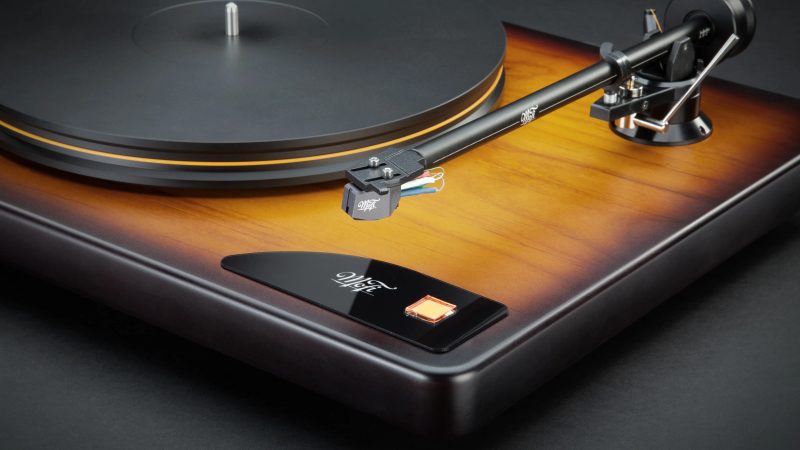
Mofi Electronics UltraGold MC



Overview
For several years, MoFi Electronics built its cartridge range around three moving magnet (MM) models, all developed in collaboration with Allen Perkins, founder of Spiral Groove. The UltraGold MC marks the brand’s arrival in the moving coil cartridge arena, with a clearly higher level of ambition: selected components, Japanese manufacturing, and final tuning by Perkins himself.
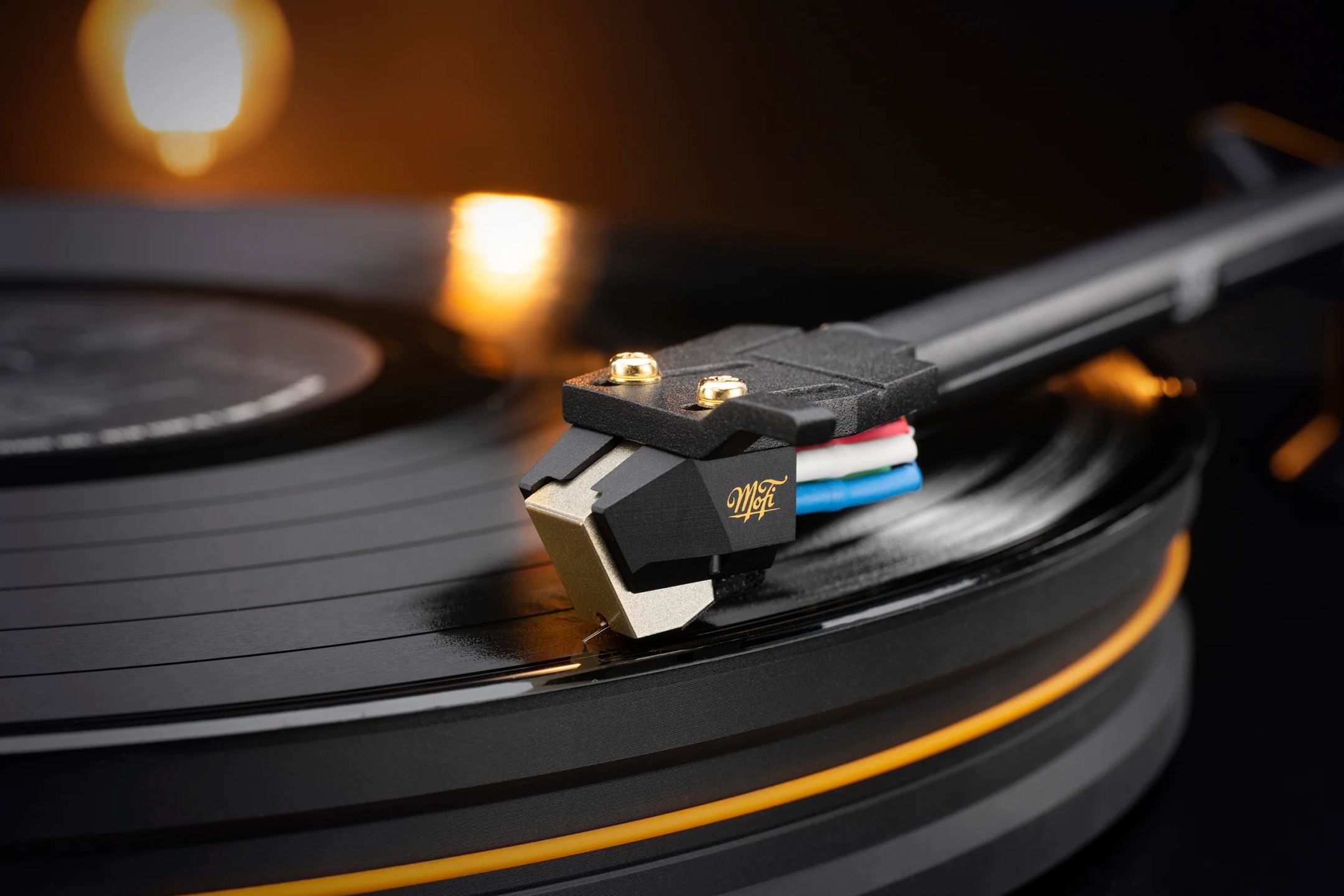
An MC generator with selected components
The UltraGold is based on a dual moving coil generator made of PCOCC copper (Pure Copper by Ohno Continuous Casting), a continuous casting process that produces single-crystal wire, with no grain boundaries in the direction of signal transmission. PCOCC copper is common in high-end MC cartridges, and for good reason: it reduces losses and distortion linked to structural impurities in the conductor.
The magnet is made of neodymium, paired with a permendur yoke, an iron-cobalt alloy with very high magnetic flux density. This combination concentrates a powerful magnetic field in the coil gap, improving generator efficiency and responsiveness to dynamic variations. Internal impedance is 12 Ω, with an output voltage of 0.4 mV, a proper level for an MC cartridge that remains compatible with most MC phono preamplifiers on the market without requiring a step-up transformer.
Nude Shibata diamond on a boron cantilever
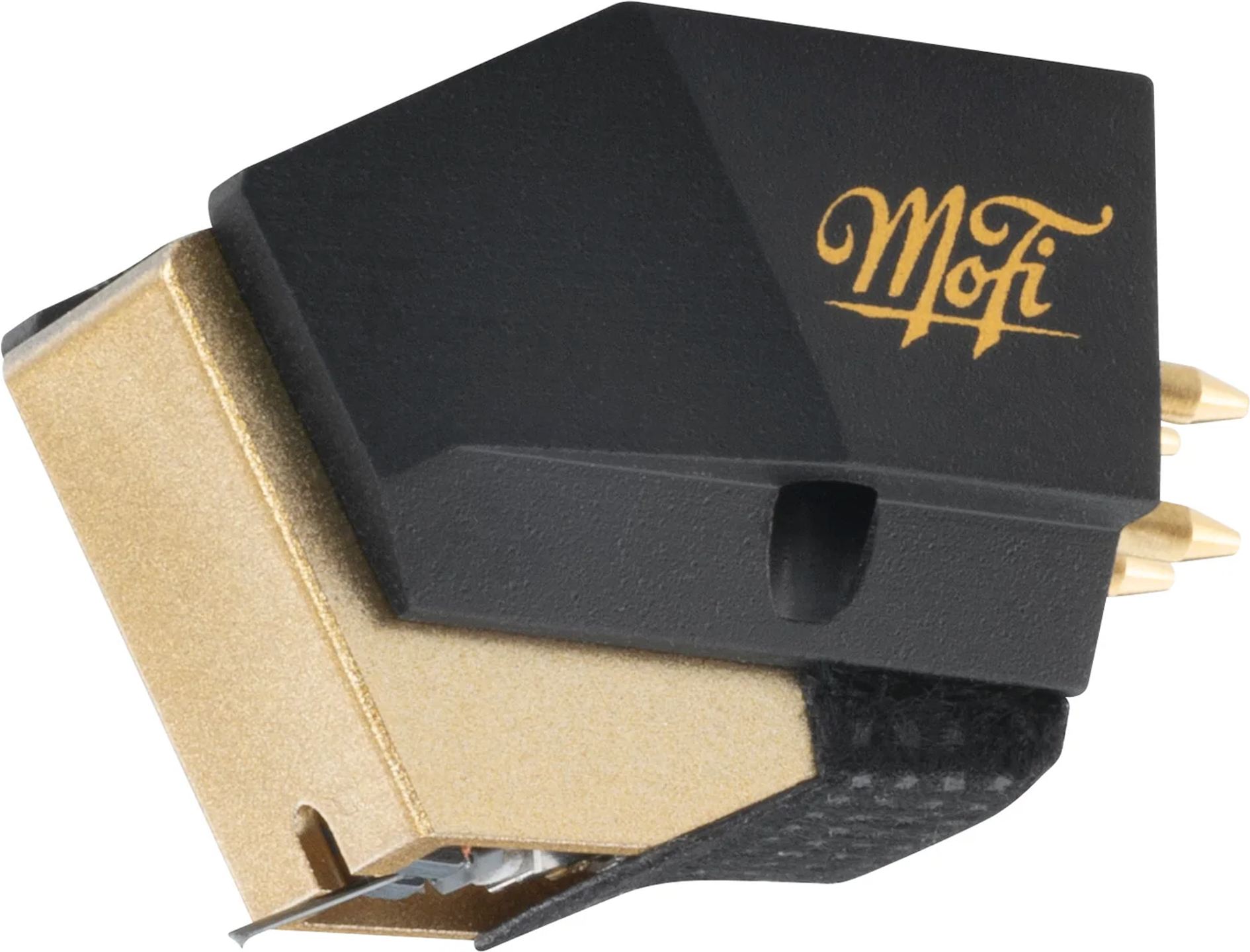
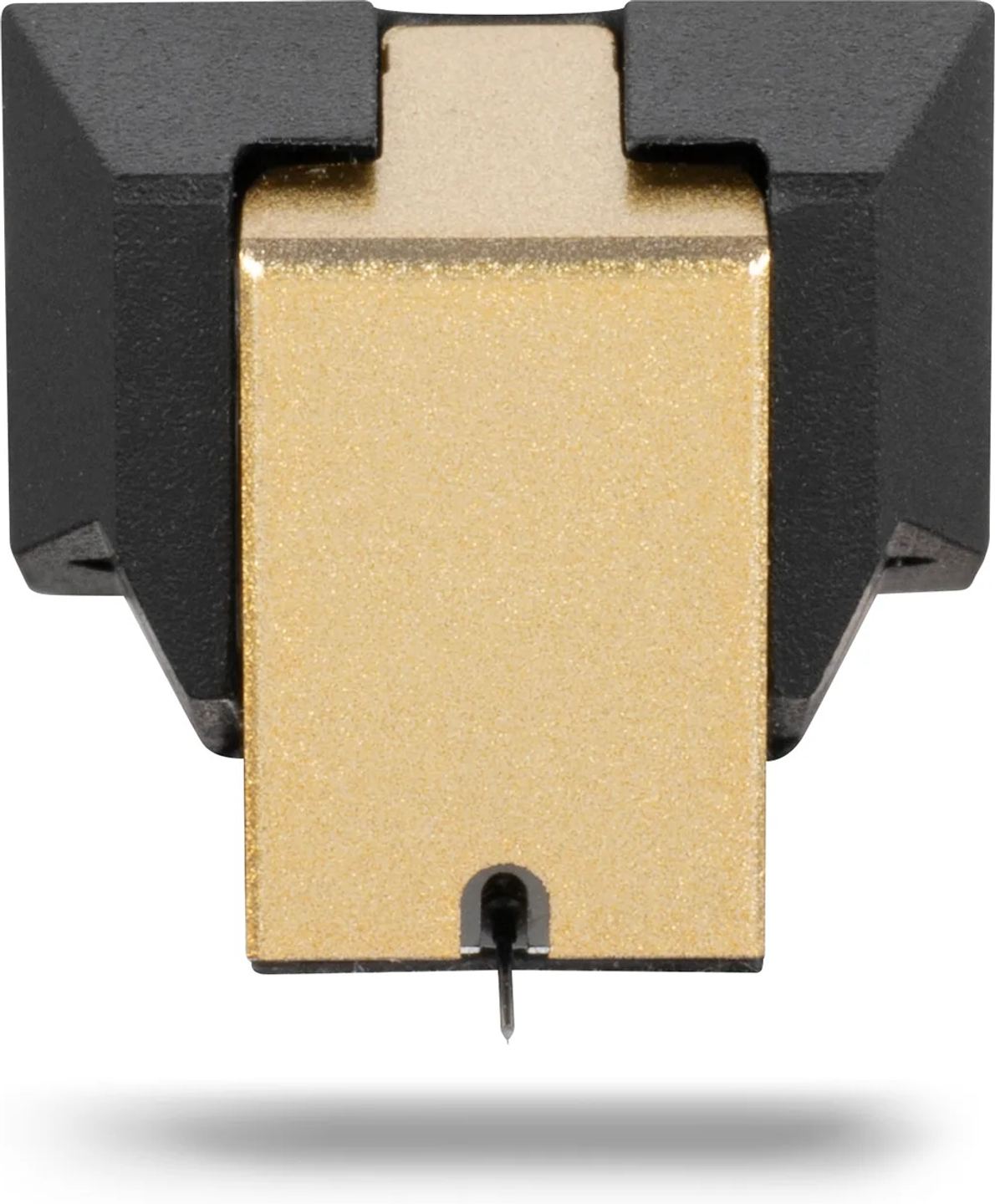
The choice of stylus says a lot about a cartridge’s priorities. MoFi selected a nude Shibata diamond (cut from a single crystal, without bonding to an intermediate shank), mounted on a boron cantilever.
The Shibata profile, invented in the 1970s by Norio Shibata for playing CD-4 quadraphonic records, stands out for its elongated contact surface with the groove wall. This vertically extended contact allows finer high-frequency playback and more evenly distributed wear on both the diamond and the vinyl. The stated frequency response, from 20 Hz to 35 kHz, reflects this ability to capture information beyond the audible spectrum.
Boron, used for the cantilever, is both a very rigid and very light material. This rigidity promotes fast transmission of the groove’s micro-vibrations to the generator, resulting in precise reproduction of transients (note attacks, percussion, consonants in voices). Boron’s lightness limits the inertia of the moving assembly, a direct advantage for tracking complex passages.
This Shibata/boron pairing is not insignificant at this price point. It is usually found on noticeably more expensive cartridges.
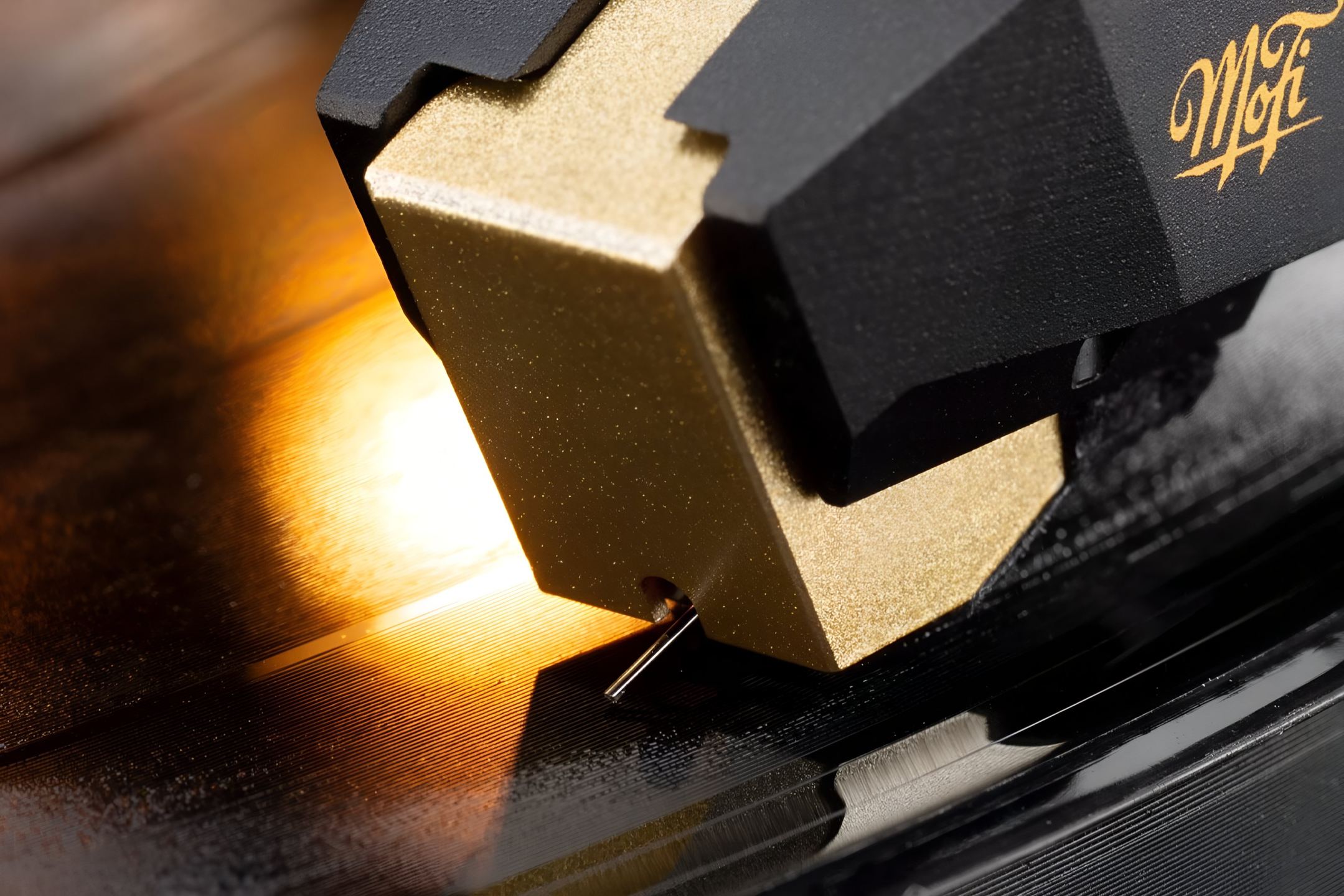
A hybrid aluminum-brass body designed by Allen Perkins
The UltraGold MC body is a hybrid aluminum/brass extrusion designed by Allen Perkins. The machined aluminum forms the main shell, while the brass is used to damp parasitic vibrations and limit mechanical resonances of the body. This type of construction using dissimilar materials aims to prevent a single resonance frequency from coloring the sound.
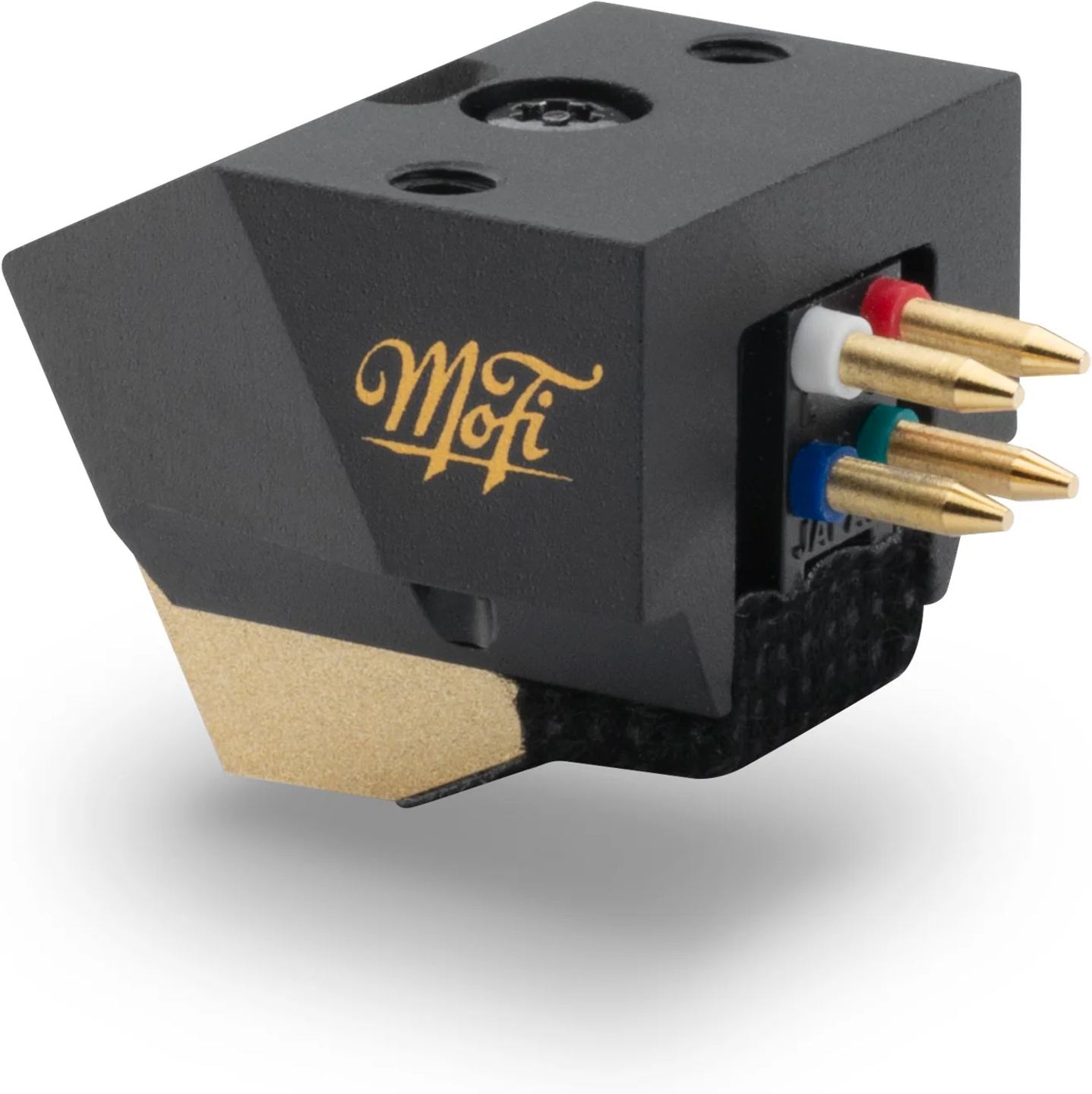
The body includes threaded inserts. Installation requires only two screws, with no nuts: the cartridge attaches directly to the headshell or integrated tonearm. This is a worthwhile practical detail, because mounting an MC cartridge (often small, fragile, with an exposed cantilever) remains a delicate operation. Total weight is 7.3 g, a standard value suitable for the vast majority of tonearms on the market.
Allen Perkins tuning, turntable specialist expertise
Allen Perkins is not a phono cartridge engineer in the traditional sense. He is a designer of turntables and tonearms, founder of Spiral Groove, whose products (turntables costing over $30,000) are recognized for their noise floor and neutrality. A former designer at SOTA in the 1980s and a jazz drummer, he approaches music reproduction with the sensitivity of both a musician and an engineer.
His role on the UltraGold is that of “voicing”: the fine tuning of the cartridge after manufacturing, which determines tonal balance and dynamic behavior. MoFi describes this collaboration as a joint development effort between its engineers and Perkins, with manufacturing carried out in Japan under strict quality control.
Listening and sonic character
The UltraGold MC’s sonic orientation leans more toward musicality than analysis. The bass is dense and well-grounded, the midrange is full-bodied with good presence for voices and acoustic instruments, and the treble extends far without aggressiveness. The soundstage is wide and stable, with good separation between layers.
This character is evident on well-pressed records: instrumental textures are rendered with plenty of substance, dynamic passages retain fluidity in piano-to-forte transitions, and the stereo image remains coherent even in complex sections. Groove tracking is secure, including at the end of a side where linear speed decreases and where many cartridges begin to show their limits.
It should be kept in mind that the Shibata, due to its fine reading ability, is more sensitive to the surface condition of records than less resolving profiles such as the elliptical. Very worn or poorly maintained vinyl will reveal more background noise.
Integration and compatibility
With a recommended load of 100 Ω or more and an output voltage of 0.4 mV, the UltraGold MC connects to any MC phono preamplifier with adjustable impedance or fixed at 100 Ω. A dedicated MC phono preamp is essential: standard MM inputs (47 kΩ) are not suitable.
The dynamic compliance of 10 × 10⁻⁶ cm/dyne places this cartridge in the medium-low compliance category, suited to tonearms with medium to medium-high effective mass (around 10 to 25 g). Light tonearms such as Rega models or certain Japanese tonearms with low effective mass may require checking the arm/cartridge resonance frequency to ensure it falls within the ideal 8 to 12 Hz range.
Recommended tracking force is between 1.8 and 2.2 g, with the optimal value to be found depending on the tonearm and turntable.
Documentation
Technical Specifications
Type and Architecture
- Type: stereo Moving Coil (MC) cartridge
- Moving coil architecture optimized for extremely precise vinyl groove tracking
- Design focused on absolute signal fidelity
- Strict manufacturing and quality control in Japan
- Signed adjustment by Allen Perkins
Internal Components
- Neodymium magnet
- Permendur yoke
- Pure PCOCC copper coils (Ohno Continuous Casting)
- Internal impedance: 12 Ω
- Output voltage: 0.4 mV
Stylus and Cantilever
- Nude Shibata diamond
- Boron cantilever
- Extremely precise tracking of micro-details in the groove
- Excellent response to fast transients
- Increased depth and realism in the soundstage
Body and Mounting
- Machined aluminum body
- Integrated threaded inserts for simplified mounting
- Direct installation with only 2 screws, no nuts required
- Reduced mounting errors
- Weight: 7.3 g
Performance and Playback Parameters
- Frequency response: 20 Hz – 35 kHz
- Recommended tracking force: 1.8 – 2.2 g
- Recommended load: ≥ 100 Ω
- Static compliance: 40 x 10⁻⁶ / dyne
- Dynamic compliance: 10 x 10⁻⁶ / dyne
Sonic Signature
- Highly detailed and transparent sound
- Excellent instrument separation
- Deep and controlled bass
- Extended highs reaching very high frequencies
- Wide and very stable stereo image
- Reproduction very close to the original master
Key Strengths
- High-end audiophile MC cartridge
- Shibata diamond for very fine groove tracking
- Boron cantilever for ultra-fast response
- Very high-purity internal components (PCOCC)
- Japanese manufacturing with signed adjustment by Allen Perkins
- Simple and quick installation thanks to the threaded body
Target Users
- Audiophiles seeking a very high-end MC cartridge
- Advanced or reference vinyl systems
- Critical listening, studio or high-end hi-fi
- Enthusiasts of very high resolution and sonic transparency
Frequently asked questions
Does the UltraGold MC require an MC step-up transformer?
No, in most cases. With 0.4 mV output, it provides a sufficient signal for common active MC phono preamplifiers. A step-up transformer remains a valid option if your preamp is designed for very low-output cartridges (0.2 mV or less), but it is not required here.
What is the estimated lifespan of the Shibata diamond?
A well-maintained nude Shibata diamond (regular cleaning, clean records, correct tracking force) can last between 800 and 1,500 listening hours. The Shibata shape wears more evenly than simple profiles, but it is also more difficult to retip or replace. MoFi offers an exchange program for worn MC cartridges.
What type of tonearm suits the UltraGold MC?
A tonearm with medium to medium-high effective mass (10 to 25 g) is recommended. Classic tonearms from SME, Jelco, Rega (with verification), VPI, Kuzma, Clearaudio, or the MoFi Ultra Tonearm are suitable. The arm/cartridge resonance frequency should ideally fall between 8 and 12 Hz.
Is the UltraGold MC suitable as a first move to an MC cartridge?
It is a logical choice for anyone who already has a good-level turntable and an MC phono preamp. Installation is made easier by the threaded inserts, reducing the stress of setup, a worthwhile advantage when you’re not used to handling MC cartridges with exposed cantilevers. Azimuth and vertical tracking angle (VTA) adjustment remain necessary to get the best from the cartridge.
Is the 100 Ω load mandatory?
It is the minimum load recommended by MoFi, and feedback is consistent: 100 Ω delivers the best results in the majority of setups. Some preamplifiers allow trying higher values (200 Ω, 470 Ω), which can slightly alter the perceived brightness in the treble. Below 100 Ω, the sound may become dull and lack dynamics.
- Eco-contribution included in the sale price.
- Manufacturer reference: 00032688