
Mofi Electronics StudioPhono


Overview
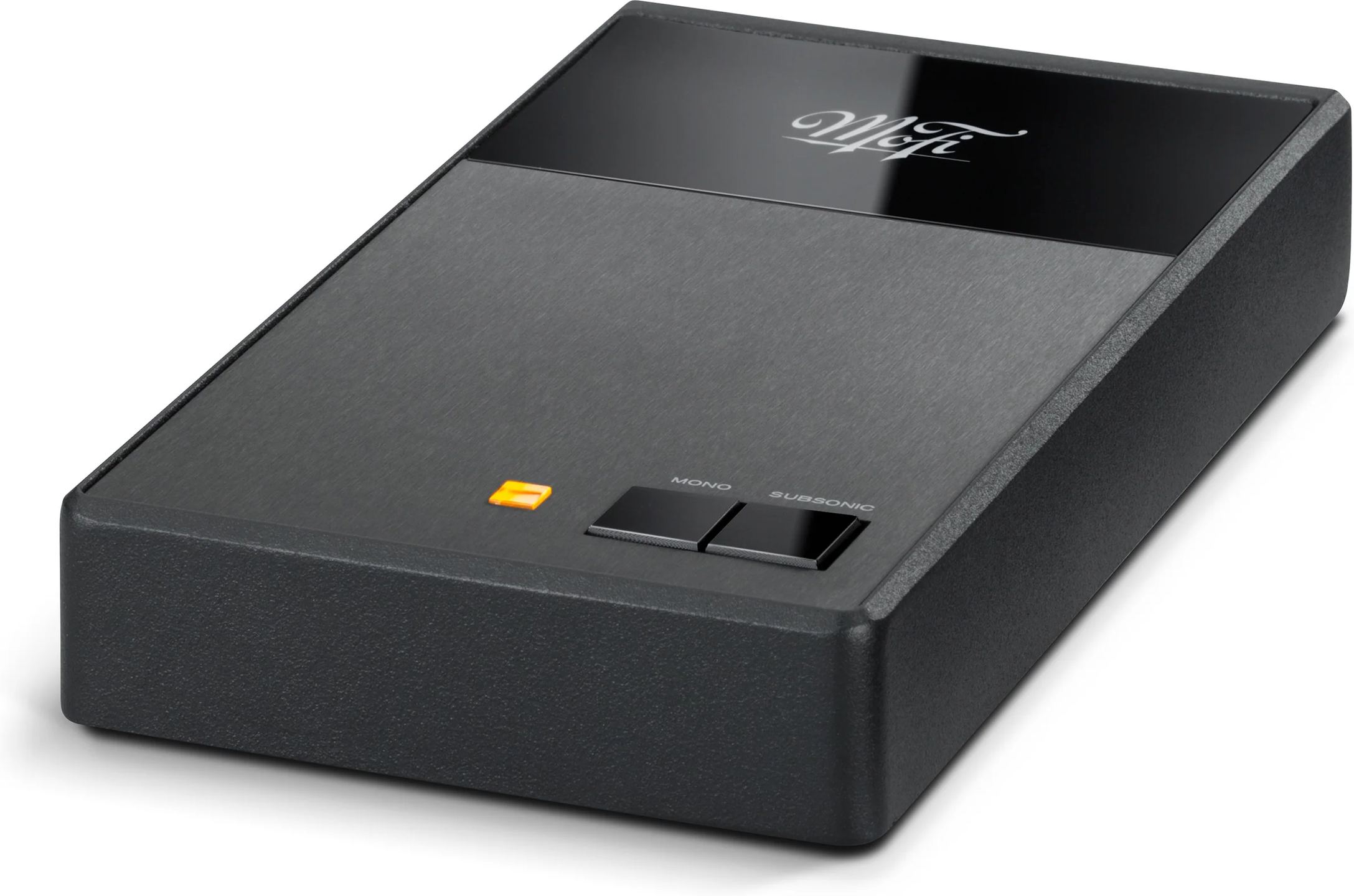
When a legendary record-pressing label starts making hi-fi electronics, you expect to find the same concern for accuracy in the components as in the grooves. The StudioPhono from MoFi Electronics is a hand-assembled MM/MC phono preamplifier made in the United States, in the Michigan factory the brand opened to produce its own equipment. Its circuit, developed with input from engineer Tim de Paravicini, draws on principles from the Gain2 Ultra Analog cutting chain used in the Mobile Fidelity Sound Lab mastering studios in Sebastopol, California.
A compact enclosure and simple setup
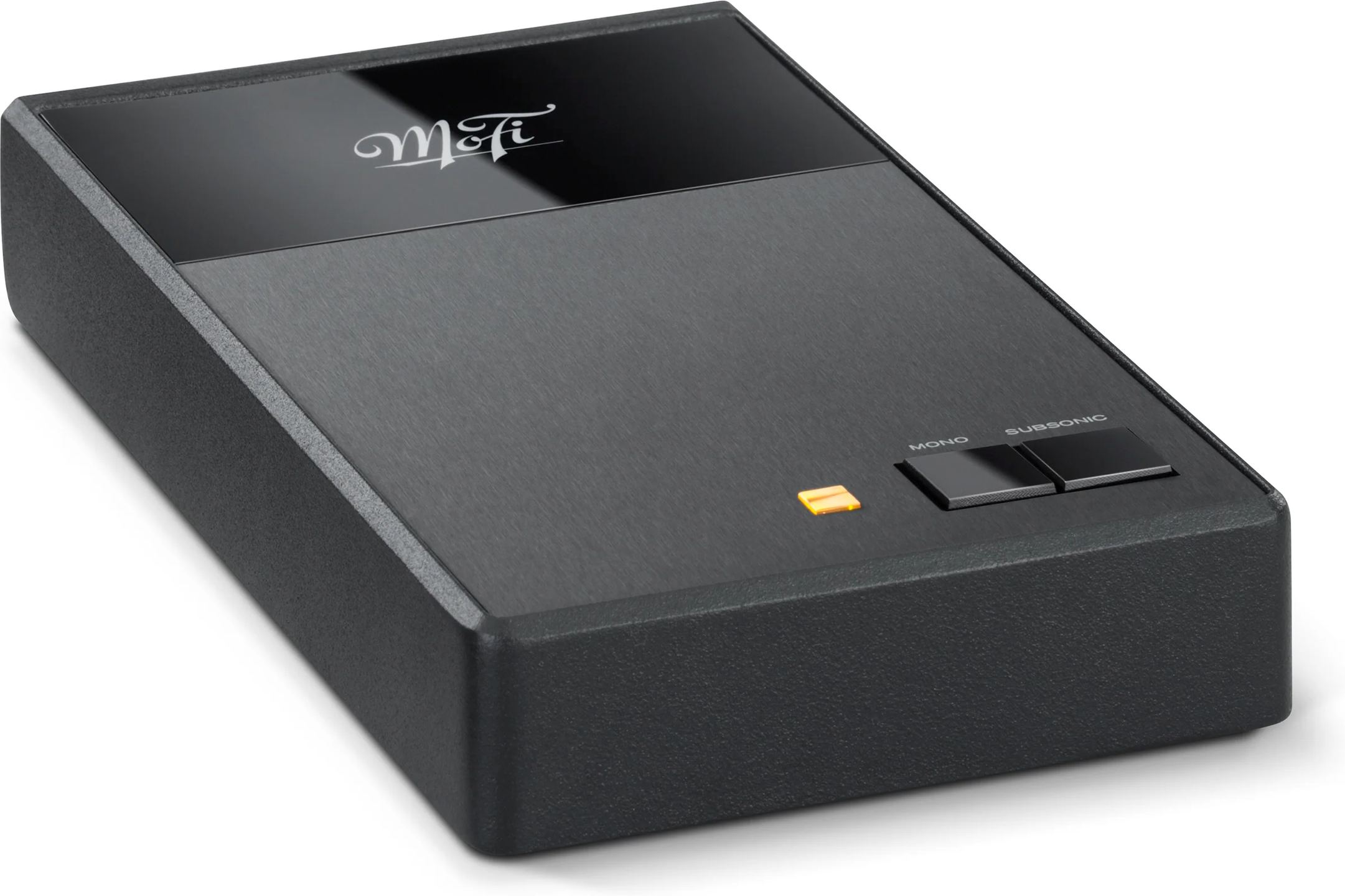
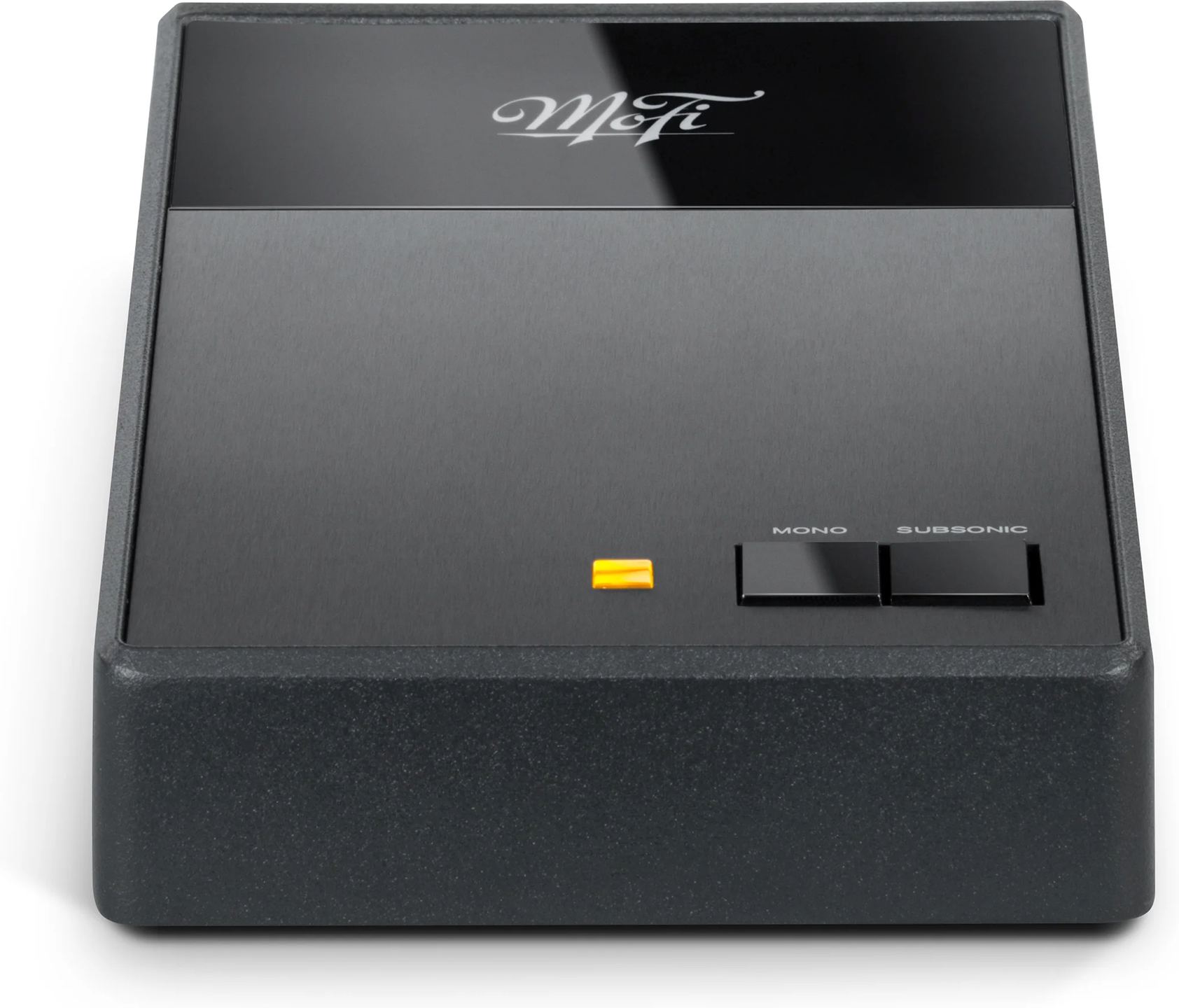
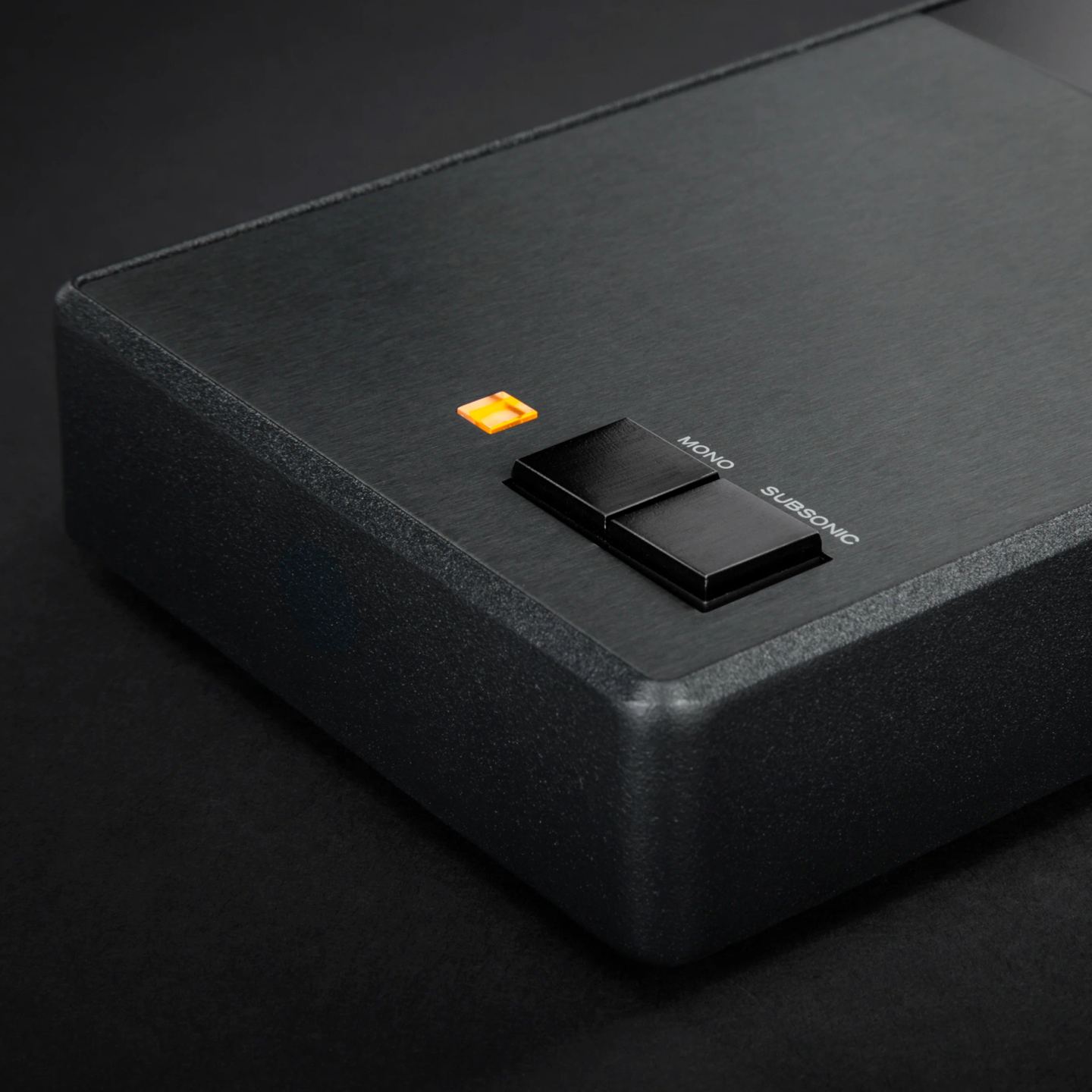
The StudioPhono fits into a vibration-resistant metal chassis measuring about 10 × 17 × 3.2 cm, barely larger than a paperback book. Its low profile (3.2 cm high) lets it slip onto a hi-fi cabinet without requiring a dedicated shelf. The enclosure has neither a power switch nor a display: MoFi recommends leaving it powered on at all times to keep the circuit at its optimal operating temperature.
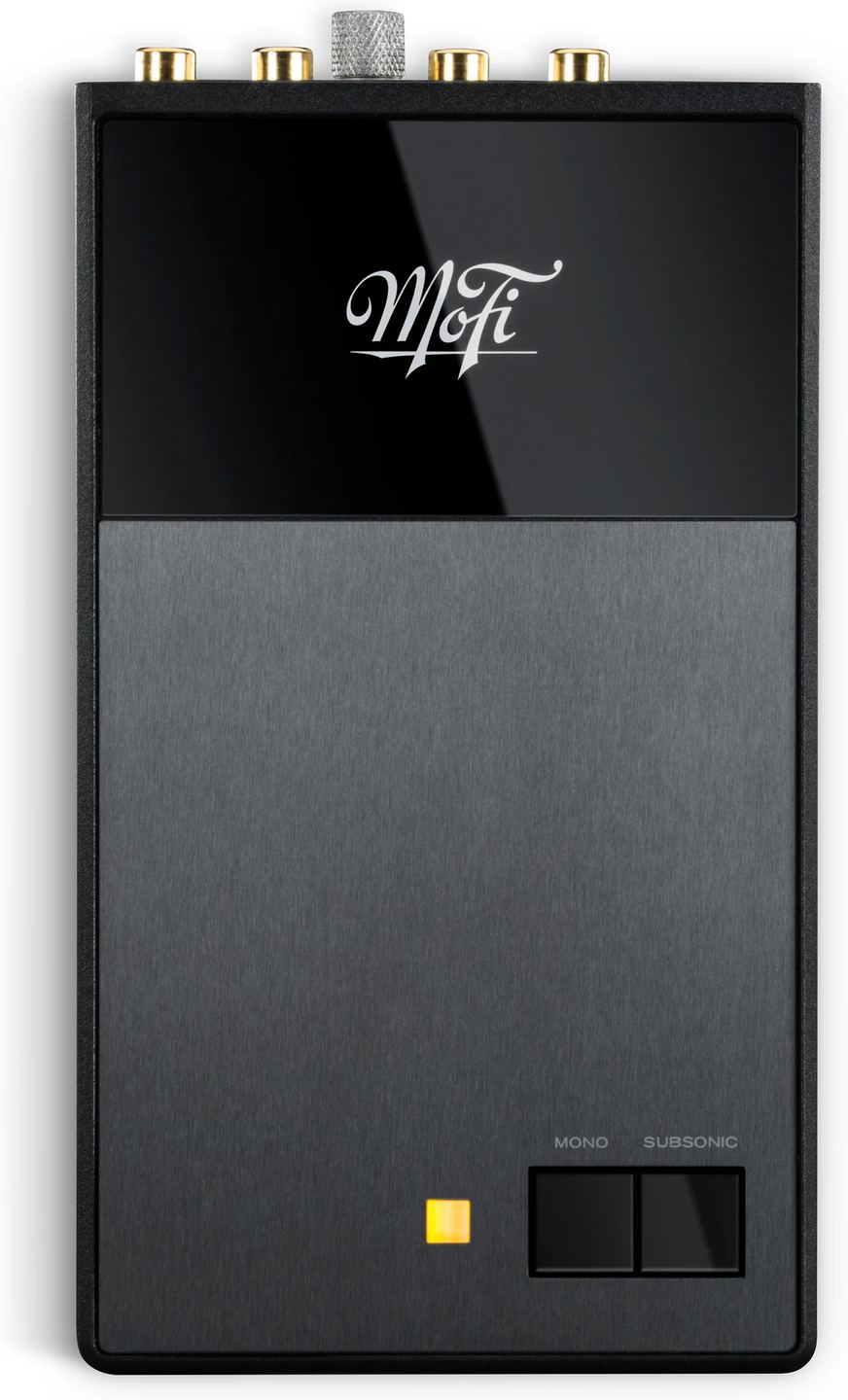
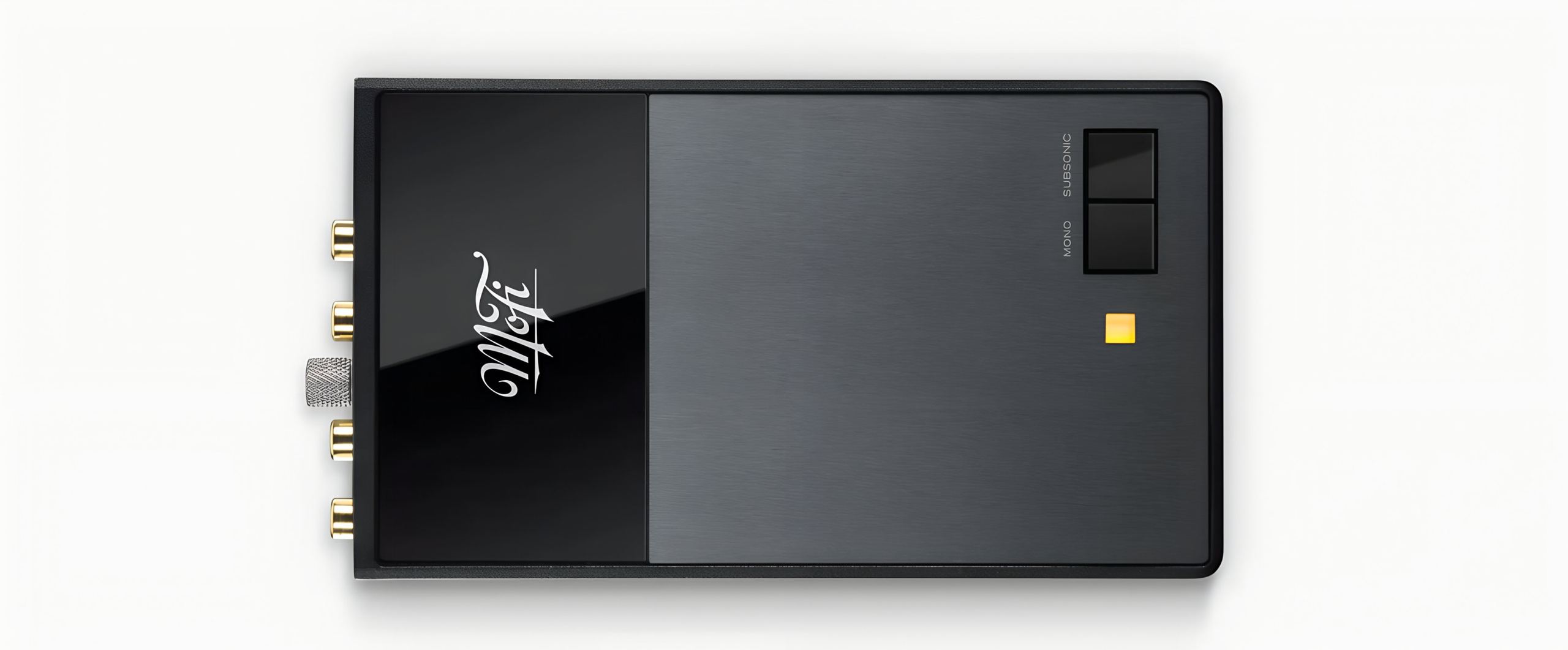
On the top, two push buttons control mono mode and the subsonic filter. The rear panel houses two pairs of RCA connectors (input and output), a ground terminal, and the external power supply connection. This remote, symmetrical power supply keeps the transformer away from the audio circuit to limit interference and maintain a very low noise floor.
Fine adjustments for almost all cartridges
Where most phono preamps in this range make do with a simple MM/MC switch, the StudioPhono goes further. A series of DIP switches located underneath the unit gives access to much more granular gain and load impedance settings. No tools are required: turn the enclosure over, flip the switches, and you’re done.
Gain can be set to four positions (40, 46, 60, and 66 dB), covering both high-output moving magnet (MM) cartridges and very low-output moving coil (MC) cartridges. Load impedance offers six values: 75, 100, 500, 1,000, 10,000, and 47,000 Ω. Input capacitance is fixed at 100 pF. This combination of settings allows the StudioPhono to match almost all cartridges on the market, including certain models with unusual configurations such as low-impedance Grado cartridges.
One point to keep in mind: the 100 pF input capacitance cannot be changed. Depending on the cartridge and the interconnect cable used, the total capacitance seen by the cartridge may vary, but it cannot be reduced below this value without internal modification.
Mono mode, an advantage for older collections
Few phono preamps at this price level offer a truly worthwhile mono mode. On a mono record, the musical signal is cut only in the horizontal plane of the groove; vertical movements produce only noise. By activating the StudioPhono’s mono mode, the two channels are summed and the vertical signal is canceled, which audibly reduces surface noise.
The result is noticeable on original pressings as well as on recent mono reissues: the sound image gains density and stability, and timbres seem fuller. On a record labeled “Electronically Reprocessed for Stereo” (the famous “fake stereo” of the 1960s), mono mode also helps restore the original tonal balance.
The subsonic filter: subtle but useful
The second front-panel button activates a high-pass filter that attenuates infrabass frequencies, generally below 20 Hz. These parasitic frequencies come from warped records, tonearm resonances, or vibrations transmitted through the turntable support. They are not audible as such, but they consume amplification power and can cause excessive woofer excursion, especially when a subwoofer is present.
The filter does not perceptibly alter musical bass reproduction. It acts as a safeguard, to be activated as needed: some systems will never need it, while others will benefit from greater cleanliness and control in the low end.
Transparency and dynamics: what the circuit says
The StudioPhono delivers total harmonic distortion (THD) below 0.01% in MM mode and below 0.012% in MC mode. These figures, combined with a very low noise floor, reflect a clear design priority: let the signal pass through exactly as it comes from the cartridge, with no added coloration.
Tim de Paravicini, who oversaw component selection and circuit topology, is also the founder of EAR Yoshino and has worked for Musical Fidelity, Quad, and Luxman. His collaboration with Mobile Fidelity dates back to the complete rebuild of the Studer A-80 tape machine in the Gain2™ mastering chain. The StudioPhono inherits that approach: wide bandwidth, respect for transients, tonal neutrality. The sound leans neither toward excessive warmth nor cold analytical character. MoFi says it spent more than two years building prototypes and testing different materials before finalizing the production version.
A preamp that evolves with the system
One of the StudioPhono’s strengths lies in its adaptability. With an entry-level turntable fitted with an MM cartridge, the default settings (47 kΩ, 40 dB) work without any adjustment. If you later move to a low-output MC cartridge, you simply change the gain and load impedance without replacing the preamp. This flexibility makes it possible to upgrade your analog source in stages while keeping the same phono stage.
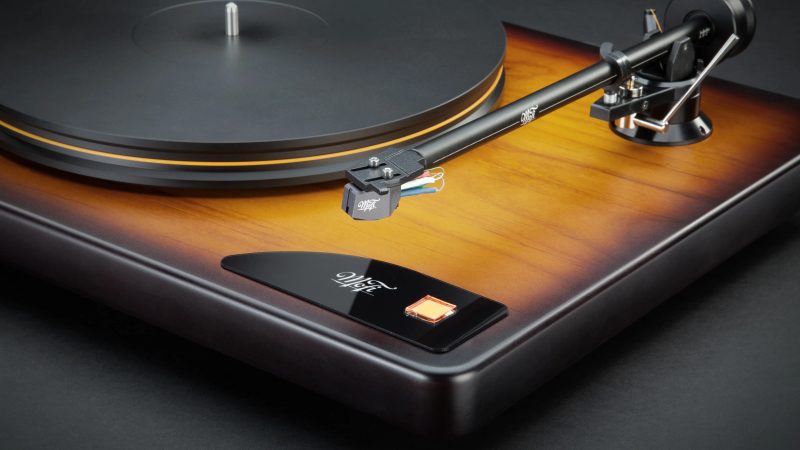
The StudioPhono works with turntables in the MoFi range (StudioDeck, UltraDeck), but it was not designed with any specific sonic synergy in mind. It integrates into any hi-fi system, between the turntable and the line input of an amplifier or receiver.
In the MoFi range: where the StudioPhono stands
The StudioPhono is the first step in the MoFi Electronics phono preamp range. Above it, the UltraPhono uses higher-quality components (better signal-to-noise ratio in MC mode, sound described as more neutral and analytical) and adds a Class A headphone amplifier. The phono circuit in both models shares the same design foundation, but the UltraPhono benefits from more carefully selected components for the MC section. Higher still, the UltraPhono Pro and MasterPhono are aimed at more ambitious setups, with fully discrete topologies and balanced outputs.
Documentation
Technical Specifications
Design and sonic philosophy
- Optimized circuit with the expertise of Tim De Paravicini
- Inspired by MoFi Gain2 Ultra Analog mastering standards
- Transparency and low sonic coloration
- Compatible with MM and MC cartridges
Settings and compatibility
- Adjustable gain: 40 dB, 46 dB, 60 dB, 66 dB
- Adjustable loading: 75 Ω, 100 Ω, 500 Ω, 1 kΩ, 10 kΩ, 47 kΩ
- Optimization of cartridge behavior
- Input capacitance: 100 pF
- Settings accessible via switches located under the unit, without tools
Advanced audio functions
- Mono mode
- Optimizes playback of mono records
- Improves stereo image stability on older pressings or mono reissues
- Subsonic filter
- Reduction of parasitic infrabass frequencies
- Improves bass stability and protects the speakers
Sound signature
- Very high transparency
- Excellent dynamics
- Very low background noise
- Respect for the natural timbre of instruments
- Stable and precise stereo image
- Faithful reproduction of the original signal
Technical specifications
- Gain: 40 dB to 66 dB (selectable)
- Total harmonic distortion (THD): < 0.01% (MM), < 0.012% (MC)
- MM load impedance: 47 kΩ
- MC load impedance: 75 Ω, 100 Ω, 500 Ω, 1 kΩ, 10 kΩ, 47 kΩ
- Input capacitance: 100 pF
Key points
- MM and MC compatibility
- Very precise gain and loading settings
- Mono mode for vintage vinyl
- Built-in subsonic filter
- Circuit designed with the expertise of Tim De Paravicini
- Transparent sound with very little coloration
Target audience
- Demanding audiophiles
- High-end MM or MC vinyl systems
- Collectors of mono vinyl and vintage pressings
- Users looking for a very neutral and flexible preamplifier
Frequently asked questions
Does the StudioPhono work with all phono cartridges?
It supports MM and MC cartridges thanks to its gain settings (40 to 66 dB) and impedance settings (75 Ω to 47 kΩ). The vast majority of cartridges on the market will find a suitable setting. Only certain very low-output MC cartridges (below about 0.2 mV) may lack gain even at the maximum 66 dB setting, depending on the sensitivity of the downstream amplifier.
Does the subsonic filter degrade the sound?
The filter acts on infrabass frequencies, below the threshold of audibility. Its effect on perceptible musical content is negligible. It is disabled by default and can be activated case by case, depending on the records and the system.
Is the external power supply an advantage or a constraint?
It is an acoustic design choice: by moving the transformer outside the audio enclosure, MoFi reduces electromagnetic interference in the circuit. The power supply block is included and plugs into a standard mains outlet. You should allow a little extra space near the unit.
Do the StudioPhono and UltraPhono have the same circuit?
The design foundation is shared (the same Tim de Paravicini topology), but the UltraPhono uses higher-quality components, which gives it a lower noise floor in MC mode and reproduction described by MoFi as more neutral. The UltraPhono also adds a headphone amplifier, absent from the StudioPhono.
Can the 100 pF input capacitance be changed?
No, the input capacitance is fixed. If the cartridge used requires a higher load capacitance, it is possible to add capacitive loading plugs to the input RCA connectors, but the 100 pF value cannot be reduced without internal circuit modification.
- Eco-contribution included in the sale price.
- Manufacturer reference: 00032689