Mofi Electronics Ultra LNF
Overview
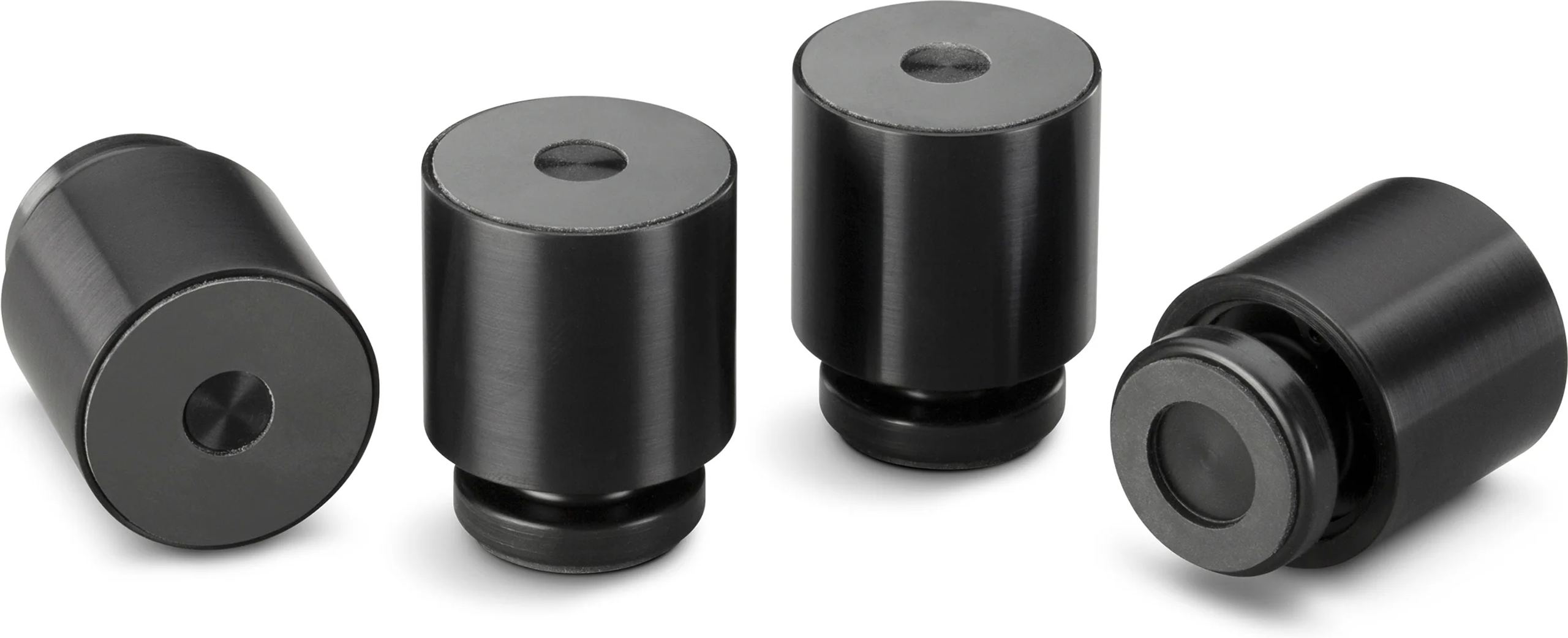
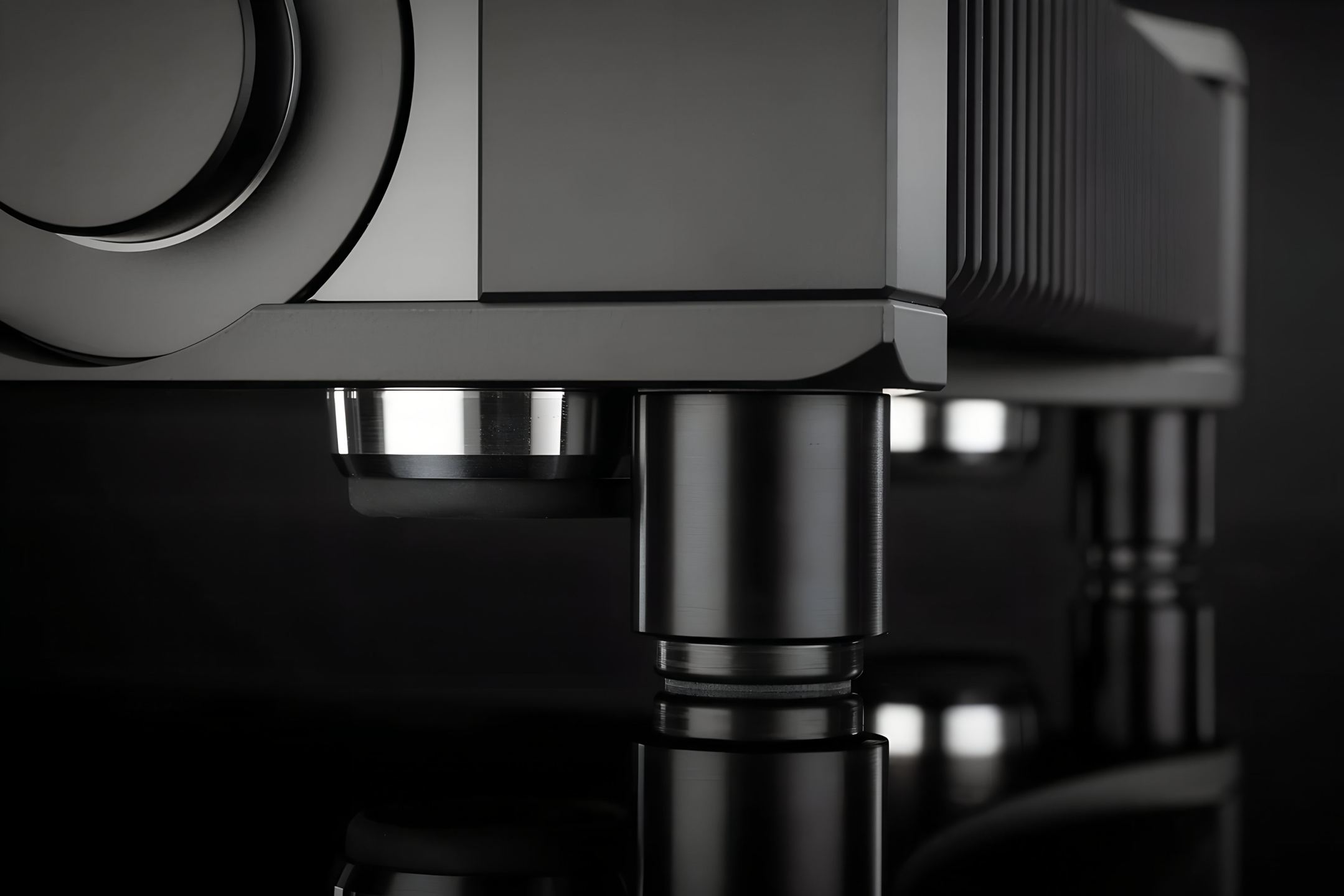
Three years of joint development between MoFi Electronics and Harmonic Resolution Systems (HRS), a vibration isolation specialist with roots in aeronautics and defense: the Ultra LNF (Ultra Low Noise Feet) condense highly specialized industrial expertise into a compact format. Sold in sets of four, these machined aluminum absorber feet slip under any hi-fi component to lower its noise floor, without altering the signal.
Why vibrations degrade sound
Speakers in operation transmit mechanical vibrations throughout the entire system via the furniture or floor. These parasitic vibrations travel up into component chassis and raise their noise floor, masking the fine details of the recording. The result is often perceptible: harshness, dryness, aggressiveness in the highs, loss of definition in the bass. And this phenomenon affects every link in the chain, from the turntable to the digital converter.
Isolation solutions have existed for a long time, from simple rubber pads to high-end decoupling bases. The Ultra LNF occupy a middle ground: a serious engineering product whose design is based on the rigorous selection of multiple materials, validated by both measurements and listening tests.
A collaboration with HRS, not just a badge
The name Harmonic Resolution Systems is not incidental. HRS was founded in 1999 by Michael Latvis, an engineer who spent decades designing isolation systems for commercial aviation, military aviation, and missile defense systems. Holder of several US patents, Latvis applied to home audio the finite element analysis methods and testing protocols he used in the aerospace sector.
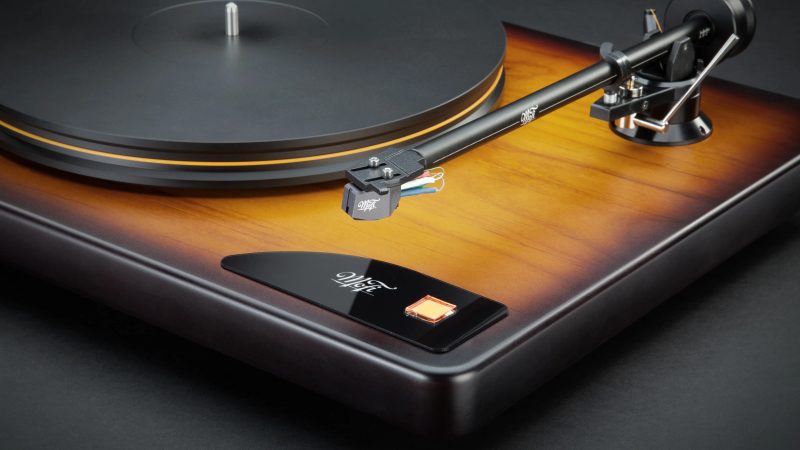
The collaboration between MoFi and HRS predates the Ultra LNF. The anti-vibration feet co-developed with HRS already equip MoFi Electronics’ StudioDeck and UltraDeck turntables, where they are an integral part of the design. The Ultra LNF make this isolation technology separately accessible, for any component.
Construction and operation
The outer housing is machined aluminum. The internal structure combines multiple materials, selected for their complementary vibration dissipation and damping properties. MoFi and HRS report having tested numerous combinations before arriving at the final product.
Each foot measures 4.01 cm tall (approximately 3.5 to 3.7 cm under load) with a diameter of 4.6 cm. The contact surface uses a high-grip, thread-free design, ensuring near-universal compatibility: no need for the component to have specific mounting holes. Simply place the component directly on the feet, without removing its original feet.
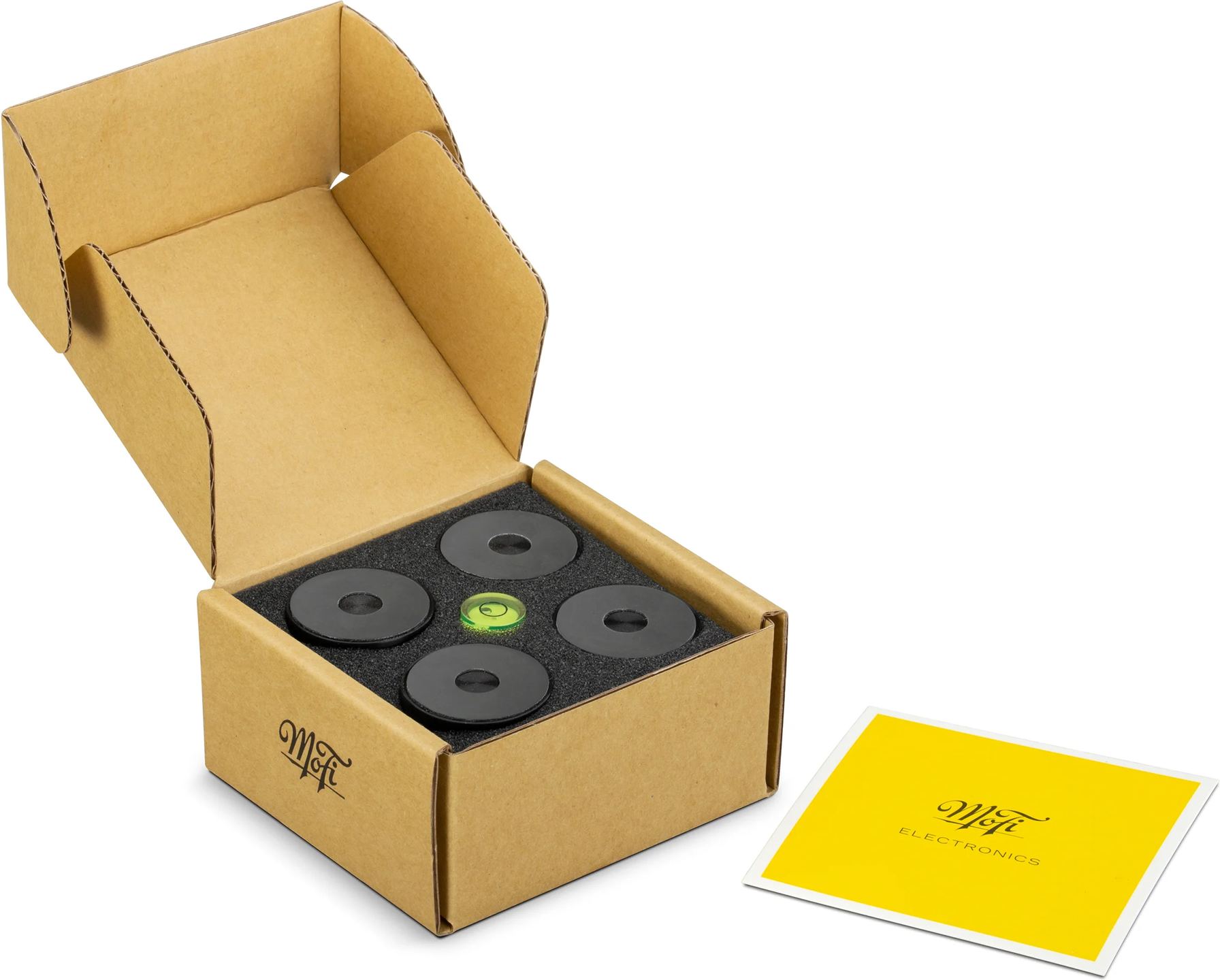
A bubble level is included with each set to verify the levelness of the installation, a detail that matters for turntables, where the platter’s alignment directly influences playback quality.
Three versions based on component weight
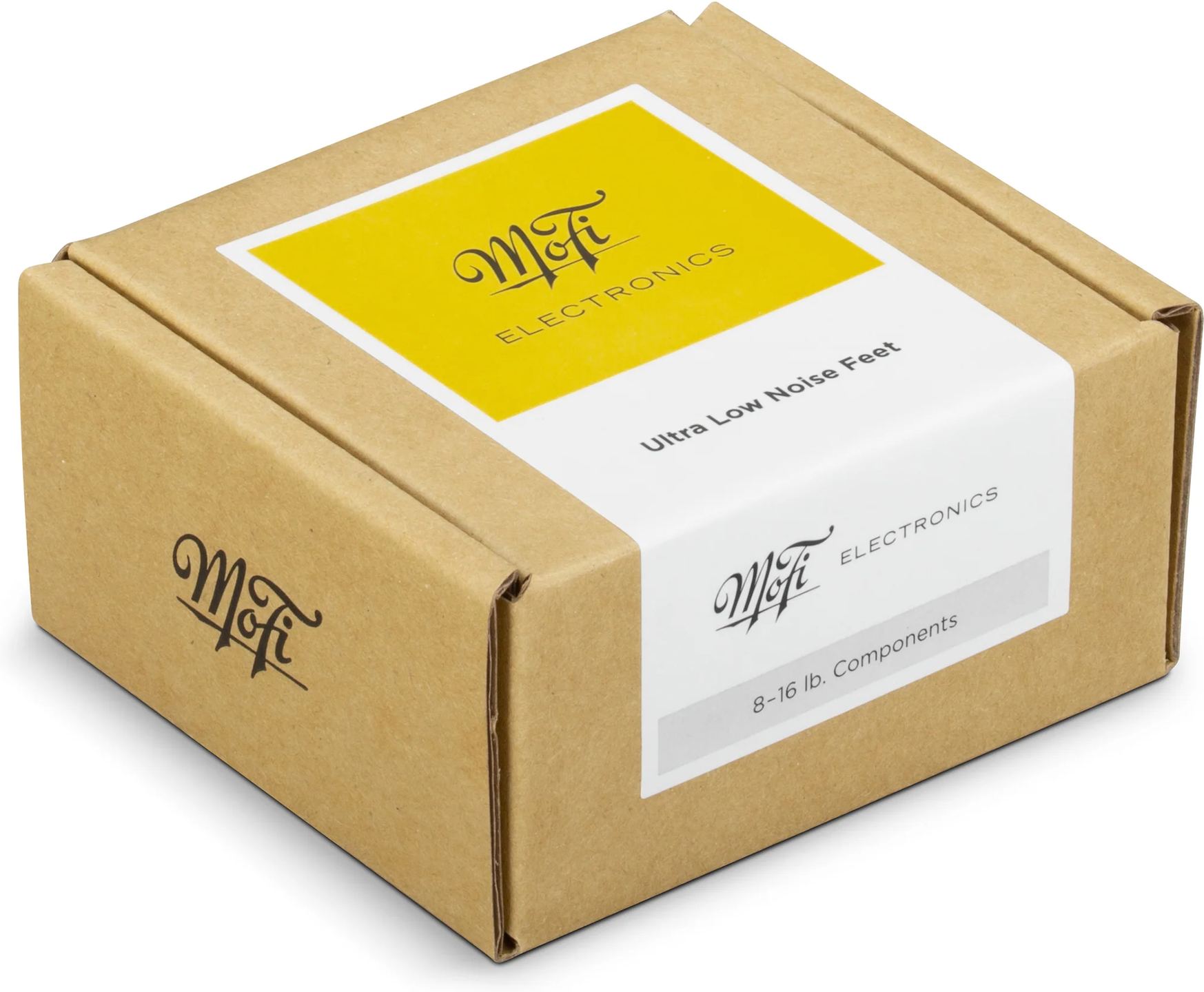
The Ultra LNF come in three variants, each calibrated for a specific load range (weight distributed across four feet):
- ULNF8-16: 3.6 to 7.3 kg
- ULNF16-24: 7.3 to 10.9 kg
- ULNF24-32: 10.9 to 14.5 kg
This calibration is not cosmetic. The effectiveness of an isolation system depends directly on the match between the supported mass and the mechanical characteristics of the device. Choosing the right version based on component weight determines the outcome. For components exceeding the maximum range, MoFi indicates that additional feet can be added to increase capacity.
What to expect when listening
MoFi claims a lowered noise floor across the entire audio spectrum, with no alteration of phase or frequency response. In practice, this translates to a quieter background, cleaner bass, a better-defined stereo image, and smoother reproduction of timbres and textures.
One of the points MoFi highlights is that the Ultra LNF impose no coloration of their own. The goal is not to modify the sonic signature of the component, but to allow it to operate closer to its potential by reducing mechanical disturbances in the chassis.
It is worth keeping in mind that the perceived benefit depends on several factors: the component’s sensitivity to vibrations (a turntable or CD player with a moving mechanism will be more receptive than a DAC with no moving parts), the quality of the support furniture, and the acoustic environment of the room. In a system already well isolated on an HRS rack or equivalent, the marginal benefit will logically be smaller than on a standard rack.
Technical Specifications
Technology and Design
- Developed in collaboration with Harmonic Resolution Systems (HRS)
- Multi-material isolation architecture
- Structure designed to dissipate mechanical vibrations
- No negative impact on phase and frequency response
- Optimized for maximum mechanical stability
Physical Specifications
- Height: 4.01 cm (1.578 inches)
- External structure: machined aluminum
- Packaging: set of 4 feet
- Manufacturing: United States
Load Capacity
- ULNF8-16: supports 3.6 to 7.3 kg
- ULNF16-24: supports 7.3 to 10.9 kg
- ULNF24-32: supports 10.9 to 14.5 kg
Audio Performance
- Reduction of overall background noise
- Reduction of harshness and sonic aggressiveness
- Improved musical fluidity and coherence
- Better stereo image focus
- Greater richness of textures and timbres
- Increased micro-dynamics
- Deeper soundstage
- Better instrument separation
- Cleaner, better-controlled bass
- Increased sense of realism and presence
Compatibility
Designed to be used under a wide range of audio equipment:
- Turntables
- DACs and digital converters
- Preamplifiers and amplifiers
- CD / SACD players
- Audiophile external power supplies
- Compact and bookshelf speakers
Installation
- Direct placement under the device
- Instant installation without tools
- No system modification required
Included Accessories
- Bubble level for precise adjustment
Frequently Asked Questions
Should the component's original feet be removed before placing the Ultra LNF?
No. The Ultra LNF are placed directly under the component, with the original feet left in place. The high-grip contact surface ensures stability without mechanical fastening.
Do the Ultra LNF work under floorstanding speakers?
They are designed for compact bookshelf speakers whose weight falls within the specified ranges. For floorstanding speakers, the weight generally exceeds the maximum capacity, even with additional feet.
What is the benefit of using Ultra LNF under a digital component with no moving parts (DAC, streamer)?
Mechanical vibrations transmitted through the chassis can affect clock circuits and capacitors in the signal path. Isolation remains relevant even in the absence of a rotating mechanism, though the effect will generally be more subtle than with a turntable or CD player.
Are the Ultra LNF suitable for a heavy power amplifier (20 kg and above)?
The ULNF24-32 version supports up to 14.5 kg across four feet. For a 20 kg component, additional feet would need to be added to distribute the load within the specified range. MoFi indicates that this approach is possible.
Can the included bubble level be reused across multiple installations?
Yes, the bubble level is a standalone accessory that can be reused with each configuration change or repositioning of the component.
- Eco-contribution included in the sale price.