

Gold Note Giotto
Overview
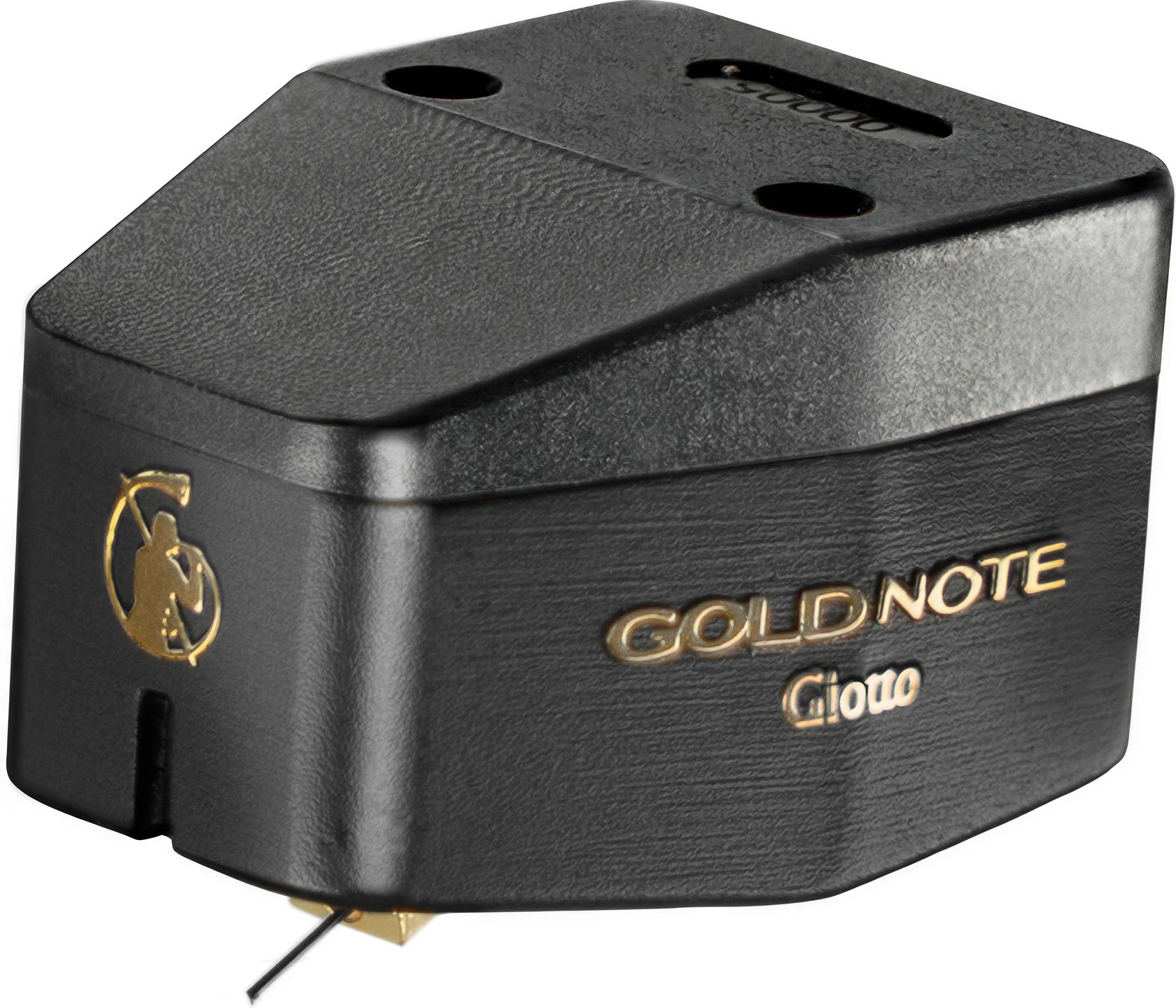
At Gold Note, cartridges bear names from the Florentine Renaissance, and that is no coincidence: the Tuscan manufacturer has been designing and assembling its products in Florence since the early 1990s. The Giotto is the most accomplished low-output MC cartridge in the current range, positioned above the Da Vinci and just below the Tuscany series. Its boron cantilever, Ultra Micro Elliptical diamond, and solid-machined body make it a technically coherent proposition for demanding analog systems.
A body carved from a solid block of 7000 series duralumin
The Giotto’s body is CNC-milled from a solid block of 7000 duralumin, an aluminum-zinc alloy used in aeronautics for its structural rigidity and light weight. Gold Note uses this same alloy across its entire MC cartridge lineup, from the Donatello to the Tuscany. The benefit is twofold: duralumin offers excellent mechanical strength while damping unwanted vibrations which, in a cartridge, can color the signal or cause undesirable resonances. The Giotto weighs 10 g, a mass compatible with the majority of modern 9- to 12-inch tonearms.
Boron and Ultra Micro Elliptical diamond: the tracking duo
The boron cantilever is one of the Giotto’s distinctive elements compared with the Da Vinci, which uses an aluminum cantilever. Boron is a material known for its high rigidity combined with very low mass: it transmits the diamond’s vibrations to the generator with minimal loss and deformation. This stiffness also promotes precise tracking of the micro-information engraved in the groove.
The diamond is an Ultra Micro Elliptical cut measuring 5 × 150 µm. This profile, more refined than a standard elliptical diamond or even the Da Vinci’s Micro Elliptical, allows more precise contact with the groove walls. The reduced contact surface improves tracking ability for fine modulations, resulting in better treble reproduction and faster transients. The downside of this finesse: this type of diamond requires careful adjustment of tracking force and tracking angle (VTA/SRA) to perform under the best conditions.
Gold Note does not manufacture its diamonds or cantilevers in-house. These parts come from two specialized Japanese manufacturers, Adamant-Namiki (also a supplier to the watchmaking industry) and Ogura, which is credited with inventing the “line contact” profile. The copper coils, on the other hand, are hand-wound in Gold Note’s Florentine workshops.
Generator and electrical characteristics
The magnetic circuit is based on a samarium-cobalt magnet, a material that produces a powerful magnetic field that remains stable over time. The copper coils generate an output level of 0.35 mV, typical of a low-output MC cartridge. That is slightly less than the Da Vinci’s 0.4 mV and significantly more than the Tuscany Gold’s 0.25 mV: the Giotto remains within a comfortable output range for most MC phono preamplifiers on the market.
Internal impedance is 8 Ω, with a recommended load of 100 Ω. Channel balance is specified at less than 1 dB of deviation, and channel separation exceeds 30 dB, two values that indicate careful generator assembly. Frequency response covers 10 Hz to 40 kHz, or 5 kHz more than the Da Vinci (10 Hz to 35 kHz): the boron cantilever and refined diamond contribute to this treble extension.
Adjustments and compatibility with tonearms
Recommended tracking force is between 1.9 and 2.1 g, a standard setting for this type of MC cartridge. Compliance of 12 × 10⁻⁶ cm/dyne is a medium value that makes the Giotto compatible with tonearms of medium to high effective mass, meaning most current 9- and 10-inch tonearms. With a very light tonearm (effective mass below 8 g), the resonance frequency would risk being too high.
The distance between the diamond tip and the mounting holes is 9 mm. This parameter is useful during installation to check overhang with an alignment protractor.
What the Giotto brings compared with the Da Vinci
The two cartridges share the same weight (10 g), the same compliance (12 × 10⁻⁶ cm/dyne), the same samarium-cobalt magnet, and the same 7000 duralumin body. The differences are concentrated in the cantilever/diamond pairing and the electrical parameters that result from it. Switching from aluminum to boron for the cantilever brings superior rigidity and more direct transmission of groove information. The Ultra Micro Elliptical diamond, finer than the Da Vinci’s Micro Elliptical, extends frequency response upward by 5 kHz and improves resolution in complex passages. The lower output level (0.35 mV versus 0.4 mV) and different impedance (8 Ω versus 4 Ω) mean you should check compatibility with the phono preamplifier, even if these values remain within common standards.
Documentation
Technical Specifications
Type and general characteristics
- Type: low-output MC (Moving Coil) phono cartridge
- Output level: 0.35 mV
- Channel balance: < 1 dB
- Channel separation: > 30 dB
Construction and materials
- Cantilever: ultra-rigid boron
- Stylus: Ultra Micro Elliptical (5 × 150 µm)
- Coil wire: copper
- Magnet: samarium-cobalt
- Body: 7000 series Duralumin alloy
Audio performance
- Frequency response: 10 Hz – 40 kHz
- Internal impedance: 8 Ω
- Recommended load: 100 Ω
- Compliance: 12 × 10⁻⁶ cm / dyne
Installation and settings
- Recommended tracking force: 1.9 to 2.1 g
- Stylus / mounting hole distance: 9 mm
- Total weight: 10 g
Sound qualities
- Rich, detailed, and perfectly balanced reproduction
- Extended dynamics and excellent spatial precision
- Wide bandwidth for very natural reproduction
- Boron cantilever for optimal rigidity and precise retrieval of micro-information
- Ultra Micro Elliptical stylus ensuring finesse, speed, and excellent groove-tracking ability
Frequently asked questions
Is the Giotto Gold Note's top-of-the-range cartridge?
No. The Tuscany series (Red and Gold) sits above it in the hierarchy. The Tuscany Gold uses a Super Micro Ridge diamond, silver coils, and a bandwidth extending from 5 Hz to 55 kHz. The Giotto is the most advanced model below that series.
What type of phono preamplifier should be used?
The Giotto requires a phono preamplifier equipped with an MC input, capable of handling an output level of 0.35 mV. The recommended input load is 100 Ω. Most MC preamplifiers with impedance adjustment are suitable, including Gold Note models such as the PH-10 or the PH-5.
Is the 12 × 10⁻⁶ cm/dyne compliance suitable for my tonearm?
This value corresponds to medium compliance. It works well with tonearms whose effective mass is approximately between 10 and 25 g. For very light tonearms (effective mass below 8 g), the resonance frequency could fall beyond the recommended 8 to 12 Hz range.
What is the difference between an Ultra Micro Elliptical diamond and a Micro Ridge?
The Ultra Micro Elliptical profile (used on the Giotto) is an ellipse with very fine radii (5 × 150 µm) that offers a good compromise between resolution and tolerance to adjustment. The Micro Ridge profile (Tuscany series) has an even finer contact edge and follows the groove more closely, which increases resolution but requires even more precise alignment.
- Eco-contribution included in the sale price.