

Gold Note Da Vinci
Overview
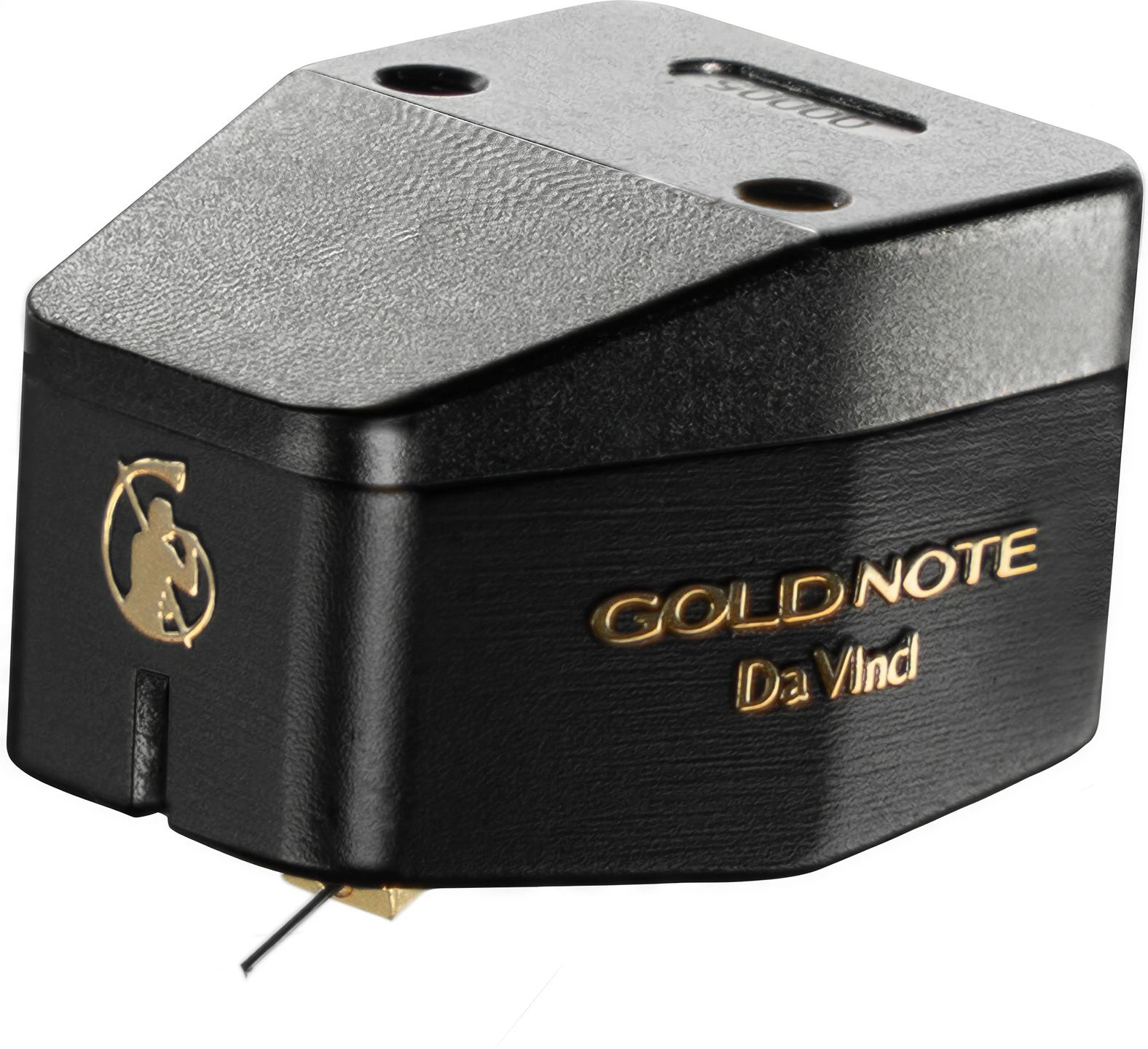
At Gold Note, cartridges are named after masters of the Florentine Renaissance. This one occupies a strategic place in the Tuscan manufacturer’s MC range, between the entry-level models and the very high-end Tuscany. With a micro-elliptical diamond mounted on an aluminum cantilever and a Series 7000 Duralumin body, the Da Vinci follows Gold Note’s in-house manufacturing principles while aiming for a balance between resolution, musicality, and relative accessibility.
A low-output MC cartridge designed and assembled in Tuscany
Gold Note develops and manufactures its cartridges in its workshops in Montespertoli, about twenty kilometers from Florence. The copper signal coils are wound on site, on armatures specific to the brand. The diamond and cantilever, however, come from two Japanese specialists recognized in the industry: Adamant-Namiki for the diamond tip and Ogura for the cantilever and crosspieces. This blend of Italian expertise and precision Japanese components is common to all of the brand’s MC cartridges.
The Da Vinci is a low-output moving coil (MC) cartridge: 0.4 mV. This level, entirely typical for an MC cartridge, requires an MC-compatible phono preamplifier or a step-up transformer. The internal impedance of 4 Ω and the recommended load of 47 Ω point toward a phono stage capable of working with very low-impedance sources.
Series 7000 Duralumin body: rigidity and resonance control
The Da Vinci’s body is machined from a solid block of Series 7000 Duralumin, an aluminum alloy with a high zinc content. This alloy, used in aeronautics for its stiffness-to-weight ratio, is found on all Gold Note MC cartridges, from the Donatello to the Tuscany. Machining from solid (rather than molding or assembling parts) limits parasitic vibrations and offers good control of cartridge body resonances.
The total weight is 10 g, a standard value that makes the Da Vinci compatible with the majority of 9-inch and 10-inch tonearms on the market, without requiring a special counterweight.
Micro-elliptical diamond and aluminum cantilever
The choice of a micro-elliptical diamond places the Da Vinci in an intermediate category in terms of tracking finesse. A micro-elliptical profile offers better groove tracking than a conical or standard elliptical diamond, with a more precise contact surface. It nevertheless remains behind more sophisticated profiles (Shibata, micro ridge, line contact) found on higher-range cartridges, including Gold Note’s Tuscany.
The aluminum cantilever, light and rigid, contributes to the cartridge’s frequency response: 10 Hz to 35 kHz. The Giotto, the model positioned just above it in the Gold Note range, adopts a boron cantilever and an ultra micro-elliptical diamond to reach 40 kHz. Boron is stiffer than aluminum at equal weight, which explains this difference in bandwidth. The choice of aluminum on the Da Vinci reflects a technical and economic compromise consistent with its positioning.
A samarium-cobalt magnetic system
The Da Vinci’s motor is based on a samarium-cobalt magnet, a material with high magnetic energy density. This type of magnet, found in the high-end MC cartridges of many manufacturers, produces a powerful magnetic field in a compact volume. Channel separation exceeds 30 dB and channel balance remains below 1 dB, two values that confirm the precision of the coil assembly and magnetic system.
Setup and compatibility with tonearms
The recommended tracking force is between 1.9 and 2.1 g, with a nominal value of 2 g. The compliance of 12 × 10⁻⁶ cm/dyne places the Da Vinci in the medium-compliance category, compatible with most tonearms of متوسط effective mass (10 to 20 g), which covers the vast majority of 9-inch and 10-inch tonearms on the market.
The distance between the diamond tip and the mounting holes is 9 mm. Gold Note recommends Baerwald alignment and specifies the overhang values for its own tonearms: 19 mm for the B-5, B-5.1, and B-7, and 21 mm for the 9-inch Betania. The recommended headshell offset angle is 24°. On a tonearm from another brand, a standard alignment protractor (Baerwald, Löfgren, or Stevenson) will allow the geometry to be set correctly.
Position in the Gold Note range
Gold Note’s cartridge range extends from the Vasari (MM) to the Tuscany Gold and Red (high-end MC models with silver or copper windings and a micro ridge diamond). The Da Vinci sits above the Vasari and Donatello, and just below the Giotto. It shares with the latter the same 7000 Duralumin body, the same samarium-cobalt magnetic system, and the same copper coil wire. The two cartridges differ in the cantilever (aluminum versus boron), the diamond profile (micro-elliptical versus ultra micro-elliptical), and the resulting bandwidth (35 kHz versus 40 kHz).
Documentation
Technical specifications
Electrical specifications
- Type: low-output MC (Moving Coil) phono cartridge
- Output level: 0.4 mV
- Frequency response: 10 Hz – 35 kHz
- Channel separation: > 30 dB
- Channel balance: < 1 dB
- Internal impedance: 4 Ω
- Recommended load: 47 Ω
Construction and components
- Stylus: micro elliptical
- Cantilever: lightweight high-rigidity aluminum
- Coil wire: copper
- Magnet: samarium-cobalt
- Body: 7000 series Duralumin alloy
- High-end Japanese components for the stylus and cantilever
Settings and compatibility
- Recommended tracking force: 1.9 to 2.1 g
- Compliance: 12 × 10⁻⁶ cm / dyne
- Stylus / mounting hole distance: 9 mm
- Total weight: 10 g
Recommended settings
- Recommended overhang depending on the tonearm:
- Gold Note B-5 / B-5.1 / B-7: 19 mm
- Betania 9” (22.86 cm): 21 mm
- Headshell offset angle: 24°
- Recommended alignment: Baerwald type for optimal tracking of the vinyl groove
Audio design
- MC cartridge fully developed by Gold Note
- Rich, detailed, and perfectly balanced reproduction
- Natural and fluid sound signature
- Design optimized for excellent midrange reproduction
Frequently asked questions
Is the Da Vinci compatible with an MM phono preamplifier?
No. With an output level of 0.4 mV and an internal impedance of 4 Ω, the Da Vinci requires an MC phono stage or a suitable step-up transformer. A standard MM preamplifier (around 40 dB of gain) will not provide enough gain for this cartridge.
What type of tonearm is suitable for this cartridge?
Its compliance of 12 × 10⁻⁶ cm/dyne and its weight of 10 g make it compatible with tonearms of medium effective mass, between about 10 and 20 g. This covers the vast majority of current 9-inch and 10-inch tonearms. Very light tonearms (effective mass below 8 g) or very heavy ones (above 25 g) will be less suitable.
What is the practical difference between the Da Vinci and the Giotto?
The Giotto’s boron cantilever is stiffer than the Da Vinci’s aluminum one, and its ultra micro-elliptical diamond provides finer contact with the groove. The Giotto reaches 40 kHz in frequency response (versus 35 kHz) and produces a slightly lower output level (0.35 mV versus 0.4 mV) with an internal impedance of 8 Ω instead of 4 Ω. In practice, the Giotto offers increased treble definition and finer retrieval of groove details.
- Eco-contribution included in the sale price.