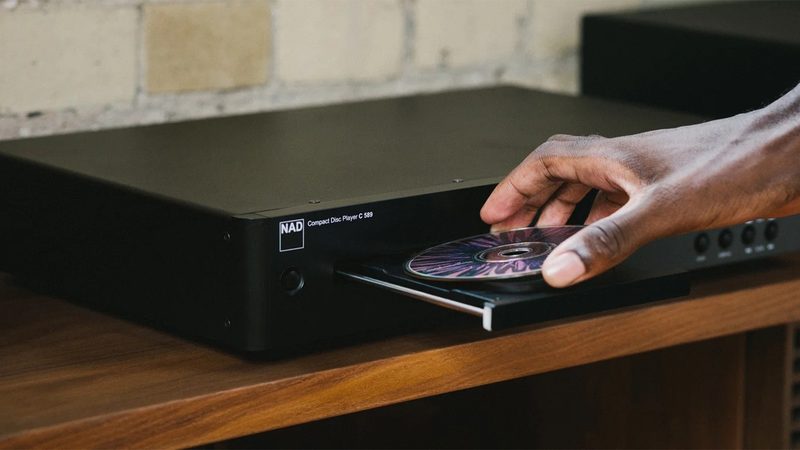
NAD C 589

Overview
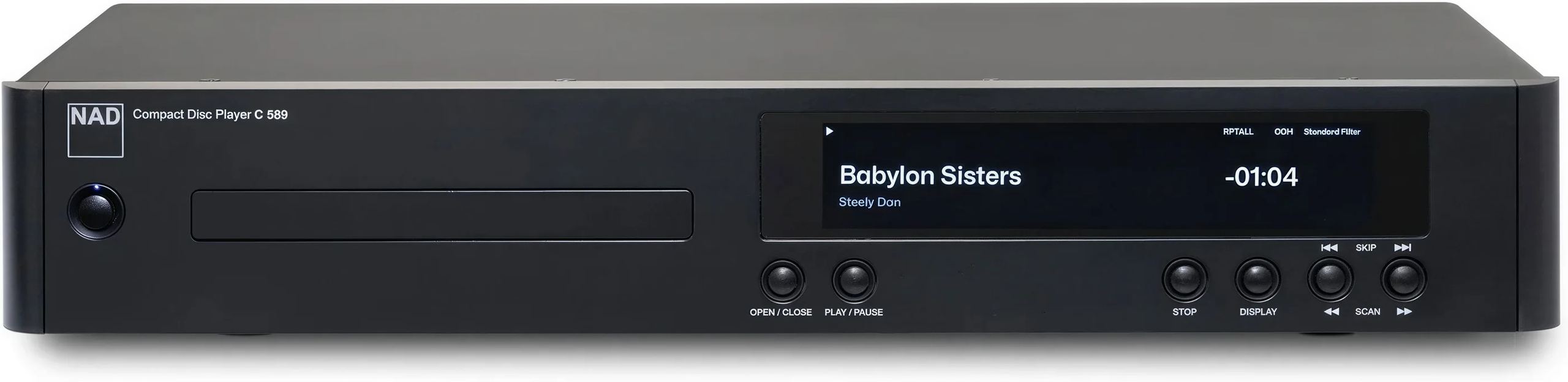
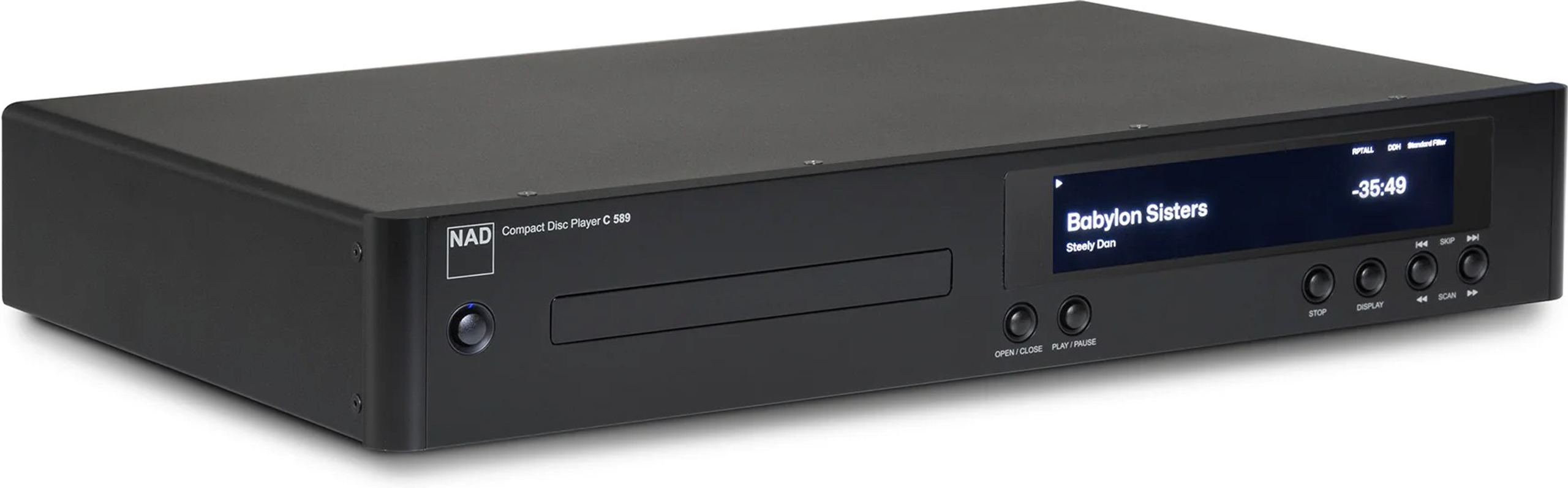
Ten years after the C 568 and its Wolfson converter, NAD is relaunching its CD player lineup with a model that moves up a level. The C 589 incorporates an ESS ES9039PRO DAC in a balanced configuration, QRONO d2a time-domain filtering from MQA Labs, and a Digital Dynamic Headroom (DDH) management circuit. The unit remains a pure CD player, with no network playback or SACD function, and that is a deliberate choice: the entire design focuses on extracting and converting the Red Book signal.
An ESS ES9039PRO converter in a balanced configuration
The C 589 is built around an ESS ES9039PRO SABRE, a chip also found in high-end standalone converters. NAD has implemented it in a fully balanced configuration, resulting in analog outputs available in both RCA (2.2 V) and XLR (4.4 V). The stated measurements are consistent with this level of component: signal-to-noise ratio of 115 dB or more (A-weighted), total harmonic distortion less than or equal to 0.005% at 1 kHz, and channel separation greater than 110 dB. Frequency response remains within a ±0.3 dB window between 20 Hz and 20 kHz.
These figures place the C 589 in a performance category where the quality of the analog output signal depends as much on the conversion stage as on the precision of disc reading upstream. That is where the other two onboard technologies come into play.

QRONO d2a: filtering in the time domain
Traditional digital filters used in D/A converters optimize frequency response, but they can introduce artifacts in the time domain, known as “pre-ringing” and “post-ringing.” QRONO d2a, developed by MQA Labs (whose technology was acquired by Lenbrook, NAD’s parent company), approaches the issue from another angle: rather than prioritizing frequency flatness, it seeks to preserve the signal’s time accuracy during analog reconstruction. The goal is to deliver cleaner transients and a more stable stereo image.
One notable point: the C 589 lets you switch between the QRONO d2a filter and a conventional digital filter. The user can therefore compare the two approaches on their own system and with their own recordings. It is a transparent approach, quite rare in this product category, that lets the listener judge the audible benefit for themselves.
It should be noted that QRONO d2a is a technology specific to the NAD/Lenbrook ecosystem. It does not decode MQA files in the streaming format sense: it applies to internal CD signal processing. The C 589 does, however, support playback of MQA-CDs, a distinct physical format that remains marginal in terms of available catalog.
Dynamic Digital Headroom: 3 dB of restored headroom
Some discs mastered at high levels suffer from inter-sample clipping, a form of distortion that occurs when signal reconstruction between two PCM samples exceeds 0 dBFS, even if no individual sample does. The phenomenon is common on CDs from the 2000s and 2010s, mastered according to the “loudness war” approach.
NAD’s DDH (Dynamic Digital Headroom) circuit restores 3 dB of internal headroom in the converter. On affected discs, this results in better-preserved dynamic peaks and reduced sonic harshness on the densest passages. On discs mastered with greater care, the effect will be less noticeable, since the signal never exceeds that critical limit.
An entirely new transport mechanism
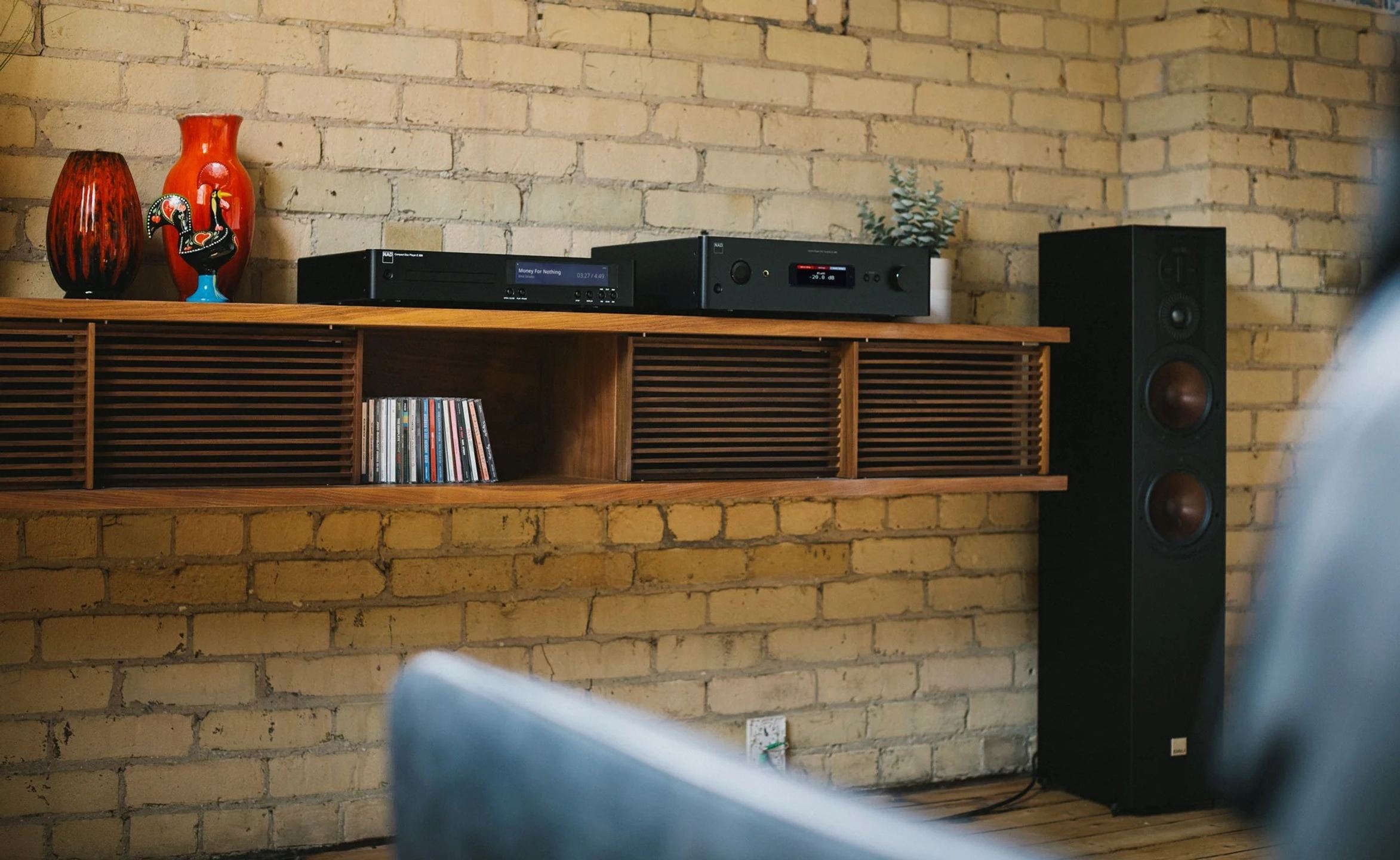
NAD developed a new transport mechanism and a new laser assembly for the C 589. Tray loading is described as fast and quiet, and the laser tracking system is optimized for stable reading, including on old or worn discs. Advanced error correction and chassis vibration control help reduce reading errors before the signal even reaches the converter.
The chassis, weighing 5.1 kg and measuring 435 x 83 x 294 mm (feet and rear connectors included), retains the standard format of Classic series components. Power consumption at idle is limited to 20 W, and drops below 0.5 W in standby.
Complete connectivity for two distinct uses
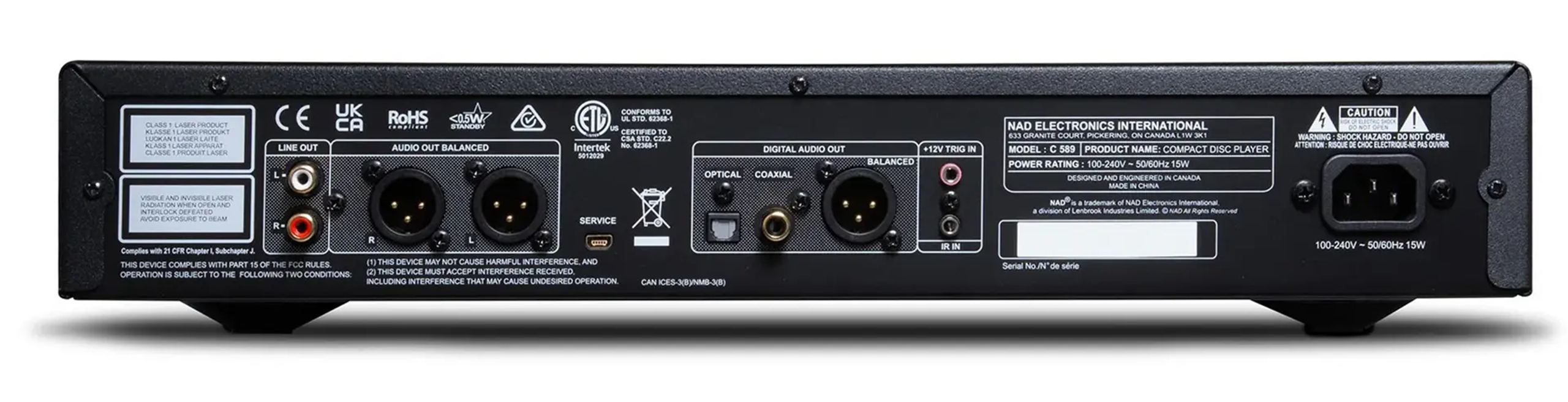
The rear-panel connections reveal the C 589’s dual purpose: standalone CD player or quality digital transport. In analog, the RCA and balanced XLR outputs allow direct connection to an integrated amplifier or a preamplifier. The XLR outputs are an advantage for installations where analog cables are long, because the balanced connection rejects interference more effectively.
In digital, three outputs are available: coaxial S/PDIF (75 ohms), optical, and AES/EBU (110 ohms). The presence of an AES/EBU output is uncommon in this range and is a real advantage for users who want to feed a high-end external converter with a very low-jitter signal. A 12 V trigger input allows integration into a home automation system or an automated rack. No digital input is provided: the C 589 is not an external converter. It is a CD player, and nothing else.
Ergonomics and display
The front panel features a 6.1-inch color LCD screen, readable from a distance, with CD-Text support. When the disc contains this metadata, the artist name and track title are displayed directly. Gapless playback is supported, which is appreciated for live albums, classical works, and continuous recordings. The supplied remote control covers all playback functions.
Documentation
Technical Specifications
Audio Performance
- RCA output level: 2.2 V ±0.1 V
- Balanced XLR output level: 4.4 V ±0.2 V
- AES / EBU digital output: 2 to 3 Vp-p / 110 ohms
- Coaxial digital output: 0.5 to 0.8 Vp-p / 75 ohms
- Frequency response: 20 Hz – 20 kHz (±0.3 dB)
- Total harmonic distortion (THD): ≤ 0.005% (1 kHz, LPF 20 kHz)
- Signal-to-noise ratio: ≥ 115 dB (1 kHz, A-weighting, LPF 20 kHz)
- Channel balance: 0.3 dB (0 dB / 1 kHz)
- Channel separation: ≥ 110 dB
Precision and Signal Processing
- NAD Dynamic Digital Headroom (DDH) technology reducing digital clipping and improving dynamics
- QRONO d2a filtering developed by MQA Labs for better time-domain accuracy and more natural sound
- Fully balanced ESS DAC delivering low noise and excellent dynamic range
- De-emphasis:
- -3.73 to -5.33 dB (0 dB / 1 kHz, 5 kHz)
- -8.04 to -10.04 dB (0 dB / 1 kHz, 16 kHz)
- Linearity:
- -3 ±0.1 dB (0 dB / 1 kHz to -3 dB)
- -6 ±0.2 dB (0 dB / 1 kHz to -6 dB)
- -10 ±0.25 dB (0 dB / 1 kHz to -10 dB)
- -20 ±0.25 dB (0 dB / 1 kHz to -20 dB)
- -60 ±0.5 dB (0 dB / 1 kHz to -60 dB)
Connectivity
- RCA stereo analog outputs
- Balanced XLR analog outputs
- Coaxial digital output
- Optical digital output
- AES / EBU digital output
Mechanical Design
- High-precision reading mechanism with fast and silent loading
- Optimized laser assembly for stable and reliable CD playback
- Robust chassis reducing vibrations and ensuring silent operation
- Easy integration into high-end hi-fi systems
Power Consumption
- Standby power consumption: < 0.5 W
- Idle power consumption: ≤ 20 W
Dimensions and Weight
- Dimensions (W x H x D): 435 x 83 x 294 mm
- Net weight: 5.1 kg
- Weight with packaging: 6.6 kg
Frequently Asked Questions
Can the C 589 play SACDs?
No. The C 589 is a pure CD player. It plays standard audio CDs (Red Book) and MQA-CDs, but not SACDs, DVD-Audio discs, or compressed files on CD-R.
Can the C 589 be used only as a CD transport with an external converter?
Yes. The coaxial, optical, and AES/EBU digital outputs allow you to bypass the internal DAC and feed an external converter. The AES/EBU output, with its 110-ohm impedance, is the most suitable for high-end systems.
What is the difference between the QRONO d2a filter and the conventional filter?
QRONO d2a prioritizes time accuracy (transients, stereo image) at the expense of slightly higher measured distortion. The conventional filter optimizes frequency response and measured distortion. The C 589 lets you switch between the two so the user can choose according to their preferences.
Is the DDH circuit active on all discs?
DDH processes the signal continuously, but its effect is audible only on discs suffering from inter-sample clipping, meaning those mastered at very high levels. On a well-mastered disc, the impact is negligible.
- Eco-contribution included in the sale price.
- GTIN / EAN: 786357003283