

IOTAVX PA3

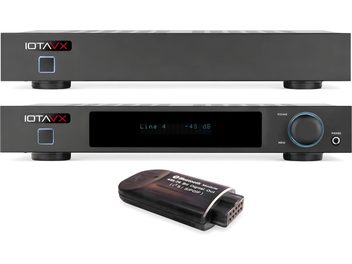
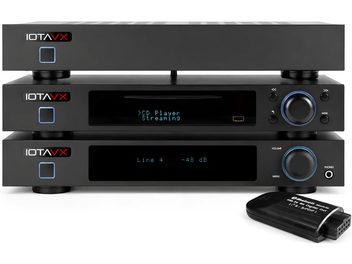
Buy as a bundle and save
IOTAVX PA3: a compact stereo power amplifier
Separating the preamplifier from the power stage has long been the preserve of expensive hi-fi setups. The IOTAVX PA3 takes a different approach: a Class AB stereo power amplifier housed in a compact steel chassis, delivering 90 watts per channel into 4 ohms and switching to bridged mode for the most demanding speakers. A device capable of supporting an integrated amplifier or powering a pair of speakers on its own.
A compact steel chassis
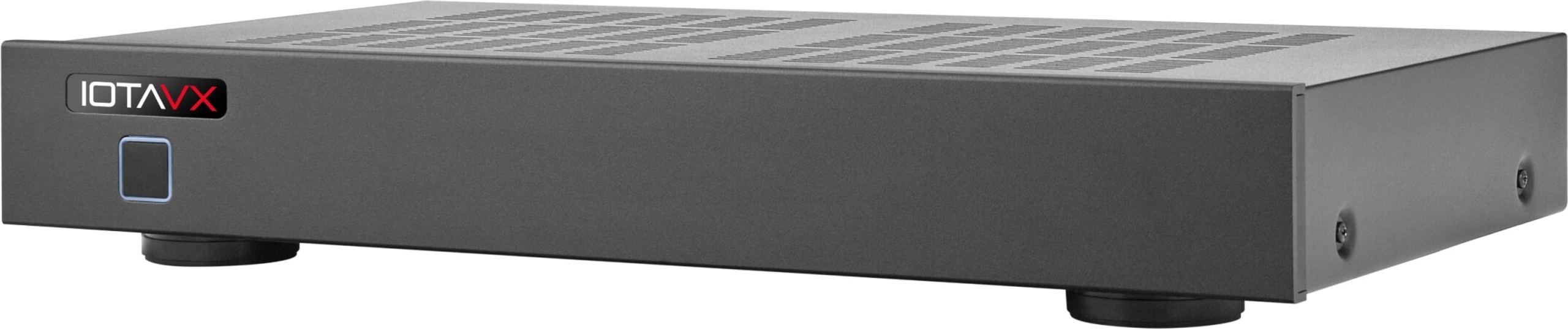
Conventional wisdom says a power amplifier takes up a lot of space. The PA3 measures 435 millimeters wide, 240 deep, and 70 high including feet, giving it a low profile that slips under another device or into a standard hi-fi cabinet. Its weight remains moderate at 6.5 kg.
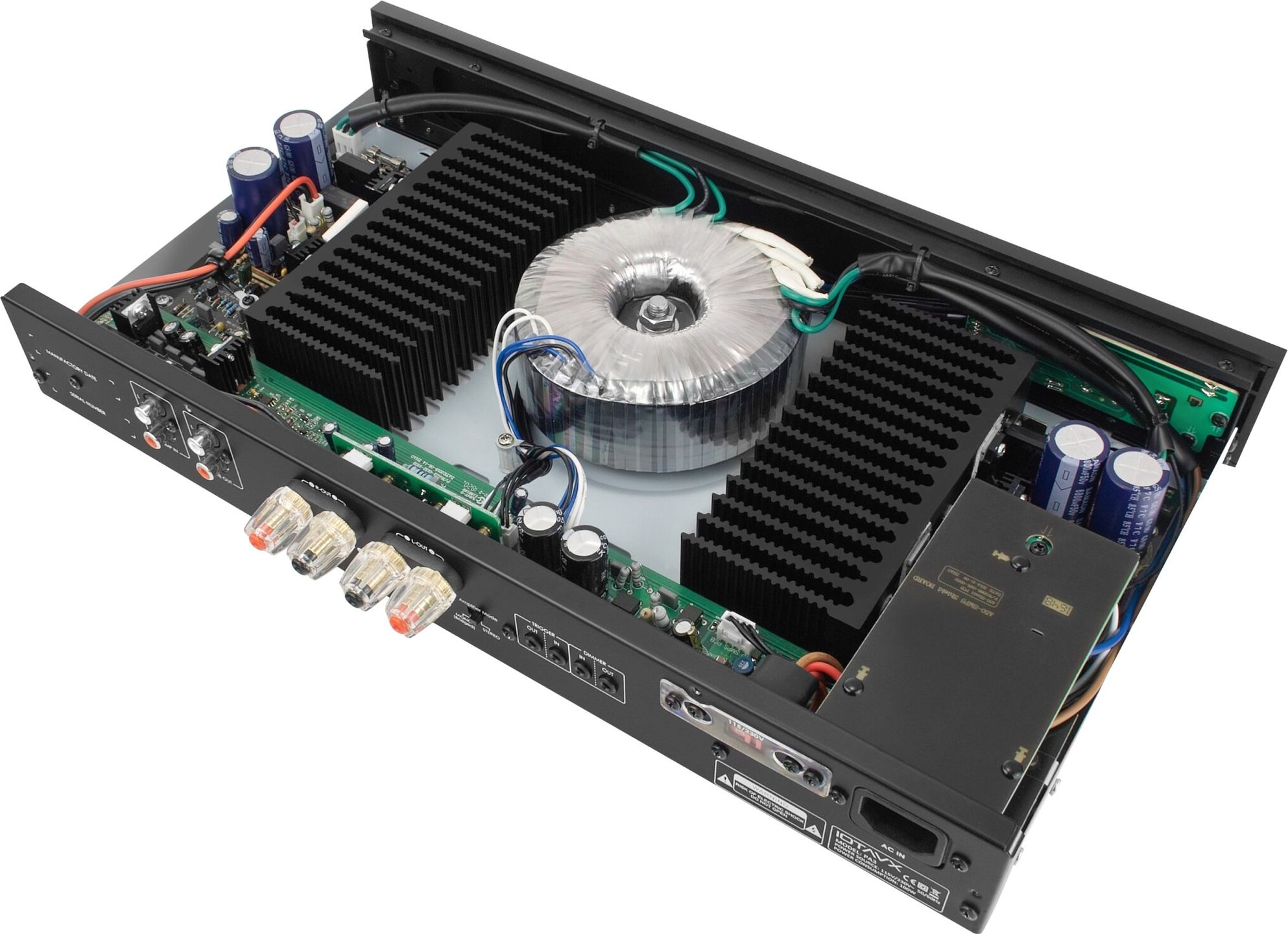
The steel enclosure serves two purposes: it protects the electronics and limits vibrations, two important points for a device designed to operate for a long time. The front panel is limited to a power switch, with no display or controls. Inside, a toroidal transformer supplies current to the power stage. This type of transformer, more compact and less prone to magnetic leakage than a conventional stacked-lamination model, helps maintain clean operation in a tight space.
Class AB amplification in practice
The PA3 is based on Class AB amplification. To understand the value of this choice, two topologies provide useful reference points. Class A keeps the transistors active over the entire signal: linearity is excellent, but efficiency is low and heat dissipation is high. Class B assigns each half-cycle of the signal to a separate transistor: efficiency improves, at the cost of crossover distortion at the zero crossing.
Class AB maintains slight conduction in both transistors around this crossover point. The result strikes a middle ground: distortion is significantly reduced compared with Class B, without the heat and bulk of a pure Class A design. This compromise explains why the majority of domestic hi-fi amplifiers adopt it, and the PA3 belongs to this category.
Controlled distortion and extended bandwidth
Three measurements summarize the PA3’s electrical behavior. Total harmonic distortion plus noise (THD + N) remains less than or equal to 0.005%, measured at 80% of power and at 1 kHz. In practical terms, the amplifier adds very little unwanted content to the signal it receives, even when operating close to its limits.
The signal-to-noise ratio exceeds 105 dB (measured at 32 W, A-weighted). This difference between the useful signal and the background noise determines the cleanliness of quiet passages and the silence between notes. Frequency response covers 10 Hz to 100 kHz within plus or minus 3 dB, a range that comfortably encompasses the audible spectrum and retains headroom at both ends. For a power amplifier sold at this market level, these figures reflect careful design rather than simple compliance with a minimum specification sheet.
Bridged mode for difficult speakers
In standard stereo operation, the PA3 delivers 45 watts per channel into 8 ohms and 90 watts into 4 ohms. These values are sufficient for average-sensitivity speakers in a reasonably sized room.
Bridged mode changes the equation for more demanding loads. It combines the two channels into one, which then delivers 90 watts into 8 ohms and 180 watts into 4 ohms. This configuration is relevant for low-sensitivity speakers, those whose impedance drops sharply at certain frequencies, or large rooms where more dynamic headroom is needed before clipping. One practical point: a bridged PA3 powers only a single channel. A fully bridged stereo system therefore requires two units, one per speaker.
Pairing with the SA3 integrated amplifier
The PA3 shares its dimensions and finish with the brand’s SA3 integrated amplifier, reusing the same steel chassis but without the display. This relationship is not merely aesthetic: IOTAVX positions the PA3 as the SA3’s power complement.
Pairing the two increases the available reserve for driving power-hungry speakers or filling a large space, without replacing the integrated amplifier already in place. For those starting with the SA3 alone and noticing a lack of reserve at high volume, adding a PA3 extends the system instead of starting over from scratch.
Documentation
Technical Specifications
Overview
- Hi-Fi stereo power amplifier
- Topology: Class AB amplification
- Audiophile design
- Robust steel chassis
- Audiophile-grade components
- Compact and discreet format
Output Power (RMS)
- Stereo mode
- 45 W × 2 at 8 Ω
- 90 W × 2 at 4 Ω
- Bridge mode, 1 channel
- 90 W at 8 Ω
- 180 W at 4 Ω
Audio Performance
- Total harmonic distortion + noise (THD + N): ≤ 0.005% (at 80% power, 1 kHz)
- Signal-to-noise ratio (SNR): > 105 dB (32 W, A-weighted)
- Frequency response: 10 Hz – 100 kHz (±3 dB)
Connectivity
- Inputs: stereo RCA
- Outputs: 1 × Pre Out
Power Supply and Consumption
- Supply voltage: 115 V AC or 230 V AC
- Mains frequency: 50 / 60 Hz
- Standby power consumption: < 0.5 W
Dimensions and Weight
- Dimensions (W × H × D, feet included): 435 × 70 × 240 mm
- Net weight: 6.5 kg
Packaging
- Contents: 1 piece
- Package dimensions: 51 × 35 × 16 cm
- Packed weight: 6.8 kg
Recommended Use
- Hi-Fi stereo power amplifier
- Can be combined with the IOTAVX SA3 for increased power
- Suitable for demanding speakers and large rooms
Key Features
- Very low distortion (0.005%)
- Wide bandwidth (10 Hz – 100 kHz)
- High power in bridge mode
- Compact format despite the performance
- Very low standby power consumption
Frequently Asked Questions
Can the PA3 be used without a preamplifier?
No. A power amplifier includes neither volume control nor source selection. The PA3 requires an upstream preamplifier, an integrated amplifier with a pre-out, or a source with variable output level, such as certain digital-to-analog converters or network players. It is this upstream device that manages volume and input selection.
Do you need two PA3 units to enjoy bridged mode in stereo?
Yes, if the goal is to benefit from 180 watts into 4 ohms on both channels. A bridged PA3 concentrates all its power on a single channel. Fully bridged stereo listening therefore requires one unit per speaker. With only one PA3, bridged mode still makes sense for mono use, or for driving a demanding passive subwoofer.
Does the PA3 run hot during operation?
Class AB amplification dissipates heat, especially at high levels and in bridged mode. The steel chassis contributes to thermal dissipation. It is best to leave clear space around the device, avoid enclosing it in a closed compartment, and place nothing on top, so that natural ventilation remains effective.
What speaker impedances does the PA3 accept?
The PA3 is designed for 4 to 8 ohm speakers, a range that covers the vast majority of domestic models. Available power increases as impedance drops: 45 watts into 8 ohms versus 90 watts into 4 ohms in stereo. A 6 ohm speaker falls between these two values and presents no particular difficulty.
How do you connect the PA3 to a network player or a digital converter?
The connection is made via the RCA inputs, provided the source has a variable-level output. Many network players and digital-to-analog converters offer a variable output mode, allowing them to be connected directly to the PA3 and the volume to be controlled from their app. Without this function, an intermediate preamplifier remains necessary.
- Eco-contribution included in the sale price.




