

IOTAVX AVXP 4-160

Overview
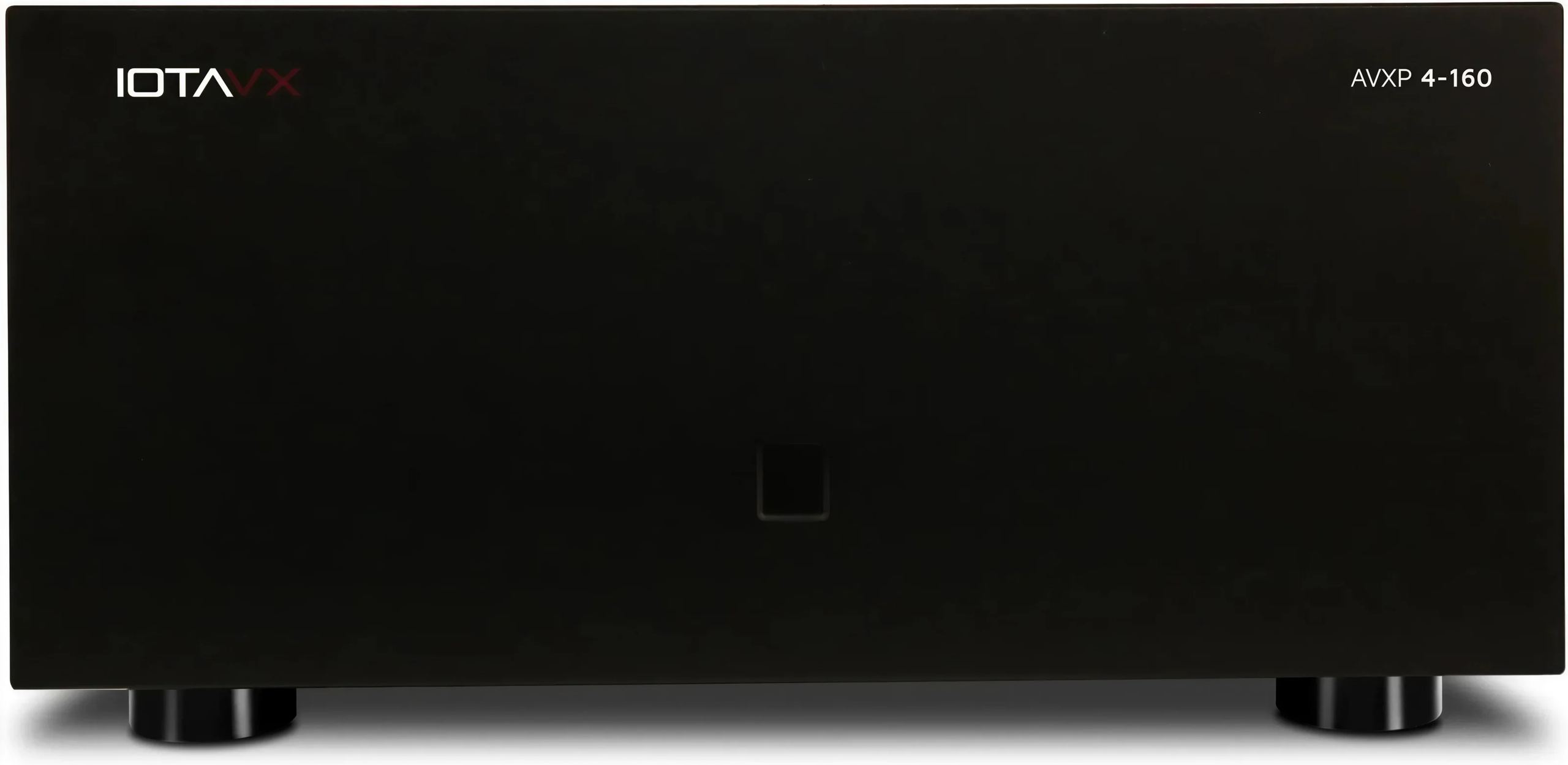
Completing a home theater system without replacing everything often means adding a few dedicated amplification channels rather than switching to a seven- or nine-channel power amp. The AVXP 4-160 fills this role in the IOTAVX range, with four Class AB stages, a shielded toroidal transformer, and mixed RCA/XLR connectivity. Four channels are enough to power Dolby Atmos height speakers, handle the rear channels of a 5.1.4 configuration, or bi-amp a pair of main speakers.
The four-channel format and its use cases
The four-channel format occupies a specific place in the power amp landscape, between stereo and seven-channel multichannel models. It addresses clearly identified situations. In a Dolby Atmos 5.1.4 or 7.1.4 setup, the AVXP 4-160 handles the two pairs of height speakers. The internal amplification of a home theater amplifier then remains available for the front soundstage and side channels, which reduces thermal load and current draw on the receiver’s internal stages.
The power amp can also drive the side and rear surround channels of a 7.1 configuration, or all four channels in a large room where the amplification of a consumer device struggles to maintain volume without clipping. Bi-amping is another possible route: two pairs of terminals per speaker, two dedicated amp stages for each tower speaker, one channel for the bass section and one channel for the midrange-treble section. This compatibility also covers in-ceiling speakers, common in discreet Atmos installations.
Current reserve and speaker control
On paper, 110 W per channel into 8 ohms and 160 W into 4 ohms with all channels driven place the AVXP 4-160 in the medium-to-high power range. The real interest lies more in its energy reserve. The damping factor exceeds 200, which indicates good control over speaker driver movement, particularly in the bass. Filtering capacity reaches 13,600 µF per channel, or 55,000 µF in total, and the shielded toroidal transformer is sized for a maximum power consumption of 1,160 W. This combination responds to the dynamic peaks typical of movie soundtracks, where peak energy can amount to several times the average power for a few milliseconds.
With speakers of average or lower sensitivity, the bass remains controlled without pumping and the midrange retains precision even at high levels. The trade-off of Class AB is well known: more heat dissipated than a Class D stage, a chassis that grows warm after a few hours, and standby consumption that remains measurable. The reinforced steel chassis and components selected for long-term reliability fit prolonged use in an active home theater system.
Dual RCA and XLR connectivity
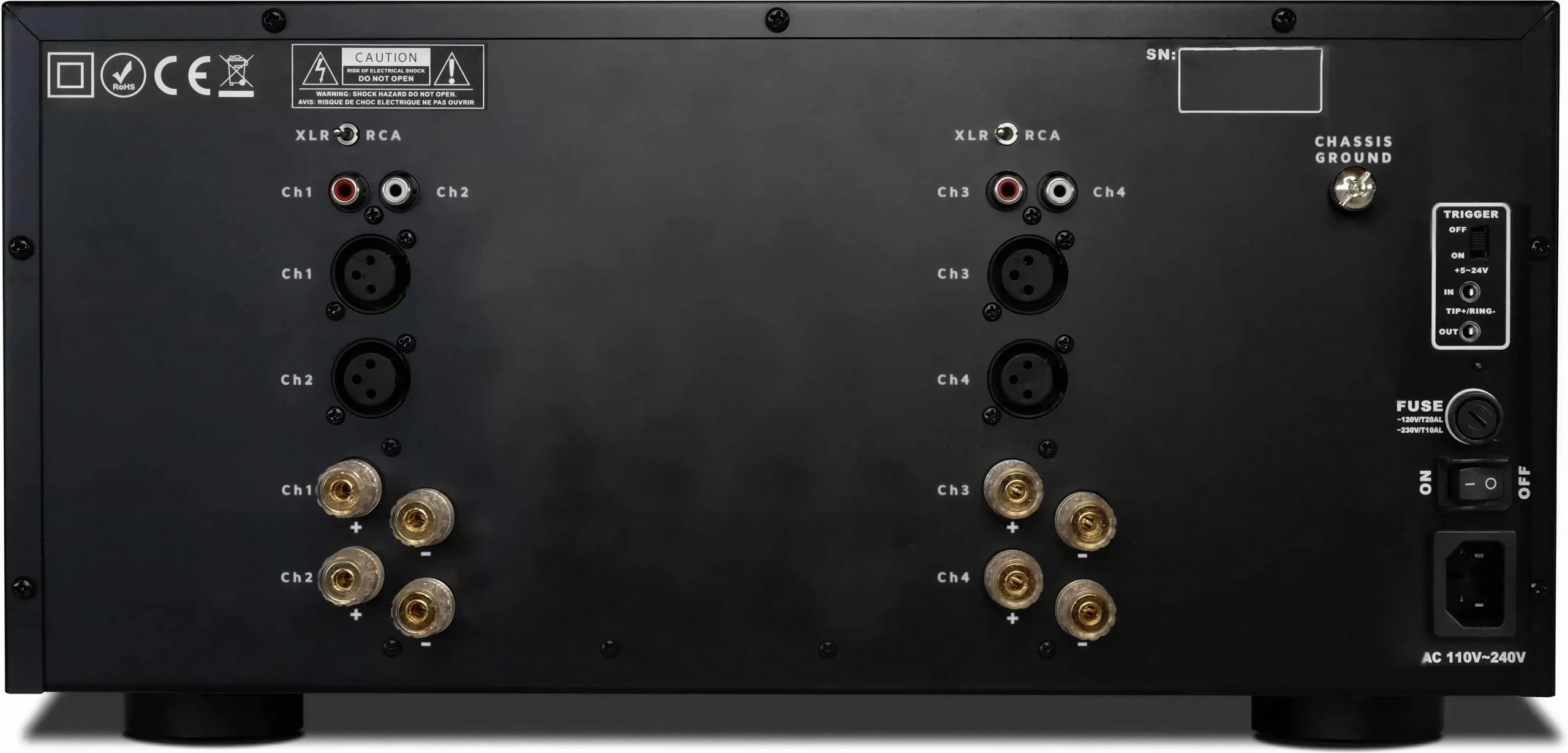
Each channel has an unbalanced RCA input and a balanced XLR input. The XLR connection limits interference over long cable runs; it matters when the power amp is installed in a technical room separate from the preamplifier, or in dedicated furniture on the ground floor of a theater room. RCA remains the standard on most consumer home theater amplifiers. This dual input arrangement leaves flexibility in the choice of matching preamplifier or processor, without imposing a specific product family.
Place in the IOTAVX range and possible configurations
In the British brand’s catalog, the AVXP 4-160 slots in between the seven-channel AVXP1 and the three-channel power amps dedicated to the front soundstage such as the AVXP 3-300. Paired with the AVX17 multichannel preamplifier, which handles up to 17 processing channels, it completes an ambitious installation: three front channels assigned to an AVXP 3-300, four height or surround channels handled by the AVXP 4-160. The combination covers Dolby Atmos or DTS:X configurations in 9.1.4 or 7.1.6 without resorting to a single seven- or nine-channel chassis.
The power amp also connects to the pre-out outputs of a consumer home theater amplifier, without a dedicated preamplifier. At 25.2 kg in shipping carton and with dimensions of 59 by 56 by 32 centimeters on delivery, integration into standard furniture requires checking the available depth and the shelf’s load capacity.
Documentation
Technical specifications
Power and amplification
- Number of channels: 4
- Output power
- 4 x 110 W into 8 Ω (all channels driven)
- 4 x 160 W into 4 Ω (all channels driven)
- Damping factor: > 200
- Filter capacitance
- Per channel: 13,600 µF
- Total: 55,000 µF
Power supply
- Low-noise shielded toroidal transformer
- Maximum power consumption: 1,160 W
- Design optimized for high current demands and dynamic peaks
Connectivity
- Unbalanced RCA inputs
- Balanced XLR inputs
Performance
- High stability with difficult loads
- Precise loudspeaker control
- High dynamic response
- Detailed reproduction with tight, controlled bass
- Compatibility with surround, Atmos, and in-ceiling speakers
Recommended applications
- High-end home theater
- Dolby Atmos / DTS:X systems
- Configurations up to 9.1.4 or 7.1.6 (in combination with the AVX17 preamplifier)
- Multichannel Hi-Fi installations
Construction
- Reinforced steel chassis
- Components selected for long-term reliability
- Robust construction intended for intensive use
Dimensions and weight
- Packed weight: 25.2 kg
- Package dimensions (W x D x H): 59 x 56 x 32 cm
Frequently Asked Questions
Can the AVXP 4-160 be used with a consumer home theater amplifier?
Yes, provided it has active pre-out outputs on the channels to be amplified. These outputs connect via RCA to the AVXP 4-160, and the receiver’s internal amplification remains available for the other channels. On a device with nine internal channels, it becomes possible to drive a 9.1.4 configuration by assigning the four height channels to the IOTAVX amplifier block.
What’s the difference compared with the entry-level seven-channel IOTAVX AVXP1?
The AVXP1 delivers 110 W per channel into 8 ohms across seven channels, which is the same power per channel into 8 ohms as the 4-160, but in a wider format. The choice between the two depends on the target configuration: seven channels in a single chassis to drive a complete 5.1.2 or 7.1 setup, or four channels to complement an existing system without oversizing the investment.
Is the AVX17 preamplifier essential for using the block?
No. The AVX17 is part of the IOTAVX range and provides consistent integration in 9.1.4 or 7.1.6 setups, but the AVXP 4-160 works with any home theater amplifier or processor with suitable pre-out outputs. The XLR connections also allow use with third-party brand preamplifiers via their balanced outputs.
What does a damping factor greater than 200 correspond to?
The damping factor reflects the amplifier’s ability to control the movement of the speaker driver, especially at low frequencies. From 100 onward, control is considered good; above 200, bass remains tight with no perceptible overhang on most speakers. This helps with the percussive peaks of movie soundtracks or with low-sensitivity height speakers, where the amplifier must start and stop the diaphragm quickly.
Can the unit be left powered on permanently?
Class AB dissipates heat even at idle, and power consumption remains measurable when not in use. To limit thermal wear on components and the electricity bill, it is better to switch off the unit outside of extended listening sessions.
Should special ventilation be provided to integrate it into a piece of furniture?
Class AB runs warm in use, more so than a Class D stage. A few centimeters of clearance above the top cover and at the sides help prevent hot air from building up; it is best not to stack another device directly on the chassis. With a packaged weight of 25 kg, the shelf must also be rated for the load.
- Eco-contribution included in the sale price.
- GTIN / EAN: 5060530750276




