Ungnoi Model Taichi MAX
Overview
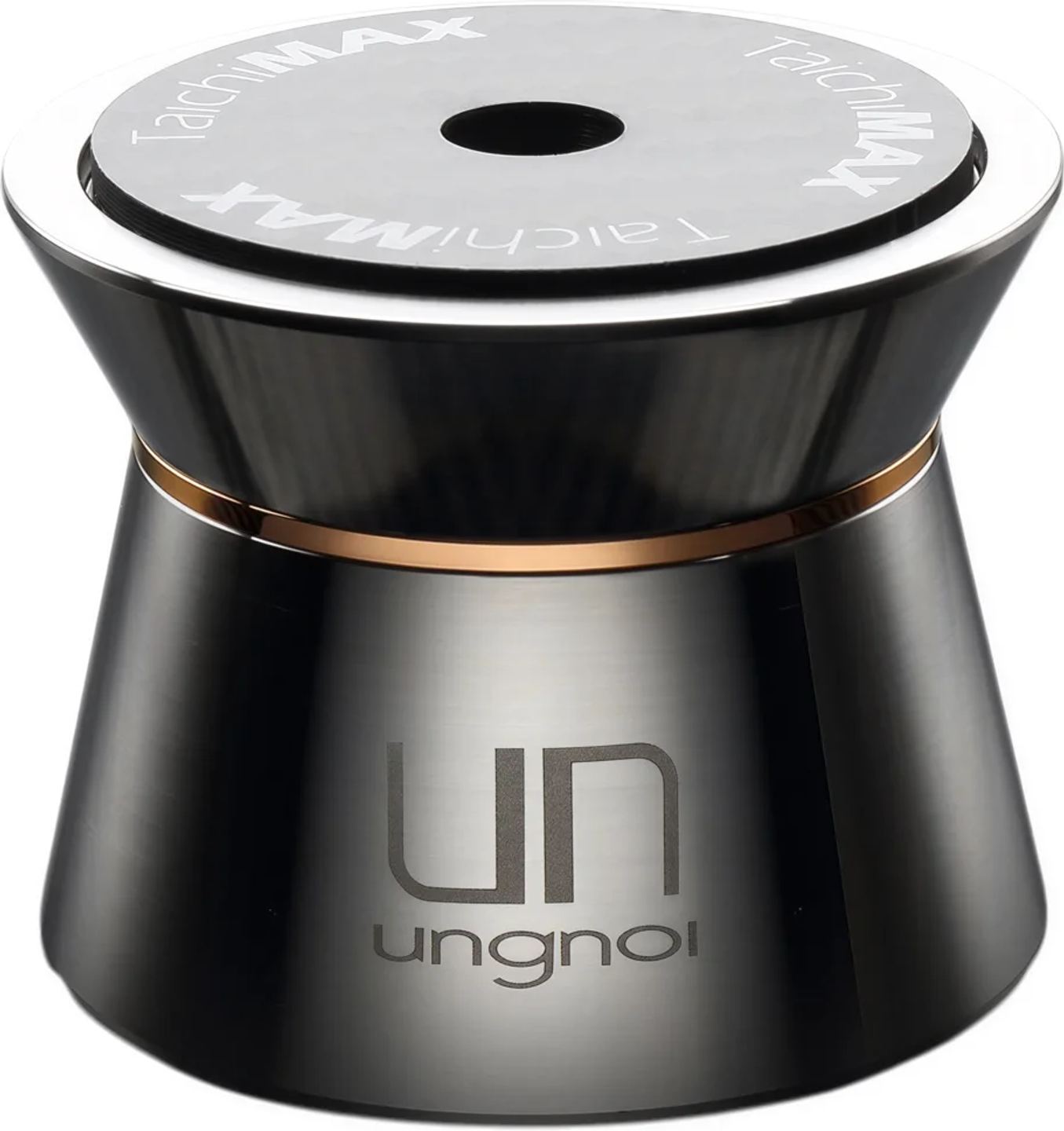
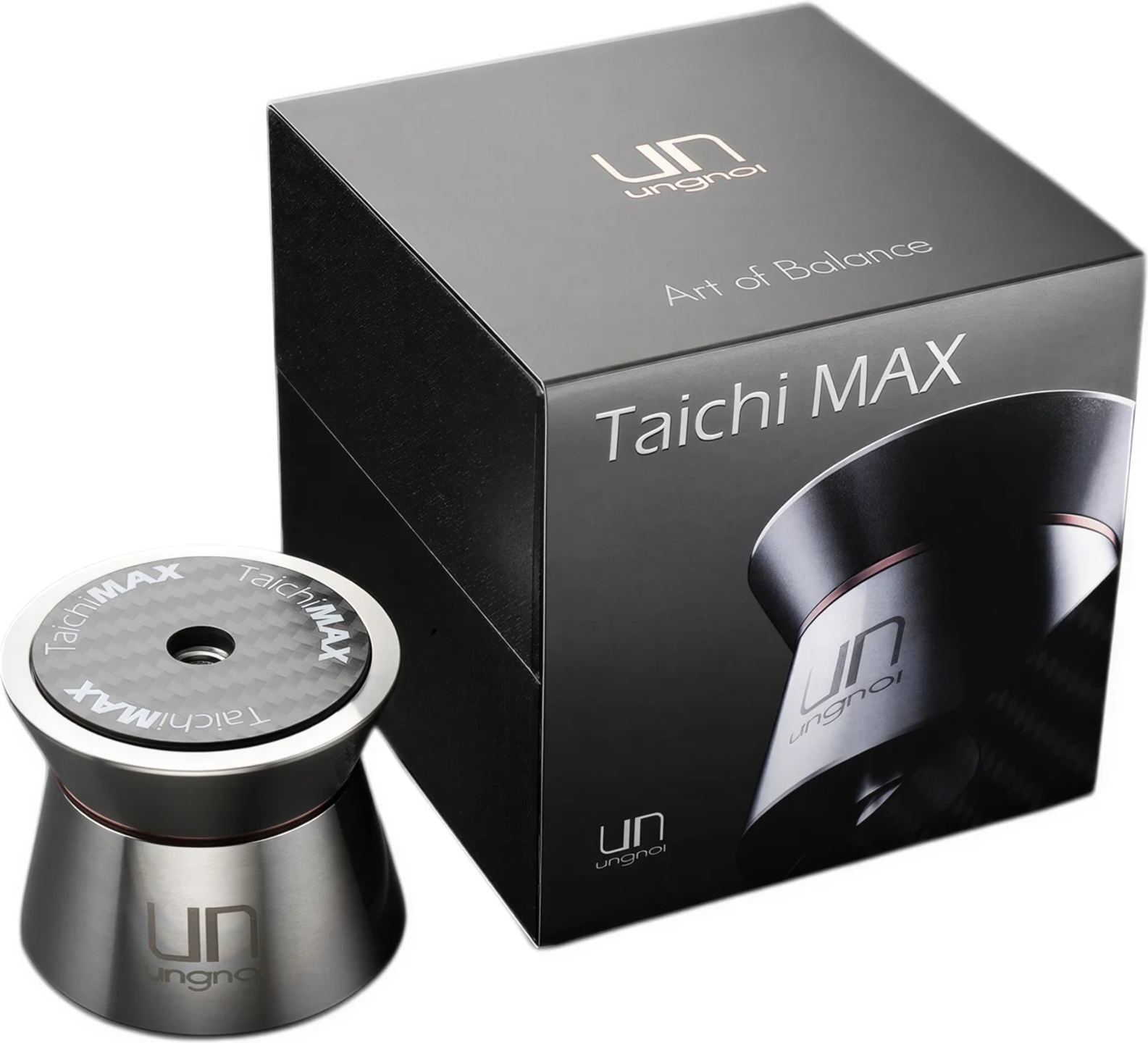
A massive amplifier, a turntable, or a floorstanding speaker placed directly on a piece of furniture: each time, mechanical micro-vibrations travel between the device and its support, eventually blurring part of the audio signal. The Taichi MAX, the high-end model in the Taichi series from Hong Kong manufacturer Ungnoi, fits in at this junction to isolate the electronics from their environment and limit these unwanted energy transfers.
The ceramic ball that disperses vibrations
Everything is based on a 14.3 mm Super Grade 5 ceramic ball, machined with near-perfect sphericity: the deviation of each ball remains below ± 0.00013 mm. Resting in its steel housing, it allows a slight lateral movement of the load. Rather than rising vertically back toward the device, vibrational energy is diverted horizontally, then dissipated. Ungnoi calls this principle horizontal deviation. This ball is 50% larger than the one in the Taichi Base, which expands the working surface and increases the allowable load. It is non-magnetic, and therefore introduces no interference with transformers or sensitive circuits placed above it.
Stainless steel and carbon fiber platform
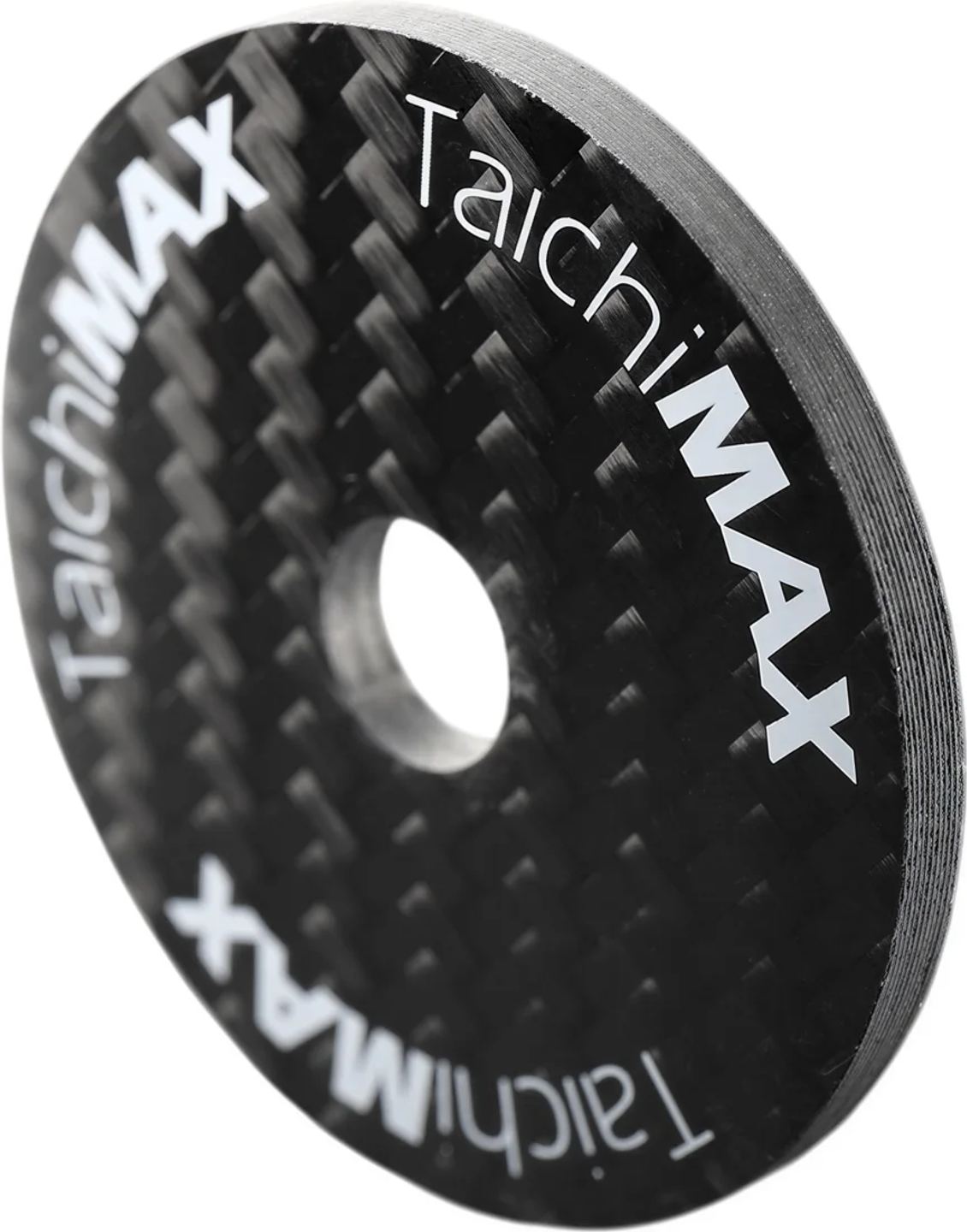
The body is carved from a block of stainless steel, polished and also non-magnetic. At the top, a 44 mm carbon fiber platform caps the ball and comes into contact with the device. This rigid and lightweight material, with high tensile strength (512 Ksi), distributes vibrations across its surface before they reach the ball. The combination of steel, ceramic, and carbon reflects the philosophy Ungnoi sums up with the phrase “the art of balance.” According to the manufacturer, these ceramic balls reduce vibration amplitude by 20 to 50% compared with conventional steel balls.
Up to 132 kg per set of four
With four units, the Taichi MAX supports up to 132 kg, enough for large integrated amplifiers, power amplifiers, or floorstanding speakers. Its height of 46.5 mm matches electronics whose original feet are already tall, as found on models from Gryphon, Accuphase, or McIntosh. The isolator is sold individually, so you are free to use three, four, or more depending on the weight and shape of the chassis.
Interchangeable M6, M8, and M10 studs
To secure the isolator to a floorstanding speaker or a rack, Ungnoi supplies threaded stainless steel studs. The Taichi MAX comes with a 25 mm M8 stud, a 25 mm M8-to-M10 adapter, and a 20 mm M8-to-M6 adapter. These three thread sizes cover most inserts found under speakers and HiFi furniture. You can therefore screw the isolator directly into the base of a floorstanding speaker, or do without that and simply place the electronics on the carbon platform.
The flagship of the Taichi series
The Taichi range includes several formats: the Nino, the most compact; the intermediate Base; and the MAX at the top of the catalog. Compared with the Base, the MAX features a larger ball, an additional carbon fiber platform, a higher allowable load, and the set of threaded studs that the lower models do not include. In return, it is bulkier and taller, dimensions to keep in mind if space under the device is limited.
Technical Specifications
Overview
- Taichi MAX: high-end decoupling device designed for large HiFi equipment, HiFi racks, and floorstanding speakers
- Instant improvement in HiFi performance: increased transparency, more detailed reproduction, richer harmonics, energetic mids, and dynamic bass
- Solid stainless steel structure with a design that is both aesthetic and functional
Super Grade 5 Ceramic Ball
- Super Grade 5 ceramic ball with perfect sphericity
- Minimum deviation of each ball: ± 0.00013 mm
- Ball diameter: 14.3 mm
- Size 50% larger than the Taichi Base
- Non-magnetic: prevents any magnetic interference
Decoupling Performance
- Horizontal diversion: perfect isolation and dispersion of vibrations
- Correction of distortions and improvement of HiFi performance
- High load capacity: designed for heavy equipment
- Maximum recommended load: 132 kg for 4 pieces
Flat Carbon Fiber Washer
- Rigorous selection for optimal sound performance
- Carbon fiber top plate providing better vibration dispersion
- Diameter: 44 mm
- Tensile strength: 512 Ksi
- Tensile modulus: 33.4 Msi
- Tensile elongation: 1.26%
Compatibility with the M System
- Height of 46.5 mm suitable for heavy HiFi equipment with taller feet (Gryphon, Accuphase, McIntosh, etc.)
- Interchangeable premium stainless steel threaded studs in M6, M8, and M10 for floorstanding speakers and HiFi racks
- Included threaded studs:
- M8 × 25 mm
- M8 to M10 adapter × 25 mm
- M8 to M6 adapter × 20 mm
Dimensions and weight
- Height: 46.5 mm
- Diameter: 53 mm
- Net weight: 0.5 kg
- Gross weight: 0.7 kg
Frequently asked questions
How many Taichi MAX are needed under a device?
Most often, four are used, one under each corner of a rectangular chassis; this configuration supports the maximum load of 132 kg. Three points are sometimes enough to stabilize a lightweight device or one with a particular shape. Since the decoupler is sold individually, you can choose the exact number your equipment needs.
Is it mandatory to use the threaded studs?
No. The studs are used to screw the decoupler into a threaded insert under a floorstanding speaker or a piece of furniture. For electronics placed freely, leave the carbon fiber plate in contact with the chassis, without any fastening.
Can the Taichi MAX accommodate a floorstanding speaker directly?
Yes, provided the maximum load is respected and you have the threaded insert suited to its base. The supplied M6, M8, or M10 adapter then screws into the speaker, which is thereby decoupled from the floor.
Can the 46.5 mm height be a problem in an enclosed cabinet?
This is the point to check before purchase. The decoupler raises the device by more than four and a half centimeters, to which the height of the original feet must be added. It is best to measure the clearance above the electronics in a niche or an enclosed shelf.
Can a Taichi MAX be paired with Taichi Base units under the same device?
This is not recommended. The two models are not the same height, and mixing them would cause the chassis to tilt. It is better to equip each device with a matching set, MAX or Base.
Does the ceramic ball require maintenance?
Super Grade 5 ceramic is hard and stable over time, with no noticeable wear under normal use. Occasional dusting of the housing and the platform is enough to maintain a clean contact point between the ball and the steel.
- Eco-contribution included in the sale price.