ROCKNA Wavedream DAC Reference + Streamer
Specifications and features


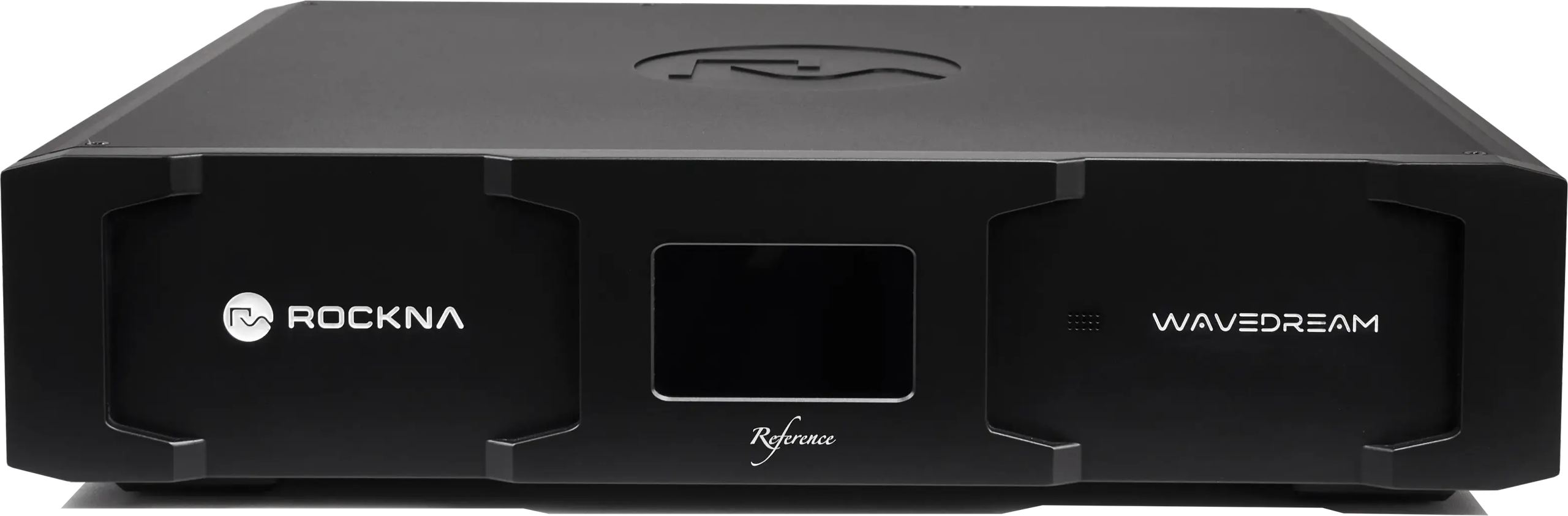
ROCKNA Wavedream Reference + Streamer, R2R DAC with network playback
At Rockna, nothing comes from a component catalog. Founder Nicolae Jitariu, who contributed to the digital circuits of PS Audio and MSB, develops his converters from end to end: discrete R2R modules, digital filters, clock management, and software are all designed in-house. The Wavedream Reference combines this proprietary conversion with an integrated network playback module, bringing together in a single chassis the dematerialized source and the converter that reproduces it.
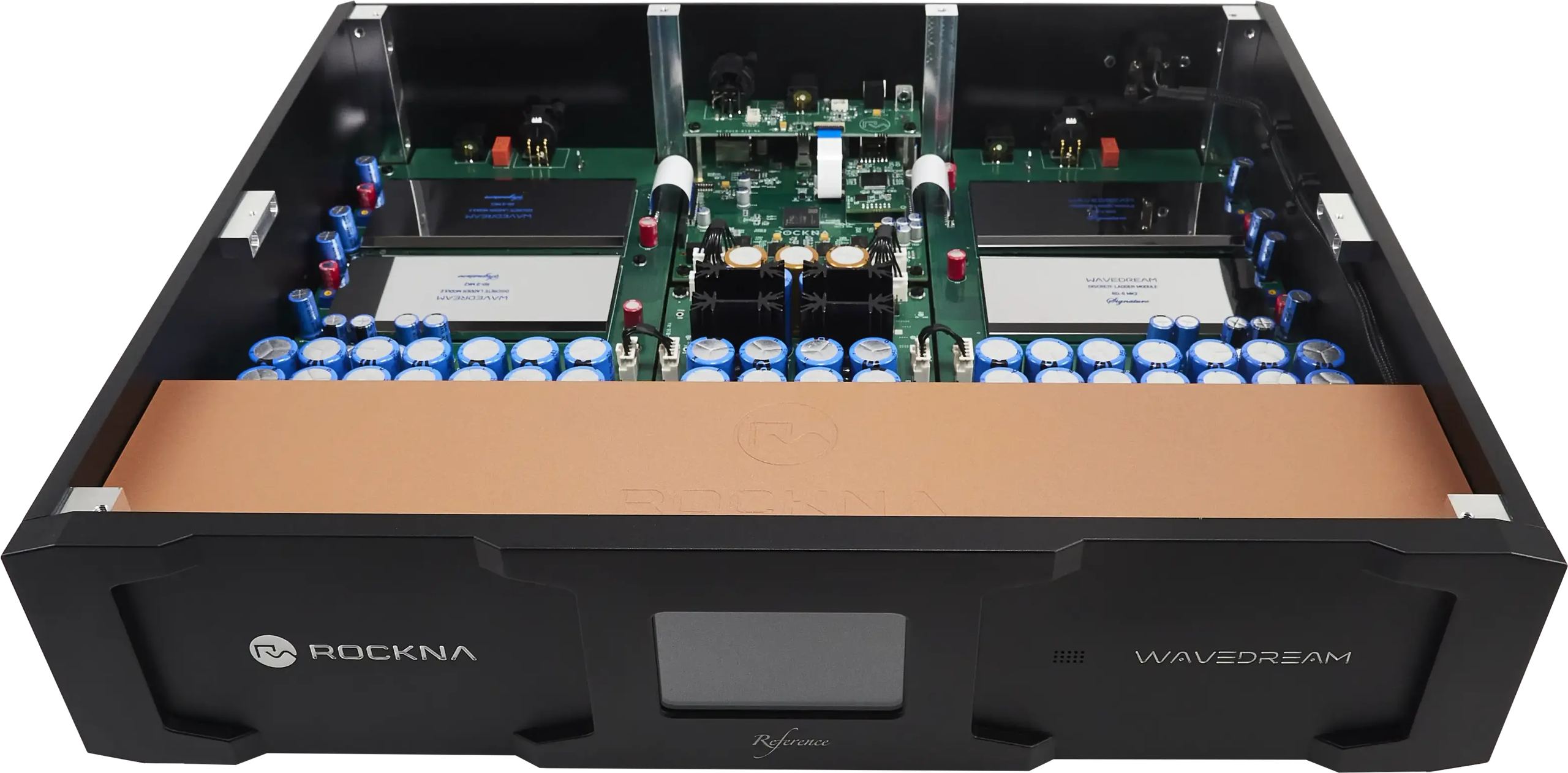
Discrete R2R modules driven by FPGA
Conversion is based on RD-1 Edition modules, here in a balanced version to feed the XLR outputs. Their discrete sign-magnitude R2R topology separates the processing of the positive and negative halves of the signal, an approach that reduces linearity errors around zero, where the ear is most sensitive to low-level detail. Each module incorporates its own FPGA, which runs the algorithm controlling the resistor network. This programmable design has a practical advantage: firmware updates can modify the converter’s behavior long after purchase, with updating done simply through an audio file played via the USB input.
16x oversampling in service of the filters
Any incoming signal is brought to a fixed 16x factor, i.e. 768 kHz or 705.6 kHz depending on the original frequency family. Behind this figure, 58 DSP blocks deliver 15 GMACS of computing power, with 68-bit integer mathematical precision. The 4820-coefficient Parks-McClellan filters achieve -145 dB attenuation in the stopband for 0.0001 dB ripple in the passband. Three impulse responses are offered (linear phase, minimum phase, hybrid phase), plus a NOS mode that bypasses filtering. Each has its own character: linear phase distributes the energy of the Gibbs oscillation before and after the impulse, minimum phase concentrates it afterward, and hybrid seeks a compromise between the two. The choice is made by listening, depending on the recordings and the rest of the system.
The Femtovox clock against residual jitter
Rockna addresses jitter where it matters: at the input of the conversion modules. The Femtovox system directly synthesizes the conversion clock, without intermediate conditioning, with jitter of about 300 fs and 1 ppb accuracy regardless of the sampling frequency. The digital PLL relies on a buffer memory and asynchronous capture sampled at 500 MHz, without resorting to an asynchronous sample rate converter (ASRC), whose processing alters the original signal. Two response modes, stream and local, adapt the loop’s behavior to the quality of the connected source: local mode stabilizes the output frequency more firmly, at the cost of lower tolerance for unstable sources.
Network playback integrated into the chassis
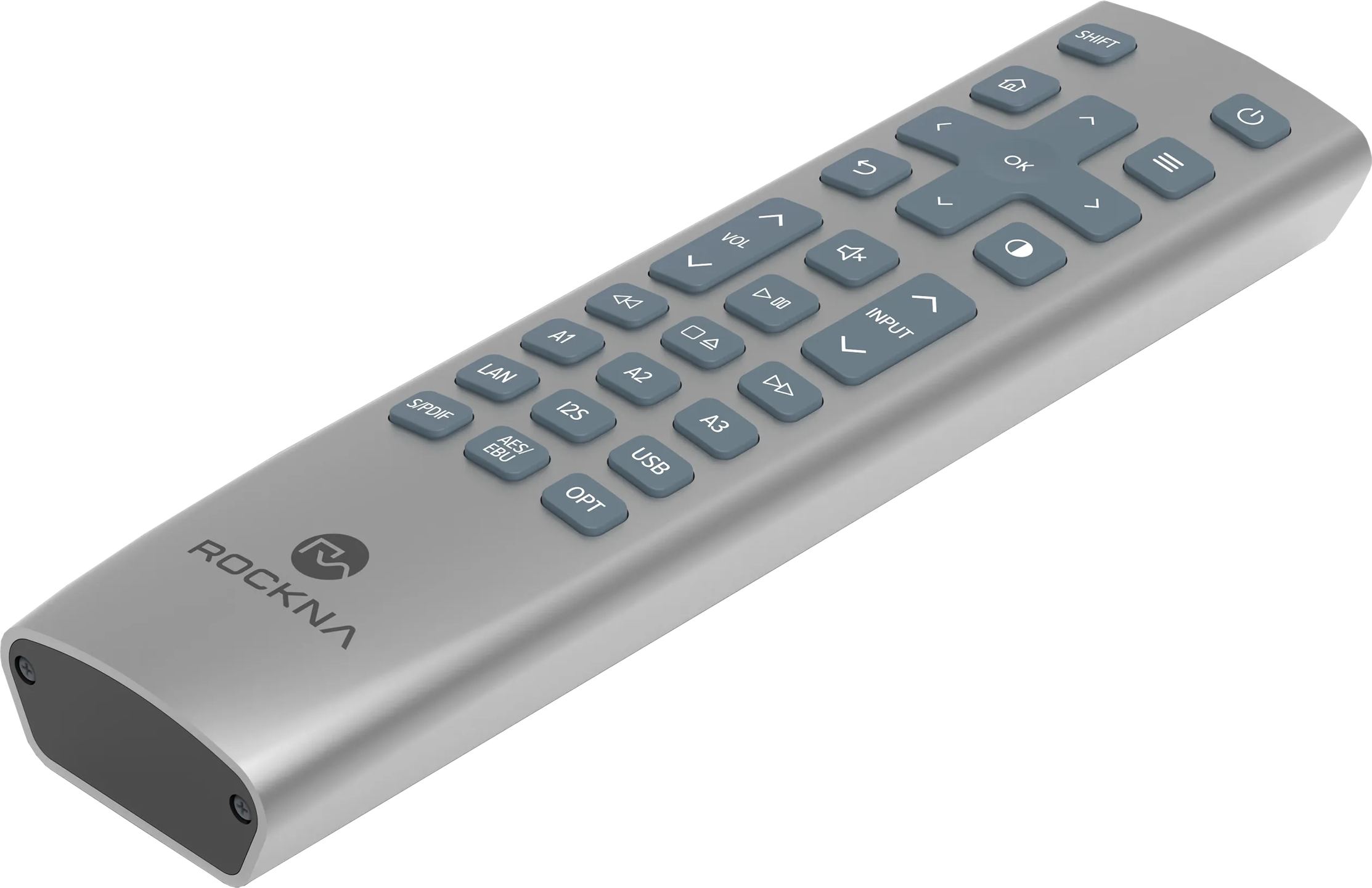
The streamer section avoids adding an external link between the network source and conversion. The stream goes directly into the DAC’s digital processing, with no intermediate cable or S/PDIF or USB interface, a shorter path that eliminates a potential source of degradation. Playback covers the brand’s usual network protocols, including Roon and UPnP, with control possible from a mobile app in addition to the infrared remote control and the four front-panel buttons. The 128 x 64 white OLED display, adjustable across four brightness levels, shows the current signal frequency, active input, volume, and selected filter.
Extensive connectivity up to DSD512
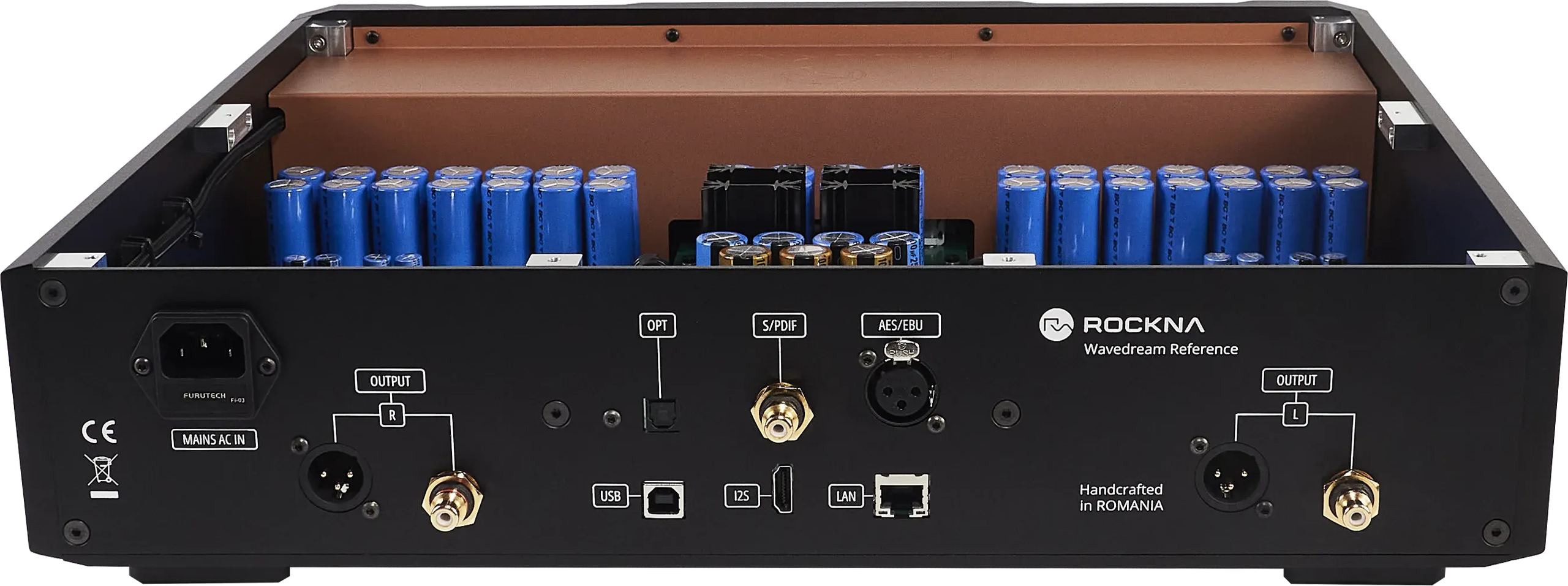
The coaxial S/PDIF and AES/EBU inputs accept 24-bit PCM up to 192 kHz and DSD64 in DoP. USB goes up to 384 kHz in 32-bit PCM and up to native DSD256, or even DSD512 with an ASIO driver. The two HD-Link inputs carry I2S in LVDS over an HDMI connector, up to 384 kHz and DSD512: this format transmits the signal in its internal form, without frame conversion, provided a compatible source is used. The selectable Rockna and PS Audio modes address the pinout issue, as I2S is not standardized across manufacturers. On output, unbalanced RCA (6.6 Vpp) and balanced XLR (13.2 Vpp) present a 0.5 Ω impedance, low enough to accommodate long cables or less sensitive input stages.
A full-fledged digital preamplifier
Volume control relies on an internally developed multiplier network, with 256 steps of 0.5 dB. This fine resolution allows direct connection to a power amplifier, removing the preamplifier from the chain. The question deserves to be assessed in each system: a quality analog preamplifier sometimes brings a substance that the direct connection does not have, but the transparency of the shortened path has its supporters. Also included are absolute phase selection (normal or inverted), triangular-distribution dither applied to the last bits to improve the linearity of the R2R network, and a wide or narrow DSD bandwidth setting.
Documentation
Technical specifications
Digital-to-analog conversion
- Conversion type: discrete R2R, hybrid sign-magnitude topology
- DAC modules: FPGA-driven RD-1 Edition, balanced version (XLR)
- Oversampling
- Fixed 16x factor (768 kHz / 705.6 kHz depending on the input frequency)
- 58 DSP blocks
- 15 GMACS of computing power
- 4820-coefficient Parks-McClellan digital filters: linear phase, minimum phase, hybrid phase, NOS mode (no filter)
- Mathematical precision: 68-bit integer calculation
- Stopband attenuation: -145 dB
- Passband ripple: 0.0001 dB
- Femtovox clock management
- Direct synthesis of the conversion clock
- Jitter of approximately 300 fs
- Accuracy of 1 ppb
- PLL
- Buffer memory in the digital domain
- High-frequency asynchronous capture (500 MHz sampling)
- Two response modes: stream and local
- Volume control
- Custom multiplier network
- 256 steps of 0.5 dB
- Direct output to a power amplifier possible
- Audio settings
- Absolute phase selection: normal or inverted
- Switchable dither (triangular distribution)
- Wide or narrow DSD bandwidth
Digital inputs
- Coaxial S/PDIF: 24-bit PCM from 44.1 to 192 kHz, DSD64 in DoP
- AES / EBU: 24-bit PCM from 44.1 to 192 kHz, DSD64 in DoP
- USB: 32-bit PCM from 44.1 to 384 kHz, DSD64 to DSD256 (DSD512 in ASIO)
- HD-Link 1 (I2S LVDS over HDMI): 32-bit PCM from 44.1 to 384 kHz, DSD64 to DSD512
- HD-Link 2 (I2S LVDS over HDMI): 32-bit PCM from 44.1 to 384 kHz, DSD64 to DSD512
- I2S compatibility: selectable Rockna and PS Audio modes
Analog outputs
- Connections: unbalanced RCA and balanced XLR
- Maximum output voltage: 6.6 Vpp (RCA), 13.2 Vpp (XLR)
- Output impedance: 0.5 Ω
Measured performance
- THD+N (at -6 dB): 0.003%, i.e. -90 dB
- Signal-to-noise ratio (at 0 dB): 122 dB
- Dynamic range: 122 dB
Control and ergonomics
- 128 x 64 white OLED screen, brightness adjustable over 4 levels
- Controls: 4 front-panel buttons
- Updates: FPGA firmware via audio file through the USB input
Physical characteristics
- Anodized aluminum chassis
- Finishes: black or silver
- Dimensions (W x D x H): 440 x 360 x 90 mm
- Weight: 7.8 kg
Included accessories
- Power cable
- Infrared remote control
- User manual
- Warranty card
Frequently Asked Questions
What is the difference between a discrete R2R conversion and a conventional chip DAC?
A chip-based DAC (most often delta-sigma) integrates the entire conversion process into an off-the-shelf circuit, with its cost and silicon area trade-offs. A discrete R2R conversion reconstructs the signal using a network of precision resistors assembled component by component. Rockna adds proprietary FPGA control, which provides total control over the conversion algorithm and allows it to evolve through firmware.
What does sign-magnitude topology mean?
The audio signal oscillates around zero. In a conventional R2R network, crossing zero switches all bits simultaneously, which generates audible switching errors on low-level signals. The sign-magnitude topology handles sign and amplitude separately: each half-cycle has its own path, which improves linearity precisely in the region of micro-details.
Is NOS mode of any interest compared with Parks-McClellan filters?
NOS (non-oversampling) mode disables digital filtering and lets the raw signal reach the conversion modules. Some find it delivers a more direct and organic sound, at the cost of unfiltered folded images in the ultrasonic spectrum. Parks-McClellan filters offer near-total rejection of these artifacts. Both approaches are valid, and immediate switching from the front panel lets you decide by ear.
How do I connect the Wavedream Reference to a Rockna network player or transport?
The HD-Link inputs over HDMI are designed for that. They receive the I2S signal in its native form, up to 384 kHz in PCM and DSD512, without going through the format conversions imposed by S/PDIF or AES/EBU. With the brand’s Wavedream NET, this is the recommended connection. The selectable PS Audio mode also enables compatibility with this manufacturer’s I2S sources.
Can this converter be used without a preamplifier?
Yes, this is planned in the design. The 256-step digital volume control in 0.5 dB increments directly feeds a power amplifier, via RCA or XLR. The 0.5 Ω output impedance ensures a stable connection even with long cables. It is still advisable not to listen continuously at very high attenuation, where the effective resolution of the signal decreases slightly.
How are firmware updates performed?
Unusually, Rockna distributes its FPGA updates as an audio file that simply needs to be played through the device’s USB input. No dedicated computer or technical handling is required. This method also makes it possible to improve the conversion algorithms of the RD-1 modules over time.
Is DSD converted to PCM internally?
The Wavedream Reference handles DSD on all its inputs, from DSD64 in DoP over S/PDIF and AES/EBU connections up to DSD512 via USB (through ASIO) and HD-Link. A DSD bandwidth setting, wide or narrow, adjusts the filtering of the quantization noise inherent to this format, which rises sharply into the ultrasonic range.
- Eco-contribution included in the sale price.