Audioquest Rocket 22 SBW (2 x 2m)
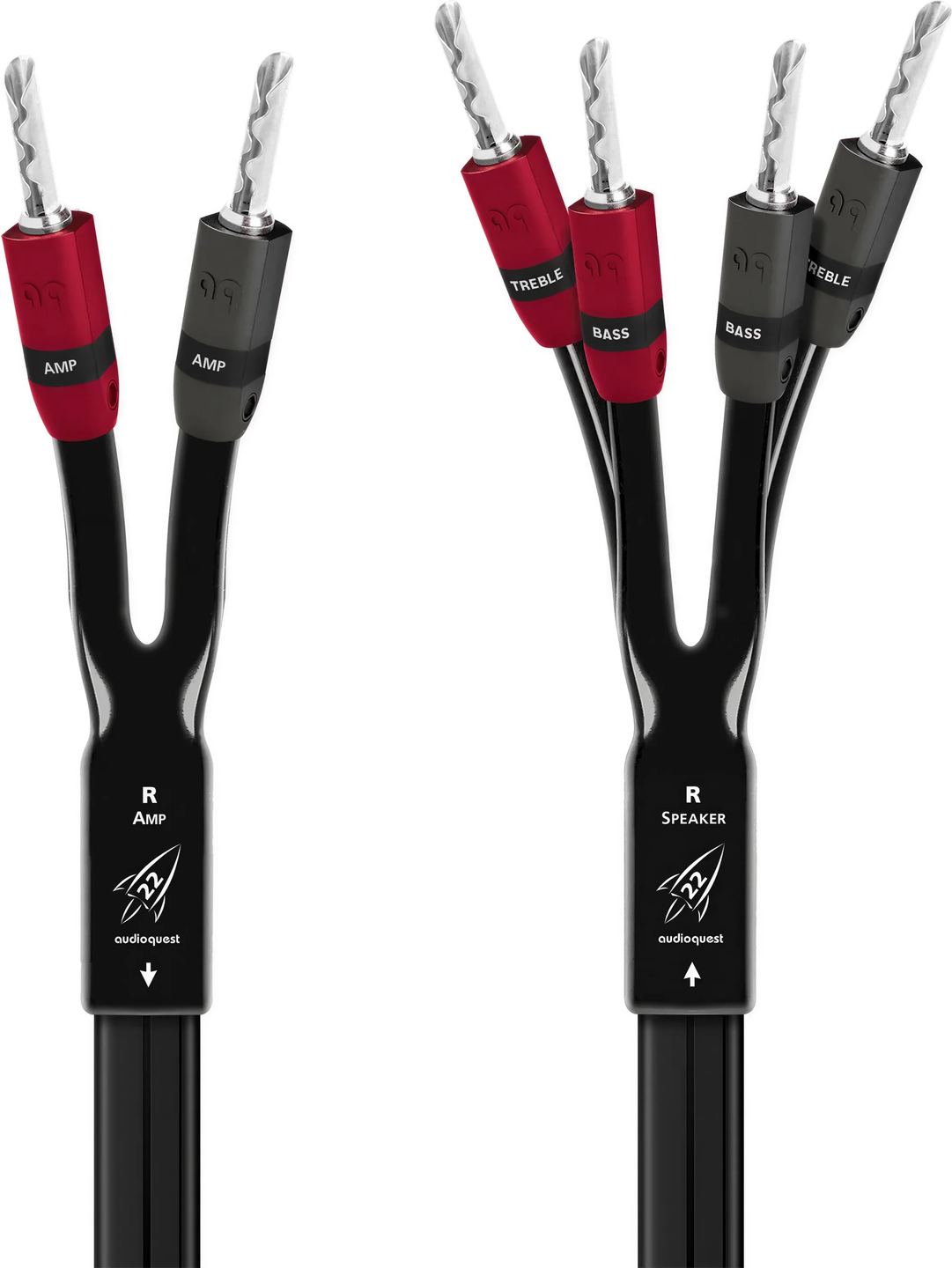
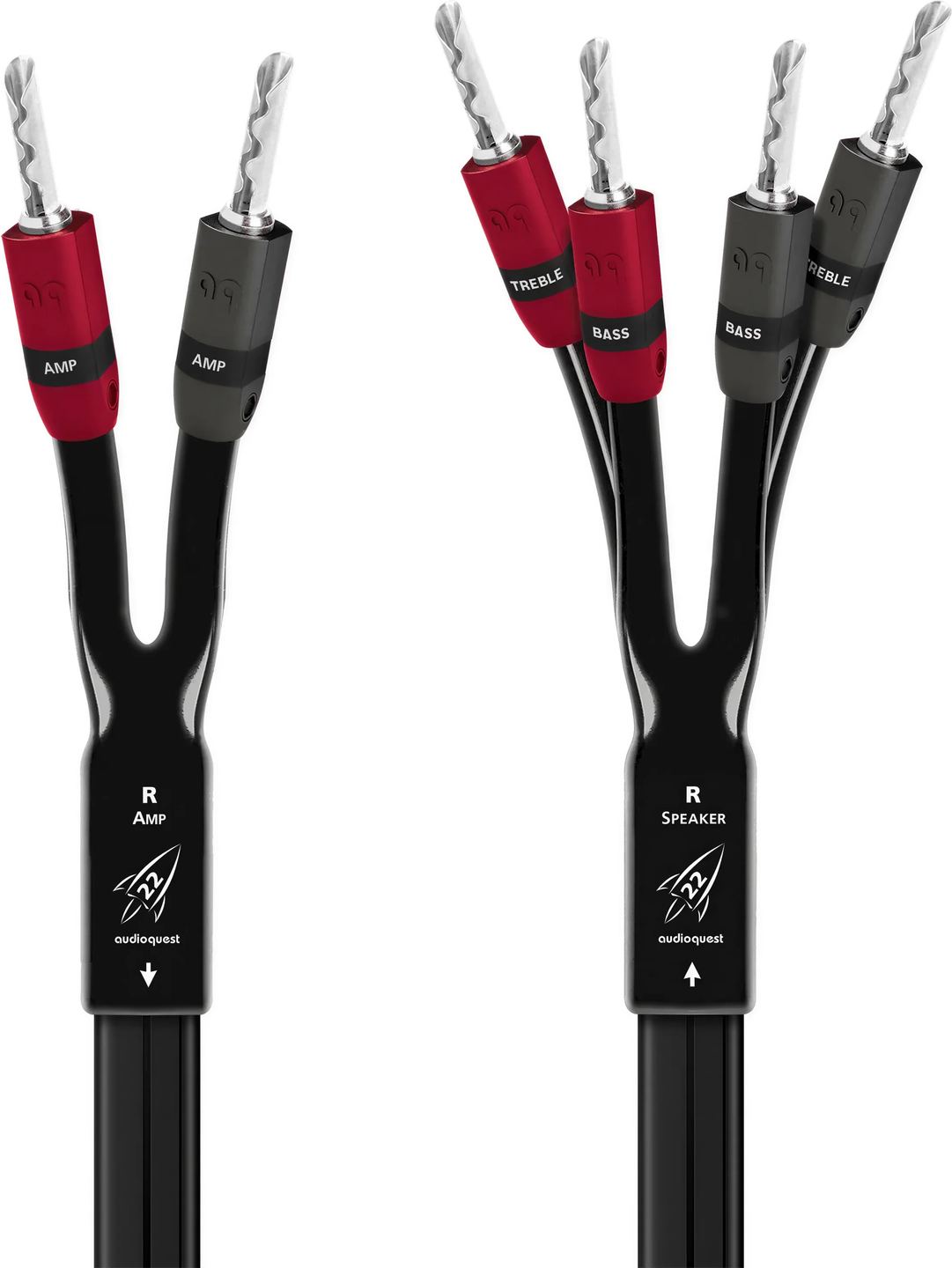
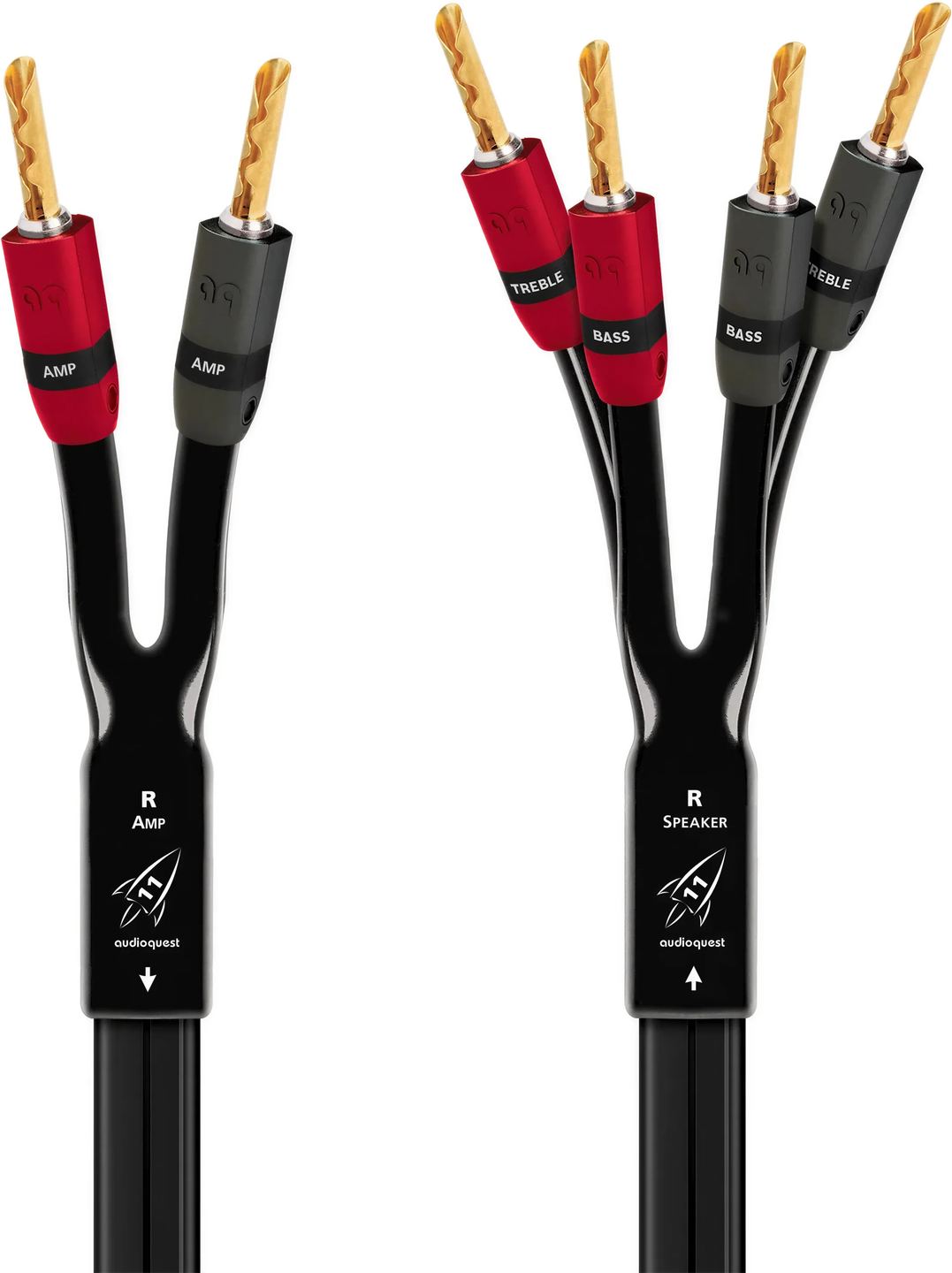
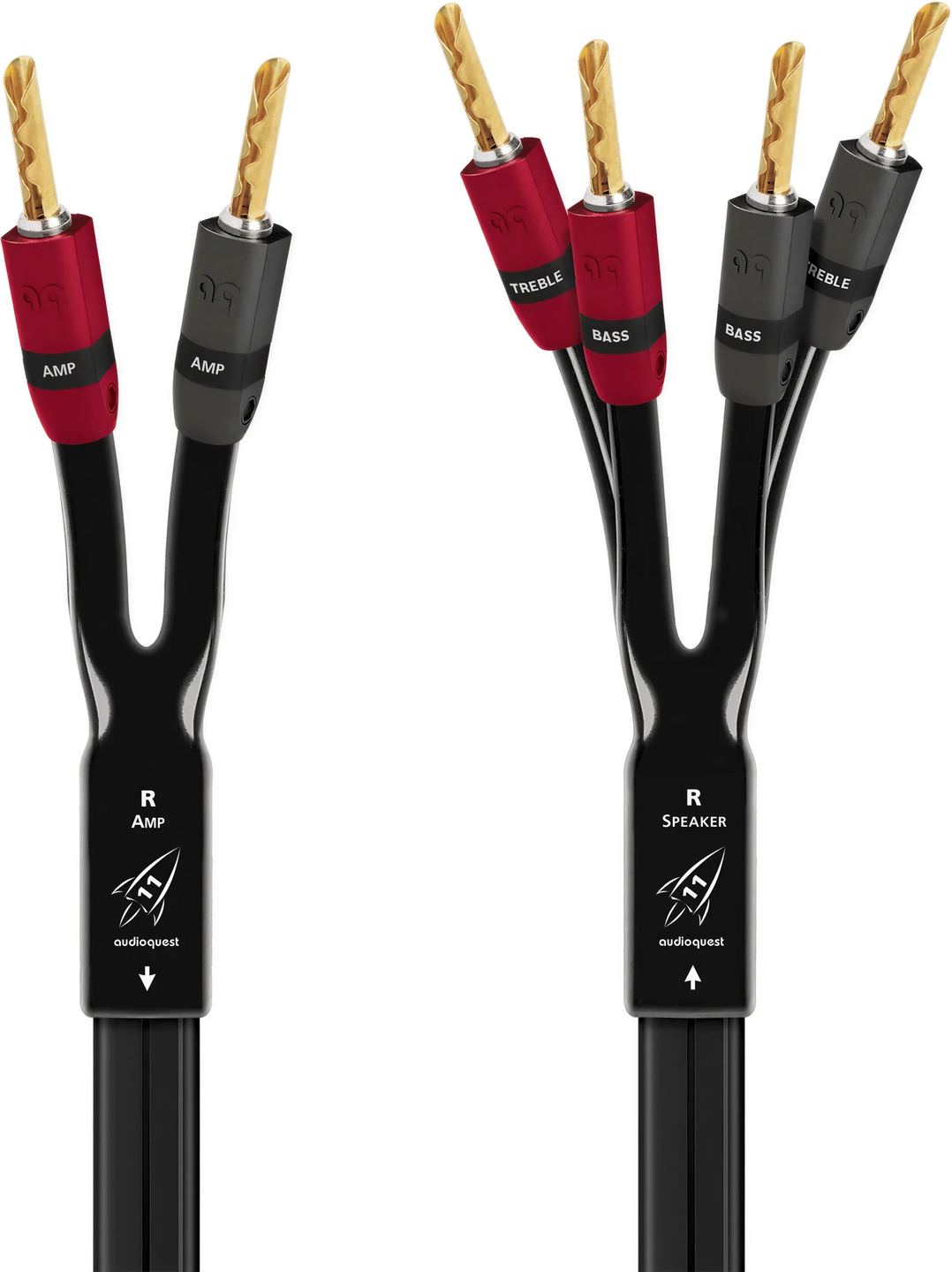
AudioQuest Rocket 22 SBW, bi-wire speaker cable
Separating bass energy from treble energy within the cable itself: that is the principle of bi-wiring, and the Rocket 22 in SBW configuration applies it right from the amplifier output. Two plugs on the amplifier side, four on the speaker side, a carefully selected copper blend, and a strand structure that remains stable along the entire length. AudioQuest positions this model one step above the Rocket 11.
Two coppers for a cleaner signal
The conductor combines two in-house copper grades. Long-Grain Copper (LGC) contains fewer impurities and fewer grain junctions than the standard OFHC copper found in common cables. Perfect-Surface Copper (PSC), even purer and especially smoother at the surface, completes the blend and makes up the main portion.
The key lies in how copper is structured. The metal forms in small crystals, or grains, and each boundary between two grains slightly disrupts the flow of current. Reducing their number limits these micro-interruptions. Surface quality also matters: at the frequencies involved, the signal travels partly near the conductor’s surface, where PSC is most refined. The intended result is a clearer, less harsh sound than with standard copper.
Limiting strand interactions
A conventional stranded cable gathers many thin wires that touch loosely, with current passing unpredictably from one to another along the entire length. This interaction between strands is a source of dynamic distortion. The Rocket 22’s semi-solid concentric structure addresses this by using fewer, larger strands held in fixed positions.
Each strand layer is spirally wound in the opposite direction to the layer beneath it. This arrangement eliminates continuous contact lines between layers and increases pressure at contact points, stabilizing the geometry. The reversed spirals keep each wire in place and secure its contact. The Rocket 11 and 22 are the first in the series to feature this type of conductor.
Separating bass from treble
The letters SBW refer to the single bi-wire configuration: two plugs connect to the amplifier output, while four plugs are distributed across the speaker’s two pairs of terminals. Bass and treble then travel through separate halves of the cable. Removing the high bass energy from the conductor carrying the more delicate treble reduces distortion within the cable. Since the two halves of the Rocket 22 remain magnetically independent, this separation is maintained throughout.
This version requires speakers fitted with two separate pairs of terminals for bass and treble. On a speaker with a single pair of terminals, the four speaker-side plugs have nowhere to connect: the Full-Range version should then be selected. Before bi-wiring, the factory-installed metal jumpers between the two pairs of terminals must be removed, otherwise separation will not take place.
Direction control and noise dissipation
During manufacturing, a copper wire acquires a drawing direction. AudioQuest controls this directionality on all conductors and marks it with arrows on the jacket. The idea is to drain radio-frequency noise picked up by the cable toward the amplifier ground rather than toward the speaker. A carbon-based noise-dissipation system supports this process. In practice, the direction of the arrows must be observed, pointing from the amplifier toward the speaker.
The insulation is PVC, chosen for its low energy absorption. It is a simpler dielectric than the polyethylene foams or air tubes used in AudioQuest’s higher series, placing the Rocket 22 in the brand’s mid-range while maintaining clear sound reproduction.
Choice of plugs and made-to-order length
The cable is terminated with the SureGrip 300 plug system, available with banana or spade connectors depending on the order, providing a firm grip on the terminal. On many European amplifiers, insulated binding posts meeting current standards leave little room to tighten a spade connector with high torque; the banana plug is therefore the safest choice, and sometimes the only possible one. The termination is chosen at the time of ordering and cannot be changed afterwards without reassembly.
The Rocket 22 SBW is supplied assembled, as a ready-to-connect pair. It is made to order, with custom lengths and a preparation time to allow for. It is therefore best to measure the distance between the amplifier and each speaker before ordering.
Technical Specifications
Overview
- AudioQuest Rocket 22 speaker cable in bi-wire configuration
- Design optimized to preserve audio signal integrity and minimize distortion
Conductors
- Blend of Perfect-Surface Copper (PSC) and Long-Grain Copper (LGC)
- Higher-purity PSC copper
- High-purity LGC copper
- Reduced distortion caused by grain boundaries
- Smoother, clearer sound reproduction compared to standard OFHC copper
Cable Geometry
- Semi-solid concentric structure
- Strands held in fixed position within the bundle
- Significant reduction in electrical and magnetic interaction between strands
- Reduced dynamic distortion
- Double-spiral geometry
- Two conductors wound around each other for each half of the cable
- Reduced inductance
- Increased clarity
- Greater frequency extension, from bass to treble
- Counter-spiral shapes for optimal wire contact and positioning
Insulation
- PVC insulation
- Minimized energy absorption
- Clearer sound reproduction
Performance and Noise Dissipation
- Directionality control of all conductors for RF noise
- Noise dissipation based on Carbon technology
Frequently Asked Questions
What is the difference between the Full-Range, SBW, and bi-amplified versions of the Rocket 22?
The full-range (Full-Range) version connects one amplifier output to a pair of speaker terminals, with two plugs at each end. The SBW version retains a single amplifier output but splits the cable to the speaker’s bass and treble terminals, with two plugs on the amplifier side and four on the speaker side. The bi-amplification version is intended for setups where two separate amplification channels independently drive the bass and treble, with four plugs at each end.
My speakers only have one pair of terminals; can I use the SBW configuration?
No. Bi-wiring requires two separate pairs of terminals on the speaker. With a single pair, you need to choose the full-range version of the Rocket 22.
Does the connection direction matter?
Yes. The conductors have controlled directionality, and the jacket bears arrows. Their orientation, from the amplifier to the speaker, must be observed so that radio-frequency noise is drained to the correct side.
Is the Rocket 22 suitable for any amplifier?
This is a passive cable compatible with the vast majority of amplifiers. Its 12 AWG gauge gives it low resistance, suitable for typical living room lengths. On the insulated terminals of European amplifiers, banana plug termination remains the most convenient.
How does the Rocket 22 differ from the Rocket 11?
It uses the same semi-solid concentric conductor design, but with a more generous cross-section: 12 AWG gauge and approximately 20% lower impedance than the Rocket 11. AudioQuest describes it as an audibly higher tier.
Is there anything special to do during installation?
For bi-wireable speakers, the original jumpers between the two pairs of terminals must be removed before connecting the four plugs. Without removing them, the bass and treble remain connected, and the separation provided by the SBW does not occur.
- Eco-contribution included in the sale price.