

Audioquest Rocket 22 SBA (2 x 2m)
Overview
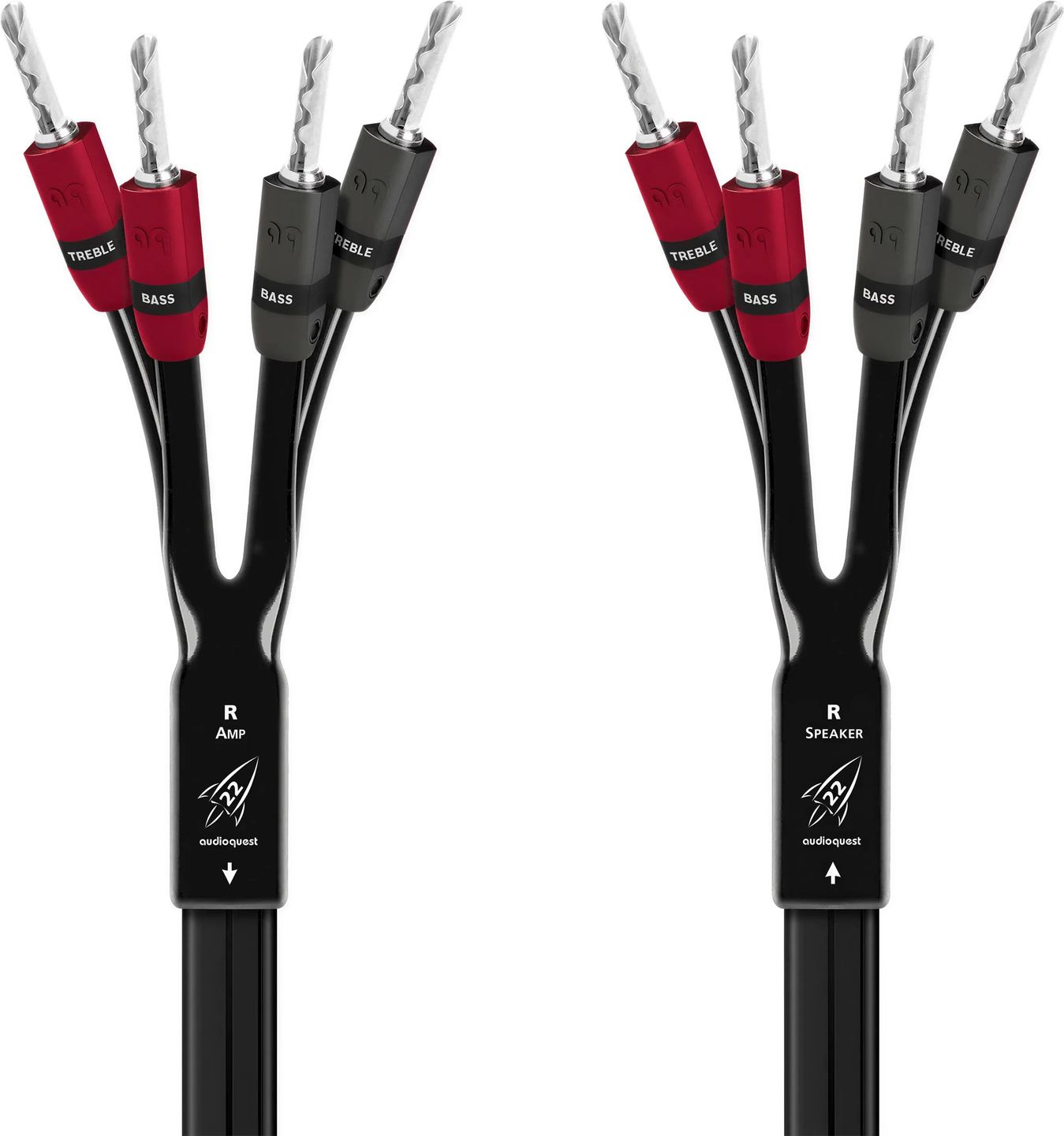
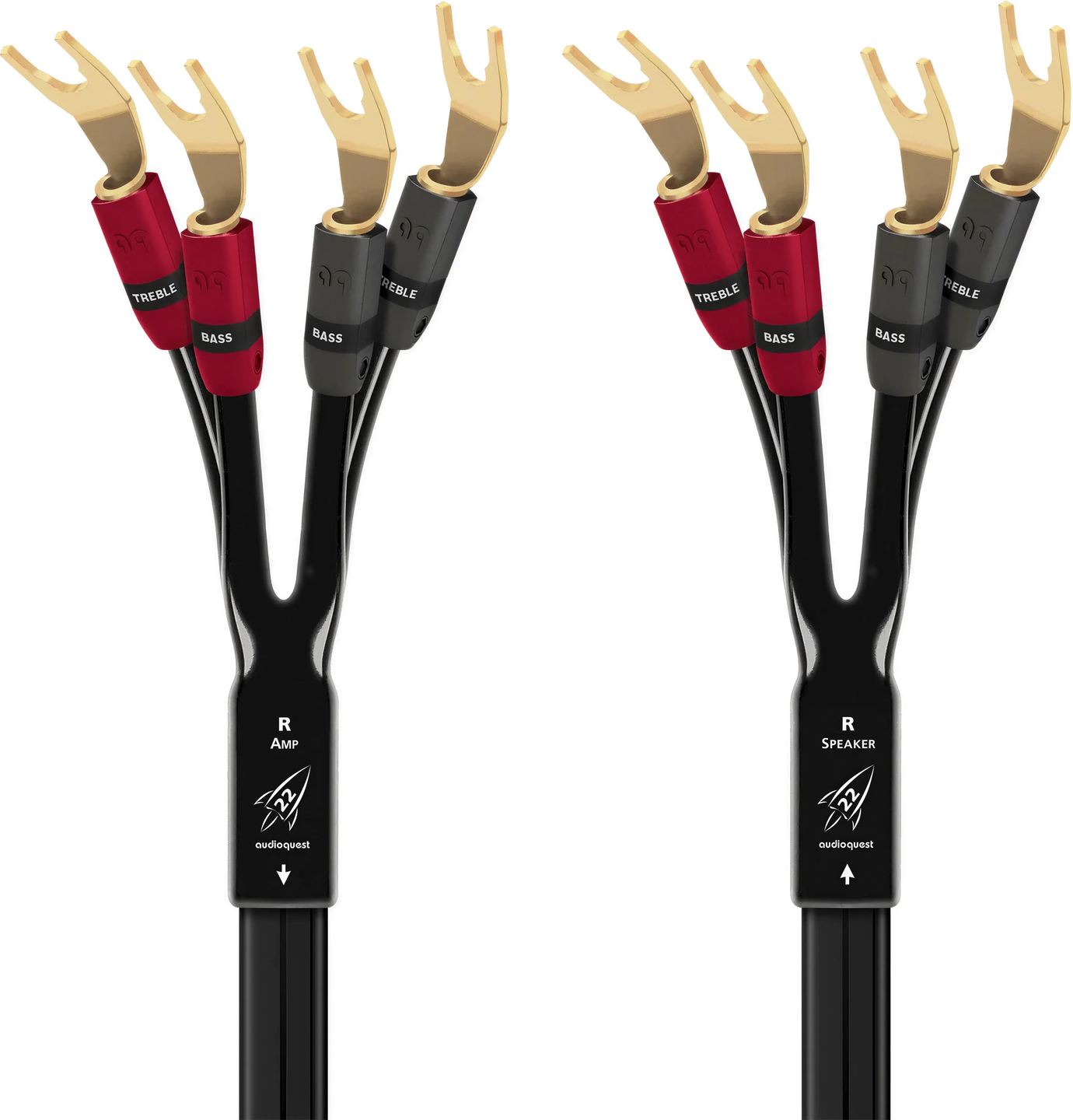
Driving the bass and treble of the same speaker with two separate amplification channels requires rethinking the connection: two pairs of cable are needed per speaker, with different terminations at each end. The Single-BiAmp version of the Rocket 22 is designed precisely for this setup. It uses the construction of the larger of AudioQuest’s two speaker cables in the Rocket series and terminates it in four contact points on each side.
Separating bass and treble at the source
In bi-amplification, each speaker is driven by two amplification channels: one handles the bass, the other the treble. The cable therefore splits into two pairs at each end. On the amplifier side, the four plugs are distributed across two separate speaker outputs; on the speaker side, they connect to the bass and treble terminals once the factory-installed metal jumpers have been removed.
This arrangement requires suitable equipment: a speaker with dual binding posts and amplification (one unit or two) capable of providing two pairs of outputs per channel. Without this equipment, there is no point in using this connection, and the Full-Range or Single-BiWire version of the Rocket 22 is better suited. The difference from bi-wiring lies in this specific point: bi-wiring starts from a single amplifier output split toward the speaker, whereas bi-amplification uses two separate channels. Hence the four contact points on the amplifier side instead of two.
Two copper types combined in the conductor
The conductors combine two proprietary AudioQuest copper types, Perfect-Surface Copper (PSC) and Long-Grain Copper (LGC). LGC reduces the number of joints between metal grains along the signal path, whereas ordinary copper has more of them; PSC improves the surface condition of the conductor, the area through which part of the audio signal travels. The aim is smoother, clearer treble than with standard OFHC copper, the high-conductivity oxygen-free copper found in many cables.
It is still important to keep in perspective what metallurgy changes over a few metres of speaker cable: series resistance is low, and the benefit lies mainly in material consistency rather than a dramatic audible difference. A matter of degree.
Strand and pair arrangement
Two construction principles govern the layout of the wires. The first, Semi-Solid Concentric geometry, locks the position of each strand within the bundle. In a conventional stranded cable, strands change position along the route and interact electrically and magnetically, adding distortion. By keeping the strands in fixed relationships, this arrangement reduces that interaction, one of the sources of dynamic distortion in a cable.
The second, Double Spiral-Pair Geometry, concerns the two conductors in each half of the cable: they are twisted around one another. Simply parallel conductors have fairly high inductance, which spreads energy over time and blurs the sound. Twisting lowers this inductance and extends response from bass to treble. This is the construction shared by the Rocket 11 and 22, with the 22 being the larger of the two, featuring 12 AWG conductor cross-section (approximately 3.3 mm²) and impedance roughly 20% lower than that of the Rocket 11.
SureGrip 300 plugs and made-to-order assembly
The cable is terminated with SureGrip 300 plugs, available as spades or bananas, with silver-on-copper contact and no intermediate nickel layer (nickel, being magnetic, is kept out of the signal path). Depending on the model, the plating is available in silver or gold. The choice between spade and banana is often a matter of preference, but insulated binding posts compliant with European standards are poorly suited to firmly clamping a spade: on these terminals, the banana is safer, sometimes the only practical option. When in doubt, it is best to check the shape of the binding post before ordering.
The insulation is PVC, chosen for its low energy absorption. All conductors are assembled in a controlled direction (Direction-Controlled), an orientation selected to limit sensitivity to high-frequency noise; an arrow printed on the jacket indicates the connection direction. The cable is assembled to order by AudioQuest, allowing custom lengths and terminations, at the cost of a manufacturing lead time.
Technical Specifications
Overview
- Model: Rocket 22 Simple-BiAmp
- Type: speaker cable with SureGrip 300 connectors
- Description: carefully refined blend of Perfect-Surface Copper (PSC) and Long-Grain Copper (LGC), packaged in a semi-solid concentric pattern with reverse spiral shapes to maintain optimal wire position and contact while minimizing signal distortion
Configuration
- Cable configuration: Single-BiAmp
- Cable length: pair
- Amplifier-to-speaker terminations: 4 to 4
Conductors
- Semi-solid concentric Perfect-Surface Copper (PSC) and Long-Grain Copper (LGC) conductors
- In a conventional stranded cable, distortion caused by the electrical and magnetic interaction of strands is amplified as each strand changes position within the bundle
- In an AQ semi-solid concentric cable, the strands inside the bundle maintain their fixed relationships, thereby significantly reducing distortion
- The carefully balanced blend of Perfect-Surface Copper (PSC) and Long-Grain Copper (LGC) provides smoother, clearer sound than cables using ordinary OFHC (oxygen-free high-conductivity) copper
- Semi-solid concentric conductors: significant reduction in strand interaction, a major source of dynamic distortion in cables
- Long-Grain Copper and Perfect-Surface Copper: carefully balanced combination of high-purity Long-Grain Copper and superior-purity Perfect-Surface Copper conductors, minimizing distortion caused by grain boundaries
- Direction control: all conductors are controlled for RF noise directionality
Geometry
- Double-pair spiral geometry
- A typical speaker cable with parallel conductors has fairly high inductance, dispersing energy over time and resulting in dull, blurred sound
- In Rocket 11 / 22 models, the two conductors in each half of the cable are wound around each other
- Benefits: lower inductance, greater clarity, and superior frequency extension from bass to treble
Insulation
- PVC insulation: minimizes energy absorption for clearer sound
Features and Performance
- Noise dissipation: based on Carbon technology
Frequently Asked Questions
What is the difference between the Full-Range, Single-BiWire, and Single-BiAmp versions of Rocket 22?
The Full-Range has one pair of connectors at each end (two contact points on each side), for a single-terminal speaker connected to a single amplifier output per channel. The Single-BiWire has two points on the amplifier side and four on the speaker side: a single amplifier output separately feeds the bass and treble terminals. The Single-BiAmp has four points on each side, for two amplification channels per speaker. The choice depends on the speaker and the amplification system in place.
My speaker only has one pair of terminals: is this version suitable for me?
No. Bi-amping requires a speaker with dual binding posts, with separate bass and treble sections. With a single set of binding posts, the Full-Range version is the right choice. Single-BiWire only comes into play if the speaker supports bi-wiring, which again requires dual binding posts.
Should the jumpers between the speaker terminals be removed?
Yes. As soon as you bi-amp or bi-wire, remove the metal jumpers that factory-link the bass and treble terminals. Leaving them in place would reconnect the two sections and defeat the intended separation, with the risk of putting two amplifier outputs in conflict.
Does bi-amping provide an audible improvement?
It depends on the system. Assigning bass and treble to separate channels relieves each amplification stage of the other’s current demand and somewhat isolates the two sections. The benefit is most noticeable when the amplification lacked power reserves; in a system that is already comfortable, the difference narrows. The quality of the setup matters as much as the cable itself.
Is the cable sold as a pair or individually?
Both. The pair covers both speakers in a stereo system; the single version is for replacement or special installations. One length is needed per speaker.
Passive or active bi-amplification: which does this cable apply to?
The Single-BiAmp version corresponds to passive bi-amplification wiring: each speaker receives two channels, while retaining its internal passive crossover, which distributes bass and treble. Active bi-amplification places an electronic crossover before the amplifiers and bypasses the speaker’s crossover; the speaker wiring remains comparable, but the setup involves a different configuration.
- Eco-contribution included in the sale price.




