OLED or QD-OLED? Samsung 2026 panel guide, size by size
August 06, 2026
Contents
Two buyers order the same Samsung S95H TV. One chooses the 65-inch version, the other the 48-inch version. They receive two products whose panels come neither from the same factory nor from the same technology. Same commercial name, same processor, same interface, same gaming features, but a display whose saturated colors and behavior in a brightly lit room differ noticeably.
This situation has existed at Samsung since 2023, and the 2026 range does not make it any simpler. It actually makes it harder to understand, since panel allocation no longer follows the model hierarchy but the selected screen size. Here is how to make sense of it. For an overview of the three series and their equipment differences, our S92H, S95H and S99H comparison complements this guide.
Why Samsung buys panels from LG
Samsung Display manufactures QD-OLED. However, this subsidiary only produces it in a limited number of sizes, mainly 55, 65 and 77 inches for TVs. Below 55 inches and above 77 inches, those cut sizes do not exist on its production lines.
To cover its 42- to 83-inch range, Samsung Electronics therefore buys WOLED panels from LG Display, its direct competitor in the television market. The practice began with the S90C in 2023, of which only the 83-inch version used an LG panel due to the lack of an equivalent QD-OLED at that size. It has since expanded to the point that most Samsung OLED models in 2026 use an LG panel.
There is nothing shameful about this industrial arrangement: both technologies are excellent. The issue is that Samsung does not mention it anywhere in its marketing communications, and the difference in rendering between the two justifies knowing what you are buying.
Two ways of producing light
QD-OLED produces only blue light at the emissive layer level. This light then passes through a quantum-dot layer that converts it into red and green. No color filter absorbs energy along the way, and no white subpixel dilutes saturation as brightness increases. This is the source of its longstanding advantage in color volume: in laboratory measurements performed on the 65-inch S95H, Rec.2020 coverage reaches 83.4% with full DCI-P3 coverage, which remains the best color performance in the OLED market.
LG Display’s WOLED historically worked the opposite way: a white layer filtered into red, green and blue, with a fourth white subpixel intended to boost brightness at the cost of desaturation in highlights. The 2026 generation, marketed as Tandem WOLED, largely abandons this principle. Its Primary RGB Tandem 2.0 structure stacks four emissive layers, two blue plus one red and one green, independently controlled. LG Display claims a 4,500 cd/m² peak, 99.5% DCI-P3 coverage and a 0.3% reflection rate for this component.
As always, these manufacturer figures correspond to optimistic measurement conditions that are not found in a finished TV. The real order of magnitude is closer to 2,700 cd/m² on a 10% window for the QD-OLED S95H in Filmmaker mode, with 458 cd/m² in full-screen white. High-end WOLED retains a slight advantage on the very smallest measurement windows, at around 3,100 cd/m² on 2% of the screen area, a difference that is barely noticeable in real viewing.
→ View Samsung TVs with QD-OLED panels
2026 allocation, size by size
| Model | 42” | 48” | 55” | 65” | 77” | 83” |
|---|---|---|---|---|---|---|
| S99H / S95H | — | WOLED | QD-OLED | QD-OLED | QD-OLED | WOLED |
| S92H / S90H | WOLED | WOLED | WOLED | WOLED | variable | WOLED |
| S85H | — | OLED SE | OLED SE | OLED SE | OLED SE | OLED SE |
| S83H / S82H | — | WOLED | WOLED | WOLED | WOLED | WOLED |
Three lessons emerge from this table.
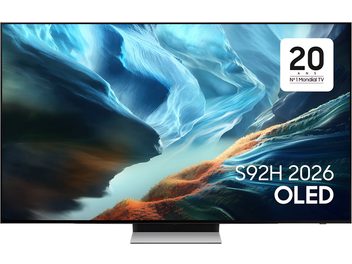
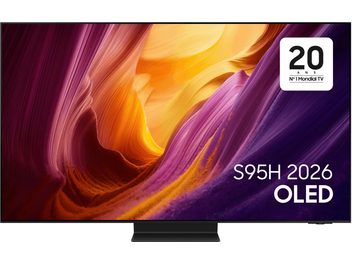
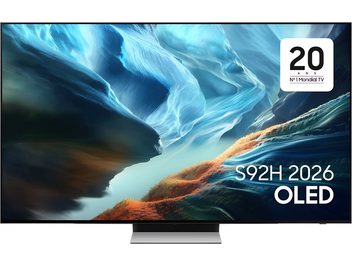
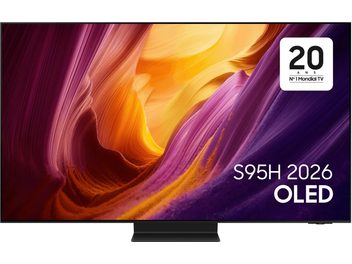
First: buying the most expensive model does not guarantee that you will get QD-OLED. The TQ48S95H, sold for €1,789 on our site, and the 83-inch S99H, priced at €6,490 as a bundle, both use Tandem WOLED from LG Display. The logic is not commercial but industrial: these sizes do not exist in QD-OLED.
Second: the 77-inch S92H is the most debated case in the range. Depending on the market, this model may receive QD-OLED, which would make it the least expensive QD-OLED in the catalog at €3,490, compared with €4,699 for the same-size S95H. However, several series of measurements published in spring 2026 on North American units concluded that the entire series used WOLED. For this specific model, checking before ordering is not an unnecessary precaution.
Third: the S85H falls outside this framework. Its panel has a name Samsung does not highlight, OLED SE, and deserves separate discussion.
The S85H case and its OLED SE panel
A third panel family slipped into Samsung’s 2026 range below the S92H. LG Display’s OLED SE, for Special Edition, occupies the lower end of its manufacturer’s catalog, below OLED EX and Tandem WOLED. Its reason for being comes down to one word: price. It targets mid-range Mini LED TVs on their own pricing ground.
The savings come from one removed component: the polarizer. This filter absorbs ambient light reflected by the screen’s internal layers, but it is expensive and also blocks some of the light emitted by the panel itself. LG Display replaces it with a lower-cost reflective film. The calculation therefore wins on two fronts, manufacturing cost and brightness, and loses on a third: reflection handling.
The differences claimed by the manufacturer are clear. The reflection rate rises from 0.3% on Tandem WOLED to 4.4% on OLED SE, a value comparable to that of a typical Mini LED LCD. Peak brightness is capped at 1,000 cd/m², DCI-P3 coverage drops to 95%, and the maximum refresh rate is limited to 120 Hz when the rest of Samsung’s OLED range reaches 165 Hz.
Even so, OLED SE retains what defines OLED: individual control of every pixel and the absolute black that results from it. An S85H installed in a bedroom, basement or room where lighting is controlled delivers results that few LCDs can achieve at this price. In a south-facing living room, on the other hand, it will behave like an LCD when dealing with reflections, without the brightness boost that allows the latter to cope with them. Room exposure matters more with this model than with any other OLED model in Samsung’s range.
The letter that reveals the panel
Samsung does not document the panel type on its product pages, but the complete reference code does it instead. A commercial reference such as TQ65S95H ends, in its long version, with a technical suffix such as HAT, HAF, HAE or HFE.
The final letter provides the information: a T or F indicates QD-OLED from Samsung Display, while an E indicates WOLED from LG Display. A TQ65S95HAT therefore contains a QD-OLED panel, while a TQ48S95HAE contains an LG panel.
This code appears on the box label, in detailed technical specifications and in spare-parts databases. On an online catalog displaying a shortened reference, asking the seller for the complete reference before confirming remains the only reliable way to know what will be delivered.
What you will really see in your living room
The gap between the two technologies narrowed in 2026, and it no longer comes down to the same criteria as in 2022.
For highly saturated colors at high brightness, QD-OLED retains the advantage. A sunset sky, a neon sign, a shot dominated by deep reds: the difference in color volume is visible, though not spectacular on SDR content or compressed streaming.
For black levels in a brightly lit room, the relationship is historically reversed. QD-OLED’s structure, lacking a conventional circular polarizer, allows ambient light to raise the black level and give it a slightly gray or purplish tint. The phenomenon is real but often exaggerated by test photographs, and the matte anti-reflection treatments deployed across the 2026 range significantly reduce it. Samsung Display developed a film for these panels called QuantumBlack that lowers reflectivity by around 20%.
In terms of viewing angle, the triangular subpixel structure of QD-OLED holds up better from the side than WOLED, which loses some saturation as you move away from the center. For office use or close-range text, however, this same triangular structure produces slight color fringing around edges, more visible than on WOLED. This deserves attention on a 48-inch model used as a PC monitor, a common use case at this size.
How to choose without making a mistake
If your target size is 55, 65 or 77 inches and color rendering matters to you, the S95H or S99H will definitely give you QD-OLED. At 48 or 83 inches, there is no question: WOLED is the only option at Samsung, and paying the premium-model price changes nothing about the panel. What it buys is the anti-reflection treatment, processor and finish.
For a very bright room, the Tandem WOLED in the 83-inch S99H or 48-inch S95H is by no means a punishment. Its black-level stability under ambient lighting is better than QD-OLED’s, and the peak brightness of LG’s fourth-generation panels has made up most of the gap.
For a dedicated room with controlled lighting, QD-OLED regains the advantage in color accuracy. Check the reference suffix before ordering, especially for the S92H, where the situation varies from one market to another.
Frequently Asked Questions
How can I tell whether my Samsung TV is QD-OLED or WOLED?
The full product reference reveals it. After the model name comes a three-letter technical suffix: a T or F in the final position (HAT, HAF) corresponds to a Samsung Display QD-OLED panel, while an E (HAE, HFE) indicates an LG Display WOLED panel. This code appears on the box label and in detailed technical specifications, but rarely on retailer product pages, which most often display the shortened reference. On a television that is already installed, the label affixed to the back of the chassis carries the same information.
Is the Samsung TQ48S95H a QD-OLED?
No. The 48-inch S95H uses a Tandem WOLED panel supplied by LG Display. Samsung Display does not produce QD-OLED panels below 55 inches, making this size unavailable with its in-house technology. The same constraint applies in reverse to the 83-inch model. In these two sizes, the price of the high-end model reflects the anti-reflective coating, the NQ4 AI Gen3 processor and the finish, not a change of panel.
Which Samsung 2026 sizes actually feature a QD-OLED panel?
Only the 55-, 65- and 77-inch models, and only in the S95H and S99H series. The other models in the range, from the S92H to the S82H, use LG Display panels, with the possible exception of the 77-inch S92H depending on the market. The 42-, 48- and 83-inch models are WOLED regardless of the series chosen. Our selection filtered by panel technology makes it easy to find your way around.
What difference do you really see between QD-OLED and WOLED?
For highly saturated colors at high brightness, QD-OLED retains a measurable advantage, with 83.4% Rec.2020 coverage recorded on the 65-inch S95H. For blacks in a brightly lit room, the hierarchy is reversed: QD-OLED allows ambient light to slightly raise the black level, a phenomenon that the matte coatings in the 2026 range significantly reduce. Viewing angles remain better with QD-OLED, while WOLED displays sharper text at close range, as its subpixel structure produces less color fringing around edges.
Is QD-OLED still superior to WOLED in 2026?
The question is no longer as clear-cut as it was in 2022. LG Display’s fourth-generation panels, with their Primary RGB Tandem 2.0 structure that stacks four emissive layers and eliminates the diluting white sub-pixel, have closed most of the gap in brightness and saturation. The choice now depends on the room: strong ambient light and prolonged exposure to static interfaces favor WOLED, while a dark room and highly colorful HDR content benefit from QD-OLED.
Featured products

You may also like to read
 Sony BRAVIA 9 II vs Samsung R95H: 2026 RGB Mini LED ComparisonComparisons and buying guides
 Samsung OLED 2026 Comparison: S92H, S95H or S99H, which one to choose?Comparisons and buying guides
 S95H, S90H, S85H: the real differences in the Samsung 2026 OLED lineupHi-fi and home cinema news
 Contrast and black level: why OLED comes out aheadComparisons and buying guides
 OLED image: Is burn-in still a real risk in 2026?Concepts and technologies
 Micro RGB or OLED: what are the differences when choosing your TV in 2026?Comparisons and buying guides
 Which screen should you choose for sports: OLED, Mini LED, or projector?Comparisons and buying guides