

Banana Plugs and Spades
Two connectors account for most speaker connections: the banana plug, a cylindrical pin that inserts into the binding post, and the spade, a flat lug that fits under the nut. The choice depends on the binding post, access to the back of the cabinet, and how often disconnection is expected. The rest, materials and plating, comes down to the details. Learn more
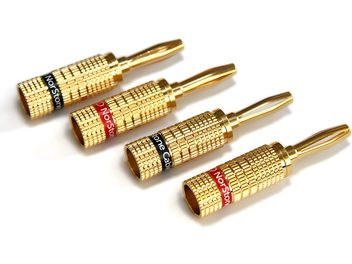
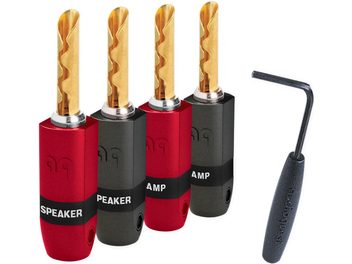
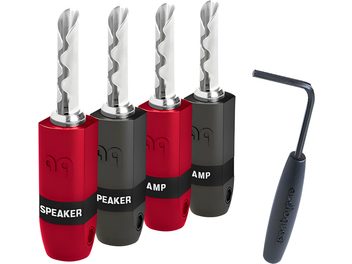
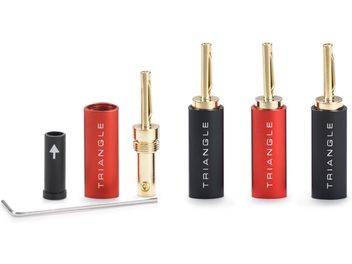
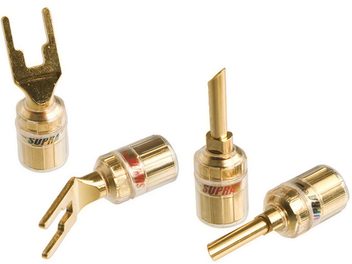
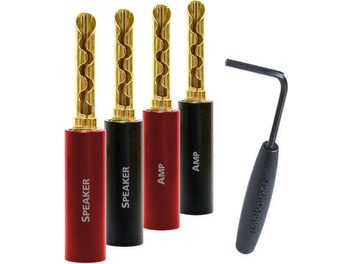
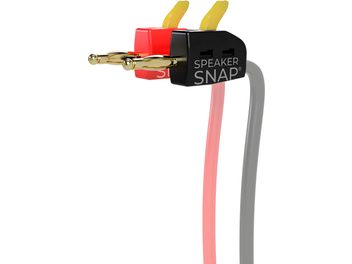
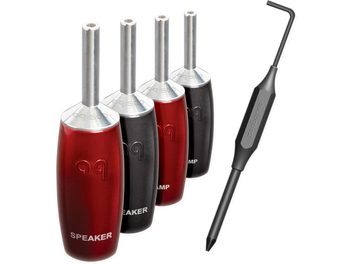
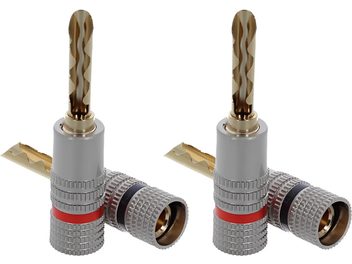
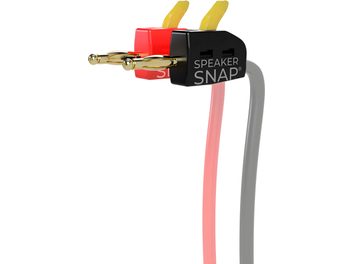
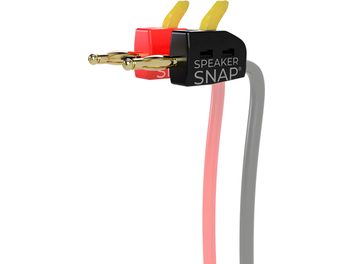
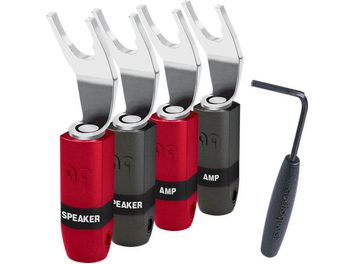
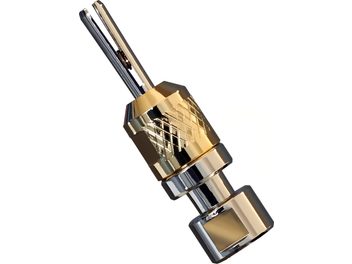
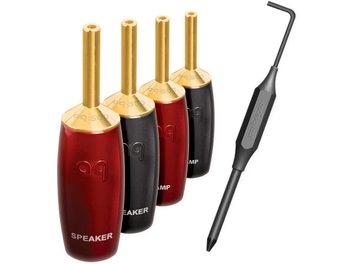
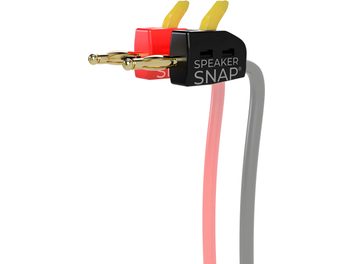
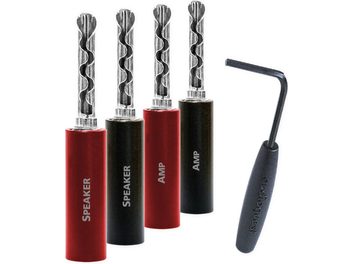
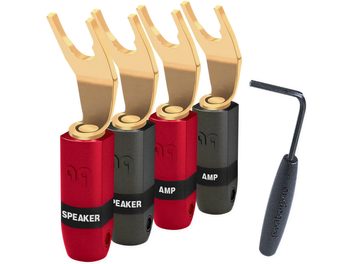
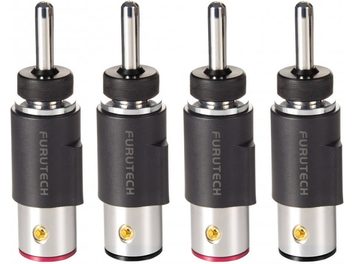
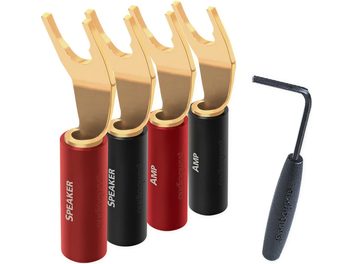
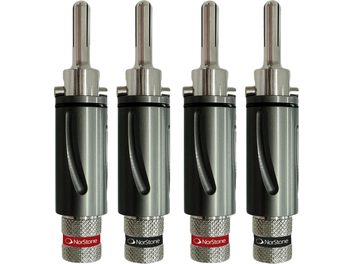
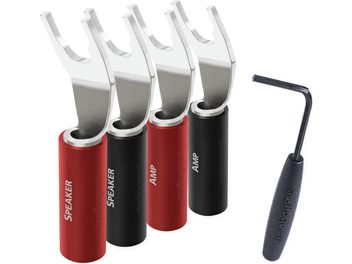
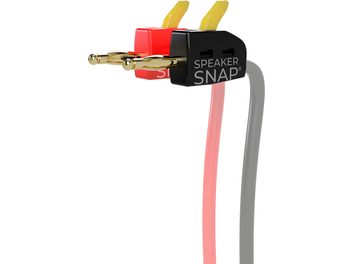
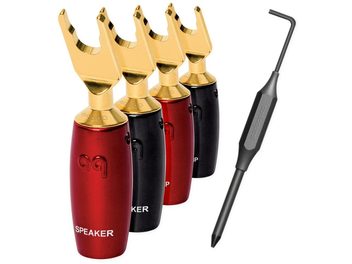
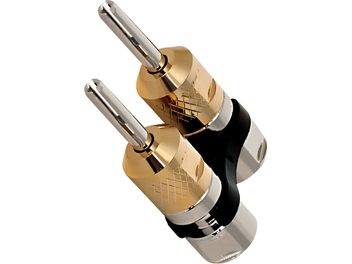
Two geometries for the same binding post
A screw binding post, whether on a speaker or an amplifier, accepts several types of speaker cable terminations. The banana plug, with its standardized 4 mm diameter, inserts into the hole drilled at the top of the threaded shaft. The spade slips around that same shaft and is clamped between the knurled nut and the base. Two ways of carrying current, two contact surfaces, two usage logics.
The 4 mm format comes from electrical engineering and measurement, where it has long been used for test leads carrying live voltage. Electrical safety standards in that field require insulated versions, whose covering prevents any contact with the metal part. Audio retained the bare version, without a protective sleeve, since the voltages present at a speaker output remain low.
The banana plug in everyday use
A banana plug inserts and removes in one motion, without tools. Its body is split, or fitted with spring leaves, and presses against the inner wall of the hole. The pressure remains modest but constant, and the connection is restored identically after each handling.
It matters as soon as a system includes many channels. In home theater, seven speakers and a subwoofer represent fourteen connections on the speaker side, and as many on the amplifier side. Moving a cabinet, changing a component, or reworking cable routing becomes a matter of minutes.
One European detail is worth knowing: many binding posts sold in Europe come with a plastic insert blocking the axial hole. Regulations intended to prevent insertion of a mains plug are the reason. The insert can be removed with pliers, and the banana plug regains its slot.
The spade and flat contact
The spade, also called a spade lug, relies on mechanical pressure. Tightened under the nut, it presses one flat surface against another, with firm contact that no vibration can loosen. On a fixed installation, on a subwoofer placed on the floor, or on a downward-facing binding post, it holds better than a cylindrical pin.
Two internal openings cover almost all binding posts on the market, 6 mm and 8 mm, with some open spades accepting both diameters. The trade-off is handling: you have to unscrew, position, and screw back down. Overtightening deforms the lug, and a stray copper strand sticking out can touch the neighboring terminal and short-circuit the amplifier output.
Advantages and disadvantages of each format
The advantage of the banana plug lies in connection speed and contact repeatability. Its disadvantage lies in its smaller contact surface and in a spring that weakens after hundreds of insertions.
The advantage of the spade lies in its contact surface and long-term stability. Its disadvantage lies in slower disassembly and the risk of short circuits on closely spaced terminals. This comparison sums up the logic of the choice: mobility on one side, permanence on the other. The best connection is the one that matches the binding post in front of it.
Bare wire, banana plug, or spade
Bare wire costs nothing and works. It has real weaknesses: the strands fray, bare copper oxidizes in air, and the contact surface changes with each new tightening. One stray strand between two terminals is enough to trigger an amplifier’s protection circuit, sometimes to damage it.
A proper connector adds resistance measured in milliohms, a negligible amount compared with that of the cable itself. Let’s say it plainly: the value of a banana plug or a spade is primarily mechanical and practical. It stabilizes the contact, protects the copper, and makes the connection repeatable. Audible gains, when they exist, come from that and not from any miraculous conductivity.
Materials, plating, and durability
The body of a connector is machined from brass, an alloy of copper and zinc, or from pure copper. Brass costs less, machines well, and its conductivity is about a quarter that of copper. Across the few millimeters involved, the electrical difference remains minimal. It mainly shows in spring retention and durability.
Plating addresses a specific problem: oxidation of the contact surface. Gold does not tarnish and is applied in a thin layer, but it remains soft and wears with repeated insertions. Silver offers the high conductivity attributed to it by metal physics, and it tarnishes by forming a sulfide which, unlike copper oxide, still conducts current. Rhodium is hard, resists abrasion, and suits connectors that are handled often. A nickel underlayer serves as a diffusion barrier on many gold-plated parts; manufacturers attentive to audio connectors replace it when they can, since nickel is magnetic.
Materials dictate the price. Gold-plated brass does the job on an entry-level system. Rhodium-plated pure copper is justified on a high-end setup that is handled often.
Attaching the cable to the connector
The screw system dominates. One or two grub screws clamp the strands in a cylindrical channel, without soldering or special tools. Crimping requires suitable pliers and creates a permanent mechanical joint, often used on spades. Soldering with tin remains possible on models designed for it, with a sufficiently powerful iron. This ease of assembly explains the popularity of the screw model among installers.
The steps take only a few motions. Strip the conductor to the length of the channel, twist the strands in the lay direction, insert them fully, tighten, then pull on the cable to check the grip. A classic technical mistake is tinning the strands before slipping them under a screw. The solder creeps under pressure, the tightening loosens over the months, and contact resistance rises.
Compatibility with speaker binding posts
The screw binding post accepts everything: banana plug, spade, bare wire, straight pin. The spring terminal, that clip pressed in with the thumb, accepts neither banana plug nor spade. Only bare wire and thin pins fit there, a frequent limitation on compact speakers, surround speakers, and some entry-level amplifiers.
The spacing between the two terminals of the same pair is standardized at 19 mm, which allows dual banana plugs, a single body carrying both pins. On an amplifier whose terminals are packed close together, an angled spade or a right-angle banana plug prevents the cable from being forced and the connector from touching its neighbor.
Bi-wiring, jumpers, and multichannel systems
Many hi-fi speakers have four terminals instead of two, one pair for bass, one pair for midrange-treble. Stamped metal jumpers connect them at the factory. Replacing them with wired jumpers, terminated with spades or banana plugs, is the first modification this type of binding post allows.
Bi-wiring goes further, with two cables per speaker. A stereo system then requires sixteen terminations, eight at each end. Connectors are sold in sets of four or eight, with red and black rings for polarity marking, a detail you regret neglecting when the soundstage collapses and the bass disappears.
Maintenance and contact oxidation
Bare copper turns green, aluminum becomes covered with insulating alumina, and an oxide layer just a few microns thick is enough to degrade a connection. A plated connector postpones this phenomenon by several years.
The rest comes down to maintenance. A lint-free cloth moistened with isopropyl alcohol cleans the pins and the inside of the holes. Periodic reinsertion, once a year, breaks the thin layer formed on the surface. Checking tightening torque on spades compensates for the natural creep of the metal.
Buying guide by installation type
Cable cross-section determines the plug. Common models accept 4 mm², the largest 6 mm² or more, and a heavy-gauge speaker cable sold by the meter will not fit into an entry-level connector. Checking the entry diameter before purchase, online or in-store, avoids a return.
The number of disconnections decides between the two families. A system that moves, an amplifier that is replaced often, a listening room with several pairs of speakers: banana plug. A one-time installation, terminals facing the wall, a subwoofer that vibrates: spade.
Last advice before buying: count eight connectors per pair of speakers for single wiring, sixteen for bi-wiring, and plan four extra pieces for the jumpers. This discreet accessory determines the quality of every connection in an audio system, from the speaker cable to the binding post, and the recommended conductor cross-section remains the first technical criterion to check.
Frequently asked questions about speaker connectors
What is a banana plug?
A cylindrical connector 4 mm in diameter, with a split body or fitted with spring leaves, that inserts into the hole of a screw binding post. The speaker cable is attached to it by screw fastening, crimping, or soldering. The name comes from the slightly bulging shape of the leaves.
What is the difference between a banana plug and a spade?
The banana plug inserts into the hole of the threaded shaft, while the spade is tightened around that shaft under the nut. The former connects and disconnects in one motion, while the latter offers a larger contact surface and superior mechanical stability against vibration.
How do you install a banana plug on a speaker cable?
Strip the conductor to the length of the plug channel, ten to twelve millimeters depending on the model. Twist the strands without tinning them. Insert them fully, tighten the grub screw with the supplied Allen key, then pull on the cable to check the grip. Mark polarity with the colored rings before connecting.
Should banana plugs be preferred over bare wire?
From a strictly electrical standpoint, the difference is marginal. From a practical standpoint, it is clear: no more strands slipping out, no more copper oxidation in open air, no more random contact from one tightening to the next.
How do you choose banana plugs?
Check the acceptable cable cross-section, the fastening method, the plating, and the quality of the spring. A pure copper body plated with rhodium or gold ages better than nickel-plated brass. The best approach is to start with the binding posts on your speakers, then those on your amplifier, before comparing products.
Does gold plating improve sound?
It protects the contact surface from oxidation, which maintains connection quality over time. No plating metal changes the signal over a path of a few millimeters. The benefit concerns durability, not a sound signature.
How do you prevent contact oxidation?
Choose a plated connector, do not leave bare copper exposed to air, clean the pins with isopropyl alcohol once a year, and reconnect periodically. In a damp room, more frequent checking of the binding posts remains advisable.




