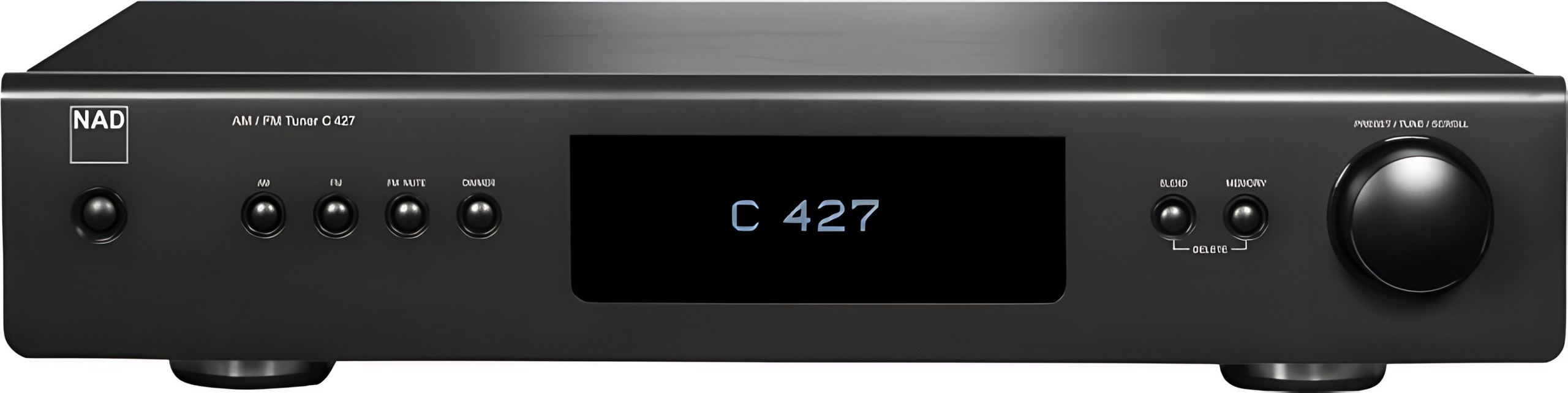
The NAD C 427 is an FM/AM tuner designed for integration into a hi-fi system. Its goal is to provide stable radio reception by reducing interference, background noise, and signal fluctuations. Its design focuses on audio reproduction accuracy, with no added processing or effects, in order to reproduce the radio signal as faithfully as possible.
MOS-FET Architecture for Crystal-Clear Reception
The C 427 stands out thanks to its RF (radio frequency) input stage built around MOS-FET transistors, a technology NAD has carried over through several generations of tuners. This architecture offers decisive advantages: increased sensitivity in challenging reception areas, exceptionally low intermodulation distortion, and a reduced noise floor across the entire audio bandwidth. The printed circuit board benefits from carefully routed tracks, with each component positioned to minimize mutual interference and parasitic coupling.
The FM section boasts rigorous technical performance. The signal-to-noise ratio reaches 60 dB, while the frequency response extends from 20 Hz to 15 kHz with a maximum variation of ±1.5 dB. These figures reflect the ability to reproduce the full audio spectrum, from deep bass to sparkling highs. The sensitivity of 10 dBμV at 98 MHz allows you to pick up distant stations or those whose signal must pass through geographic obstacles.
The AM section, often overlooked in modern tuners, receives special attention. Although the physical limits of amplitude modulation impose a reduced bandwidth (100 Hz to 2.3 kHz), NAD has optimized this section to extract maximum clarity from the signal, with a signal-to-noise ratio of 42 dB and total harmonic distortion kept to 1.5%.
An Interface Designed for Everyday Use
The C 427’s front panel breaks away from the clutter of rarely used buttons. A 24-position rotary encoder is the central navigation element. This dial lets you scroll through frequencies, select preset stations, and access various functions with a smoothness reminiscent of vintage analog tuners, while benefiting from the precision of digital processing.
The four-line VFL (Vacuum Fluorescent Display) simultaneously shows all relevant information: frequency, station name via RDS, signal strength, and reception mode. This instant readability eliminates the need for repeated actions to check reception parameters. The RDS system is deliberately limited to the PS (Program Service) and RT (Radio Text) functions—those that provide real everyday value. The station name displays automatically—“France Inter” or “BBC R1” replace abstract digital frequencies.
The 40 preset slots accept any combination of AM and FM stations: 35 FM and 5 AM, or 20 of each, depending on your listening habits. The system automatically skips empty slots when scrolling, so you don’t have to cycle through unprogrammed positions. Non-volatile memory retains these presets even after a prolonged power outage or complete disconnection of the device.
Technical Features Serving Musicality
The Auto Search function scans the radio spectrum and automatically stops on strong signals, instantly optimizing tuning. Weaker stations remain accessible via manual tuning, allowing you to explore the far reaches of the FM band in search of local or distant radio stations. The FM Mute mode eliminates hiss between stations, letting only sufficiently strong signals emerge from absolute silence.
The Blend function deserves special mention. Some stations broadcast a noisy stereo signal while their mono component remains clean. Blend gradually reduces stereo separation to decrease noise without abruptly switching to mono, thus preserving some spatialization. This nuanced approach lets you keep enjoying stations at the edge of their range.
The power consumption reflects NAD’s environmental commitment. In standby, the C 427 consumes just 0.5 watts, while keeping remote control interfaces active. This technical achievement is the result of a complete redesign of the power supply, which still retains the ability to instantly deliver the energy needed for optimal reception circuit performance.
Integration into the Modern Hi-Fi Ecosystem
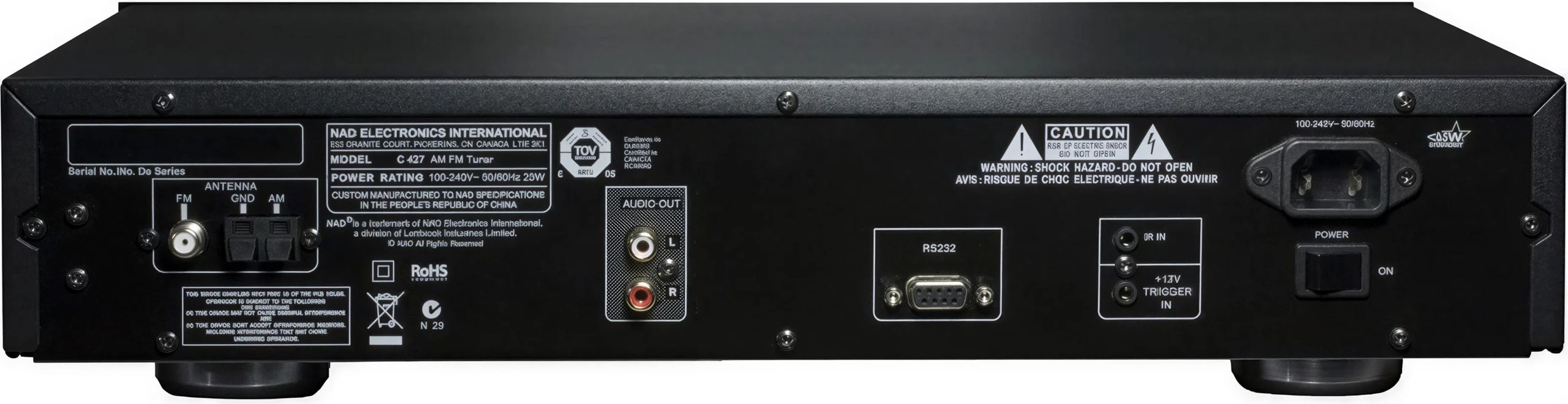
The rear panel reveals the dual nature of the C 427: traditional tuner and modern home automation component. The stereo audio outputs on RCA are accompanied by an RS-232 port for integration into sophisticated control systems. A remote infrared input allows commands to be received even when the device is installed in a closed cabinet. The 12V trigger input synchronizes power-on with other components in the system, creating a unified setup that activates with a single command.
This compatibility extends to the main home automation protocols on the market. Professional installers can integrate the C 427 into Control4, Crestron, URC, RTI, or Lutron configurations, making this tuner a link in a complex multiroom system. The supplied infrared remote control covers all functions, maintaining accessibility for classic home use.
The dimensions of 435 x 96.3 x 315 mm comply with the standard size for hi-fi components, making it easy to integrate into existing furniture and racks. The weight of 4.5 kg reflects solid construction without excess, where every gram contributes to sound quality or mechanical rigidity.