Robert
Good quality product.
Comment from 8 March 2023 — Experience from 18 February 2019
Automatically translated — Show original (French)
Produit de bonne qualité.
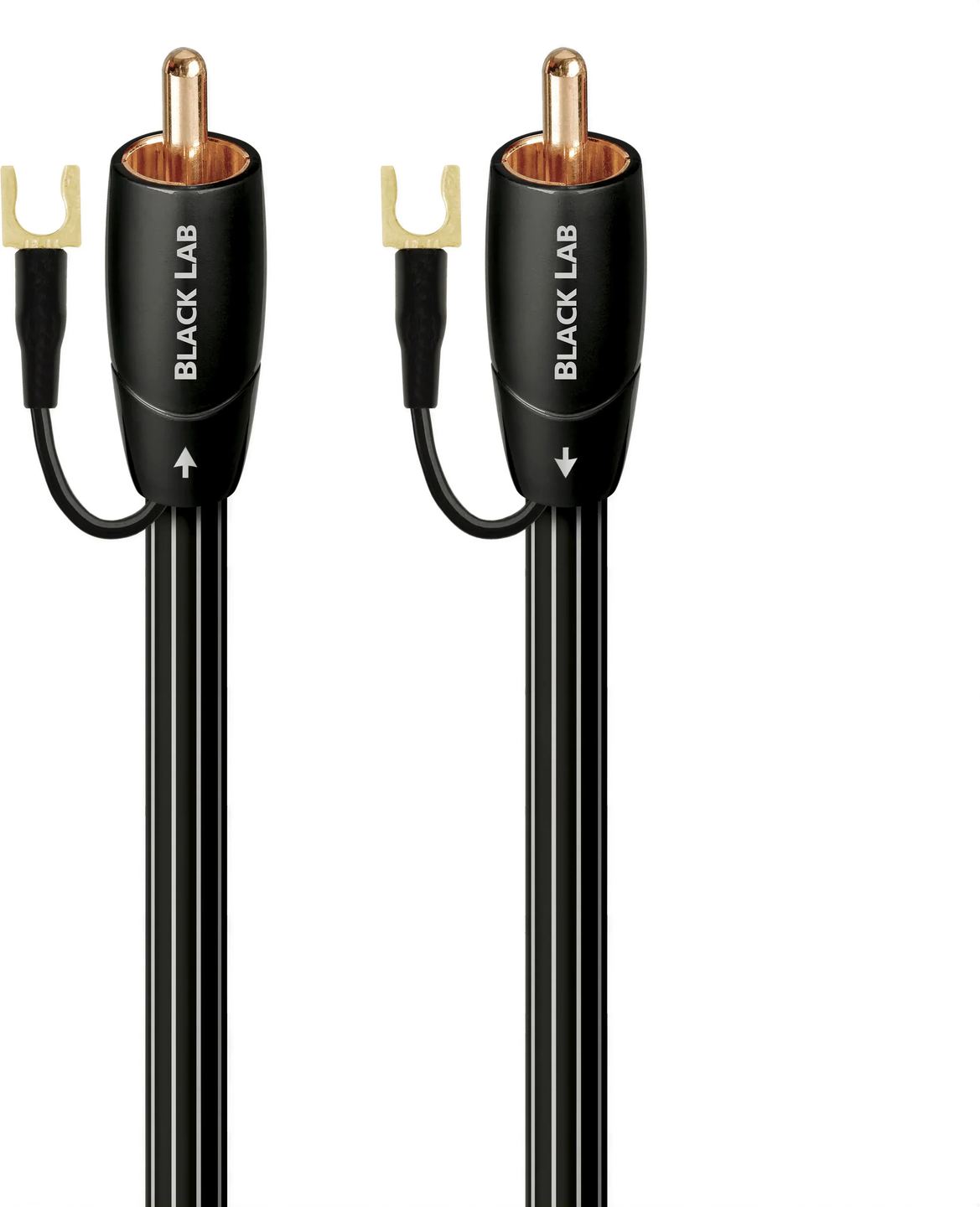
A subwoofer deserves a connection that matches what it can deliver. Too often neglected in favor of the main speakers, the cable that connects the amplifier or processor to the subwoofer nonetheless plays a decisive role in low-frequency reproduction. AudioQuest designed the Black Lab to address this issue with a coherent technical approach, from the conductor all the way to the connector.
The Black Lab uses a solid long-grain copper conductor, a crystalline structure that limits the number of junctions between the metal’s grains. These junctions act as microscopic obstacles to the passage of the signal, particularly in the low-frequency range where the slightest discontinuity can result in a loss of definition. By reducing these points of friction, LGC (Long Grain Copper) promotes a more direct transfer of audio information.
The chosen geometry is a symmetrical coaxial design: the positive and negative conductors have identical cross-sections, while the shielding remains physically separated from the signal path. This architecture allows the shielding to fulfill its protective role without interfering with the transmission itself, helping maintain a stable signal with little background noise.
Between the conductor and the outer jacket, insulation plays a role that is often underestimated. The Black Lab uses nitrogen-injected, foamed polyethylene, a material whose high air content reduces energy storage in the dielectric. In practice, this limits timing smearing that can affect the attack and decay of low notes, thus preserving the bite of a bass line or the impact of a cinematic effect.
Home cinema or hi-fi setups multiply potential sources of interference: Wi-Fi routers, dimmer switches, switching power supplies. The Black Lab incorporates a metal-layer noise dissipation system that combines absorption and reflection of radio-frequency (RF) and electromagnetic (EMI) interference. This protection also extends to ground loops, which are responsible for hum and buzz that can pollute the signal, especially over runs of several meters between the electronics and the subwoofer.
The cable is suitable for setups where the subwoofer is located far from the amplifier: in-wall runs, routes under carpet, or through conduits. The quality of the shielding helps maintain a clean signal over these distances without audible degradation.
The Black Lab’s RCA plugs feature gold plating that protects the contacts from oxidation over time. AudioQuest has chosen high-pressure cold-weld assembly rather than traditional tin soldering. This method avoids exposing the conductors to high temperatures that could alter the copper’s structure and create additional points of resistance. The result is a mechanically solid and electrically reliable connection over the long term.
On a well-calibrated system, the Black Lab allows the subwoofer to operate under better conditions: tighter, better-defined bass, improved integration between the subwoofer and the main speakers, and the absence of interference that clarifies the entire spectrum. In home cinema, this signal cleanliness also translates into better dialogue intelligibility, as the subwoofer no longer masks or disturbs midrange frequencies.
This wire with a spade connector solves hum problems caused by ground loops between the subwoofer and the amplifier. Simply connect the metal chassis of the two devices if a humming noise appears. In most setups, this wire remains unused, but its presence helps avoid future complications.
This cable works with any active subwoofer equipped with an RCA input, whether hi-fi or home cinema. It is compatible with subwoofer (LFE) outputs on amplifiers, AV receivers, soundbars, and audio processors that provide a dedicated RCA output.
Each Black Lab cable provides a mono connection between one output and one input. For a dual-subwoofer configuration, you need two separate cables, one per subwoofer, connected to the corresponding outputs of the amplifier or via an RCA splitter if only one output is available.
Traditional soldering heats the conductor to several hundred degrees, which can locally alter the copper structure and create microscopic resistances. High-pressure cold-weld assembly joins the elements mechanically, without heat, thus preserving the integrity of the conductor along its entire length.
Robert
Good quality product.
Comment from 8 March 2023 — Experience from 18 February 2019
Dominique
No issues, good product that meets my expectations.
Comment from 7 May 2020 — Experience from 15 April 2020
Gerald
Very good quality 8m I have some margin.
Comment from 25 April 2020 — Experience from 3 April 2020