Arkadiusz
Good product, very good in-store service
Comment from December 12, 2025 — Experience from December 01, 2025
Automatically translated — Show original (French)
Bien produit , très bien service magasin
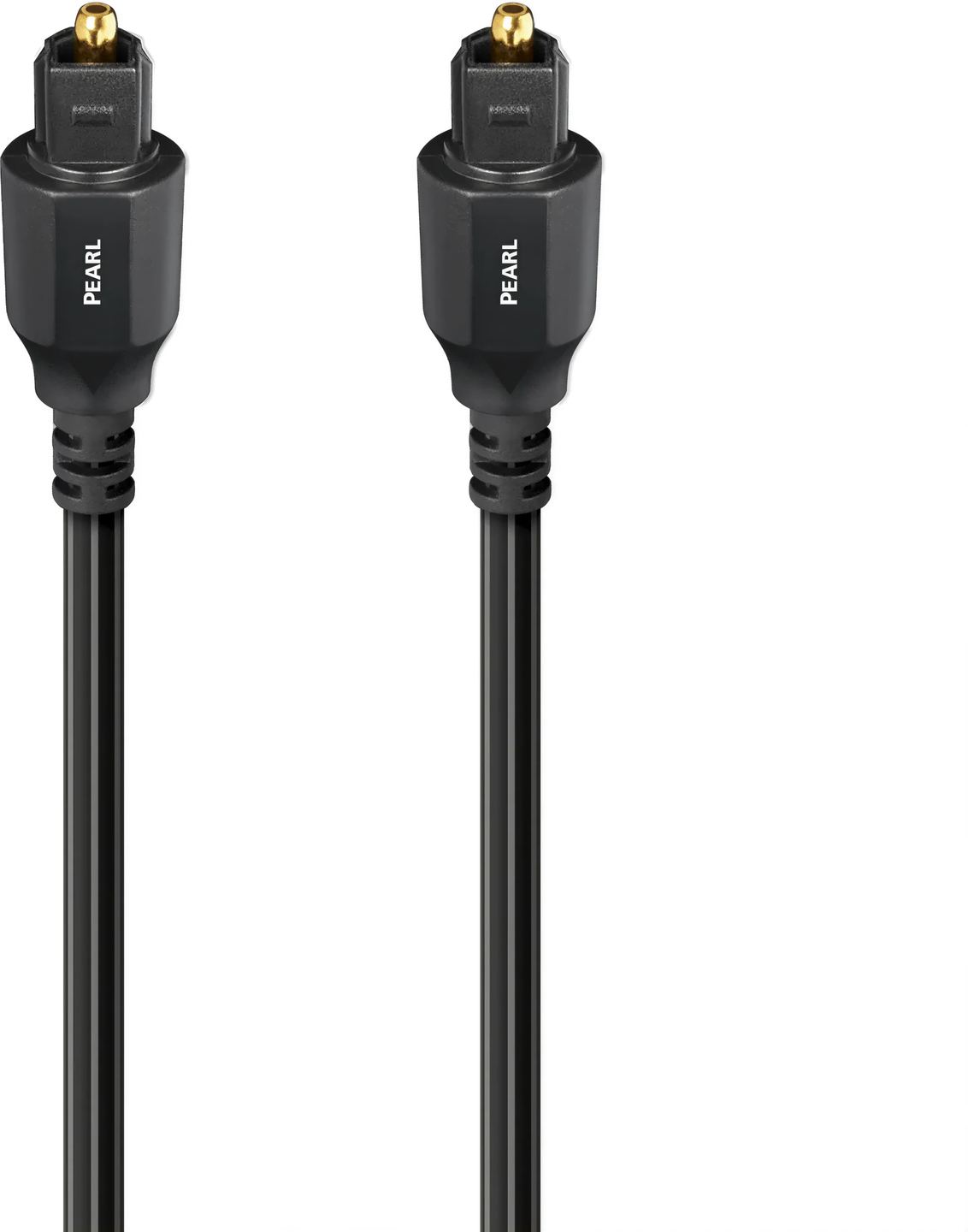
The AudioQuest Pearl optical cable uses an optical fiber engineered to limit light dispersion and reduce digital timing errors. It enables reliable transmission of digital audio signals and serves as an entry-level solution in AudioQuest’s range of optical cables. This model is compatible with many audio-video devices such as TVs, soundbars, DACs, or Blu-ray players.
AudioQuest’s Pearl is based on a synthetic fiber specially selected for its low-dispersion properties. Far from being anecdotal, this technical characteristic is the very heart of the cable’s performance. When the light signal travels through a standard optical fiber, part of the light disperses and bounces off the inner walls like a microscopic game of billiards. These deviated rays cover a longer distance and arrive late at their destination, creating what engineers call “jitter”—timing errors that degrade the precision of the digital signal.
AudioQuest combats this phenomenon with a meticulous approach: the Pearl’s synthetic fiber has fewer imperfections and impurities than conventional fibers, drastically reducing unwanted reflections. The standard Toslink connectors benefit from high-precision polishing, ensuring optimal alignment of the light flux between transmitter and receiver. This carefully polished interface is a critical element often overlooked in entry-level cables.
The cable’s structure also reveals attention to detail. The black-and-gray outer sleeve, certified for in-wall installation, effectively protects the fiber while maintaining the rigidity needed to avoid excessive bends that could compromise transmission. This robust construction ensures performance stability over time, a particularly appreciated aspect in fixed installations.
The Pearl stands out for its versatility. In a typical home theater setup, it links a modern TV to a soundbar, faithfully transmitting Dolby Digital and DTS streams. The quality of the fiber ensures dialogue retains its natural clarity while sound effects maintain their dynamic impact. Users frequently report a noticeable improvement in separation between highs, mids, and lows, with increased precision on voices and ambient sounds.
For hi-fi configurations, the Pearl fits perfectly between a CD transport and an external DAC, or between a network streamer and an integrated amplifier. The reduction in jitter translates into a more stable and defined soundstage, where each instrument occupies its place more naturally. Cymbals gain finesse, shedding the metallic harshness often associated with lower-quality digital transmissions.
An often underestimated aspect is the Pearl’s universal compatibility. Available in Toslink–Toslink and Toslink–3.5 mm mini-jack versions, it adapts to a wide range of setups, from Mac laptops to high-resolution portable DACs. This flexibility, combined with lengths from 0.75 m to 16 m, can virtually solve any domestic optical connection challenge.
The main difference lies in the quality of the fiber and the care taken with the connectors. A basic cable generally uses standard plastic fiber with wide tolerances, generating more light dispersion. The Pearl employs a low-dispersion synthetic fiber with precisely polished connectors, significantly reducing jitter and improving sonic clarity. Users particularly note better treble definition and clearer separation between instruments.
The standard Toslink protocol intrinsically limits bandwidth to about 96 kHz/24-bit for PCM stereo, regardless of cable quality. The Pearl perfectly transmits these formats as well as compressed multichannel Dolby Digital and DTS streams. For high-resolution formats beyond 96 kHz or uncompressed multichannel streams, an HDMI or USB connection is still required. However, within Toslink’s limits, the Pearl optimizes transmission quality.
AudioQuest designs its cables to maintain consistent performance across the full range of offered lengths. The Pearl retains its characteristics up to around 10 meters without amplification. Beyond that, optical losses can theoretically affect transmission reliability, although the Pearl remains functional up to 16 meters in most setups. For critical distances, choose the shortest length compatible with your installation.
Absolutely. Recent PlayStation and Xbox consoles feature optical outputs that are fully compatible with the Pearl. The cable efficiently transmits game audio streams, preserving spatialization and the impact of sound effects. Many gamers particularly appreciate the optical connection for its total immunity to electromagnetic interference, ensuring noise-free sound even in electrically noisy environments.
Unlike electrical connections where gold plating prevents oxidation, optical connectors transmit light, not electricity. Gold plating provides no technical benefit on an optical link and is purely marketing. AudioQuest prioritizes investment in fiber quality and polishing of optical interfaces—factors that truly determine performance.
Glass fiber (quartz) theoretically offers superior transmission with less dispersion than synthetic fibers. However, over typical domestic distances (1–5 meters), the difference remains marginal. The Pearl uses high-quality synthetic fiber that delivers excellent performance at a controlled cost. Glass fiber cables like AudioQuest’s Vodka or Diamond models are intended for very high-end systems where every marginal improvement matters.
Arkadiusz
Good product, very good in-store service
Comment from December 12, 2025 — Experience from December 01, 2025
Sandy-Clémence
Does exactly what it’s supposed to do
Comment from October 29, 2025 — Experience from April 25, 2025
Philippe
Hello
Good product so far
Best regards
Phtour
Comment from September 30, 2025 — Experience from September 19, 2025