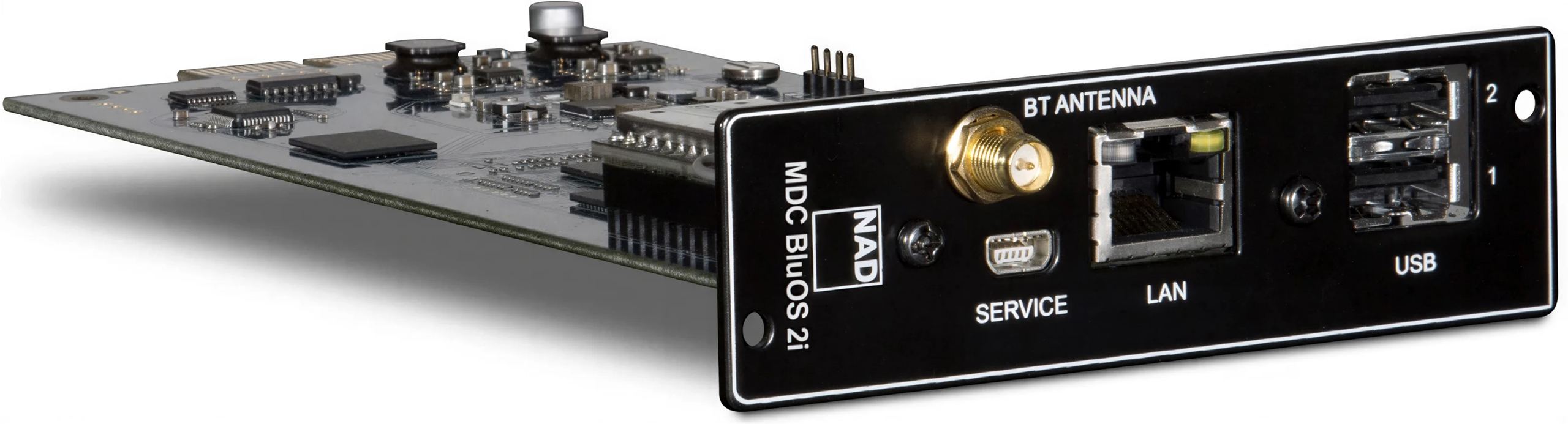
The MDC DD-BLUOS2i module from NAD is a modular expansion card designed for compatible amplifiers, providing access to the high-resolution BluOS streaming platform. Based on NAD’s MDC modular design, this card features a recent ARM processor to enhance responsiveness. It is compatible with the NAD C 368, C 388, C 390DD, M32, and M12 models, and allows management of up to 63 audio zones simultaneously in a multiroom system.
Technical Architecture and Next-Generation ARM Processor
At the heart of the MDC DD-BLUOS2i is a next-generation ARM processor, marking a significant evolution compared to previous versions. This processor architecture, renowned for its energy efficiency and optimized computing power, enables the module to handle high-resolution audio streams, complex network protocols, and the user interface simultaneously, with no perceptible latency. The choice of ARM reflects a modern approach where performance does not come at the expense of thermal efficiency, which is especially crucial for an internal module operating within the confined space of an amplifier.
The physical integration of the module follows a logic of absolute simplicity. Unlike external solutions that require dedicated power supplies and multiple cables, the DD-BLUOS2i slots directly into the host amplifier’s MDC slot. This “plug-and-play” approach eliminates additional signal conversions and maintains the integrity of the audio path. The module communicates natively with the amplifier’s firmware, creating perfect synergy between the device’s core functions and the extended capabilities brought by BluOS.
The module’s connectivity includes two USB Type-A ports for direct playback from storage devices, a Gigabit Ethernet port for a stable wired network connection, and a micro-USB port reserved for maintenance operations. An external USB WiFi module is provided, along with an antenna and USB extension cable, allowing wireless reception to be optimized according to the installation environment.
BluOS: A Versatile and Scalable Streaming Platform
BluOS is much more than just a streaming protocol. Developed jointly by NAD and its sister company Bluesound, a member of the Lenbrook Industries group based in Ontario, this platform forms a complete audio ecosystem. The system deliberately abandons traditional middleware protocols such as UPnP, DLNA, or even AirPlay in their standard implementations, preferring to create direct connections with music sources. This approach enables the transmission of audio files up to 24-bit/192 kHz without compression or degradation, including FLAC, ALAC, WAV formats, and hardware MQA (Master Quality Authenticated) decoding.
The BluOS Controller app, available free on iOS, Android, Windows, and macOS, offers a unified interface to manage the entire system. The customizable home screen displays the most-used features and the latest updates. The smart search function remembers recent queries and allows simultaneous exploration of streaming services, local libraries, and Internet radio stations. More than twenty streaming services are natively integrated, including Spotify Connect, Tidal, Qobuz, Deezer, Amazon Music, as well as thousands of radio stations via TuneIn and iHeartRadio.
Multiroom management is one of BluOS’s key strengths. The system allows you to create flexible or fixed playback groups, perfectly synchronize music between rooms, or play different content in each zone. Fixed groups can be configured as stereo pairs, home theater setups, or custom multi-player groups. The FollowMe feature allows you to instantly transfer playback from one room to another, following the user’s movements.
Asynchronous Network Connectivity and Jitter Minimization
One of the most sophisticated technical aspects of the MDC DD-BLUOS2i lies in its asynchronous network connection processing. Both Ethernet and WiFi operate in asynchronous mode, a technical feature that drastically minimizes jitter—those microscopic timing variations that can affect sound quality. This approach allows the module to resynchronize audio data according to its own high-precision internal clock, rather than relying on the network’s clock.
The module also includes Bluetooth 4.0 with aptX support, enabling wireless streaming from any compatible device within standard range. While considered secondary compared to the main network capabilities, this feature offers a convenient backup solution for guests or temporary audio sources. The Bluetooth signal can then be redistributed throughout the BluOS system via the home WiFi network.
AirPlay 2 compatibility, available specifically on the C 368 and C 388 models equipped with the DD-BLUOS2i module, adds an extra dimension to integration within the Apple ecosystem. Users can control playback via Siri, synchronize multiple AirPlay-compatible devices throughout the home, and benefit from the ultra-low latency characteristic of the AirPlay 2 protocol. This feature transforms the NAD amplifier into a true audio hub compatible with all Apple devices in the home.