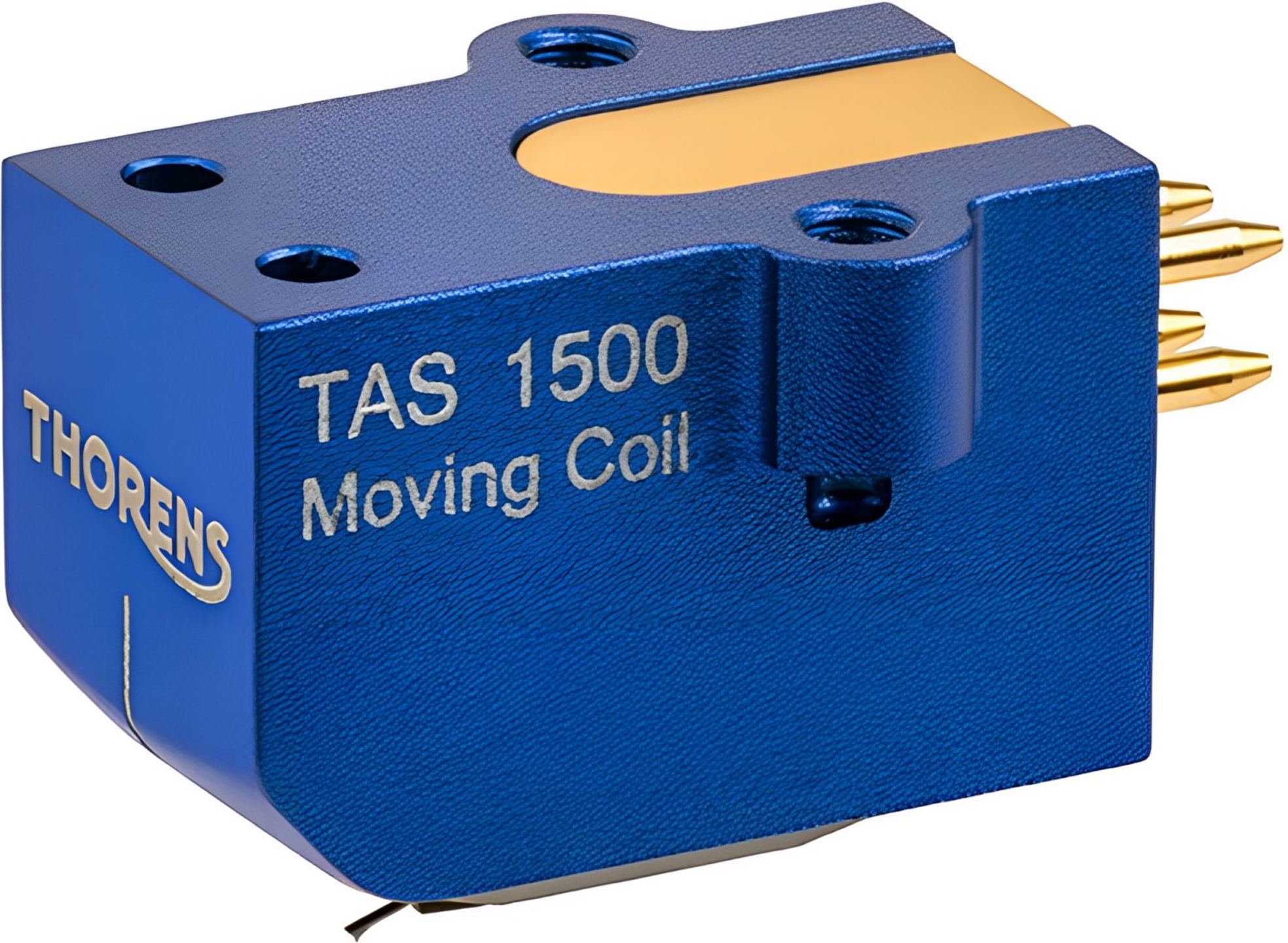
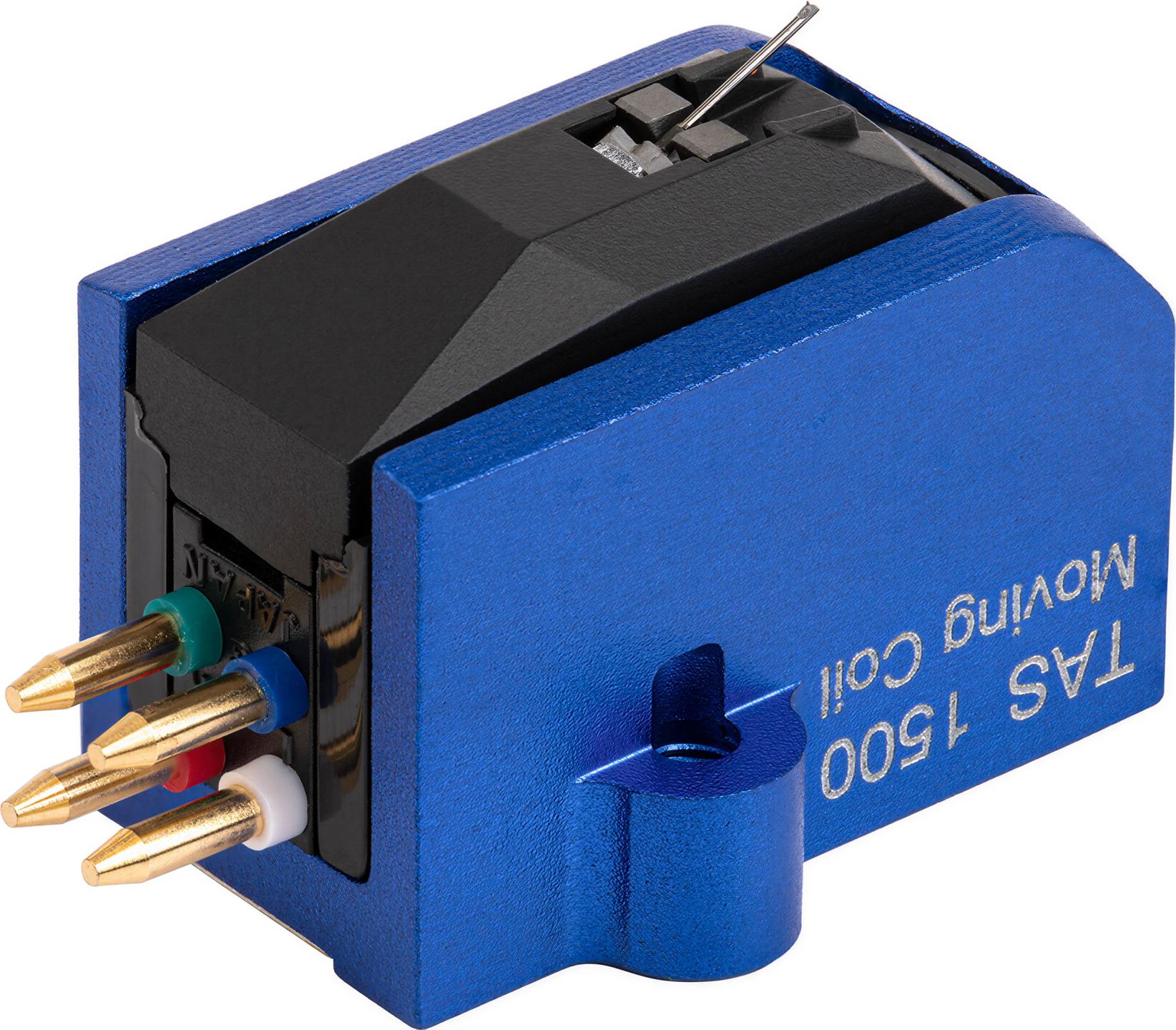
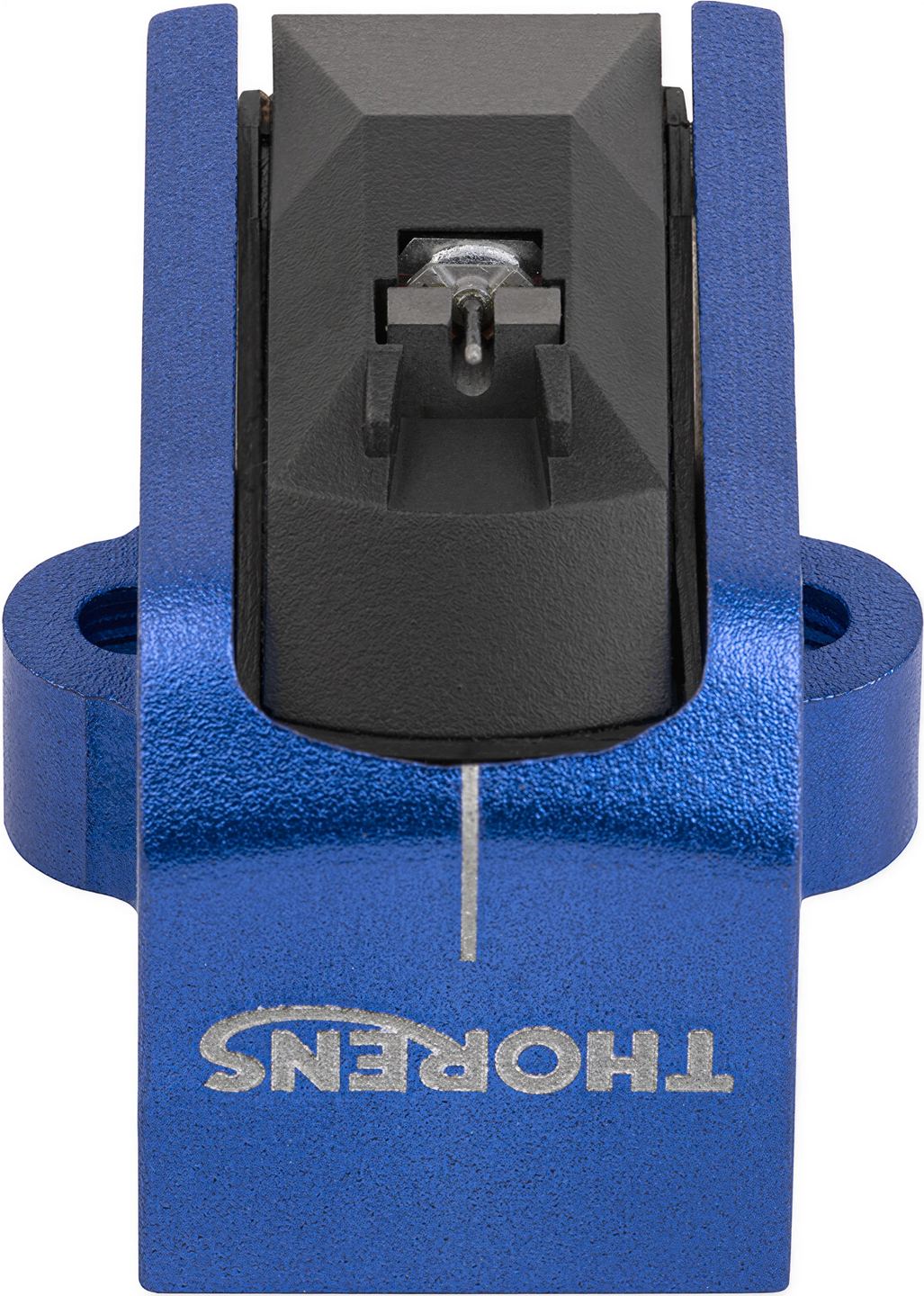
A moving-coil cartridge manufactured in Japan, the result of a technical collaboration between Thorens and Japanese specialists renowned for their expertise in analog transducers. The TAS 1500 combines a solid boron cantilever with a micro-linear cut diamond, all housed in an aluminum body designed by industrial designer Helmut Thiele. It was developed in tandem with the TD 1500 and TD 403 DD turntables, but also adapts well to many other setups.
A finely tuned reading mechanism
The cantilever of the TAS 1500 is made from a solid boron tube with a diameter of 0.28 mm. This material, prized for its exceptional rigidity and low mass, transmits the vibrations picked up by the diamond with minimal loss and coloration. At its tip, a nude diamond with a Line Contact profile (dimensions 55.9 × 3.0 μm) closely follows the groove modulations. This advanced geometry, sometimes called micro-linear, offers an extended contact surface in the direction of playback while remaining very thin laterally, which allows more high-frequency information to be extracted while preserving the groove walls.
The dynamic compliance of 16 × 10⁻⁶ cm/dyne at 100 Hz and the static compliance of 20 × 10⁻⁶ cm/dyne place the TAS 1500 in the medium-compliance range. It therefore works easily with most medium-mass tonearms, such as the TP 150 with which it was developed, as well as other arms with an effective mass between 10 and 20 grams.
PCOCC copper coils and generator circuit
The coils of the TAS 1500 use PCOCC (Pure Copper by Ohno Continuous Casting) copper, a continuous casting process developed by Professor Ohno of the Chiba Institute of Technology. This technique produces a monocrystalline copper wire whose grains can reach over 200 meters in length, compared to a few centimeters for conventional OFC copper. The near-total absence of grain boundaries reduces obstacles to the flow of the electrical signal.
With an output voltage of 0.4 mV at 1 kHz for a cutting speed of 5 cm/s, the TAS 1500 belongs to the low-output MC cartridge category. It therefore requires a phono preamplifier equipped with an MC input or a step-up transformer. Its internal impedance of 12 Ω and inductance of 25 μH make it compatible with most MC phono stages that accept a minimum load of 100 Ω.
An aluminum body designed for easy installation
The machined aluminum housing integrates M2.5 threads directly into the cartridge body, with the standard 12.7 mm (half-inch) spacing. This design avoids having to hold nuts under the cartridge during installation, an often tedious operation with traditional Japanese cartridges that use through-bolts. The brass connection pins ensure reliable contact with the tonearm wires.
The total weight of 8.2 grams places the TAS 1500 in the standard mass range. Most tonearms handle this load without difficulty, and setting the tracking force between 1.8 and 2.0 grams (nominal value: 2.0 g) is generally straightforward.
Frequency response and channel separation
The specified bandwidth extends from 20 Hz to 47 kHz, a range that goes well beyond the audible spectrum and demonstrates the ability of the cantilever-diamond system to follow the finest modulations. In practice, this treble extension contributes to the reproduction of harmonics and transients.
Channel separation reaches 27 dB at 1 kHz, a value that guarantees a well-defined stereo image with controlled crosstalk. Left/right channel balance is specified at ±1 dB, which limits perceptible level imbalances between the two channels.
Compatibility and integration
Although the TAS 1500 was developed for the TD 1500 and TD 403 DD turntables equipped with the TP 150 arm, it works just as well on other Thorens decks: suspended subchassis models such as the TD 160, TD 147, or TD 320, as well as turntables from other brands fitted with tonearms of comparable effective mass. The vertical tracking angle of 20° corresponds to the current industry standard.
For turntables equipped with balanced XLR outputs, such as the TD 1500 or TD 1601, the TAS 1500 allows you to fully benefit from this connection, provided you have a phono preamplifier that accepts balanced inputs.