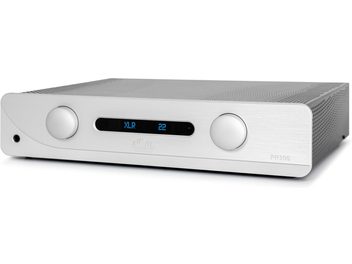
The Atoll AM300 Evolution is a stereo power amplifier designed and manufactured in Atoll Electronique’s workshops in Normandy. It reflects the brand’s audiophile philosophy, with meticulous construction, rigorously selected components, and particular attention to sound reproduction. Positioned between the AM200 and AM400 in the range, this “Evolution” model offers notable improvements in performance and reliability. Delivering 150 watts per channel into 8 ohms and capable of operating in bridged mono mode, the AM300 Evolution offers a versatile solution suitable for a wide variety of speakers.
An uncompromising dual mono design
The AM300 Evolution is based on a full dual mono architecture, a high-end design principle where each channel has its own power supply and amplification circuit. This approach ensures optimal channel separation and minimizes interference between the left and right channels. At the heart of this architecture are two imposing 440 VA toroidal transformers, complemented by an additional 5 VA transformer dedicated to control logic.
The energy reserve is provided by a bank of capacitors totaling 83,600 μF, allowing the amplifier to respond instantly to the most demanding current requirements, particularly during dynamic musical passages. This generous filtering capacity contributes to power supply stability and bass control, even at high volumes.
The power stages of the AM300 Evolution employ six MOS-FET transistors per channel, components renowned for their musicality and ability to deliver sound that is both powerful and fluid. The Class A/B bias offers an optimal balance between energy efficiency and sound quality, with remarkably low total harmonic distortion of 0.005% at 1 kHz.
Artisanal manufacturing and quality materials
The build quality of the AM300 Evolution demonstrates Atoll Electronique’s expertise. Its 8 mm thick aluminum front panel, brushed, micro-blasted and anodized, features high-precision engraving that gives it timeless elegance. The 2 mm steel chassis ensures perfect rigidity and effective protection against vibrations and electromagnetic interference.
Inside, each component has been selected for its audiophile qualities. The high-quality MKP coupling capacitors are shielded to prevent interference. The printed circuit boards benefit from a specific nickel/gold treatment guaranteeing optimal conductivity and increased durability. The RCA input/output connectors are screwed directly to the chassis for uncompromising solidity, while the tellurium copper speaker outputs ensure lossless signal transmission.
This meticulous attention to detail translates into a substantial weight of 16 kg, testifying to the quality of the components used and the robustness of the unit. The standard dimensions (440 × 351 × 103 mm) allow for harmonious integration into a traditional hi-fi rack.
Audio performance
The AM300 Evolution delivers 150 watts per channel into 8 ohms and 280 watts into 4 ohms in stereo mode. For applications requiring even more power, the amplifier can be configured in bridged mono mode, offering 500 watts into 8 ohms, ideal for driving particularly demanding speakers or for a bi-amplified configuration.
The extended frequency response from 5 Hz to 200 kHz ensures faithful reproduction of the entire audible spectrum and beyond, while the ultra-fast rise time of 1.5 μs allows precise reproduction of transients. The signal-to-noise ratio of 105 dB ensures a perfectly silent background, allowing the finest musical details to emerge.
The audio stages have been specifically reworked in this Evolution version to make the device insensitive to capacitive loads, ensuring perfect stability regardless of the connected speaker. The current sources with bipolar transistors and LEDs guarantee optimal voltage stability, contributing to the precision and coherence of sound reproduction.
Improvements in the Evolution version
The Evolution version of the AM300 brings several significant improvements over the standard model. Thermal protection has been reinforced to guarantee reliability under all conditions, even during prolonged use at high volume. The signal-to-noise ratio has been optimized to reach 105 dB, ensuring a perfectly silent background.
The audio stages have been completely redesigned to make the amplifier totally insensitive to capacitive loads, guaranteeing perfect stability regardless of the connected speaker. The XLR signal processing now benefits from a pure balanced design, maximizing the advantages of this high-end connection.
These technical improvements translate into even more convincing musicality, with precise stereo imaging, impeccable articulation in the mid-high range, and perfectly controlled bass. Dynamics are preserved even at high volume, without ever giving the impression that the amplifier is reaching its limits.
Sound signature and compatibility
The AM300 Evolution is distinguished by its balanced and transparent sound signature. Its ability to drive virtually any speaker, from compact bookshelf models to imposing floor-standers, makes it an ideal partner for a wide variety of audio systems. Its generous power reserve allows it to maintain control and precision even during the most demanding musical passages.
In the tradition of Atoll Electronique, the AM300 Evolution prioritizes neutrality and fidelity to the original recording. The mid-high range is characterized by its transparency and articulation, while the bass is both deep, fast, and perfectly defined. The stereo imaging impresses with its precision and stability, with excellent separation of instruments and convincing reproduction of recording venue acoustics.
The AM300 Evolution integrates naturally into a complete Atoll system, particularly in combination with the ST300 preamplifier/streamer or the PR300 preamplifier. It can also be paired with equipment from other brands thanks to its dual RCA/XLR connectivity and high input impedance of 220 kΩ.