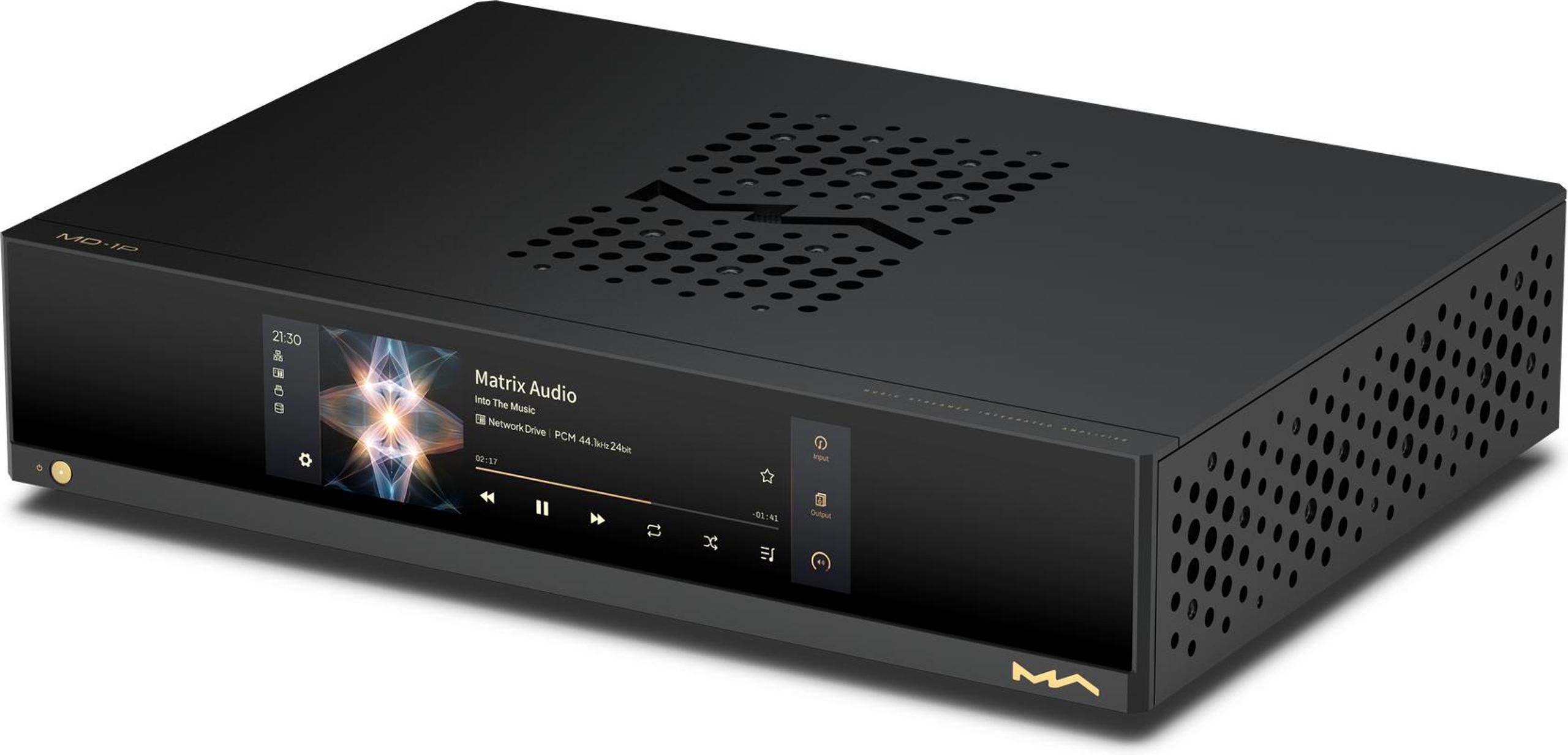
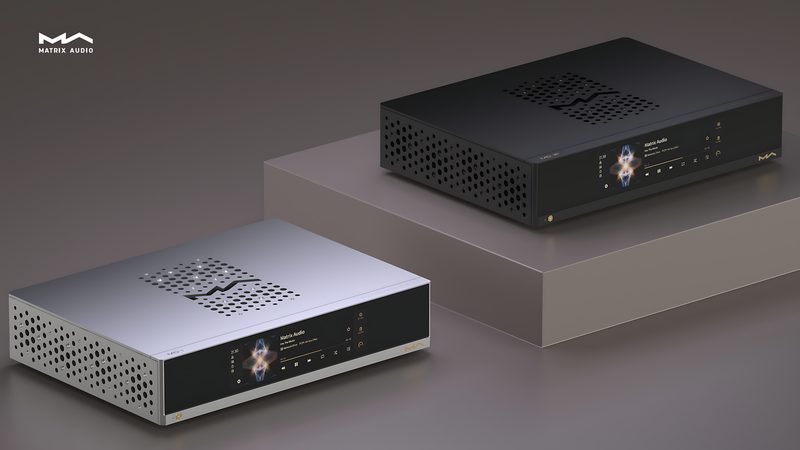
The Matrix AudioMD-1P is an integrated stereo amplifier that brings together multiple functions in a compact enclosure less than 10 cm high. It combines 300-watt-per-channel amplification, a digital-to-analog converter, a network streamer, a music server, and a phono preamp. This functional integration is aimed at users seeking a complete and easy-to-use audio system.
Compact Design and Meticulous Architecture
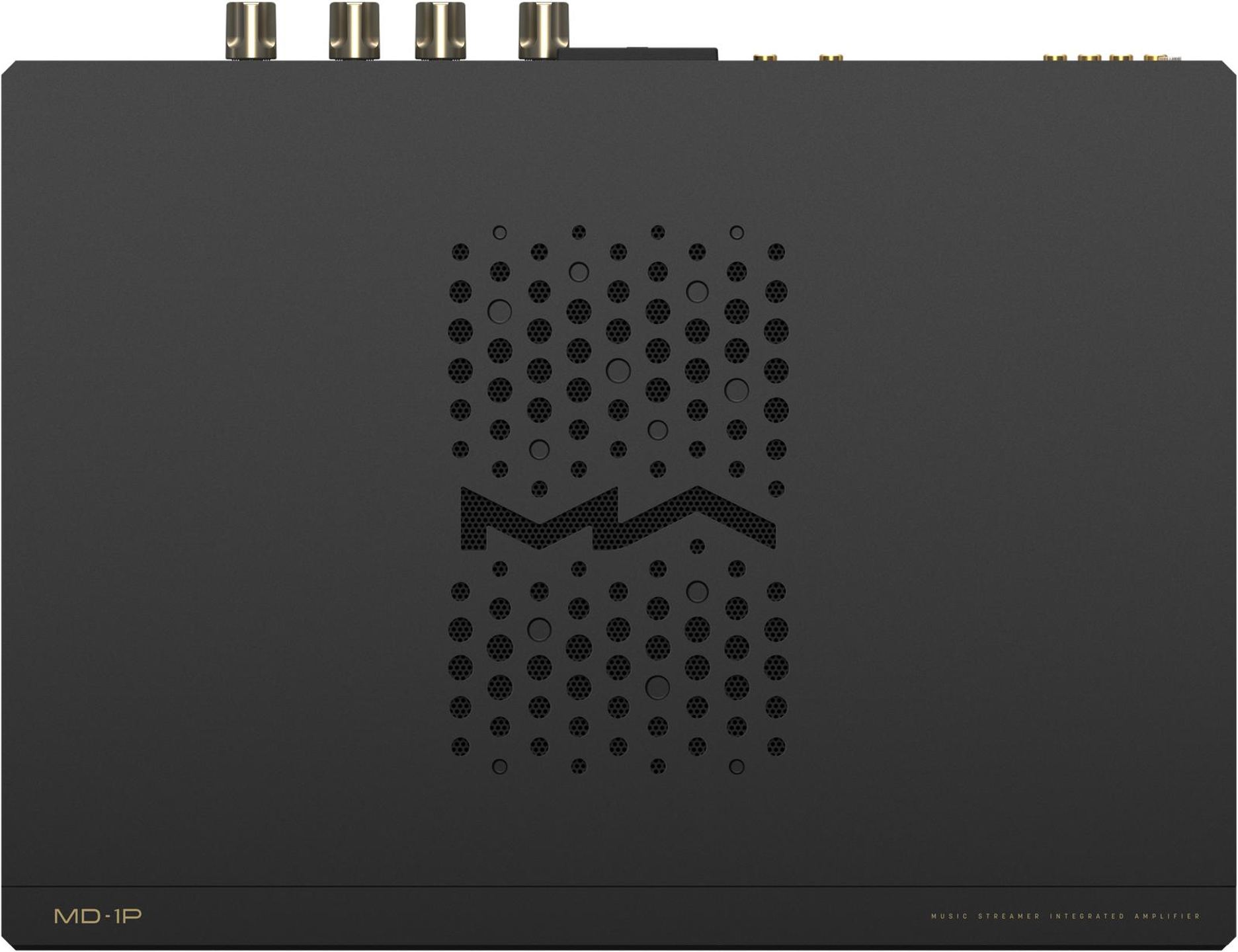
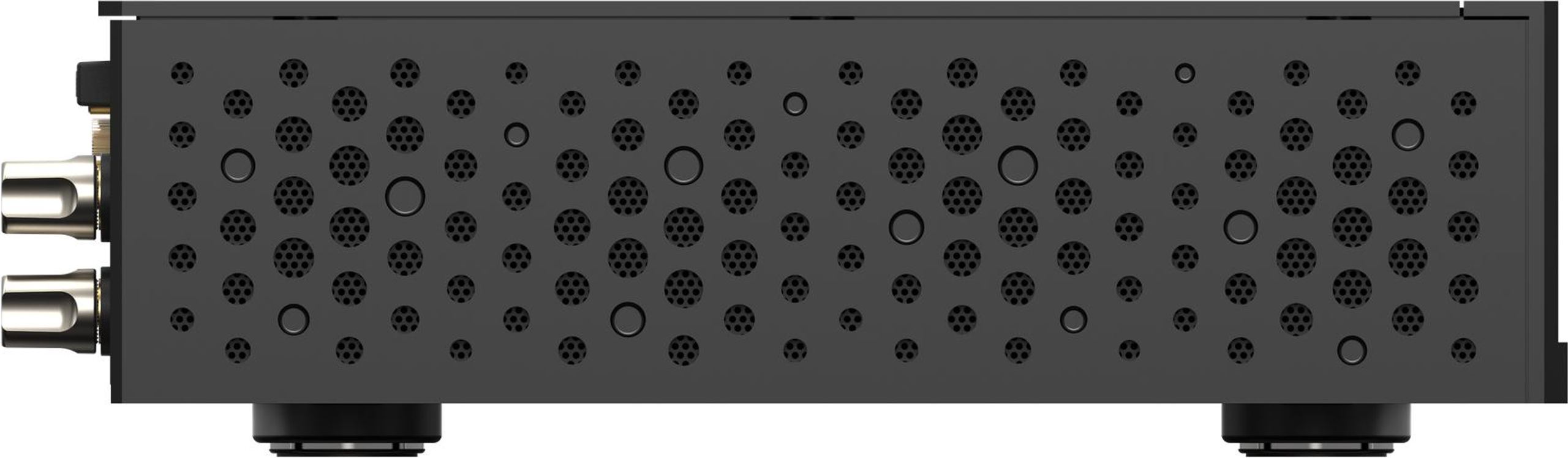
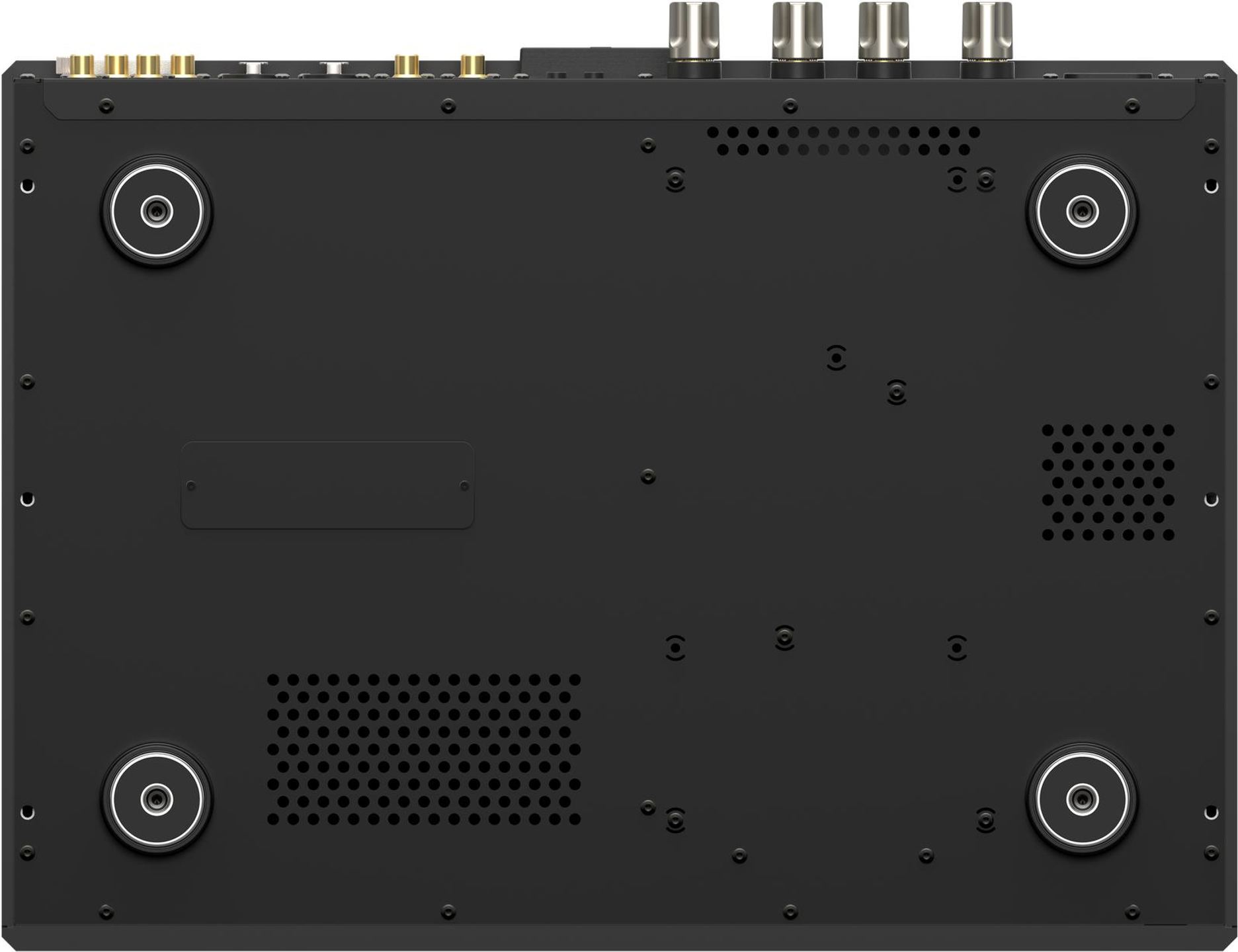
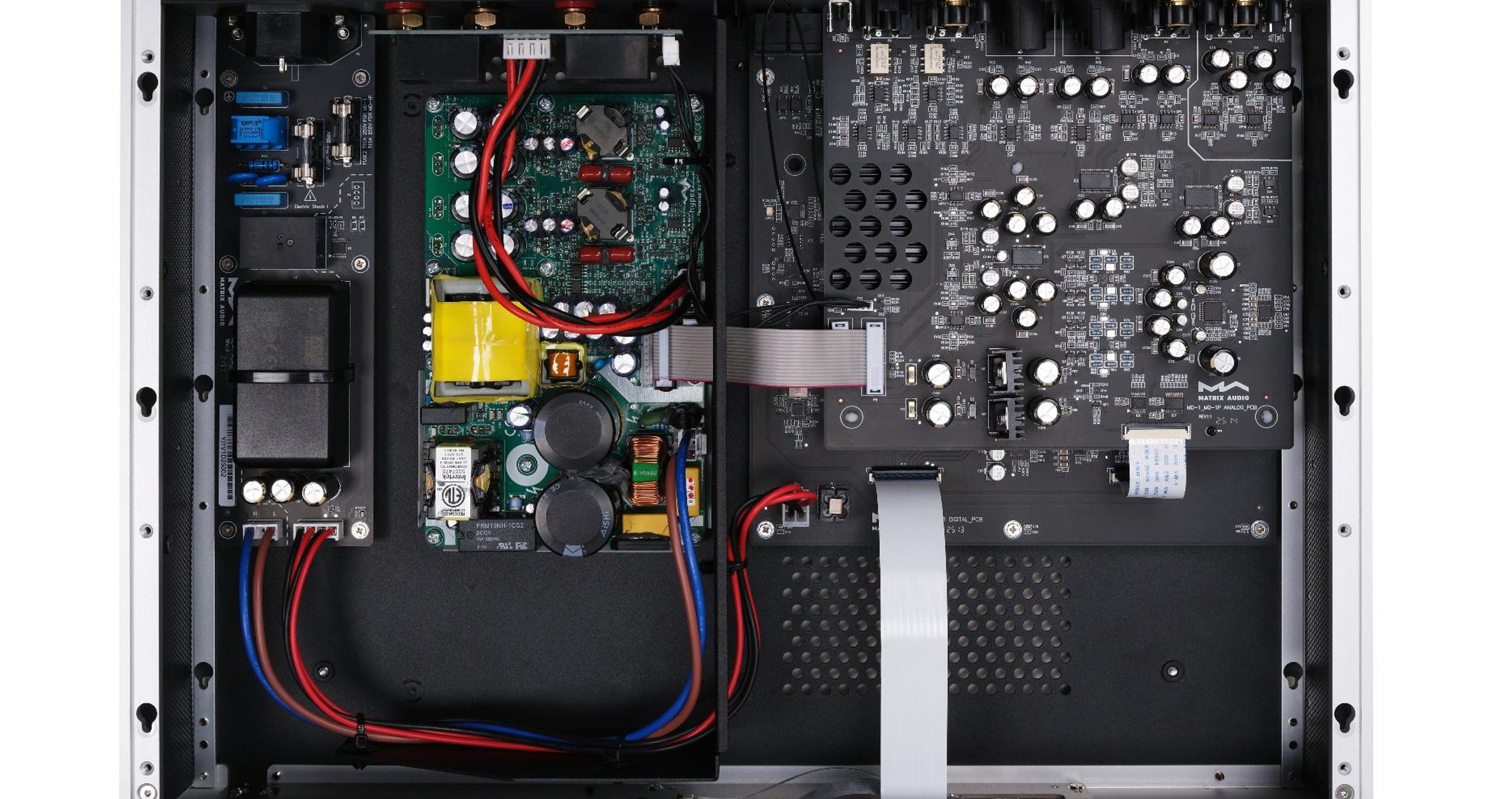
With its modest dimensions (43 × 33.1 × 9.6 cm) and weight of 7.6 kg, the MD-1P defies the established norms of high-power amplifiers. This remarkable compactness results from the adoption of next-generation PWM (Pulse Width Modulation) amplification technology, which replaces the heavy traditional transformers and heat sinks with ultra-efficient digital circuits.
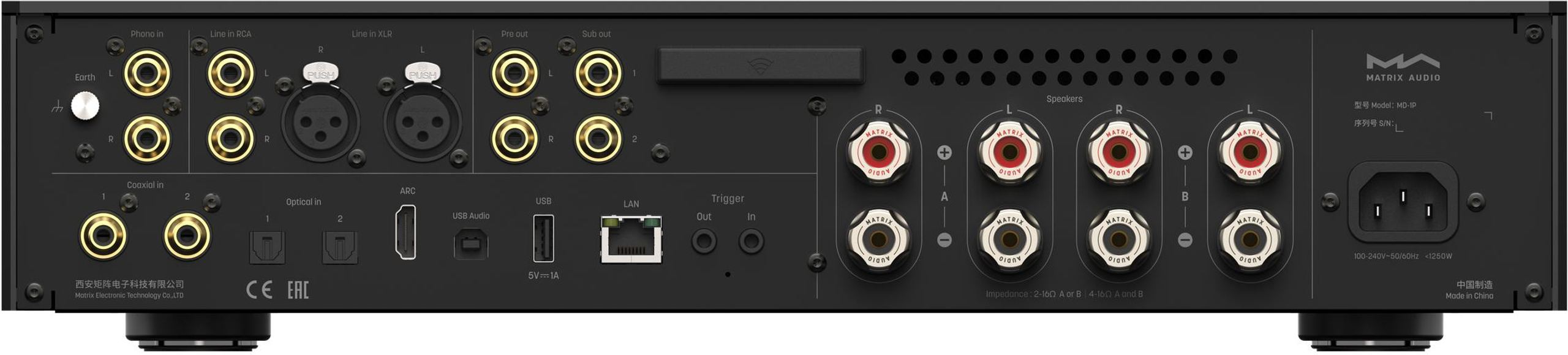
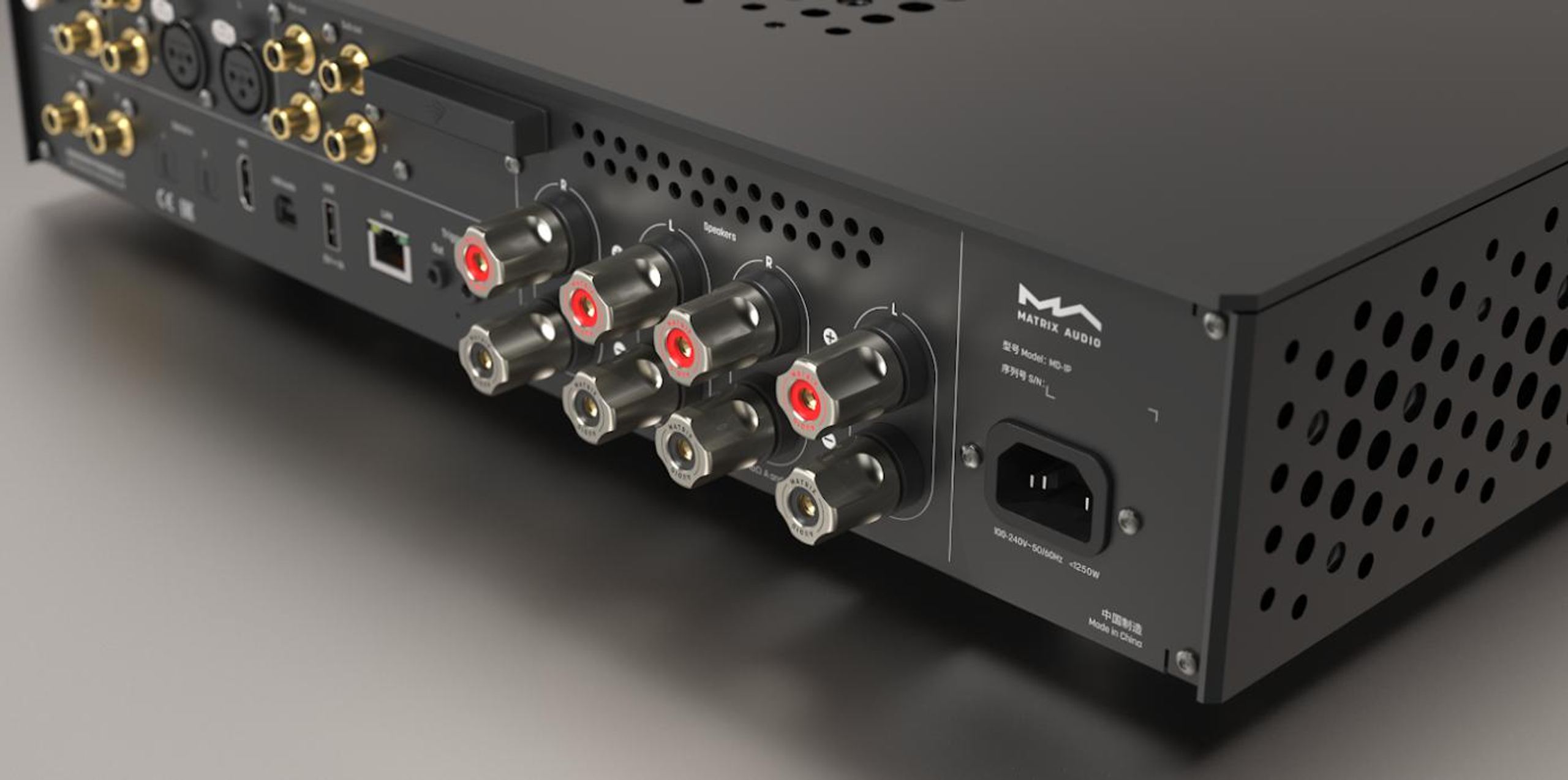
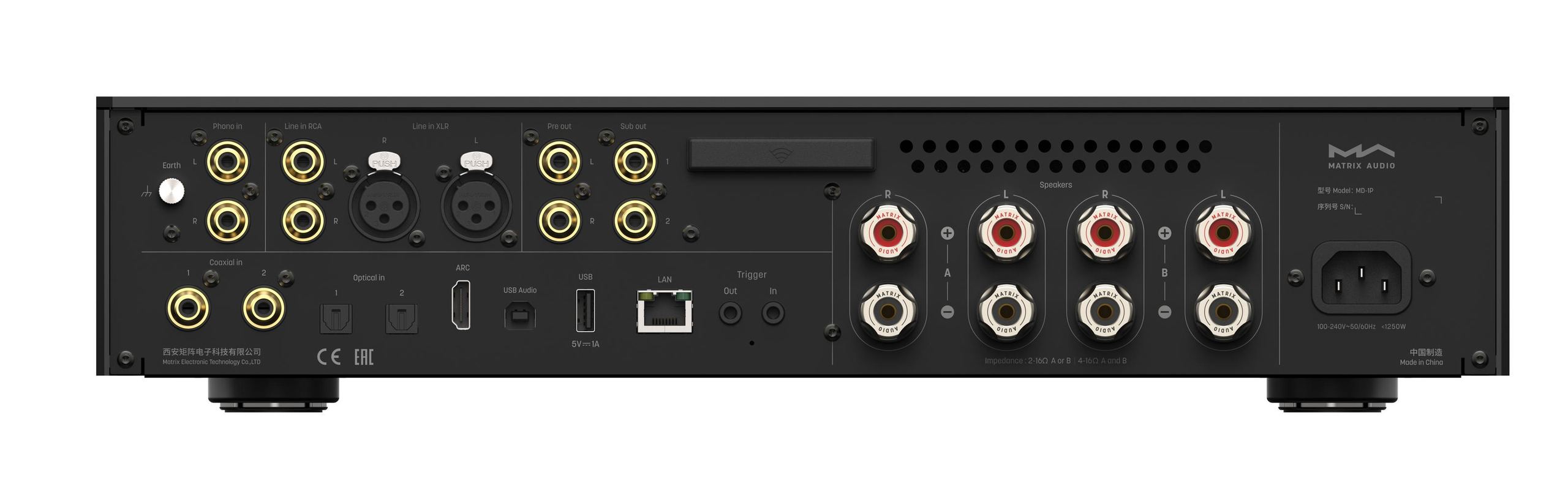
The pure copper, gold-plated speaker terminals reflect the attention to detail. Matrix Audio has doubled these connections, allowing two pairs of speakers to be connected with remote-controllable A/B switching. This practical feature makes it easy to listen in multiple rooms or instantly compare different speakers.
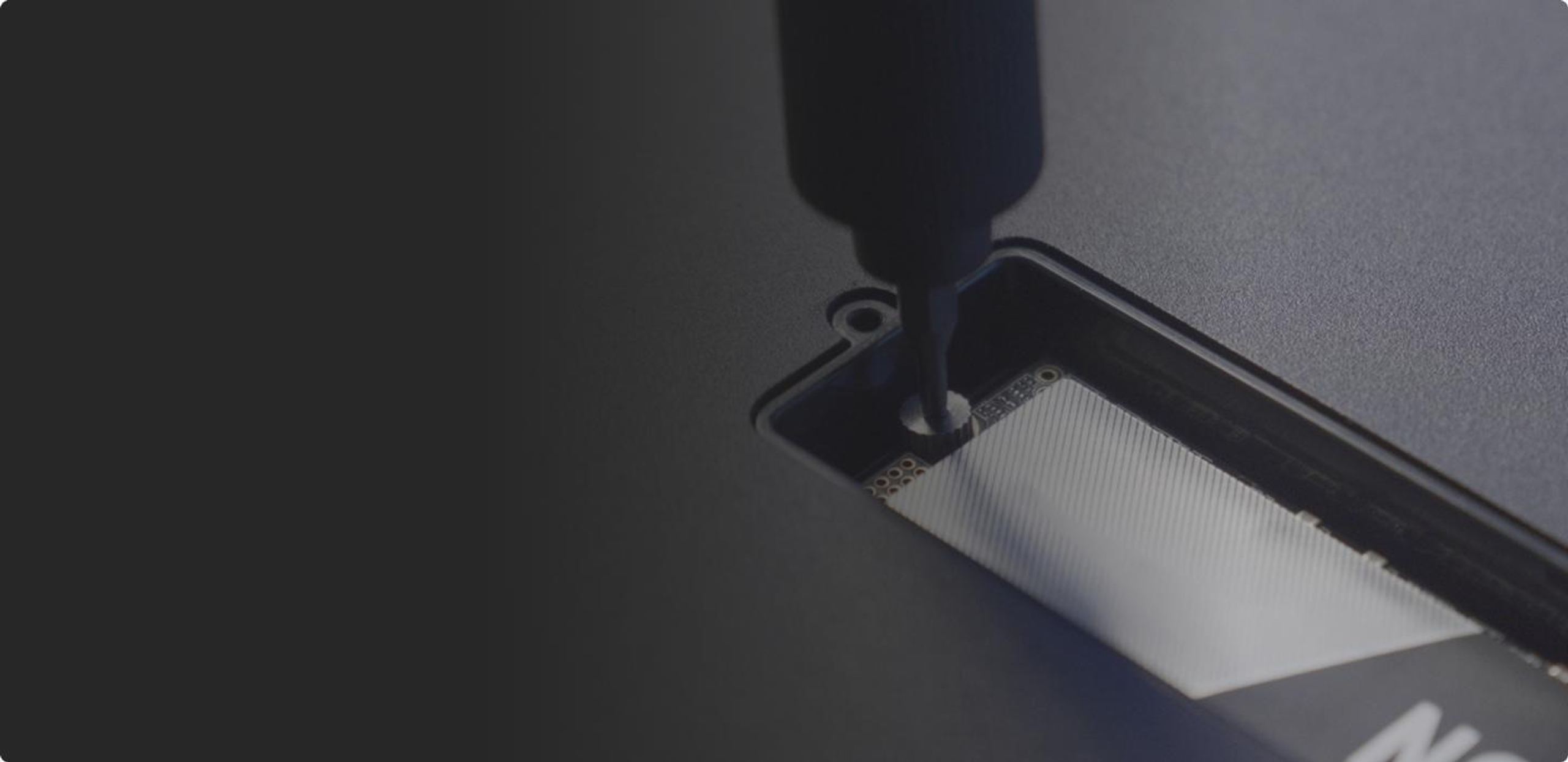
The dense yet organized rear panel reflects the device’s versatility, with its multiple digital, analog, and network inputs carefully arranged. The M.2 slot for NVMe SSD, accessible without disassembly, is a welcome modern touch.
PWM Amplification: Power and Efficiency Reconciled
The PWM technology used in the MD-1P represents the culmination of decades of research in digital amplification. Unlike traditional class A or AB amplifiers that dissipate considerable energy as heat, PWM modulates pulse width at high frequency to reproduce the audio signal with over 90% efficiency.
This approach delivers 2 × 300 watts into 8 ohms with idle power consumption under 45 watts. Distortion remains negligible across the entire bandwidth, while the signal-to-noise ratio reaches 122 dB. The ultra-low output impedance (< 3 mΩ) ensures optimal control of the speakers, even the most demanding models.
Matrix Audio has paid particular attention to frequency response, which extends from 20 Hz to 20 kHz with a maximum variation of ±0.1 dB, and maintains remarkable linearity up to 45 kHz (-3 dB). These performances place the MD-1P on par with the best analog amplifiers, while offering the advantages of digital technology.
High-Resolution Digital Nerve Center
The digital core of the MD-1P is based on a mastering-grade DAC powered by custom dual femtosecond clocks. This ultra-precise timing architecture, coupled with a proprietary Matrix Audio FPGA, minimizes jitter and optimizes clock division to preserve digital signal integrity.
The digital inputs accept an impressive variety of formats. The USB port supports PCM files up to 768 kHz/32-bit and native DSD up to 22.4 MHz (DSD512), while the S/PDIF inputs handle signals up to 192 kHz/24-bit. The inclusion of an HDMI ARC input makes integration into a home theater system easy, turning the MD-1P into the main amplifier for your TV.
The built-in Bluetooth 5.0 makes no compromise on quality, supporting high-definition codecs aptX HD and LDAC for wireless transmission up to 96 kHz. This careful Bluetooth implementation ensures near-CD quality even over wireless connections.
Next-Generation Network Streaming
The integration of a dual-band Wi-Fi 6 module and a Gigabit Ethernet port positions the MD-1P as a true connected audio hub. Native compatibility with major streaming services (TIDAL, Qobuz, Spotify) eliminates the need for external devices, while AirPlay 2, Chromecast, and DLNA/UPnP protocols ensure seamless integration into any home ecosystem.
The MA Remote app, available on iOS and Android, centralizes control of all these sources. Its intuitive interface allows you to navigate between streaming services, the local library, and physical inputs without interrupting playback. Multi-source playlist management and unified search greatly simplify music access.
Support for the TIDAL Connect protocol deserves special mention, as it allows playback to be controlled directly from the TIDAL app while benefiting from the MD-1P’s native MQA decoding. This deep integration ensures the best possible quality for TIDAL HiFi Plus subscribers.
Precision Digital Volume Control
The MD-1P’s volume control system abandons traditional potentiometers in favor of a digitally controlled analog preamplifier. This architecture offers 256 adjustment levels from -80 dB to +12 dB in 0.5 dB steps, with precision and repeatability impossible to achieve with mechanical components.
Channel balance correction, adjustable over 12 levels, compensates for acoustic asymmetries in the listening room. This feature, usually reserved for high-end preamplifiers, is especially useful for optimizing stereo imaging in less-than-ideal setups.
Bypass mode instantly transforms the MD-1P into a pure power amplifier, disabling all preamplification circuits for maximum transparency. This flexibility allows the device to be integrated into existing systems or used with a reference external preamplifier.
Integrated Storage and Smart Music Management
The M.2 slot for NVMe SSD sets the MD-1P apart from its competitors. Once equipped with a drive (not included), the amplifier becomes a true music server accessible via the SMB protocol on the local network. This NAS function not only allows you to store a substantial music library, but also to share it with other UPnP/DLNA-compatible devices.
The CD ripping function via USB port is a relevant addition for collectors. By connecting an external USB CD drive, the MA Remote app allows you to extract and encode CDs directly to the internal SSD, with automatic metadata retrieval. This feature preserves your investment in a physical collection while offering the convenience of streaming.
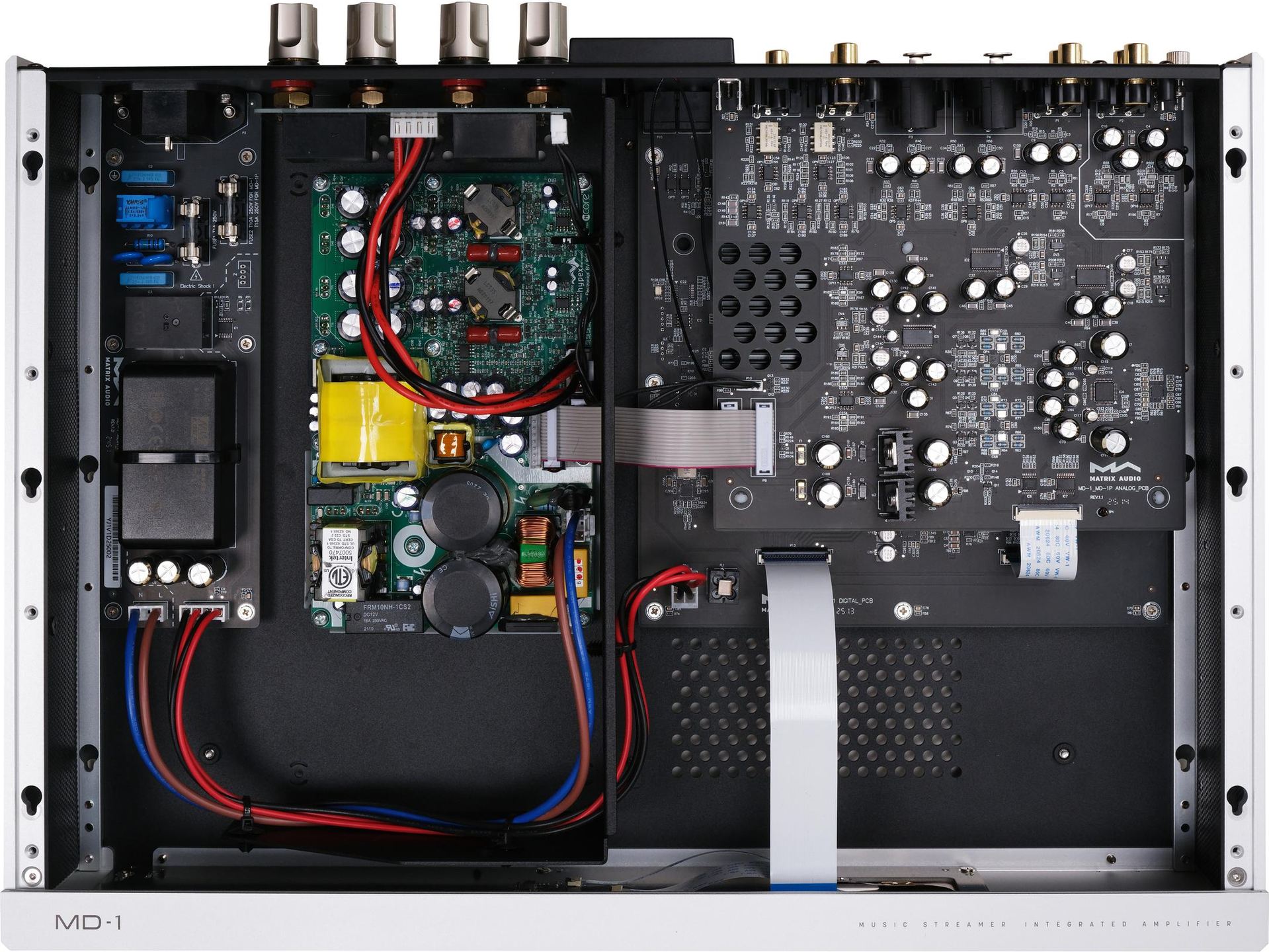
The dedicated SSD power supply, isolated from the audio circuits, ensures silent operation without interference. Matrix Audio has clearly paid special attention to isolating the various subsystems to preserve audio signal purity.
Complete Analog Connectivity
Despite its digital focus, the MD-1P does not forget analog sources. Balanced XLR and unbalanced RCA inputs accept levels up to 8V and 4V respectively, with an input impedance of 47 kΩ perfectly suited to most sources.
The built-in phono input, calibrated to the RIAA curve with a gain of +40 dB, accommodates turntables equipped with moving magnet (MM) cartridges. Although limited to MM cartridges, this input benefits from a low-noise circuit that preserves the dynamics and nuances of analog recordings.
The RCA preamplifier outputs allow you to add an external power amplifier or drive an active subwoofer. The two independent subwoofer outputs, filtered at 150 Hz, make it easy to integrate stereo subs for ambitious home theater setups. The 12V trigger port automatically synchronizes the power-up of connected equipment.
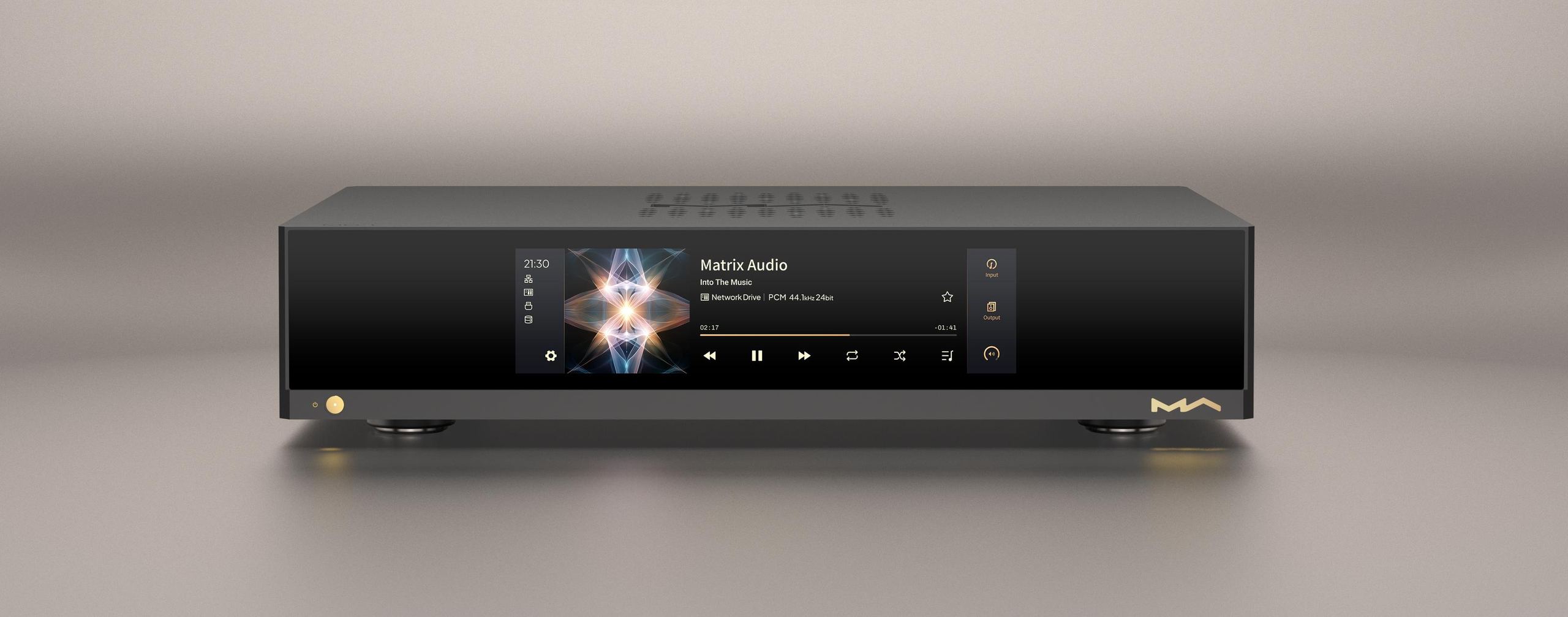
Intuitive interface for managing streaming, volume, inputs/outputs, and music library
Use the MA Remote app to rip your CDs
Direct archiving to internal SSD with metadata
Combines the tradition of CD with the flexibility of streaming
Trigger Ports
Trigger input: 6 to 12 V DC < 10 mA
Trigger output: 12 V DC / max 50 mA
General Specifications
Power Supply
Voltage: 100 to 240 V AC, 50 / 60 Hz
Standby power consumption: < 5 W
Idle power consumption: < 45 W
Maximum power consumption: < 1250 W
Dimensions and Weight
Width: 43.0 cm
Depth: 33.1 cm
Height: 9.6 cm
Weight: 7.6 kg
Included Accessories
1 power cable
1 infrared remote control
1 printed documentation
Frequently asked questions
Can the MD-1P fully replace a traditional hi-fi system?
+
Absolutely. With its 300 watts per channel, high-resolution DAC, comprehensive streaming capabilities, and phono input, the MD-1P is a complete hi-fi system in a single device. Only speakers need to be added. For users with a CD collection, an external USB drive even allows you to digitize them directly to the internal storage.
Does the SSD need to meet specific requirements?
+
Any NVMe SSD in M.2 format (2280, 2242, or 2230) compatible with PCIe 3.0, 4.0, or 5.0 is suitable. Matrix Audio recommends capacities from 256 GB to 2 TB depending on your library size. The dedicated 3.3V/3A power supply supports most consumer models. A 1 TB SSD can store about 3,000 albums in 16-bit/44.1 kHz FLAC.
Can the MD-1P be used without a smartphone or tablet?
+
Yes, the supplied infrared remote control allows you to operate essential functions: volume, input selection, speaker switching, and basic navigation. However, the MA Remote app is still required to access streaming services, manage the music library, and configure advanced settings. A front display would have been appreciated for fully standalone use.
Does PWM technology degrade sound quality compared to a traditional amplifier?
+
Objective measurements contradict this common belief. With distortion below 0.0005%, a signal-to-noise ratio of 122 dB, and extended bandwidth, the MD-1P matches or surpasses many prestigious class A/B amplifiers. Modern PWM technology, when properly implemented as here, offers transparency and musicality without the thermal and energy drawbacks of traditional topologies.
What audio formats can be played from internal or USB storage?
+
The integrated MA Player system decodes most formats: MP3, WMA, WAV, AIFF, AAC, FLAC, APE, ALAC, M4A, OGG for compressed and uncompressed formats, as well as DSF and DFF for DSD. High-resolution files up to 768 kHz/24-bit PCM and DSD up to 24.58 MHz are supported. SACD ISO files and CUE files for albums are also recognized.
Can the phono input accommodate a moving coil (MC) cartridge?
+
No, the MD-1P’s phono input is exclusively designed for moving magnet (MM) cartridges, with a fixed input impedance of 47 kΩ and a capacitance of 100 pF. To use an MC cartridge, an external phono preamplifier must be connected to the line inputs. This limitation is consistent with the product’s positioning, as MM cartridges cover the majority of needs.
User reviews
Patrice
It replaces a Cabasse amp240s amplifier that was already high-quality; we're making a significant leap in terms of power, precision, and sound depth (the price too). I'm underutilizing it because I only use it with Tidal connect, which is a shame given its capabilities. It powers Cabasse Murano speakers with 87db sensitivity that don't flinch with the volume at 70 on the amplifier. I added an Audioquest powerquest 707 power conditioner that allows it to perform even better in bass and dynamics; I think time will further improve the whole setup. As I read in a Chinese article, the MD-1P requires at least 30 to 45 minutes of warm-up to reach optimal temperature before revealing its full potential, which is true and surprising for a Class D. Don't judge the sound quality during this warm-up period: you might get the impression that the midrange and bass volume is low, that the dynamics are insufficient, and that the sound energy is uneven. These issues completely disappear after half an hour of listening. There's been a software update for the amplifier roughly every month since I purchased it, but there are still translation bugs in some menus of the app—nothing bothersome. In conclusion, I'd say I don't regret this blind purchase since there's virtually no feedback in France; I hesitated quite a bit between a Class D or AB, particularly the Atoll sda 300—only its reliability could make me change my mind.
Comment from 21 January 2026 — Experience from 1 November 2025
Automatically translated — Show original (French)
Il remplace un Ampli Cabasse amp240s qui était déjà qualitatif ,on passe un gap non négligeable en terme de puissance , précision et profondeur sonore (le prix aussi).
Je le sous exploite car je ne m'en sers qu'avec Tidal connect c'est dommage au vu de ses possibilités.
Il alimente des Cabasse Murano au rendement de 87db qui ne bronchent pas avec un volume à 70 sur l'ampli.
J'ai rajouté un conditionneur secteur Audioquest powerquest 707 qui lui permet de s'exprimer encore mieux en basse et dynamique, je pense que le temps va encore améliorer l'ensemble.
Comme j'ai pu le lire dans un article chinois ,Le MD-1P nécessite au moins 30 à 45 minutes de préchauffage pour atteindre une température optimale avant de révéler tout son potentiel, ce qui est vrai et étonnant pour un Classe D.
Ne vous fiez pas à la qualité sonore pendant cette période de préchauffage : vous pourriez avoir l'impression que le volume des médiums et des graves est faible, que la dynamique est insuffisante et que l'énergie sonore est irrégulière. Ces problèmes disparaissent complètement après une demi-heure d'écoute.
Il y a une mise à jour logicielle de l'ampli à peu près tout les mois depuis son achat mais il y a encore des bugs de traduction dans certain menu de l'appli ,rien de gênant.
En conclusion je dirai que je regrette pas cet achat fait à l'aveugle puisqu'il n'y a quasiment aucun retour en France, j'ai pas mal hésité entre un Classe D ou du AB et notamment l'Atoll sda 300,seule sa fiabilité pourra me faire changer d'avis.
To better understand our visitors, measure marketing effectiveness and personalise ads, we and our partners use cookies and mobile advertising identifiers on your device. This data makes it possible to display personalised and non-personalised ads and measure their performance. Some cookies, which are technically necessary, are exempt from consent. You can accept those that require your consent, refuse them by clicking “Reject”, or customise your choices via “More options”.
To find out how Google uses the data collected once you have given your consent, see Google’s Business Data Responsibility site (opens in a new window).
You can change or withdraw your consent at any time via the “Cookies” link. Your choices will apply on our site for 12 months.