

Optoma ML1050STI
This product is no longer available for sale!

Specifications and features

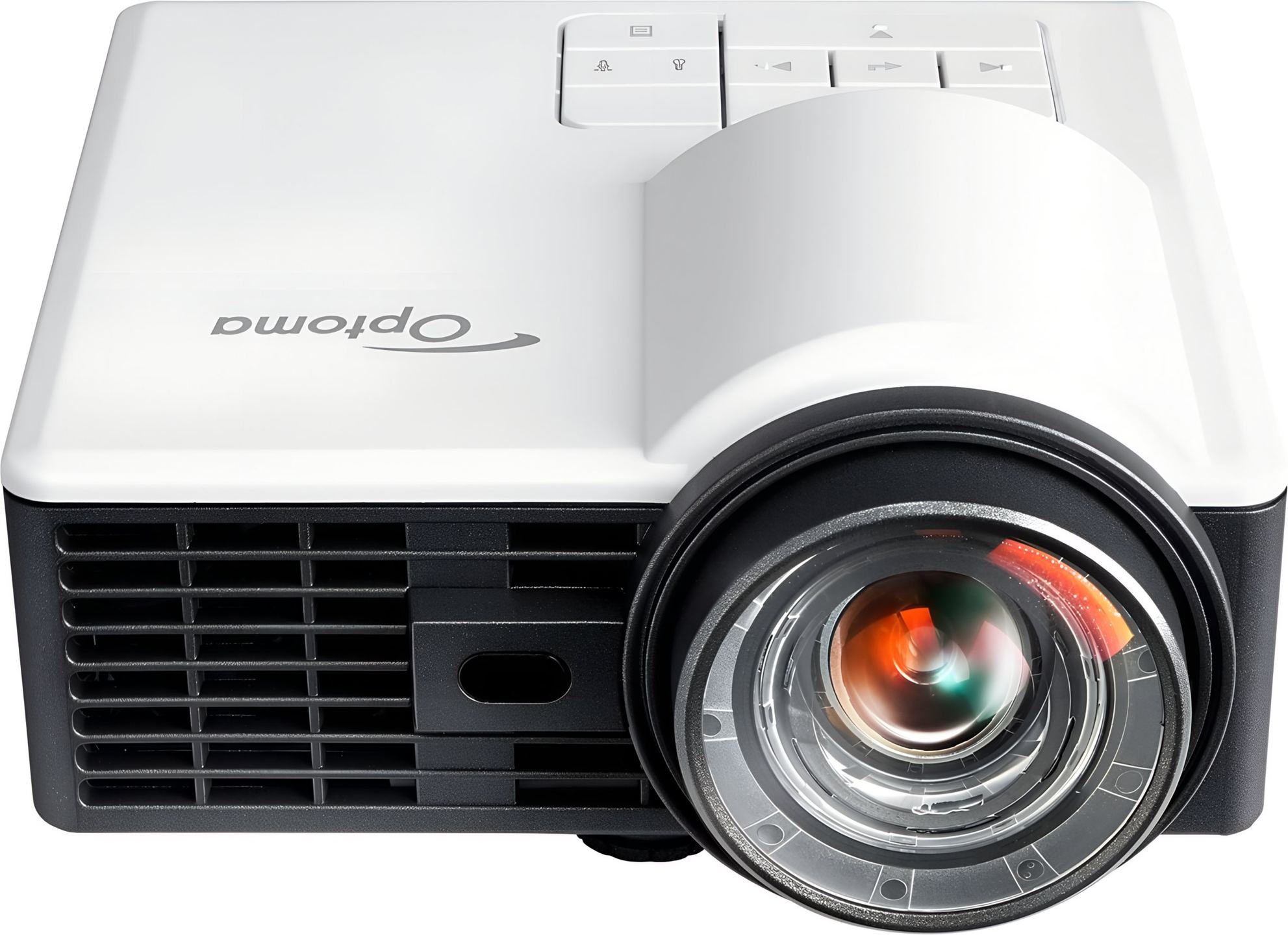
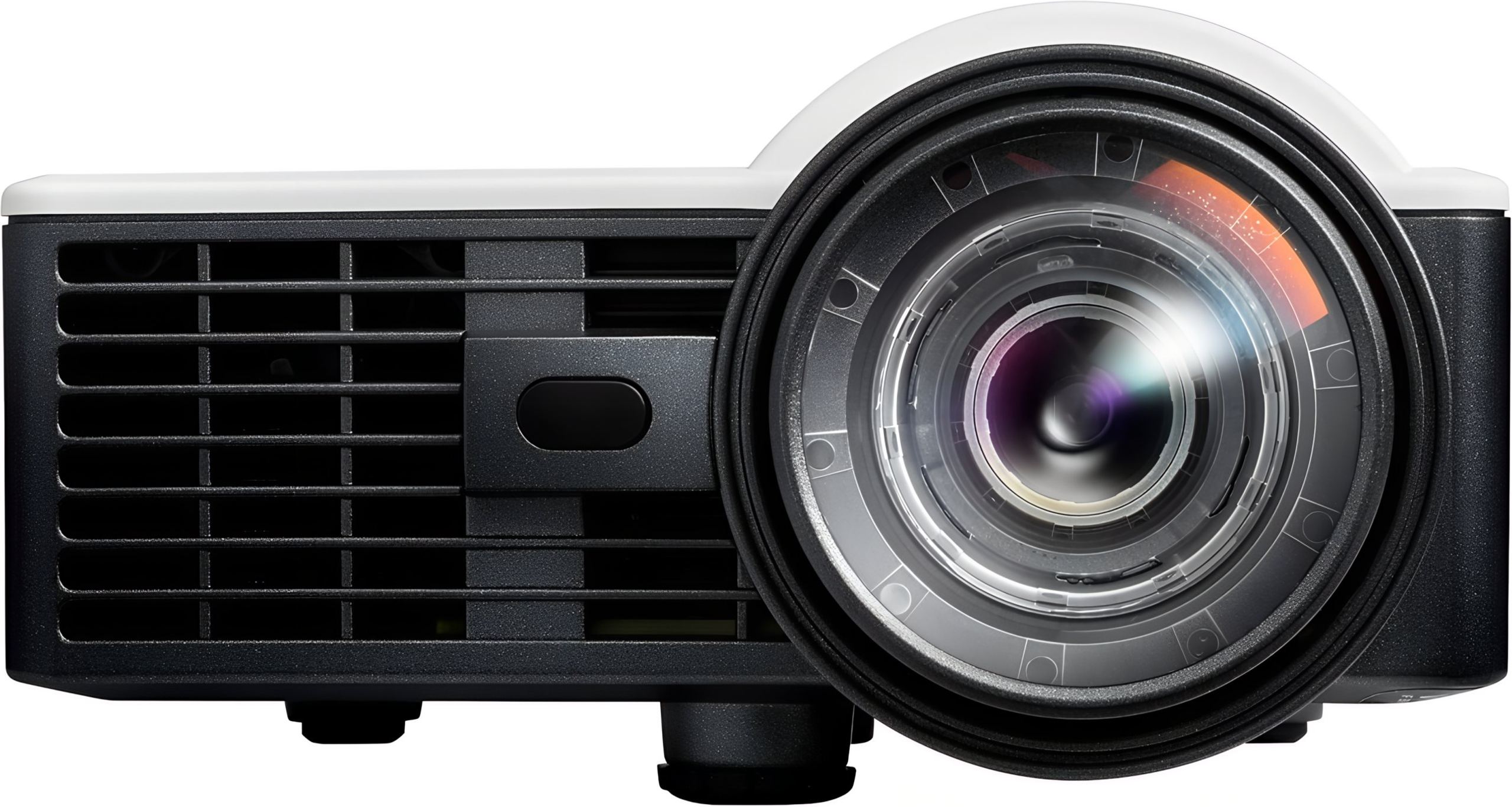
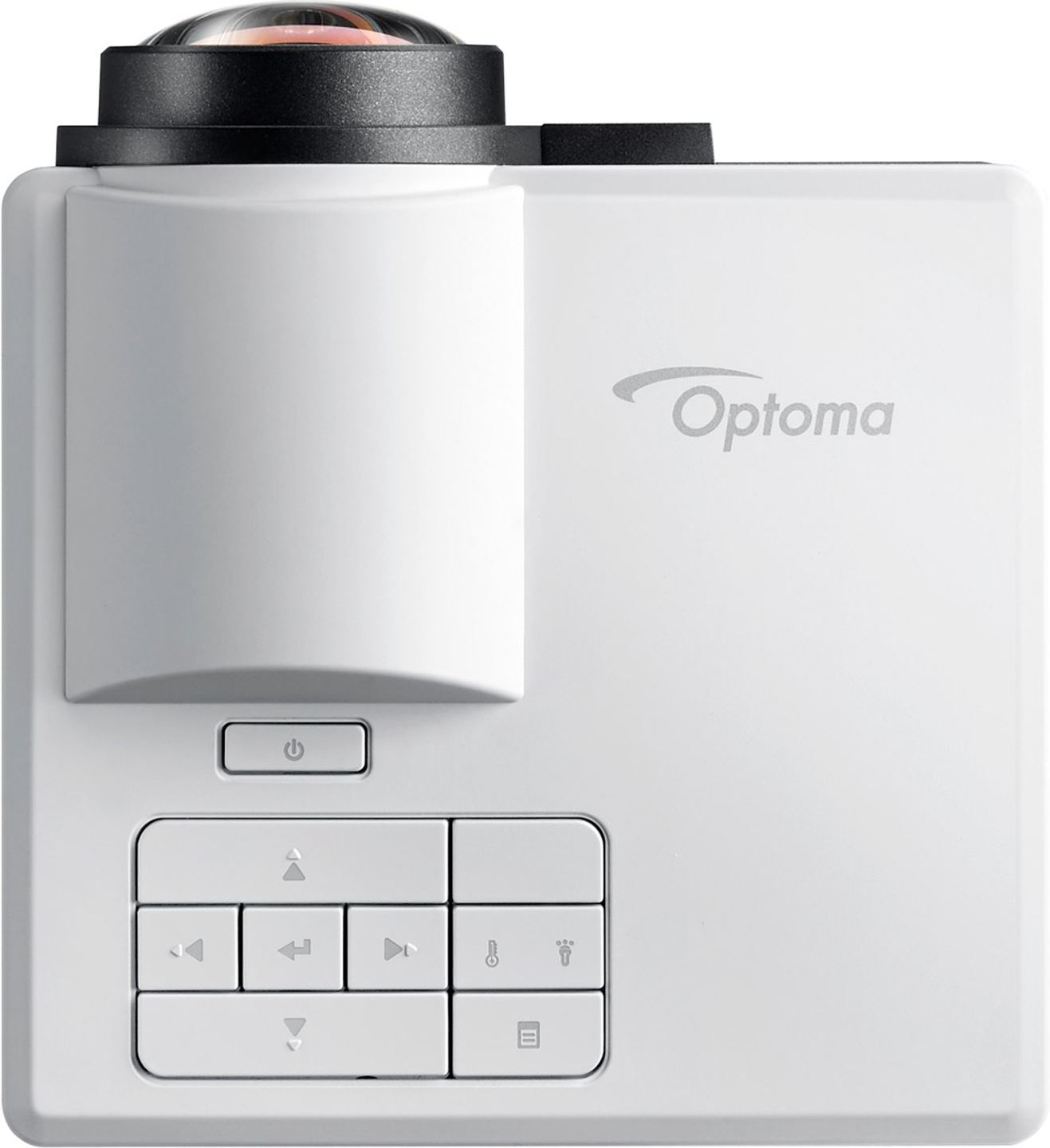
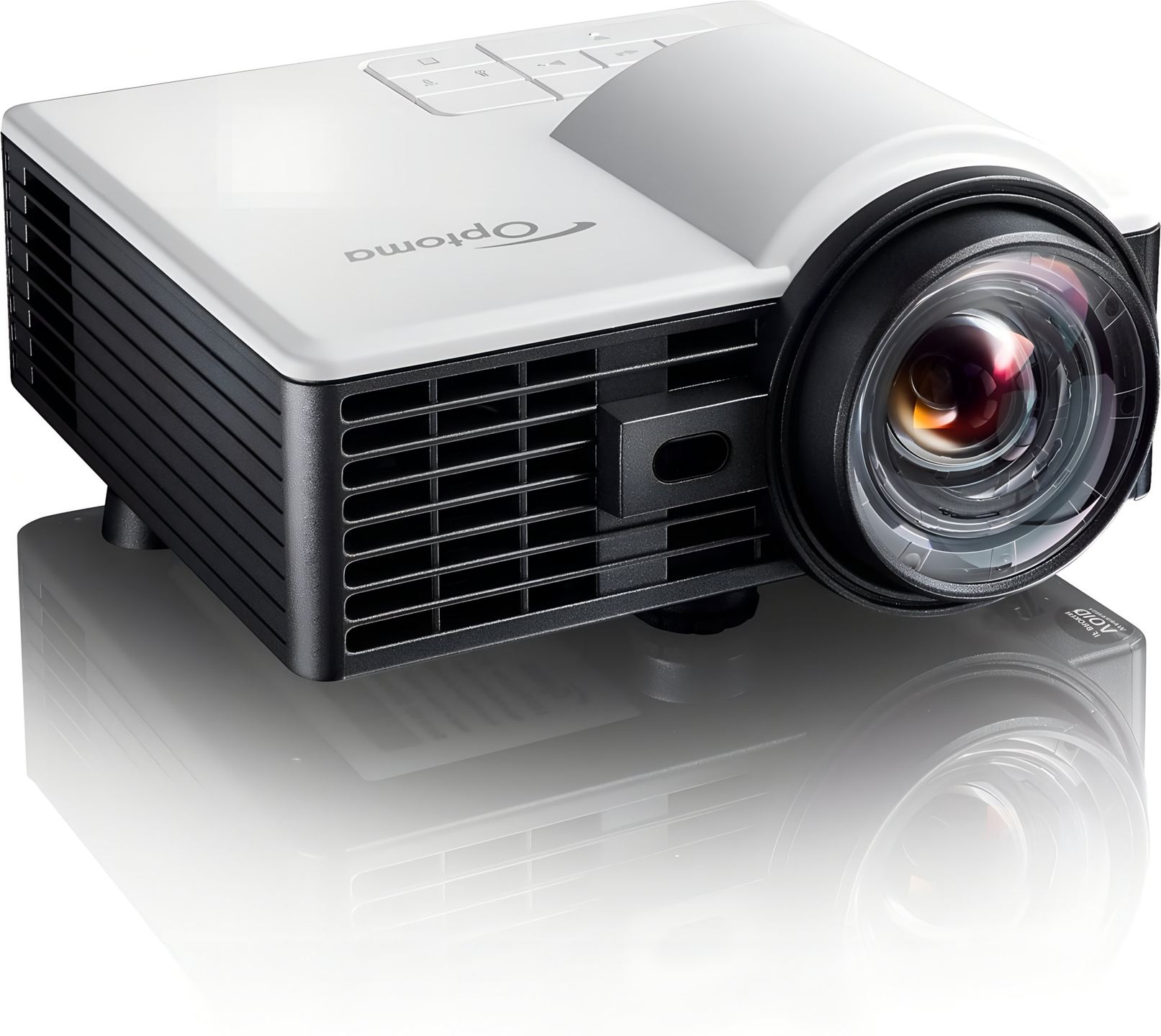
Optoma ML1050STi: ultra-compact short-throw LED projector
The ML1050STi represents the latest evolution in Optoma’s portable projector range, enhancing the proven ML1050ST+ formula with professional control features and native wireless connectivity. This 420-gram DLP LED projector combines a pocket-sized form factor with short-throw projection, delivering a 100-inch image diagonal from just 86 centimeters away.
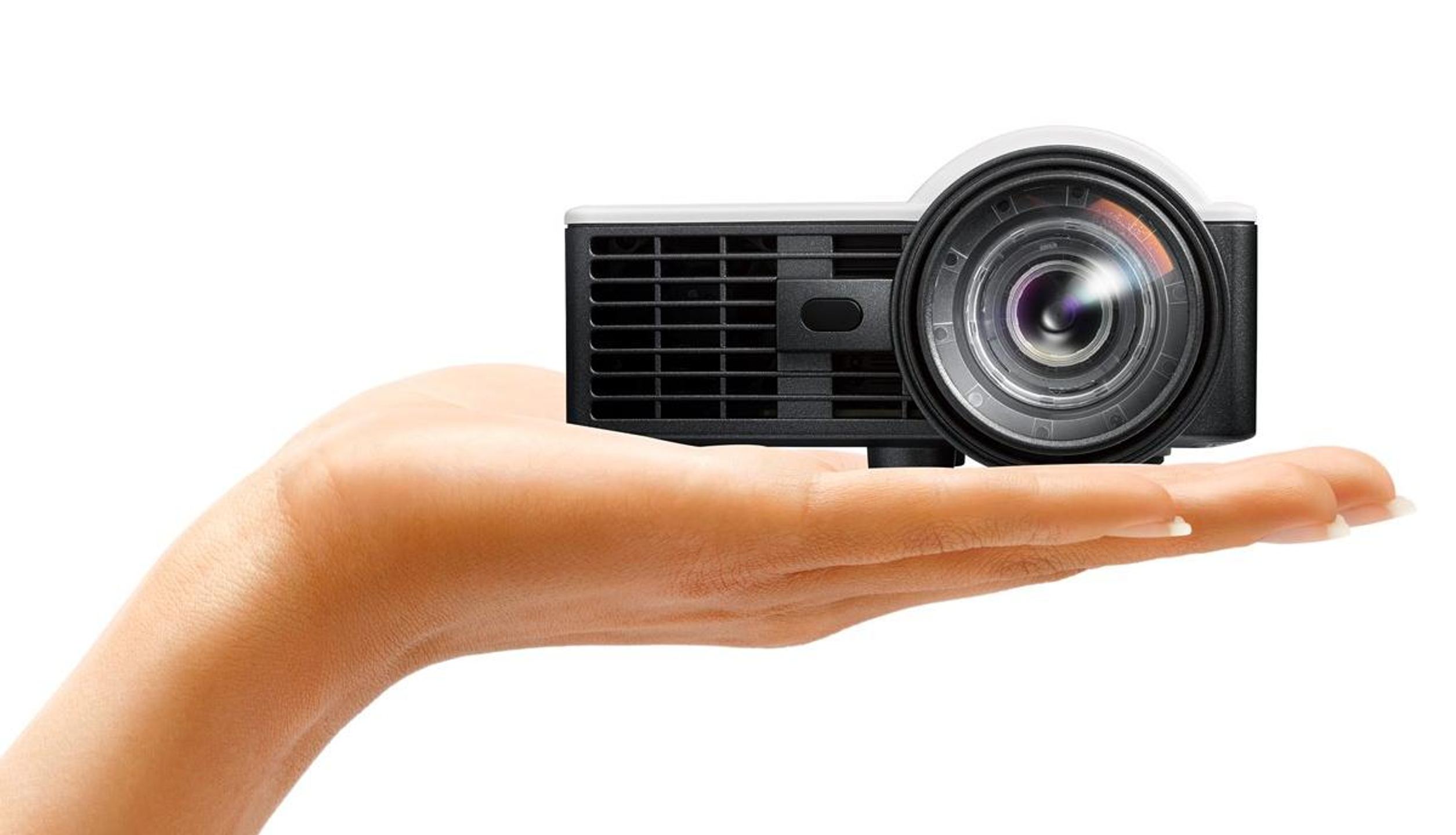
An optical design based on three independent LEDs
The ML1050STi moves away from the traditional architecture of DLP projectors equipped with a rotating color wheel. Instead, three distinct red, green, and blue LED modules directly generate the primary colors needed to form the image. This configuration eliminates the visual artifacts sometimes noticeable on conventional single-chip DLP projectors, notably the rainbow effect that can affect some viewers during rapid motion or high-contrast scenes.
The absence of a color wheel offers several technical advantages. First, it removes a continuously rotating mechanical part, a potential source of noise and wear. Second, it allows direct synchronization between the LEDs and the DLP chip, thereby optimizing light efficiency. This architecture also contributes to the device’s compactness, as LEDs take up less space than a traditional lamp–color wheel system.
The light-emitting diodes have a nominal lifespan of 20,000 hours, or roughly 10 years of use at 5 hours per day. This longevity comes with remarkable color stability: unlike arc lamps whose spectrum progressively degrades, LEDs maintain their chromatic characteristics throughout their lifecycle. LED technology also enables instant on and immediate off, with no warm-up or cool-down phase.
The Helmholtz–Kohlrausch phenomenon and perceived brightness
A lesser-known but fundamental aspect of LED technology concerns the subjective perception of brightness. The Helmholtz–Kohlrausch effect, documented as early as the 19th century, describes how highly saturated colors appear brighter to the human eye than objective photometric measurements would suggest. This psychophysical phenomenon is explained by the visual processing mechanisms of the brain, which interpret intense monochromatic stimuli differently from white light.
In the context of the ML1050STi, this effect is particularly evident with RGB LEDs that produce very pure primary colors. The stated 1000 ANSI lumens correspond to a standardized industry measurement, but perceived brightness can, under certain conditions, appear noticeably higher. This perception varies according to several factors: the nature of the projected content (colorful images benefit more from the effect than monochrome documents), the ambient lighting environment (the effect diminishes with stray light), and the individual sensitivity of each observer.
It should be noted that this perceptual effect is not a marketing ploy but a documented optical phenomenon, studied notably in the development of laser and LED display technologies for professional and cinematic applications.
Technical architecture and projection characteristics
At the heart of the ML1050STi lies a DLP (Digital Light Processing) chip developed by Texas Instruments. This technology, invented in 1987 by Dr. Larry Hornbeck, is based on a matrix of movable micromirrors etched onto silicon. Each mirror, measuring a few micrometers per side, flips several thousand times per second between two positions: one directing light toward the lens (pixel on), the other deflecting it out of the optical path (pixel off). Temporal modulation of this switching creates shades of gray, while additive synthesis of the three primary colors forms the complete image.
The native WXGA resolution of 1280 x 800 pixels corresponds to the 16:10 format, standard in the professional world. The projector nevertheless accepts higher-resolution signals up to Full HD 1920 x 1080, with internal scaling that preserves image quality. The 0.8:1 throw ratio places the ML1050STi in the short-throw category: concretely, a 50-inch image is obtained at 54 centimeters, while a 100-inch projection requires only 86 centimeters of throw.
The optical system incorporates a laser autofocus mechanism that analyzes the sharpness of the projected image and automatically adjusts focus. This is particularly convenient for temporary setups or frequent moves. Automatic keystone correction, operating within ±40° vertically, compensates for geometric distortions when the projector is not perfectly perpendicular to the projection surface.
RS232 connectivity and professional automation integration
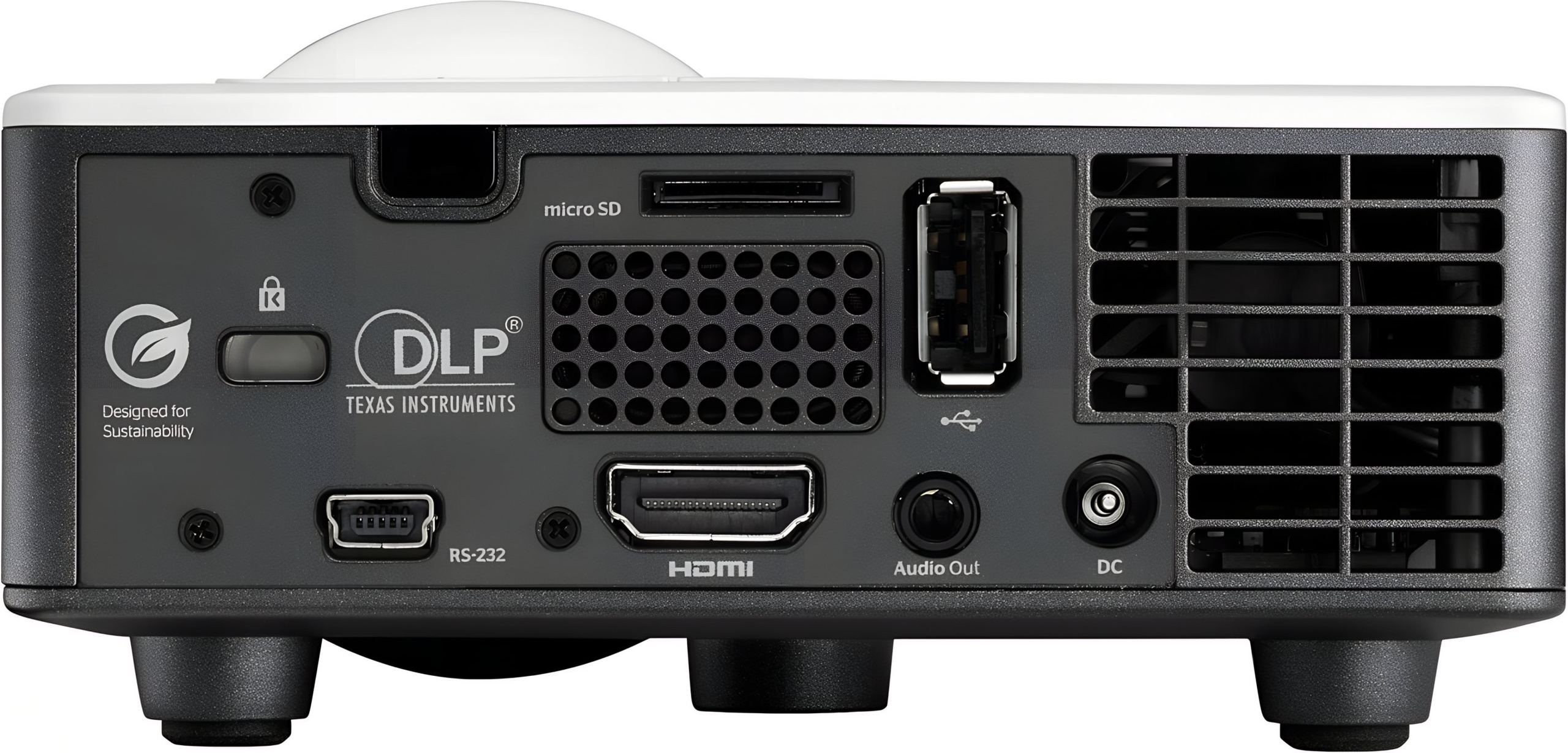
The addition of an RS232 interface sets the ML1050STi apart from its predecessor and paves the way for automated installations. This serial communication protocol, dating back to the 1960s, remains a standard in the professional AV industry due to its reliability and universal compatibility. The projector’s mini-USB port, paired with the supplied adapter, enables connection to centralized control systems.
Compatibility with AMX, Crestron RoomView, and Extron IPLink platforms means the ML1050STi can be integrated into automated conference room environments. These systems allow remote control of power on/off, source selection, and projector settings from wall-mounted touch panels or mobile apps. The bidirectional protocol enables not only the sending of commands but also the retrieval of status information: internal temperature, LED hour counter, presence of a video signal.
This integration capability has varied applications: meeting rooms where the projector powers on automatically upon booking, museum installations with programmed projection sequences, commercial spaces requiring remotely controlled digital signage.
Standalone multimedia playback and document viewer
The ML1050STi includes a full-featured media player capable of directly reading files stored on microSD card or USB drive. This operational autonomy removes the need for a computer in many use cases. The native Office viewer decodes common office formats: Word documents, Excel spreadsheets, PowerPoint presentations, PDF files, and JPEG images.
Playback is performed directly from the projector, with no prior conversion or third-party software. This feature proves useful in various contexts: sales presentations where a laptop would be unnecessary clutter, projection of technical manuals in industrial environments, display of schedules or information in public spaces.
For multimedia content, the built-in player supports common video and audio formats, enabling the playback of promotional clips, tutorials, or entertainment content. Compatibility with the 24 frames-per-second cinematic standard ensures smooth film playback without judder or conversion artifacts.
Specialized projection modes and digital signage
The ML1050STi supports 360° omnidirectional projection, allowing installation in any orientation: ceiling, floor, vertical wall, or inclined surface. This flexibility opens creative possibilities for digital signage, scenography, or art installations. The portrait mode, less common on compact projectors, enables vertical display suitable for poster-style content, restaurant menus, or signage.
Round-the-clock 24/7 operation, certified by the manufacturer, makes the ML1050STi suitable for permanent display applications: shop windows, reception areas, exhibition spaces. Optimized thermal management and the absence of moving mechanical parts (apart from the cooling fan) contribute to this operational endurance.
Gaming performance and responsiveness
With a response time of 16 milliseconds, the ML1050STi is well positioned for gaming applications. This latency, measured between the arrival of the signal and its actual display, remains below the perception threshold for most players. By comparison, a typical gaming LCD shows values between 1 and 5 ms, while many home theater projectors exceed 30 ms.
Support for refresh rates up to 85 Hz in 2D and 120 Hz in 3D ensures smooth display suitable for fast-paced action games. Native Full HD compatibility allows you to make the most of the resolution of the latest consoles, even though scaling down to the native WXGA resolution implies a slight loss of detail.
Technical Specifications
Projection and Display
- Display technology: DLP
- Native resolution: WXGA (1280 × 800)
- Aspect ratio: 16:10
- Compatible with 4:3 and 16:9
- Brightness: 1,000 ANSI lumens / 535 HK
- Contrast: 20000:1
- Vertical keystone correction: ± 40°
- Automatic correction available
- Scanning frequency
- Horizontal: 15.375 ~ 91.146 kHz
- Vertical: 24 ~ 85 Hz (up to 120 Hz for 3D)
- Uniformity: 90%
- Projected screen size: 127 cm ~ 254 cm (50” ~ 100”)
- Short throw projection distance: 86 cm – 172 cm for 254 cm (100”)
- Throw ratio: 0.8:1
- Zoom: fixed
- Native offset: 100%
Light Source
- Type: LED (red, green, blue)
- Lifespan: 20,000 hours
- Helmholtz-Kohlrausch (HK) effect: higher perceived brightness and vivid colors
- LED technology: vibrant colors and extended lifespan
Connectivity and Control
- Inputs
- 1 × HDMI 1.4b
- 1 × microSD
- 1 × USB-A (built-in media reader)
- Outputs: 1 × 3.5 mm audio
- Control: RS232 via mini USB
- Compatible with AMX, Crestron RoomView, Extron IPLink
- Wireless options: EZCast Pro, Creative Cast, Display Share
Built-in Audio
- Speaker: 1 × 2 W built-in
- No external speakers required
Multimedia Features
- Built-in media player: project files from USB, microSD, or SD card
- Built-in Office Viewer: Word, Excel, PowerPoint, PDF, JPEG
- Wireless projection: PC, Mac, Android, iOS
- Creative Cast and Optoma File Manager: file and cloud management, screen mirroring, remote control
- Quick power on/off
- 360° projection and portrait mode for dynamic displays
- 24 FPS compatibility for movies
- Direct playback from microSD or USB flash drive
Performance
- Response time: 16 ms
- Continuous operation mode: 24/7
- Fast autofocus: automatic laser focus
- Automatic vertical keystone correction for quick image alignment
Power and Consumption
- Power supply: 100 ~ 240 V, 50 ~ 60 Hz
- Power consumption
- Standby: 0.5 W
- Minimum: 23 W
- Maximum: 67 W
- Up to 45% lower energy consumption compared to traditional lamp projectors
Dimensions and Weight
- Dimensions (W × D × H): 112 × 123 × 57 mm
- Net weight: 0.42 kg
- Gross weight: 1.2 kg
- Ultra-compact and lightweight
Security and Compatibility
- Security bar and Kensington lock slot
- Password protection
- OSD languages: 12 languages including French, English, German, Spanish
- OS compatibility: Windows 7 / 8 / 10, macOS 10.9+, Android 4.0+, iOS 8+
Sustainability and Eco-Design
- Chassis with 50% post-consumer recycled (PCR) plastic
- Eco-designed packaging (up to 97% recyclable)
- Optimized logistics to reduce carbon footprint
Box Contents
- ML1050STi projector
- Carrying case
- Universal I/O cable
- AC power cable
- Remote control + CR2032 battery
- Quick start guide
- Mini-USB RS232 adapter
Frequently Asked Questions
What’s the difference between the ML1050STi and the previous ML1050ST and ML1050ST+ models?
The ML1050STi mainly adds an RS232 interface for professional control, which was absent from earlier versions. It also includes the Display Share and Creative Cast apps as standard, whereas the ML1050ST+ required optional accessories for wireless connectivity. Laser autofocus replaces the manual system of the original ML1050ST. Optical specifications (brightness, resolution, throw ratio) remain identical across the three generations.
How does short-throw projection work in practice?
The ML1050STi’s wide-angle lens projects the image using a very open cone. For a 100-inch projection (254 cm diagonal), the projector is placed just 86 cm from the screen. This proximity reduces shadows when someone passes in front of the beam and facilitates installation in tight spaces. The tradeoff is increased sensitivity to irregularities in the projection surface.
Does the RS232-over–mini-USB port require specific drivers?
The supplied adapter converts the RS232 signal to standard USB. Most control systems automatically recognize the interface. Commands follow Optoma’s standard RS232 protocol: 19200 baud, 8 data bits, no parity, 1 stop bit. Complete technical documentation, available on the manufacturer’s website, details the full set of command codes.
Does LED technology have particular limitations?
LEDs offer excellent color saturation but may appear less bright than traditional lamps in very bright environments. The Helmholtz–Kohlrausch effect partially offsets this difference for colorful content, but monochrome documents or presentations with a predominantly white background will appear at their nominal brightness. LEDs require no replacement throughout the projector’s lifespan.
Can multiple wireless connection modes be used simultaneously?
The ML1050STi can handle only one active wireless connection at a time. Switching between Display Share, EZCast Pro, or Creative Cast requires ending the current session. This technical limitation stems from the available bandwidth on the embedded processor and ensures optimal performance for the active connection.
How can I optimize image quality for different types of content?
The projector offers several presets: Presentation prioritizes brightness and text contrast, Cinema optimizes colors for video, sRGB ensures color accuracy for graphic work. Manual adjustment remains possible via the OSD menu. For gaming, disable any additional image processing to minimize display latency.
- Eco-contribution included in the sale price.
- Manufacturer reference: E9PP7MC01EZ1




