Siltech Explorer 90i RCA 2m
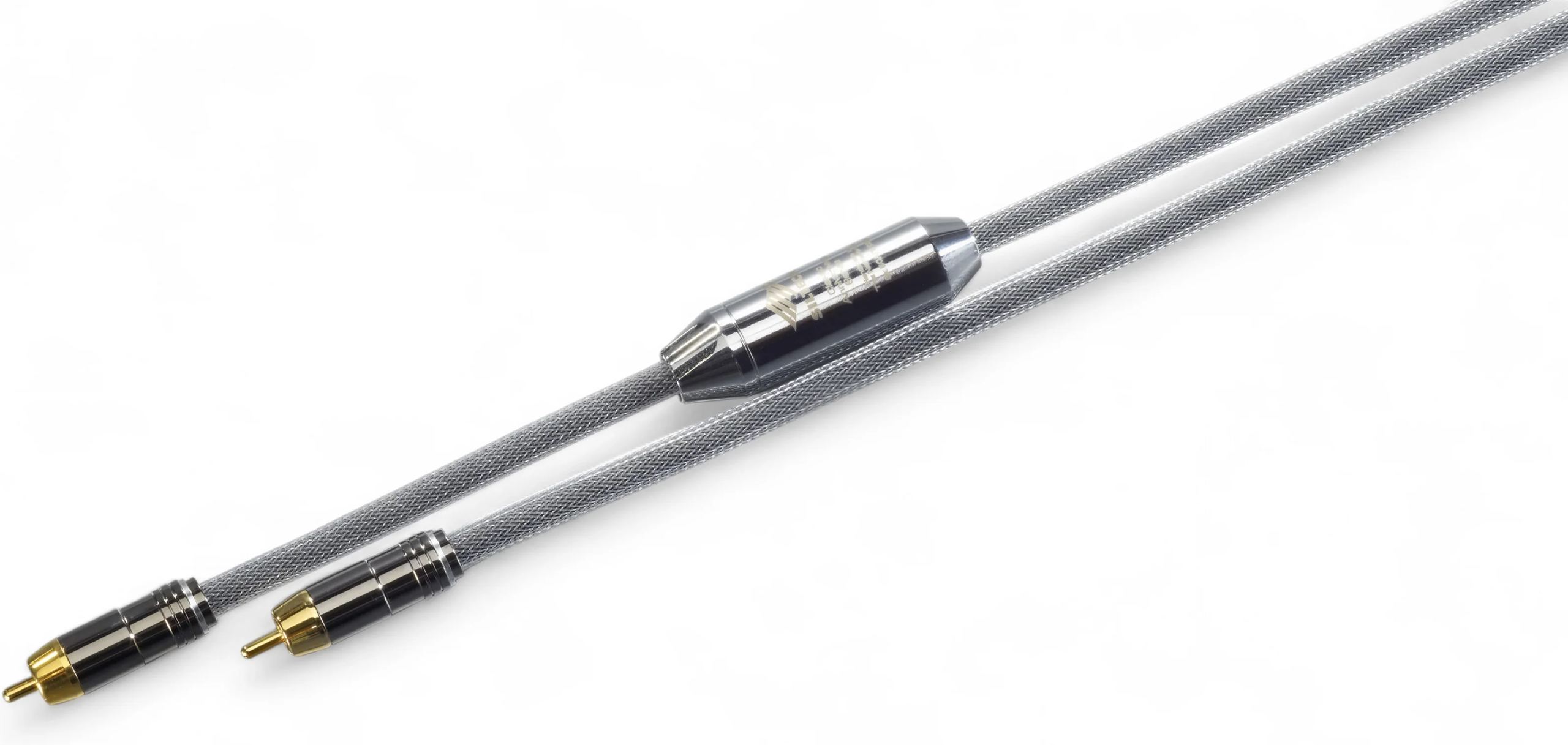
Overview
The Siltech Explorer 90i is the entry point into the world of this Dutch manufacturer, which has specialized since 1983 in precision audio cables. This ultra-pure monocrystalline copper RCA interconnect cable proves that it is possible to achieve remarkable acoustic performance without necessarily resorting to the silver conductors that made the brand famous.
Copper like no other: Mono X-tal technology
At the heart of the Explorer 90i lies a monocrystalline copper conductor of exceptional purity, certified 6N (99.9999% purity). This technology, dubbed Mono X-tal by Siltech, fundamentally differs from conventional copper used in most audio cables. The monocrystalline structure means the conductor is formed from a single continuous crystal, with no grain boundaries that could disrupt the passage of the electrical signal.
This sophisticated metallurgical approach solves a major problem with ordinary copper cables: the progressive degradation of performance over time. Contaminants present in standard polycrystalline copper cause internal oxidation and a deterioration of conductive properties over the years. Siltech’s Mono X-tal copper, thanks to its homogeneous structure and high purity, preserves its acoustic characteristics intact for decades.
Manufacturing this special conductor requires drawing processes controlled with extreme precision. Each cable is produced at Siltech’s factory in Elst, the Netherlands, where specialized equipment ensures the conductor’s crystalline continuity along its entire length.
Unique dual-layer Kapton–Teflon insulation
The Explorer 90i uses a distinctive combination of two dielectric materials: Kapton and Teflon (PTFE). This uncommon pairing in the audio industry reflects Siltech’s rigorous technical approach.
Kapton, a polyimide film developed by DuPont, has exceptional dielectric properties with high mechanical rigidity. Unlike Teflon alone, which can create mechanical damping of the conductor, Kapton maintains a stable structure and minimizes dielectric absorption. This material, commonly used in aerospace for its performance under extreme conditions, offers a particularly low dielectric constant and remarkable thermal resistance (from -269°C to +400°C).
The Teflon layer complements this insulation by contributing its chemical inertness and low dielectric constant. Applying these two materials in distinct layers creates an effective barrier against mechanical, radio-frequency, and electromagnetic interference.
Processing Kapton is a considerable technical challenge. Its extreme rigidity makes manual cable stripping nearly impossible. Siltech has developed automated precision cutting tools that trim each layer to exact length and depth, ensuring a perfect termination and precise matching between the two conductors of a stereo pair.
Coaxial construction and full shielding
The Explorer 90i adopts a coaxial geometry with a super-shielding system that completely envelopes the central conductor. This construction, derived from Siltech’s higher-end models, offers several significant acoustic advantages.
The coaxial structure maintains a constant impedance along the cable’s entire length, minimizing signal reflections and phase distortion. The shielding, meanwhile, forms an effective Faraday cage that protects the audio signal from the electromagnetic disturbances ubiquitous in the modern home environment.
A discreet metal cylinder near one of the RCA plugs houses elements of the shielding system and displays each cable’s unique serial number. This individual identification attests to Siltech’s rigorous quality control and helps combat counterfeiting, a recurring problem for high-end cables.
In-house gold-plated connectors
The Explorer 90i’s terminations deserve special attention. Siltech offers two RCA connector options, both manufactured in-house: the SCC85 and the standard Siltech RCA. These connectors benefit from high-quality gold plating that ensures optimal conductivity and corrosion resistance.
In-house connector manufacturing allows Siltech to control every aspect of the signal transmission chain. Tight tolerances guarantee a perfect mechanical contact with equipment RCA jacks, eliminating micro-arcs that can generate noise and distortion.
The directional arrow engraved on the metal cylinder indicates the cable’s optimal connection direction. Although controversial in some audiophile circles, this directionality stems from the manufacturing process, which creates a slight asymmetry in the conductor’s crystalline structure.
Positioning within the Explorer range
The Explorer 90i occupies the entry-level position in the Explorer series, which includes three levels of interconnects. Above it are the 180i (unbalanced RCA like the 90i) and the 180ix (balanced XLR), which share the same Mono X-tal metallurgy but with additional refinements in construction.
The Explorer series represents an unusual approach for Siltech, traditionally associated with silver and silver-gold conductors. The development of this monocrystalline copper range aimed to make Siltech’s sonic signature accessible to a wider audience, without compromising on build quality or longevity.
Explorer cables benefit from the same production standards as the brand’s flagship models. Each unit is hand-assembled in the Netherlands, individually tested, and accompanied by a lifetime warranty on materials and workmanship.
Documentation
Technical Specifications
Construction and Materials
- Metallurgy: ultra-pure single-crystal copper (6N)
- Construction: coaxial
- Insulation: double-layer Kapton-Teflon
- Shielding: super shielding
- Number of cores: 1
- Robust, durable design
Connectivity
- Equipped with gold-plated SCC85 RCA connectors
- Terminations: high-quality gold plating
Signal Characteristics
- Signal type: unbalanced (RCA)
- Use: high-fidelity audio interconnect
- Clear, precise signal transfer
General Information
Siltech’s Explorer 90i is an unbalanced stereo interconnect offering exceptional audiophile performance at an affordable price. This entry-level, high-purity single-crystal copper cable ensures excellent value for money for high-fidelity audio applications, combining robust construction with optimal signal transfer.
Frequently asked questions
What is the difference between monocrystalline copper and standard copper in audio cables?
Monocrystalline copper forms a continuous conductor without grain boundaries, unlike ordinary polycrystalline copper, which has multiple crystal interfaces. These discontinuities in standard copper create resistance to signal flow and promote internal oxidation. Mono X-tal preserves its conductive properties intact for decades.
Why does Siltech use Kapton rather than Teflon alone?
Kapton offers superior mechanical rigidity and lower dielectric absorption than Teflon used alone. This rigidity prevents mechanical damping of the conductor that can color the sound. The Kapton–Teflon combination leverages the strengths of each material: Kapton’s mechanical stability and Teflon’s chemical inertness.
Do the directional arrows on cables really matter?
Siltech indicates a preferred direction based on the conductor’s manufacturing process. Copper drawing creates a slightly asymmetric crystalline orientation. While the effect is subtle, following the indicated direction theoretically optimizes signal transmission according to measurements performed by the manufacturer.
How does the Explorer 90i compare to the 180i and 180ix models in the same series?
All three models share the same 6N Mono X-tal metallurgy. The 180i and 180ix benefit from additional refinements in their construction and use different connectors (SC006 for the 180i, gold-plated Neutrik XLR for the 180ix). The 90i remains the logical choice for a first approach to Siltech technology.
- Eco-contribution included in the sale price.