Each year, dozens of European journalists gather to select the best electronic products of the year. Awarded by a diverse and impartial jury, the EISA (Expert Imaging and Sound Association) awards recognize exceptional products for their performance, design, or ergonomics.
Overview
The Volumio Primo Plus is a network audio player with a built-in digital-to-analog converter, designed and hand-assembled in Florence. This new generation abandons the single DAC of the original Primo in favor of a dual-mono configuration with two ESS ES9039Q2M chips, accompanied by a revamped linear power supply and a low-jitter clock. Roon Ready, compatible with Tidal Connect, Qobuz, Spotify and AirPlay, it integrates the VolumioOS system and offers XLR and RCA analog outputs with preamplifier function.
A compact chassis
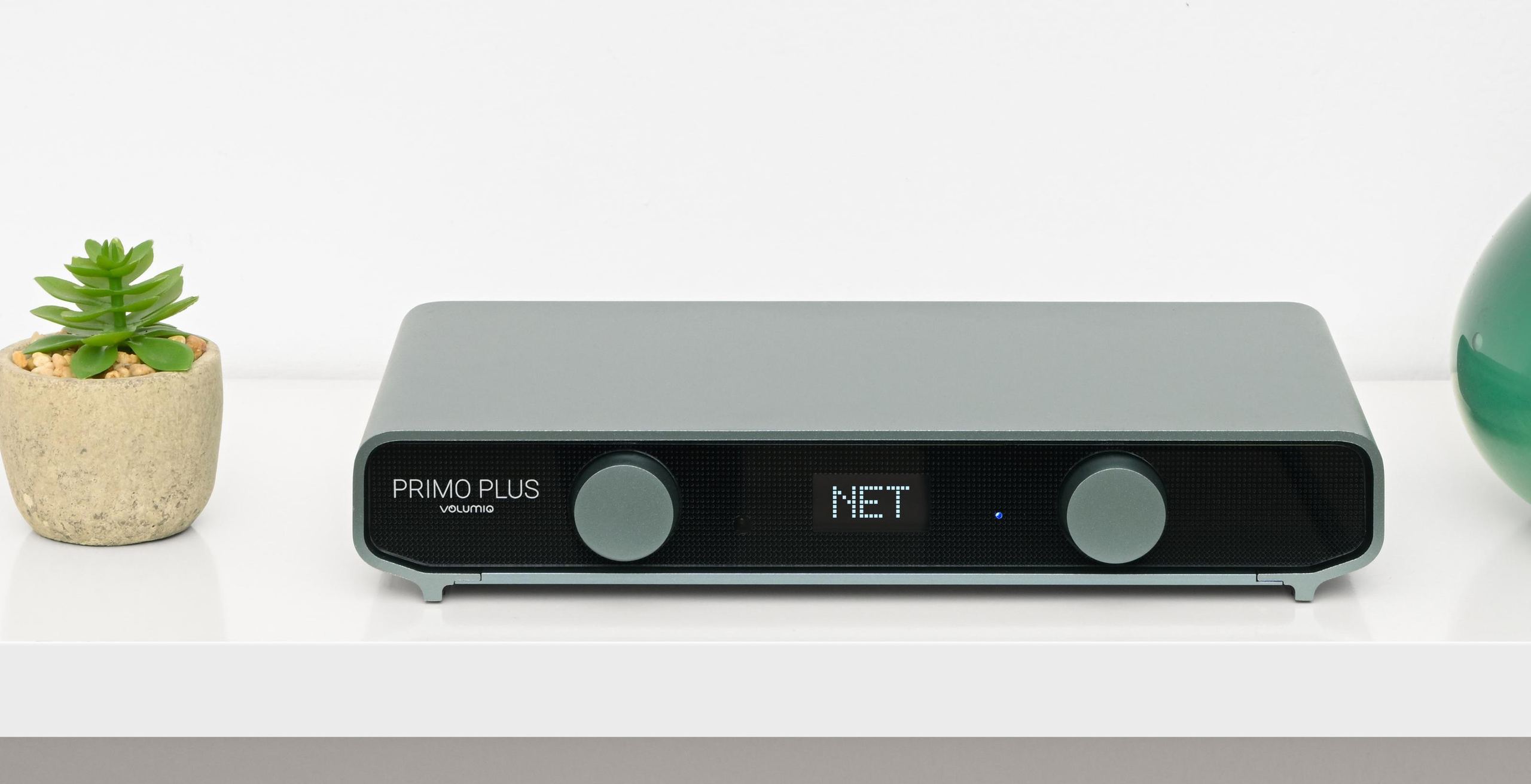
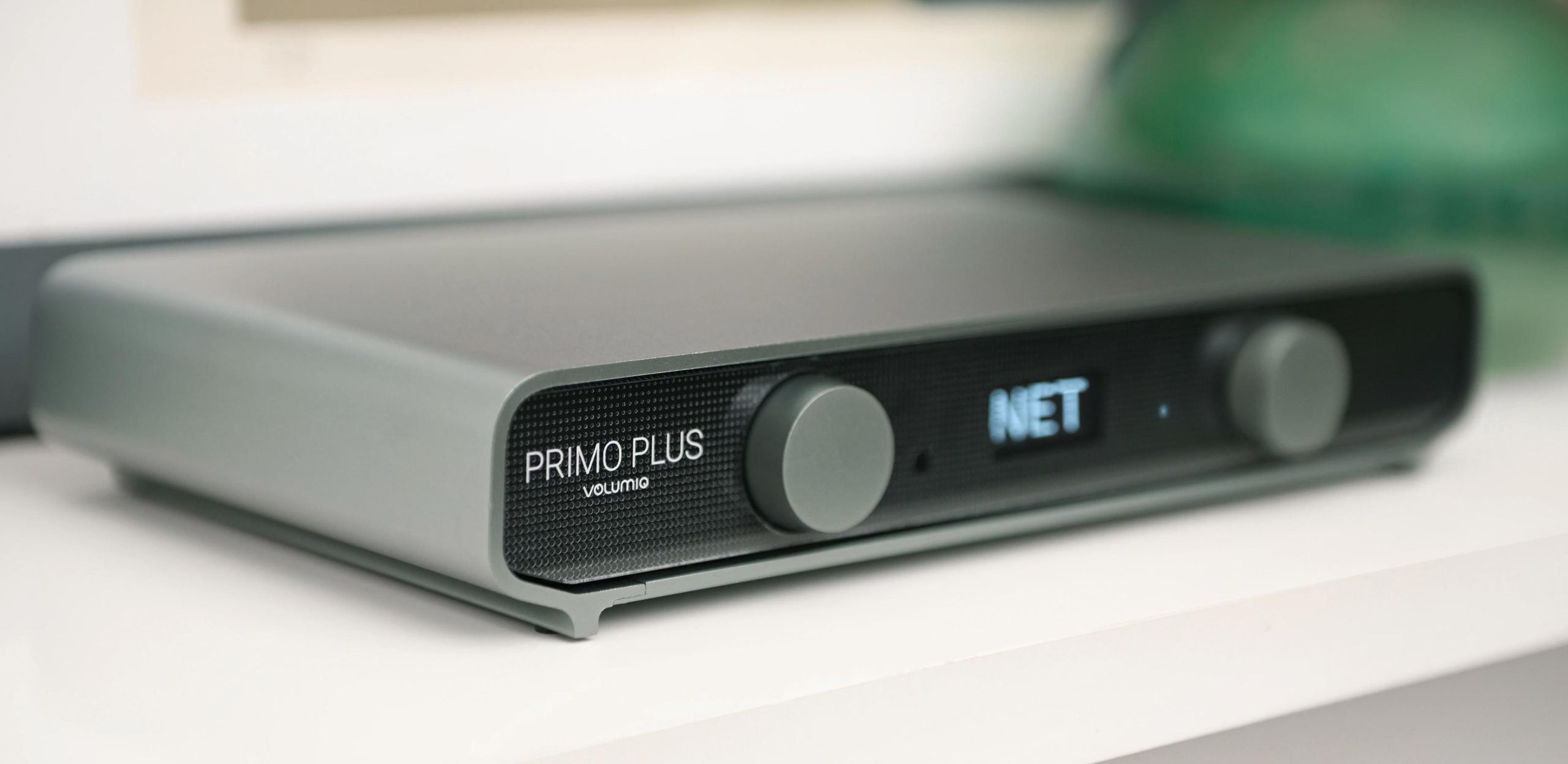
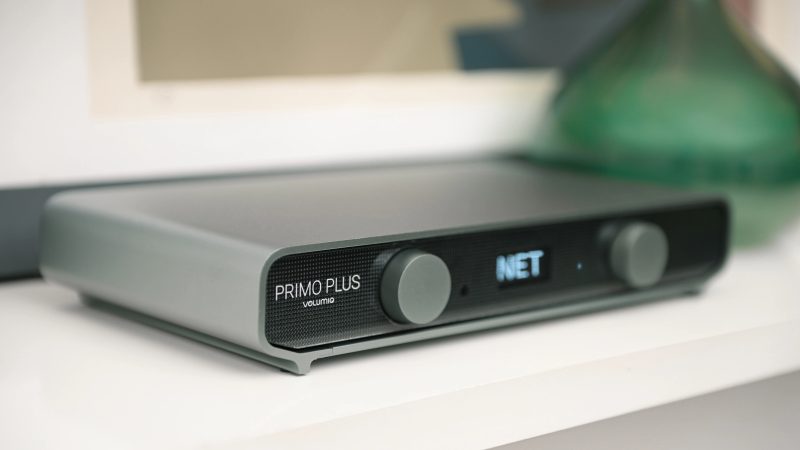
The Primo Plus comes in an aluminum enclosure measuring 27 × 15 × 5 cm and weighing 2.25 kg. Design Narratives Ltd, a Red Dot Award winner, designed the anti-magnetic aluminum chassis. This collaboration between the streaming specialist and the British design studio has also given rise to the other products in the Volumio range.
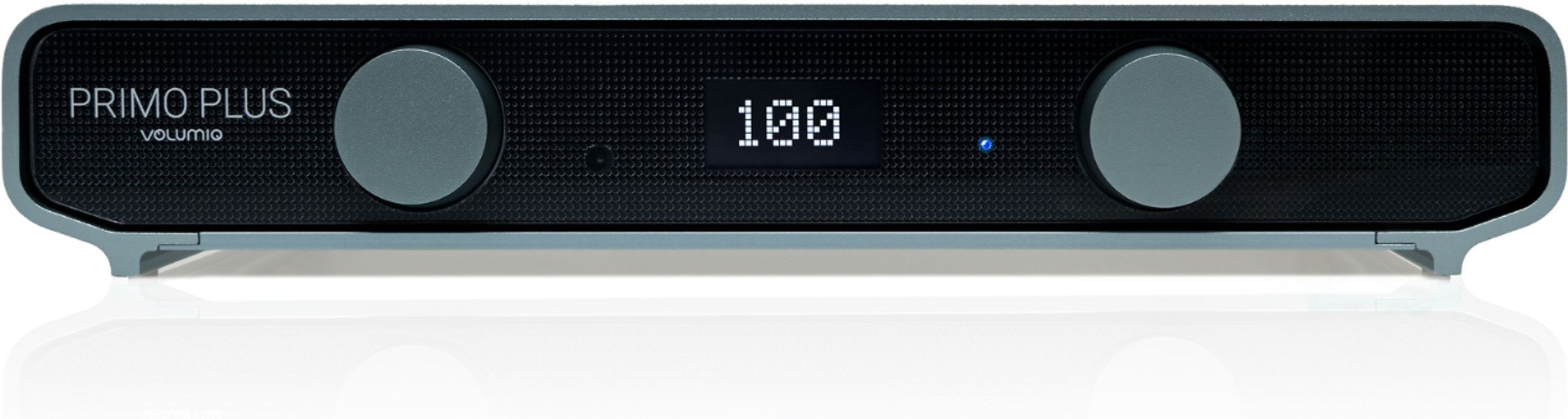
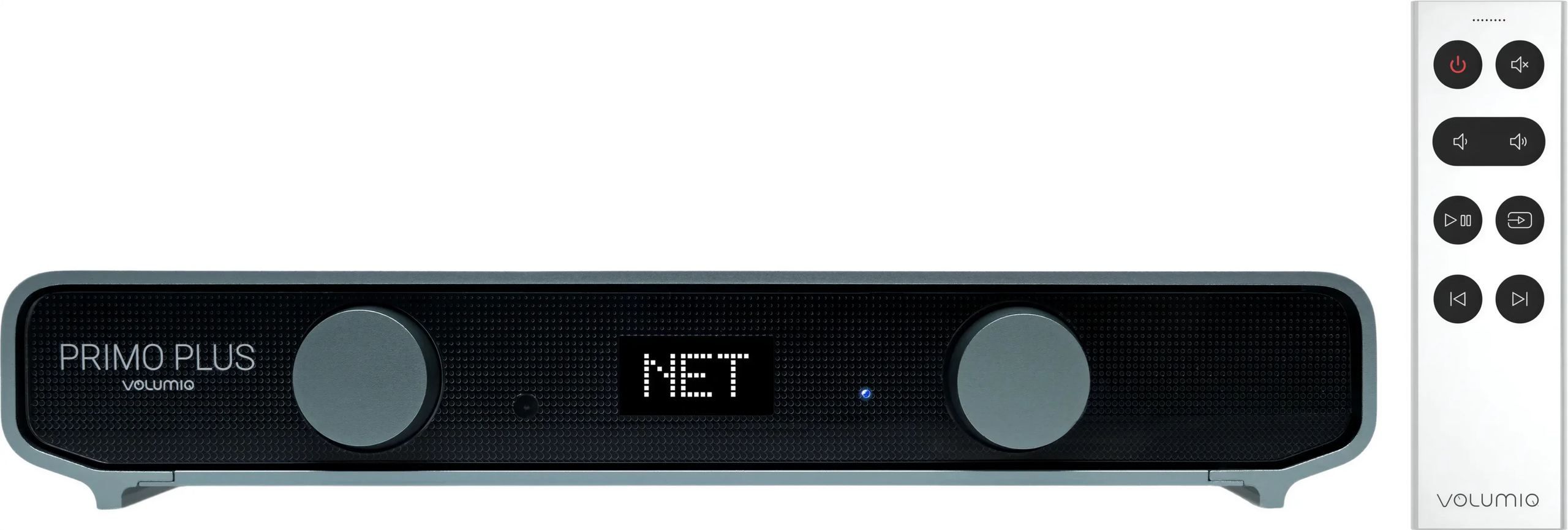
The front panel features a small 1.3-inch OLED screen that displays playback information, as well as two rotary encoders with push buttons for navigation and volume control. The unit comes with an aluminum remote control called Volumio Remoto, equipped with an infrared receiver integrated into the chassis.
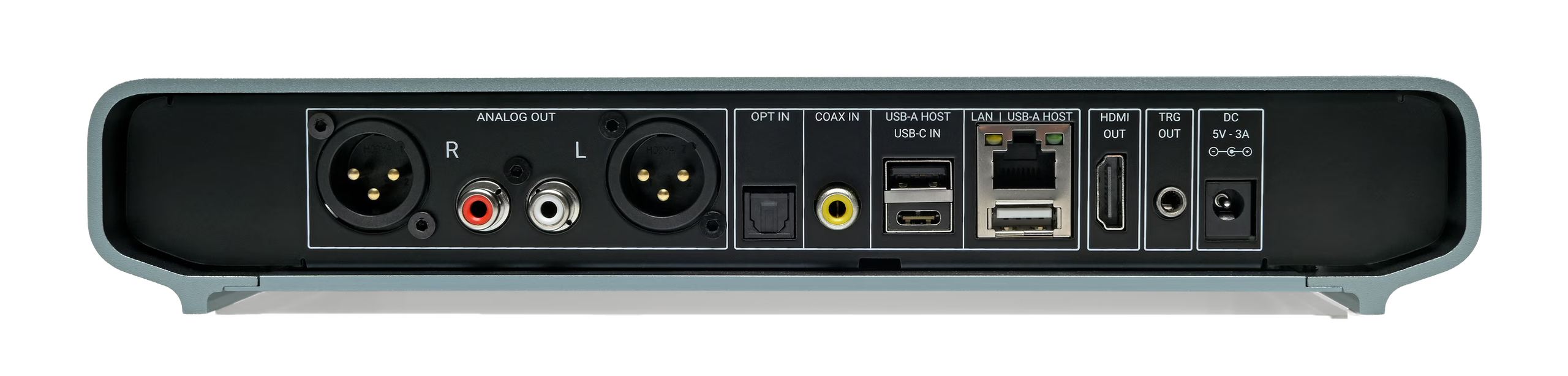
On the back, the connectivity brings together the digital and analog inputs and outputs, the Gigabit Ethernet port, the Wi-Fi antennas and an HDMI output to display the VolumioOS interface on a TV or monitor up to 4K/60 fps this is not an HDMI ARC input.
Dual-mono conversion: two ESS ES9039Q2M chips
The Primo Plus abandons the single DAC chip of the original Primo in favor of a dual-mono configuration using two ESS ES9039Q2M chips. This approach consists of dedicating one converter to each audio channel, left and right, rather than having both channels processed by a single chip.
This dual-mono configuration offers increased definition with virtually no crosstalk between channels. The physical separation of the conversion circuits limits mutual interference between the left and right channels, which theoretically results in better localization of instruments within the soundstage.
The ES9039Q2M is ESS’s mobile-oriented chip, a less power-hungry variant than the flagship ES9039PRO found in more expensive DACs. Whereas the PRO chip targets absolute performance with its 32-bit HyperStream IV architecture and -122 dB THD+N, the Q2M sacrifices some of this measurement precision in favor of efficiency and integration.
Power supply and clock: the foundations of the signal
The improved power supply and operational amplifiers ensure the lowest possible distortion, while the new clock design delivers virtually jitter-free playback.
The Primo Plus power supply is based on a dual-stage linear architecture with LC filtering and dedicated regulators separating the analog and digital sections. This separation is intended to prevent noise generated by the digital circuits from contaminating the final analog signal.
The high-precision clock boasts 90 femtoseconds of jitter. To give a sense of scale, one femtosecond is one millionth of a billionth of a second. This timing accuracy helps maintain soundstage stability and rhythmic coherence during playback.
Eight digital filters and NOS mode
Eight user-selectable DAC filters plus a NOS (non-oversampling) mode allow you to slightly adjust the sonic character of the Primo Plus according to individual preferences.
Digital filters change the way the converter interpolates audio samples. Each filter involves a different compromise between transient response (note attack), attenuation of frequencies beyond the audible band, and the potential appearance of pre-echoes or post-echoes. NOS mode disables oversampling, delivering the signal without additional interpolation—an approach some listeners prefer for what they consider a more natural rendering, even if it can theoretically let more high-frequency artifacts through.
Analog outputs and preamplifier function
The Primo Plus features balanced XLR and unbalanced RCA outputs. The output levels are selectable among eight values from 0.5 to 6.30 Vrms, which can solve gain-matching issues that affect certain hi-fi systems.
This flexibility allows the signal level to be adjusted according to the amplifier used. A very sensitive preamplifier or integrated amplifier will benefit from a reduced output level to avoid saturation, while a power amplifier with low gain can take advantage of the highest output levels.
The built-in volume control allows direct connection to a power amplifier or to active speakers, without an intermediate preamplifier. Volume adjustment is then done via the app, the web interface, or the supplied remote control.
VolumioOS: integrated software and unified streaming
VolumioOS remains the Primo Plus’s major asset. The platform’s reputation within the Raspberry Pi community suggests that this network player could appeal to users who have outgrown DIY streaming solutions but want to retain an open-source philosophy.
Streaming support includes Roon Ready, Spotify Connect, Tidal Connect, UPnP and AirPlay, with many other services accessible via the Volumio app or web interface.
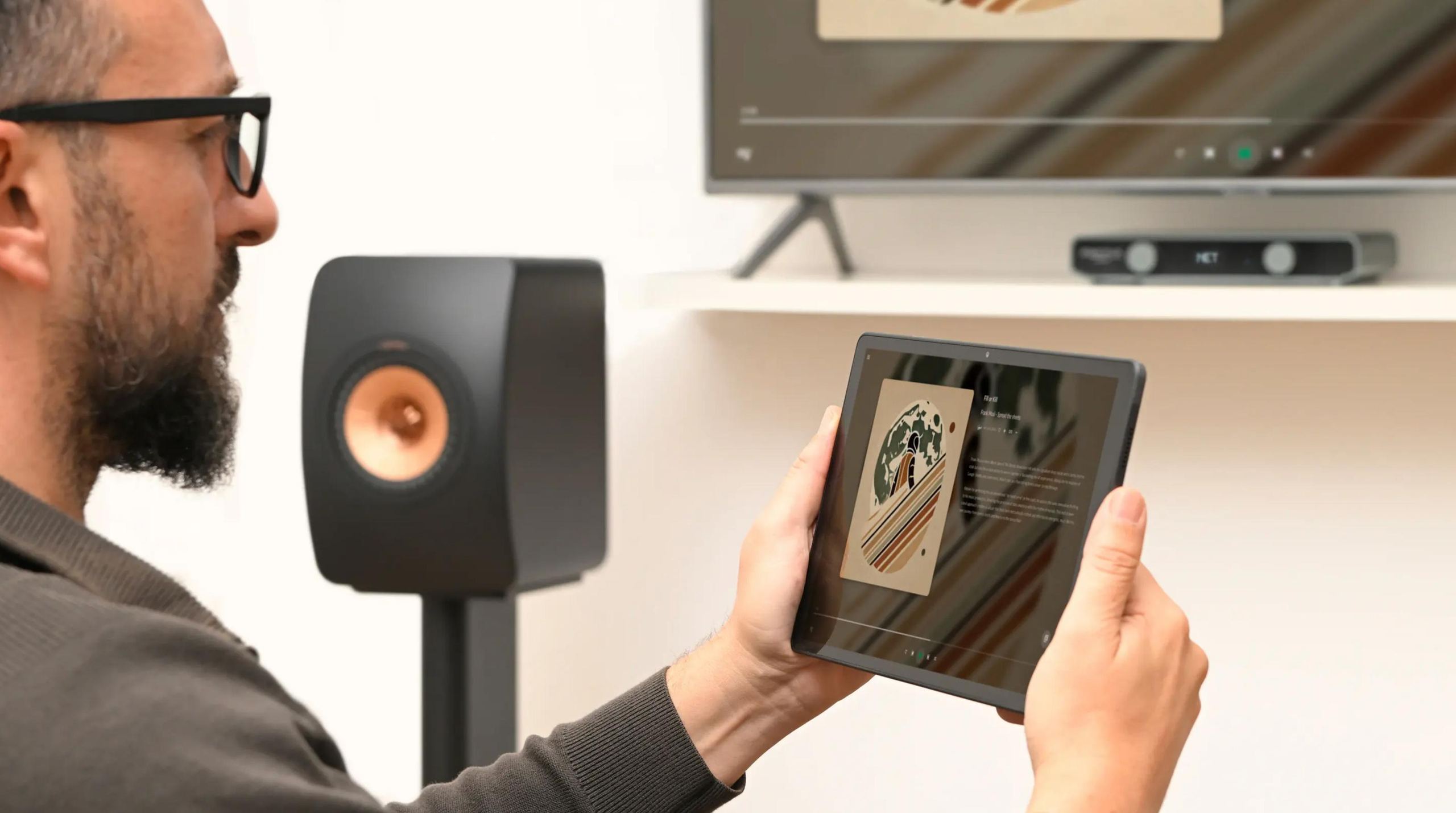
The operating system brings together in a single interface locally stored files, streaming services, internet radio, Bluetooth sources and NAS network drives. The app is available on iOS and Android, and the interface remains accessible from any web browser. Multiroom playback lets you connect up to six Volumio devices on the same home network and create groups to play music simultaneously on several devices, each retaining its own volume control.
From Primo to Primo Plus: what’s changed
The original Primo used a single ESS ES9038Q2M chip in a differential configuration. The Primo Plus moves to two ES9039Q2M chips in dual mono—a newer generation from the ESS range. Beyond the converter, the power supply and operational amplifiers have been improved, and the clock design has been completely reworked.
Connectivity has also been expanded: the Primo Plus adds a native audio USB-C input and a coaxial input port, both absent from the previous model. Output levels are now adjustable, whereas the original Primo offered a fixed level.
The processor has also evolved, moving from an Amlogic to a quad-core ARM Cortex-A72 clocked at 1.5 GHz, paired with 2 GB of LPDDR4 RAM and 16 GB of eMMC storage. Each Primo Plus is hand-assembled in Florence.
What the press says
This streamer offers an ideal combination of warmth and precision—everything one expects from network playback to fully enjoy one’s favorite recordings with complete ease. [...] The Volumio excels at extracting micro-details to enhance the sense of presence of vocals and lead instruments, while a wide and deep soundstage unfolds in the background. [...] Nevertheless, we did not find the density and substance we had obtained with the Motivo, a benchmark in its class, albeit slightly more upmarket.
Automatically translated — Show original (French)
Ce streamer offre une combinaison idéale entre chaleur et précision, c'est-à-dire tout ce que l'on attend de la lecture en réseau pour profiter pleinement de ses enregistrements favoris en toute simplicité. [...] Le Volumio excelle dans l'extraction des micro-informations pour renforcer l'effet de présence des voix et des instruments leads tandis qu'en arrière-plan se développe une scène sonore large et profonde. [...] Néanmoins, nous n'avons pas retrouvé la densité et la matière que nous avions obtenue avec le Motivo, un modèle du genre, certes un peu plus haut en gamme.
Audio architecture and digital-to-analog conversion
Digital-to-analog converter: dual mono architecture with 2 × ESS ES9039Q2M
Extended dynamic range
Reduced distortion
Increased transparency
Extremely low noise
High-precision clock with ultra-low phase noise
Jitter: 90 fs
More stable soundstage
Greater accuracy
Ultra-low-noise power supply
Dual linear power supply
LC filtering
Separate regulation for analog and digital sections
Fully balanced output stages for maximum channel separation
Digital inputs and supported formats
USB-C (device)
PCM up to 768 kHz / 32-bit
DSD up to DSD512
USB-A (host)
External storage
PCM up to 1536 kHz / 32-bit
DSD up to DSD1024
Coaxial S/PDIF: PCM up to 192 kHz / 24-bit
Optical TOSLINK: PCM up to 192 kHz / 24-bit
Bluetooth 5.0
Network: PCM up to 384 kHz / 32-bit
Audio outputs
Balanced XLR (2 outputs)
Selectable output level: 1 to 6.30 Vrms (8 levels)
Unbalanced RCA (2 outputs)
Selectable output level: 0.5 to 3.15 Vrms (8 levels)
Preamplifier function
Integrated volume control
Allows direct connection to a power amplifier or active speakers
Digital processing and filtering
8 selectable digital filters
Non-oversampling (NOS) mode for natural sound reproduction
Streaming and network protocols
Built-in Volumio Premium
Unified management of local files, streaming, radio, USB, network drives
Intuitive interface (iOS / Android / Web)
Compatible with Tidal, Qobuz, Spotify, HighResAudio
CD playback via external drive
Multiroom compatible via Volumio
Protocols and certifications
Roon Ready
DLNA / UPnP
AirPlay
Bluetooth 5.0
HDMI mirroring (up to 4K/60)
Hardware and connectivity
Processor: Quad-core Cortex-A72 (1.5 GHz)
RAM: 2 GB LPDDR4
Storage: 16 GB eMMC
Wi-Fi: 802.11 a/b/g/n/ac (2.4 + 5 GHz)
Ethernet: Gigabit LAN (10/100/1000)
Connectors
1 × USB-C audio (device)
2 × USB-A (host)
1 × coaxial
1 × optical
2 × RCA
2 × XLR
1 × HDMI (Volumio OS mirroring)
1 × 12 V trigger output (3.5 mm jack)
User interface
1.3-inch OLED display
2 rotary encoders with push button
Infrared receiver
Volumio Remoto aluminum remote control included (battery included)
Power supply
Power: 5 V DC / 3 A
Connector: 5.5/2.1 mm plug, positive polarity
Trigger output: 12 V (3.5 mm jack)
Dimensions and weight
Dimensions: 27 × 15 × 5 cm
Weight: 2.25 kg
Package contents
Volumio Primo Plus (DAC with streaming)
Volumio Remoto aluminum remote control (battery included)
5 V 3 A power supply
Frequently asked questions
Can the Primo Plus replace a preamplifier?
+
Yes, the built-in volume control allows the Primo Plus to be connected directly to a power amplifier or to active speakers. Volume is adjusted via the app, the web interface, or the included Volumio Remoto remote control. The 12 V trigger output allows automatic power-on of a power amplifier.
Which streaming services are compatible?
+
The Primo Plus natively supports Tidal (with Tidal Connect), Qobuz, Spotify (with Spotify Connect), HighResAudio and internet radio. Roon Ready certification ensures integration with the Roon ecosystem. AirPlay enables streaming from Apple devices. Other services can be added via plugins available in the Volumio interface.
How does TV display work?
+
The HDMI output mirrors the VolumioOS interface on an external screen at up to 4K/60 fps. It is a video output only, not an HDMI ARC audio input. This feature is handy for browsing your music library from the sofa with the remote control, without using a smartphone or tablet.
What is the difference between USB-C and USB-A on this device?
+
The USB-C port operates in device mode: it receives the audio stream from a computer, phone or tablet, up to PCM 768 kHz / 32-bit and DSD512. The USB-A ports operate in host mode: they accept storage devices (USB sticks, hard drives, CD drives) for local file playback, with support up to PCM 1536 kHz / 32-bit and DSD1024.
Is NOS mode suitable for all types of music?
+
NOS (non-oversampling) mode disables oversampling and delivers the signal without interpolation. Some listeners find it more natural on acoustic or jazz recordings, while others prefer digital filters for electronic music or modern recordings. The eight available filters and NOS mode allow you to experiment according to your tastes and associated equipment.
User reviews
Dries
Very satisfied with the sound It does take a bit of figuring out how to set everything up because the manual is only in English
Comment from 23 February 2026 — Experience from 12 February 2026
Automatically translated — Show original (Dutch)
Heel teveden over de klank
Het is wel een beetje zoeken om alles in te stellen omdat de handleiding enkel in het Engels is
Ronald
A beautiful product, unfortunately not really compatible with the rest of my setup, which is why I sent it back. A shame!
Comment from 3 February 2026 — Experience from 23 January 2026
Automatically translated — Show original (Dutch)
Een prachtig product, helaas niet echt kompatibel met de rest van mijn installatie, daarom heb ik‘m ook terug gestuurd. Jammer!
To better understand our visitors, measure marketing effectiveness and personalise ads, we and our partners use cookies and mobile advertising identifiers on your device. This data makes it possible to display personalised and non-personalised ads and measure their performance. Some cookies, which are technically necessary, are exempt from consent. You can accept those that require your consent, refuse them by clicking “Reject”, or customise your choices via “More options”.
To find out how Google uses the data collected once you have given your consent, see Google’s Business Data Responsibility site (opens in a new window).
You can change or withdraw your consent at any time via the “Cookies” link. Your choices will apply on our site for 12 months.