

Michell Engineering Pack REVOLV + T8 + Cusis E (Low)


Buy as a bundle and save
Overview
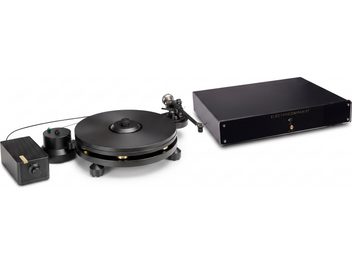
Between the understated, minimalist TecnoDec and the suspended Gyro, Michell has positioned a turntable that adopts several of the latter’s design solutions without its suspension. This package pairs the Revolv with the T8 tonearm and the Cusis E moving-coil cartridge, for a complete Michell setup from platter to stylus. The turntable is designed, manufactured and assembled by hand in the United Kingdom. You will still need a phono preamplifier suitable for low-output cartridges.
A rigid chassis resting directly on its feet
The Revolv’s chassis is machined from a 19 mm-thick plate of aircraft-grade aluminium. Unlike the Gyro, it is not suspended on springs: the bearing, platter and tonearm are attached to the same rigid structure, and vibrations picked up during playback are directed towards the supporting surface rather than oscillating within the mechanism. The tonearm is attached via a machined aluminium mounting base, ensuring firm coupling between the cartridge and the record. Each foot incorporates six Sorbothane pads, a damping polymer that filters vibrations from the floor or supporting furniture. This choice involves a trade-off: without suspension, the Revolv depends more on the quality of its support, which should ideally be stable, heavy and perfectly level. On a flexible wooden floor that transmits footsteps, a wall shelf is a good option.
The platter is made of Delrin, a dense, low-resonance polyacetal, ringed with 10 mm brass weights set into its perimeter. Placing weight far from the centre increases inertia: the platter behaves like a flywheel and better resists the small speed fluctuations that the ear perceives as wow. A supplied record clamp holds the record against the platter to limit its own vibrations.
The inverted bearing inherited from the Gyro
The Revolv uses the inverted main bearing that built the Gyro’s reputation. In a conventional bearing, the platter rotates on a ball positioned at the bottom of a well. In Michell’s design, the rotation point is at the top of the spindle, as close as possible to the platter’s centre of gravity, stabilising its rotation. A helical groove circulates oil along the full height of the spindle as the platter turns: lubrication remains constant, rotation stays quiet, and bearing wear remains very low over the years.
A motor separate from the turntable
The motor is housed in a heavy, independent unit placed beside the turntable, with no connection to it other than the belt. Its vibrations do not reach the chassis or, consequently, the cartridge, which reads grooves whose contours are measured in microns. The motor housing and external power supply are machined from solid blocks of aircraft-grade aluminium: these rigid, almost seamless enclosures also block radio-frequency interference. The assembly is earthed via a shielded cable.
Speed is changed electronically, using a button on the power supply, between 33 1/3 and 45 revolutions per minute, without having to move the belt on a pulley.
The T8 tonearm, an evolution of the T2
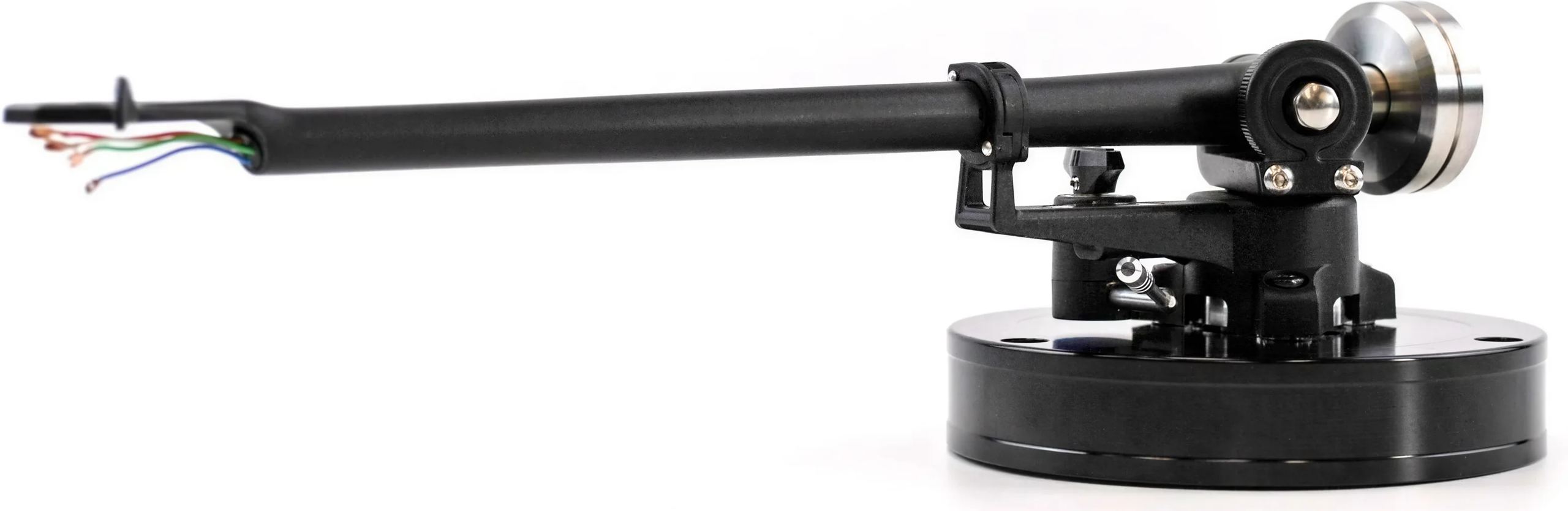
The T8 succeeds the T2 in Michell’s tonearm range, retaining its design principle while making the mechanics more rigid. The vertical bearing housing is now aluminium, the sleeve has been redesigned and the vertical bearing spindle is stainless steel. These changes increase the tonearm’s rigidity and stability, and limit unwanted movement and resonance. The bearings are matched by hand, and the arm tube has been designed to have as few resonance points as possible.
With an effective mass of 11 g, the T8 is a lightweight tonearm. Effective mass refers to the weight “seen” by the cartridge as it follows the groove: a lightweight tonearm reacts quickly to record warps and suits cartridges with fairly firm suspension, such as the Cusis E. The internal wiring is low-mass copper, and the tonearm terminates in low-capacitance phono cables fitted with high-quality plugs. The T8 is not sold separately: Michell supplies it only fitted to its own turntables.
Cusis E, a low-output moving-coil cartridge
The Cusis E is the entry point to Michell’s cartridge range. It operates on the moving-coil (MC) principle: tiny coils move within a fixed magnetic field, unlike the more common moving-magnet cartridges (MM). The moving assembly is lighter, which promotes fine detail retrieval and fast transients. The samarium-cobalt magnet, combined with pure iron, creates a highly stable magnetic field. The coils are precision-wound from 30 µm pure copper wire on an ultralight armature, mounted on a damper tuned to follow the groove faithfully. For each Cusis model, Michell adjusts the number of turns, output voltage and body material to suit the stylus used.
The stylus tip is an elliptical-profile diamond, narrower along the groove than a conical diamond: it follows rapid modulations more closely and reproduces treble with greater precision. It is carried by an aluminium cantilever (stylus holder). The high-density acetal body is mounted on a wide aluminium chassis that absorbs vibrations and provides a rigid base for the assembly. The recommended tracking force is 2 g, and the frequency response extends from 20 Hz to 25 kHz.
A setup to be completed with an MC preamp
With an output voltage of 0.35 mV, the Cusis E delivers a signal around ten times weaker than an MM cartridge. It requires a high-gain, low-noise MC phono input, offering around 60 dB or more, or a step-up transformer placed before an MM input. The preamp must be able to load the cartridge at 100 Ω, the value recommended by Michell for an internal impedance of 4.5 Ω. The turntable has no built-in preamplifier: the tonearm output connects to this phono preamp, and the earth wire connects to its dedicated terminal to prevent hum.
The Revolv is designed to evolve with its owner. Its design allows the setup to be upgraded in stages rather than replacing the turntable, starting with the cartridge, the easiest component to replace.
REVOLV Turntable
Construction and materials
- 19 mm solid aluminium chassis
- Precision-machined for maximum rigidity
- Unsuspended design for direct mechanical grounding
- Delrin platter with peripheral mass
- 10 mm brass peripheral weights for increased inertia
- Rigid tonearm coupling via a machined aluminium plate
- Handcrafted construction
- Designed, manufactured and hand-assembled in the United Kingdom
- Timeless engineering and a minimalist footprint
Motor system and isolation
- Isolated and shielded standalone motor unit
- Drastically reduces vibration transmission to sensitive components
- Preserves musical detail and clarity
- Shielded power supply with electronic speed selection
- Motor and power supply machined from aircraft-grade aluminium blocks
- Rigid enclosures blocking RF interference
- Grounding and shielded wiring
- Entire assembly grounded and connected by shielded cable
- Ensures a pure signal path and exceptional audio quality
Stability and damping
- Sorbothane isolation feet
- Six vibration dissipation points
- Optimal damping to preserve sound fidelity
- Inverted single-helix main bearing with oil circulation
- Ensures stable, quiet rotation
- Contributes to precise and clear musical reproduction
- Optimised mechanical architecture
- Direct grounding without suspension
- Absolute motor system stability
Upgradeability and accessories
- Upgradeable platform
- Architecture designed to accommodate future upgrades
- A turntable you can build on and invest in for years
- Included accessories
- Dust cover
- Record clamp
T8 Tonearm
Performance and sound quality
- Very high-end audiophile tonearm
- Significant improvement in rigidity and stability over the T2 model
- Extremely detailed and natural sound reproduction
Mechanical specifications
- Effective mass: low (11 g)
- Mounting distance: 222 mm (measured from the centre of the platter to the centre of the tonearm)
- Compatibility: Michell Gyro series turntables
Design and construction
- Hand-matched precision bearings
- Advanced arm tube design for maximum resonance reduction
- Low-mass copper internal wiring
- Low-capacitance phono cables fitted with high-end connectors
Box contents
- Michell Gyro turntable with chassis, platter and bearing
- Decoupled motor unit
- Shielded external power supply
- Acrylic cover
- Michell record clamp
- Drive belt
- Connection and grounding cables
- User manual
Cusis E Cartridge
Physical construction
- Type: moving coil (MC) cartridge
- Stylus tip: elliptical
- Cantilever: aluminium
- Chassis: wide aluminium chassis
- Body: high-density acetal
Audio performance
- Tracking force: 2.0 g
- Frequency response: 20 Hz – 25,000 Hz
- Channel separation: 23 dB
- Channel balance: < 1 dB
- Tracking ability: 70 µ / 2.0 g
- Compliance: 8 × 10⁻⁶ cm / dyne
Electrical characteristics
- Output voltage: 0.35 mV
- Recommended load: 100 Ω
- Internal impedance: 4.5 Ω
- Coil winding: precision-wound 30 μm pure copper
Technical design
- Magnet: samarium-cobalt combined with pure iron for a stable magnetic field
- Damper: designed for precise groove tracking
- Optimisation: each element (number of turns, output, body) is tailored to the stylus profile for optimal reproduction
General information
- Mass: 8.9 g
- Recommended break-in: > 40 hours
Frequently asked questions
Does the turntable play 78 rpm records?
No. Electronic speed selection offers 33 1/3 and 45 rpm only. Playing 78 rpm records also requires a specific, wider stylus, which the Cusis E does not have.
What is the difference between the Cusis E in this bundle and the Cusis E/H?
The Cusis E/H is the high-output version of the same cartridge, with 2 mV instead of 0.35 mV, making it compatible with a standard MM phono input. The version in this bundle is the low-output Cusis E, which requires an MC input. If your amplifier or preamp only has an MM input and you do not wish to replace it, the E/H version is the simplest to connect.
Are the T8 tonearm and the Cusis E a good mechanical match?
Yes. A tonearm and cartridge form a mass-spring system whose resonant frequency must remain below the audible bass range and above record warps and undulations, at around 8 to 12 Hz. With an effective mass of 11 g for the T8, 8.9 g for the cartridge and a compliance of 8 × 10⁻⁶ cm/dyne, this resonance sits at around 12 Hz, at the upper end of the recommended range. A low-compliance cartridge like the Cusis E pairs well with a lightweight tonearm.
Does the cartridge need to be broken in?
Michell recommends more than 40 hours of listening before the Cusis E reaches normal operation. During this period, the cantilever suspension gradually softens. It is best to wait until the break-in period is over before fine-tuning settings such as preamp loading or tracking force within the recommended range.
What is the supplied pinch roller used for?
It sits on the central spindle to press the record against the Delrin platter. It reduces vibrations in the vinyl itself and improves contact with the platter. It does not screw on: simply place it on before playback and remove it to turn the record over.
Can the Revolv accommodate a tonearm other than the T8?
The tonearm is attached to the chassis via a machined aluminium mounting base, which Michell offers for various types of tonearm. The T8 remains the brand’s most refined option for this turntable, but compatibility with other tonearms is part of its upgradable design.
What maintenance is needed for the bearing and belt?
The inverted bearing operates in an oil bath circulated by rotation and experiences very little wear. Checking the oil level during routine maintenance is sufficient. The belt, which connects the separate motor unit to the platter, must be kept clean and free of grease, and should be replaced when it stretches or the speed becomes less stable.
- Eco-contribution included in the sale price.


