Milan
Beautiful product. Paired with Wharfedale EVO 5.1 speakers, it sounds amazing. Very happy.
Comment from May 01, 2026 — Experience from April 20, 2026



Each year, dozens of European journalists gather to select the best electronic products of the year. Awarded by a diverse and impartial jury, the EISA (Expert Imaging and Sound Association) awards recognize exceptional products for their performance, design, or ergonomics.
Fifty years after the original 3030, NAD is reinterpreting one of its most iconic models. The C 3030 reprises the visual codes of the 1970s, with its illuminated VU meters and cursive logo, but incorporates modern electronics based on class D amplification. More compact and affordable than the anniversary C 3050 launched in 2023, this 2 × 50 W integrated amplifier focuses on a balance between retro aesthetics, up-to-date connectivity, and performance that remains faithful to NAD’s philosophy.
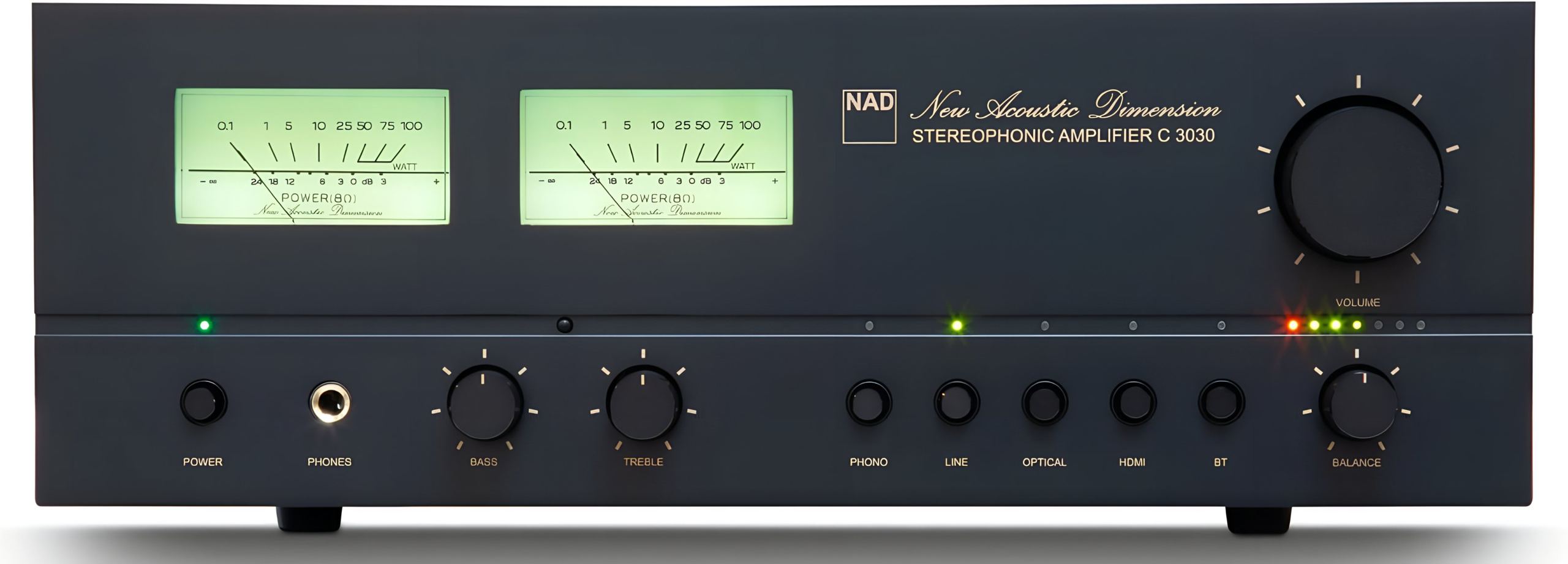
The C 3030 immediately evokes the amplifiers that built NAD’s reputation in the late 1970s. The dark gray front panel features two needle VU meters that react in real time to level changes, offering a visual representation of the unit’s dynamic behavior. Push-button input selectors let you choose the source at a glance, without diving into menus. The weighted volume knob allows for fine adjustments during long listening sessions.
The unit’s proportions, closer to those of the original 3030 than the C 3050, make it easier to integrate into modern living spaces. At about 36 cm wide and just under 6 kg, it fits on a shelf, TV stand, or audio rack without dominating the room.

The power stage is based on HybridDigital UcD technology, a variant of the self-oscillating class D architecture developed by Hypex. This type of circuit integrates a feedback loop after the output filter, allowing it to maintain a stable frequency response regardless of the type of speakers connected. The C 3030 delivers a continuous 2 × 50 W (20 Hz to 20 kHz, both channels driven), into both 8 Ω and 4 Ω, in line with NAD’s Full Disclosure Power methodology. Single-frequency or single-channel measurements, which tend to look better on paper, are not part of the brand’s vocabulary.
Dynamic headroom reaches 120 W into 8 Ω, 250 W into 4 Ω, and up to 390 W into 2 Ω, leaving plenty of margin to handle brief transients without compression or hardening of the sound. Instantaneous current capability is 16 A, ensuring firm control over the drivers, including those whose impedance dips in the bass.
The Texas Instruments PCM5242 digital-to-analog converter, wired in differential mode, handles digital signals up to 192 kHz / 24-bit. This chip, known for its immunity to clock jitter, is used in several models across the NAD lineup. The optical input lets you connect a CD player, media box, or any other device equipped with an S/PDIF output.
The phono preamp, designed for moving magnet (MM) cartridges, features a subsonic filter circuit. This filter eliminates unwanted vibrations generated by the warp of slightly bowed records, a often-overlooked source of distortion that makes the woofers work unnecessarily hard and taxes the amplifier.
The HDMI eARC input turns the C 3030 into an audio companion for a TV. The audio signal travels directly from the television, with no extra cable, and volume can be controlled from the TV’s remote. This link simplifies integration in a living room where the amp handles both music listening and TV sound.
Bidirectional Bluetooth aptX HD allows you to receive audio streams from a smartphone or tablet, and also send the signal to a compatible wireless headset. Audio quality reaches 24-bit / 48 kHz, sufficient to enjoy digital music catalogs in very good conditions.
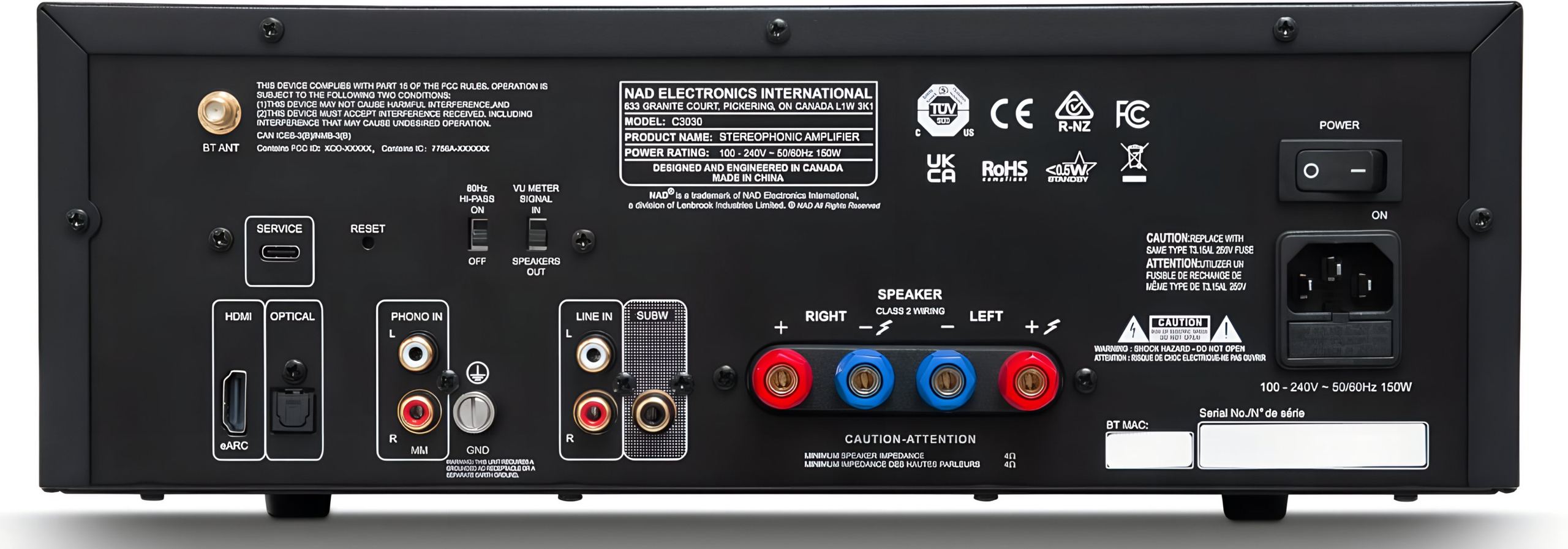
The subwoofer output, combined with a fixed 80 Hz high-pass filter that can be activated via a switch, allows you to build a well-balanced 2.1 system. When the filter is engaged, the lowest frequencies are no longer sent to the main speakers, freeing up power for the mid and treble while handing the low end over to a dedicated subwoofer.
The rear panel also includes a line input, a pre-out, and a 12 V trigger connector for integration into a home automation system. The front panel houses a headphone jack.
Unlike the C 3050 or the amplifiers in the 300 series, the C 3030 does not feature an MDC2 slot. It is therefore not possible to add a BluOS module later to access network streaming or Dirac Live room correction. Users who want these features will need to opt for the C 3030S, which has BluOS built in, or consider an external streamer.
The digital section is limited to a single optical input. The lack of a coaxial input may require workarounds in some setups, although most mainstream sources now provide an optical output. The internal DAC does not support MQA or DSD streams.
The efficiency of class D amplification allows the C 3030 to operate without generating excessive heat, making it suitable for installation in a relatively enclosed cabinet, provided some ventilation is maintained. Standby power consumption, capped at 0.5 W, remains negligible on the yearly energy bill.
Paired with bookshelf speakers or floorstanders of average sensitivity, the unit can easily fill a standard-sized living room with sound. Its dynamic headroom helps reproduce percussion attacks and orchestral crescendos without any sense of strain. In a smaller room, comfortable listening levels remain well below the available power, keeping the amp in an operating range where distortion is imperceptible.
Adopting the name and design of a legendary model from the 1970s, the NAD C 3030 is a thoroughly modern integrated stereo amplifier/DAC. A highly appealing device that truly masters the neo-vintage concept.[...] Our only regret is the absence of wood-finished side panels, which would have enhanced this amplifier’s vintage essence.[...] While not entirely beyond reproach (the very high frequencies lack a bit of finesse, in our view), the device performs very well technically.
The unit delivers the same rated power into 8 Ω and 4 Ω, indicating a well-dimensioned power supply. Its 16 A current capability and 390 W dynamic power into 2 Ω allow it to handle speakers whose impedance briefly dips in the bass. That said, speakers renowned for being difficult loads are still better served by higher-powered power amplifiers.
The C 3030S integrates the BluOS platform, providing access to more than twenty streaming services, internet radio, local music libraries, and multiroom features. It also offers Wi‑Fi and Ethernet connectivity. The standard C 3030 does not include these functions and is aimed at users who already own a streamer or who prefer physical sources.
No, the phono preamp is calibrated for moving magnet (MM) cartridges. Using an MC cartridge requires an external phono preamplifier that provides the additional gain this type of transducer needs.
The unit can switch to standby after a period of inactivity to reduce its already very low power consumption (0.5 W). The exact behavior depends on the settings available via the supplied remote control or the configuration menus.
Milan
Beautiful product. Paired with Wharfedale EVO 5.1 speakers, it sounds amazing. Very happy.
Comment from May 01, 2026 — Experience from April 20, 2026