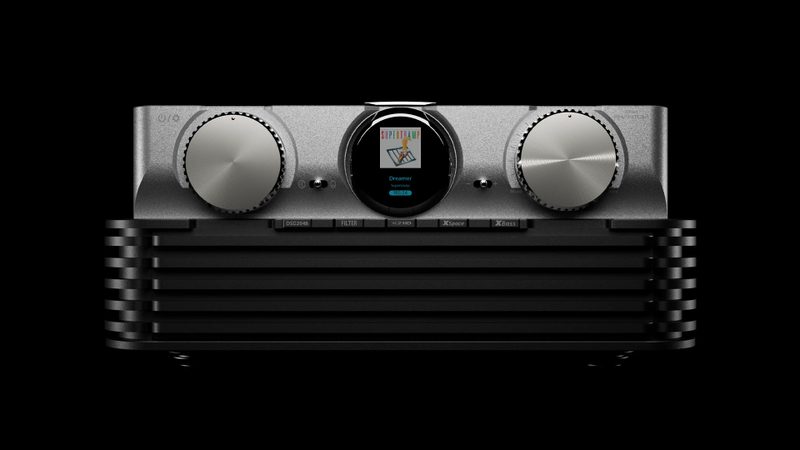
iFi Audio iDSD Phantom
Specifications and features


Overview
Successor to the Pro iDSD Signature, the iDSD Phantom combines a DAC, network player, and headphone amplifier in a single unit with an unusual two‑tone design. This new iFi Audio flagship follows its predecessor’s philosophy while reworking every stage: a modernized streaming engine, conversion pushed to DSD2048, a redesigned amplification stage with 67% more power, and expanded user control.
A quad-core DAC inspired by multibit legends
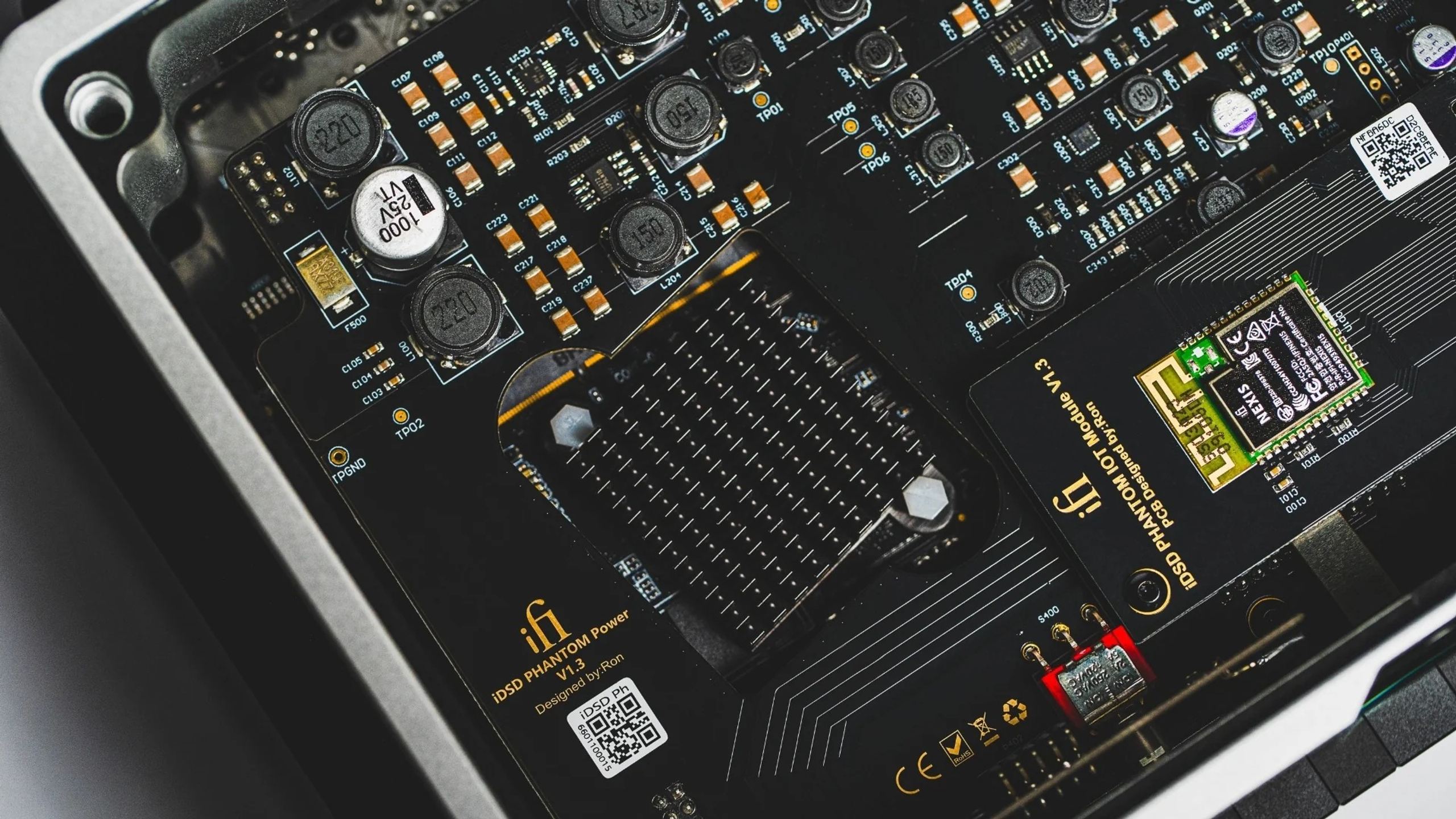
The digital architecture of the iDSD Phantom is built around four Burr-Brown DSD1793 chips in an interleaved configuration. This approach is inspired by classic multibit converters, specifically the Philips TDA1541A found in the famous AMR CD-77 CD player. The principle: each converter handles part of the signal, improving low-level linearity and reducing background noise compared to a single chip.
Digital processing is then handled by the in-house iFi Chrysopoeia FPGA circuit. This engine applies proprietary remastering algorithms and reduces jitter before conversion. In “Remastered” mode, the signal can be converted up to DSD2048, corresponding to a sampling rate of around 90 million times per second. The DSD stream is then sent directly to the converters with no digital filtering, while volume is managed in the analog domain.
The Phantom supports PCM up to 768 kHz, native DSD512, and full MQA decoding. In normal mode, DSD files are passed straight to the converters, while PCM is processed through one of the selectable digital filters.
Three sonic signatures in a single chassis
The iDSD Phantom offers three amplification topologies that can be switched in real time, a concept first seen on the Pro iDSD but here extensively reworked.
The Solid-State mode uses discrete JFETs in a dual-mono configuration. It favors speed, neutrality, and very low distortion. The Tube mode relies on hand‑matched NOS GE5670 tubes, adding a smoother texture and a slightly softened character. Tube+ mode reduces loop gain and feedback to boost the second harmonic by +6 dB, enhancing the “vintage” flavor and suiting older recordings or analytically voiced headphones.
The output stage has been redesigned to deliver 67% more current than the Pro iDSD Signature. Chief engineer Colin Farch explains that the tube supply voltage has been adjusted to move the grid further from its contact potential, improving linearity.

Output power and headphone compatibility
The class A amplifier delivers 4,676 mW RMS and 7,747 mW peak from the balanced output. This power reserve can drive current-hungry planar magnetic headphones such as the HiFiMAN Susvara or Abyss Diana. High‑impedance dynamic headphones are also well covered, with 564 mW available into 600 Ω in balanced mode.
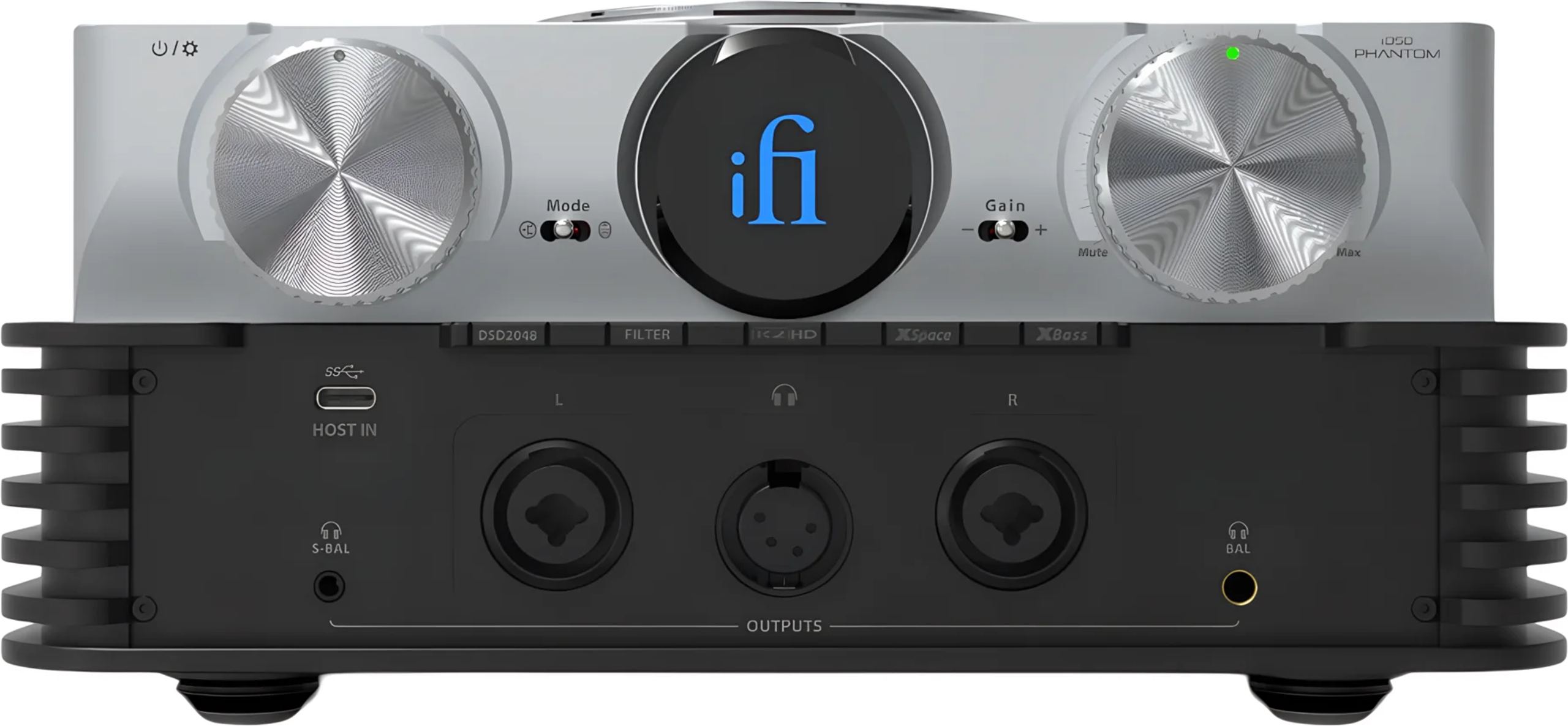
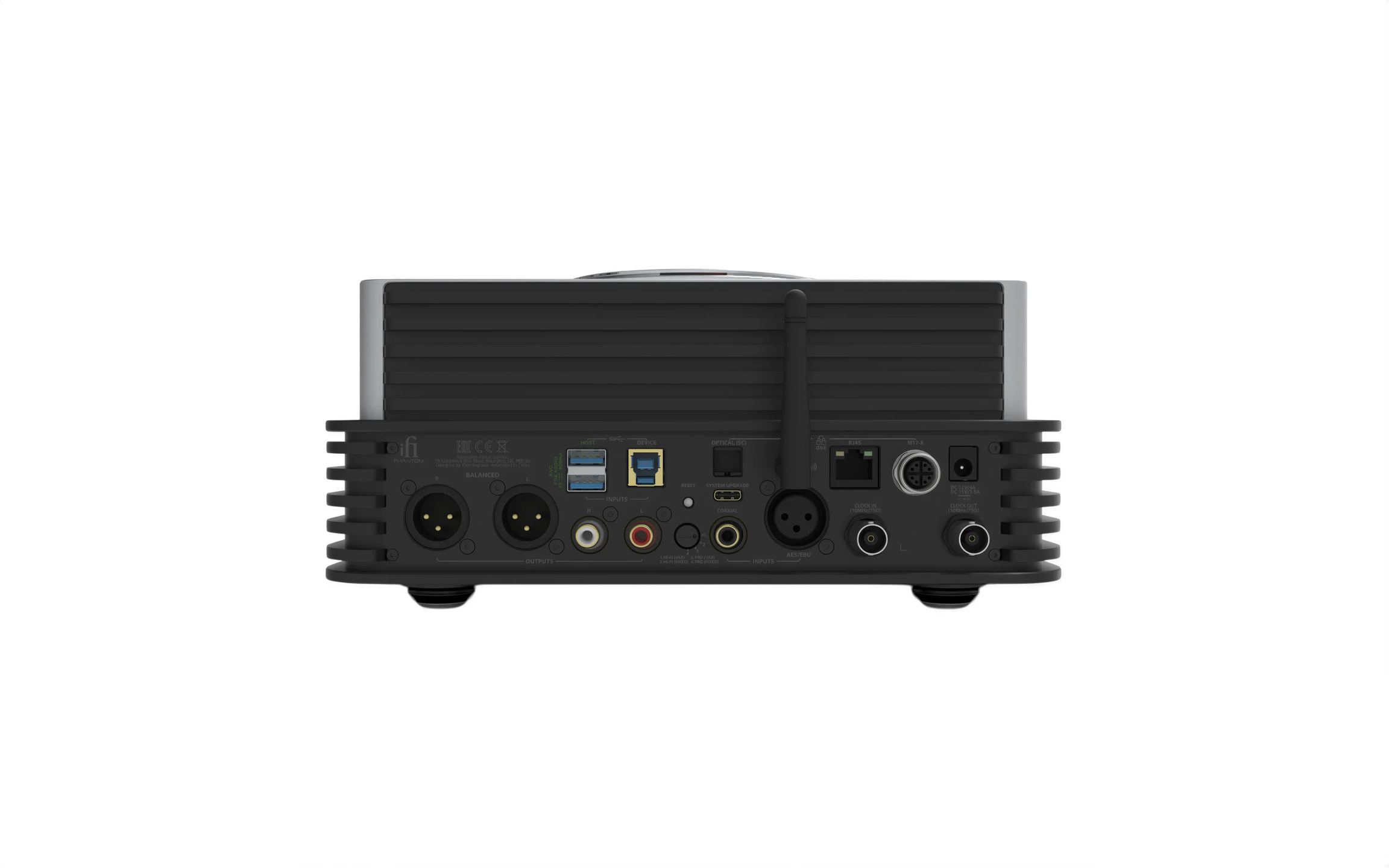
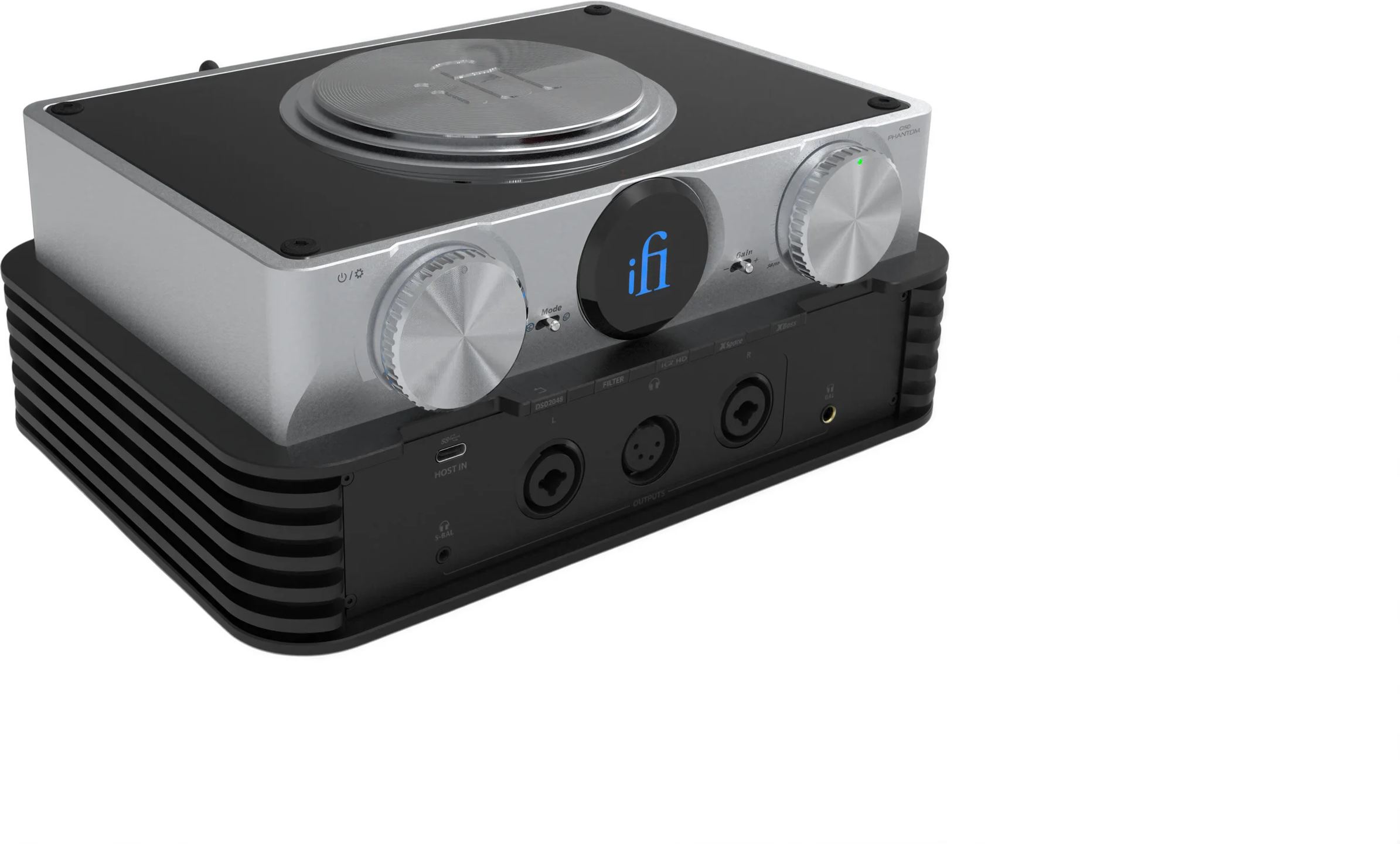
Three headphone outputs are available: 4‑pin XLR, 6.35 mm jack, and 4.4 mm Pentaconn. The RCA and XLR line outputs can operate in fixed mode (for connection to a power amplifier) or variable mode (as a preamplifier for active speakers). Output impedance stays below 2 Ω on XLR and below 1 Ω on RCA, ensuring proper control even with sensitive in‑ear monitors.
The signal‑to‑noise ratio reaches 116 dBA from the balanced output and 114 dBA from the unbalanced. Total harmonic distortion remains under 0.005%.
XBass Pro and XSpace Pro analog processing
The iDSD Phantom includes two signal processing systems, both purely analog.
XBass Pro is a variable shelving equalizer offering three cutoff frequencies: 10 Hz, 20 Hz, and 40 Hz. It compensates for the lack of low frequencies in open‑back headphones without affecting the midrange. The selectable settings let you tailor the effect to your headphones and personal taste.
XSpace Pro recreates a “loudspeaker‑like” listening experience by introducing controlled crosstalk between channels. Unlike classic Bauer/Linkwitz or Meier‑type crossfeeds, XSpace is based on research by the East German Ministry of Radio and Television on headphone/speaker compatibility. Three angle settings (30°, 60°, 90°) allow you to tune the depth of the effect.
These processes are implemented within a constant‑impedance feedback architecture, preventing interactions between the different active functions.

Digital filters and K2HD technology
The iDSD Phantom offers several digital filters to fine‑tune time‑domain rendering:
Bit-Perfect and Bit-Perfect+ pass the signal through unchanged, remaining as close as possible to the original recording. GTO (designed by iFi) upsamples to 352.8/384 kHz with minimal filtering and very little post‑ringing, which densifies the signal. Transient Aligned balances the filtering by reducing high‑frequency noise for a smoother sound. Apodising upsamples to 705.6/768 kHz with a character similar to GTO but slightly rounder.
K2HD technology, developed in partnership with JVCKENWOOD, aims to restore harmonics and microdynamics lost during digital encoding. Two modes are available: K2, which preserves the file’s original resolution, and K2HD, which upsamples to 192 kHz/24‑bit. Processing is performed in the time domain rather than the frequency domain, with parameters specifically tuned for iFi hardware.
Network streaming and digital connectivity
The streaming engine has been completely redesigned. The iDSD Phantom natively supports Qobuz Connect, Tidal Connect, Spotify Connect, AirPlay 2, and Roon Ready. The iFi Nexis app, now Wi‑Fi compatible, lets you control playback and access files stored on a NAS or USB hard drive.
Galvanic isolation is applied to the Ethernet, S/PDIF, and AES/EBU inputs to block electrical noise without affecting the audio signal. An “exclusive mode” can disable unused system processes during playback, lowering the noise floor.
The package includes the OptiBox, an optical Ethernet converter that eliminates electromagnetic and radio‑frequency interference on the network connection. This solution prevents any galvanic link to the home network.
On the digital connectivity side, you get: USB‑B 3.0, two USB‑A ports (for local file playback), USB‑C, RCA coaxial, AES/EBU XLR, RJ45, M12, SC optical, BNC for an external clock, and BNC clock output.

Design and build
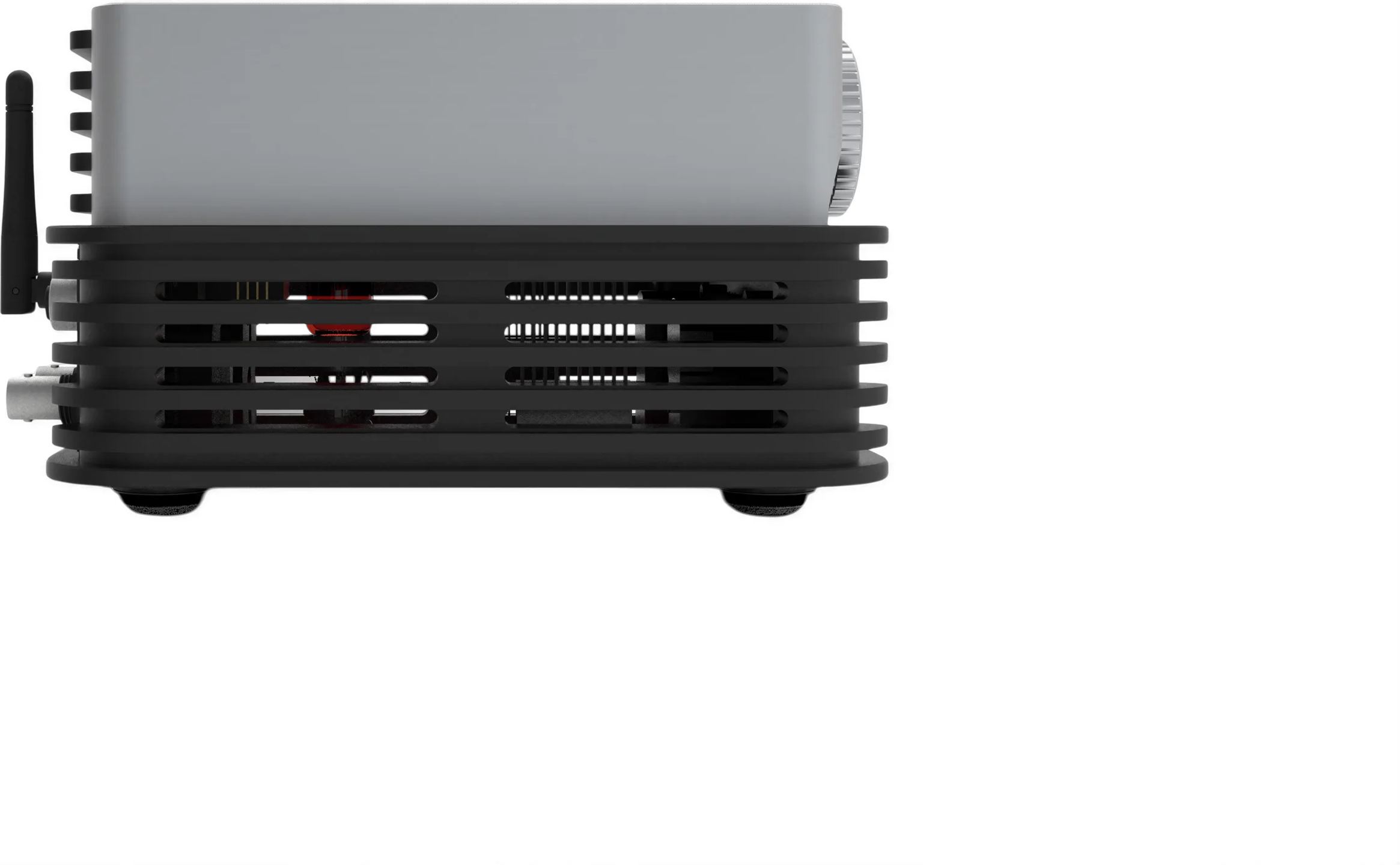
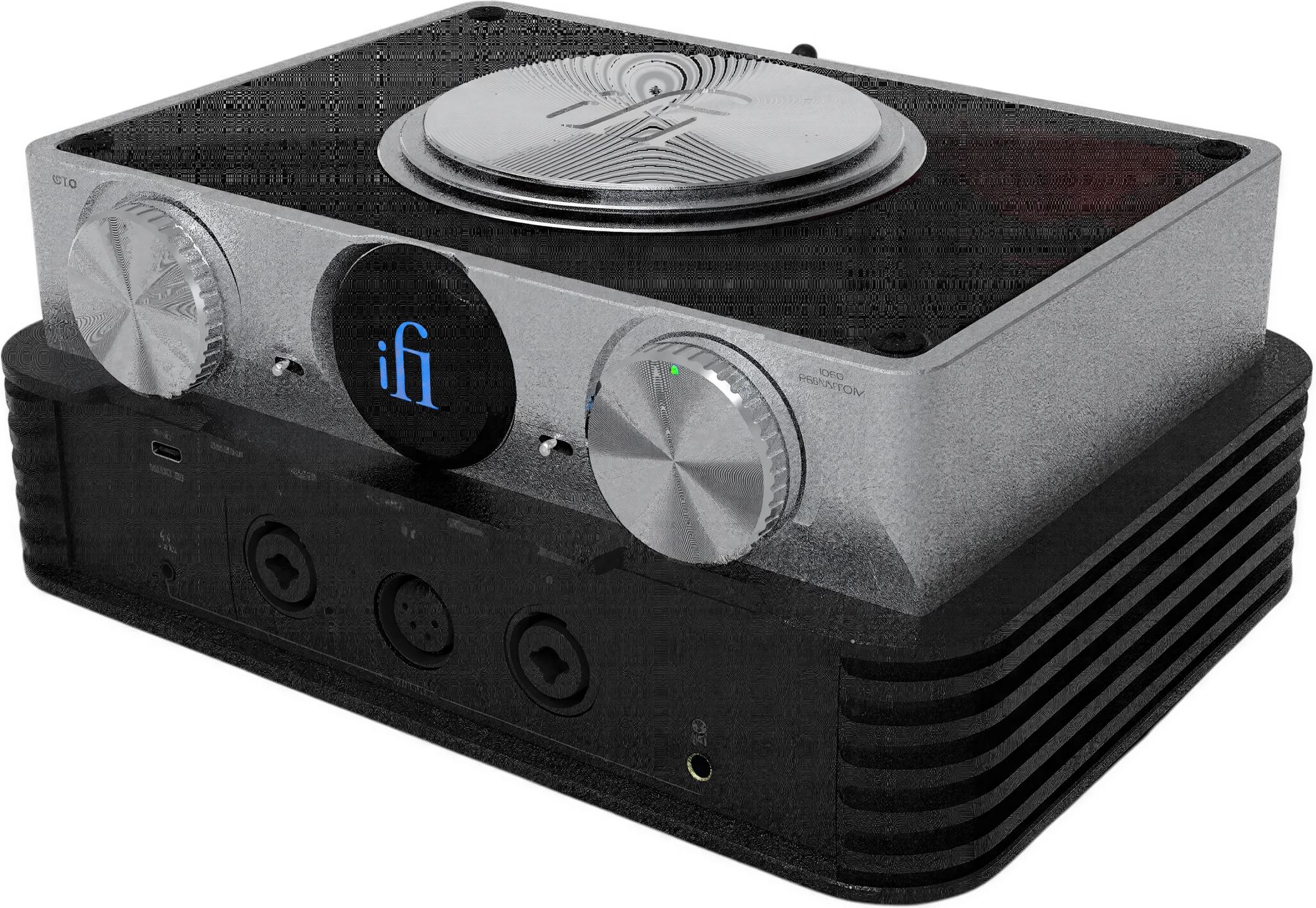
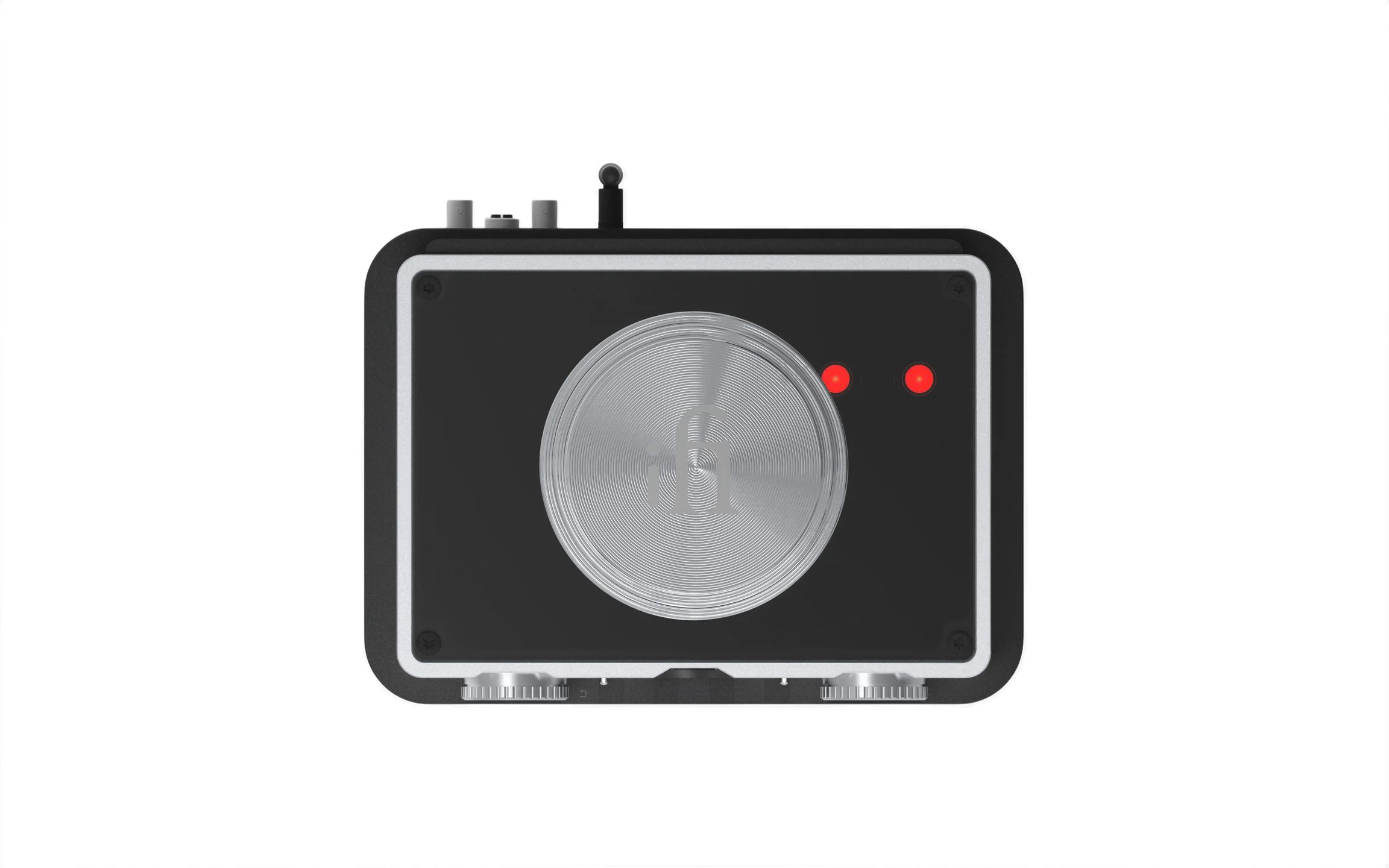
The two‑tone chassis of the iDSD Phantom follows the design language of the iCAN Phantom, the headphone amplifier released in 2023. The rounded black aluminum base is ribbed, while the grey top section houses the controls, knobs, and circular color display. A smoked‑glass cover reveals the tubes.
The design is polarizing. Some see it as a stack of two separate devices; others appreciate its originality. The dimensions remain compact (256 × 185 × 120 mm), and the 3.6 kg weight makes the unit easy to handle.
All switches and potentiometers have a firm resistance and a clear click. The connectors are solidly mounted with very little play.
Improvements over the Pro iDSD Signature
The move from the Pro iDSD Signature to the iDSD Phantom is a complete overhaul rather than an incremental update. The streaming engine now integrates Qobuz Connect and benefits from a more responsive interface. DSD remastering goes from DSD1024 to DSD2048. Output power increases thanks to a redesigned stage delivering 67% more current. JVCKENWOOD’s K2HD technology makes its debut. Galvanic isolation now covers more inputs, and the OptiBox strengthens the anti‑interference setup.
The design is radically different: where the Pro iDSD Signature used a simple rectangular form factor, the iDSD Phantom adopts a two‑tier sculptural style that stands out immediately.
What the press says
For all its technical prowess, the iDSD Phantom remains fundamentally musical. Everything I played made me very happy indeed. [...] It's astonishingly capable, sounds fabulous, and looks every bit as impressive as its high price might suggest. [...] This is a complex beast that I suspect will be over qualified for most users, and the price is a stinger.
Documentation
Technical specifications
Digital architecture
- Digital-to-analog converter: 4 × Burr-Brown DSD1793 in quad-core configuration
- Processing via proprietary Chrysopoeia programmable logic circuit
- Internal rematrixing up to DSD2048 (≈ 90 MHz)
- Supported formats
- PCM up to 768 kHz
- Native DSD512
- Full MQA decoding
- Multi-chip design improving linearity, lowering noise floor, and offering a more natural reproduction than a traditional single-chip converter
Analog stages
- Three available sound signatures
- Solid-state (JFET class A): maximum neutrality, speed, and ultra-low distortion
- Tube (GE 5670 new-old-stock): smoother, more organic harmonic texture
- Tubes+: controlled enhancement of harmonics for a warmer presentation, ideal for older recordings or analytical headphones
Audio processing
- K2HD JVCKENWOOD: restoration of harmonics and micro-dynamics
- XBass Pro: bass reinforcement (10 / 20 / 40 Hz) without altering the midrange
- XSpace Pro: loudspeaker-like spatialization (analog controlled crosstalk)
- Fully analog processing, with no loss of resolution
Network connectivity and streaming
- New-generation iFi streaming operating system
- Native compatibility: Qobuz Connect, Tidal Connect, Spotify Connect, AirPlay 2, Roon Ready
- Galvanic isolation of critical inputs
- Optical Ethernet connection via OptiBox to eliminate electromagnetic and radiofrequency interference
Connectivity
- Digital inputs: USB-B 3.0, 2 × USB-A, USB-C, coaxial, AES / EBU XLR, RJ45, M12, optical SC, BNC
- Headphone outputs: 4-pin XLR, 6.35 mm, 4.4 mm
- Line outputs: unbalanced RCA / balanced XLR (variable or fixed mode)
Technical performance
- Balanced power: ≥ 4676 mW @ 64 Ω, ≥ 564 mW @ 600 Ω
- Unbalanced power: ≥ 2311 mW @ 32 Ω, ≥ 144 mW @ 600 Ω
- Maximum voltage: 18.4 V (XLR) / 9.3 V (RCA)
- Signal-to-noise ratio: ≥ 116 dBA (XLR) / ≥ 114 dBA (RCA)
- Total harmonic distortion + noise: < 0.005 %
- Output impedance: < 2 Ω (XLR) / < 1 Ω (RCA)
Physical specifications
- Dimensions: 256 × 185 × 120 mm
- Weight: 3.6 kg
Recommended uses
- Driving demanding headphones (Hifiman Susvara, Abyss Diana, etc.)
- Mastering listening station thanks to DSD2048
- Preamplifier for high-end active loudspeakers
- Ultra–high-end minimalist system without stack of separate units
Box contents
- iPower Elite 15 V power supply
- Infrared remote control
- OptiBox optical Ethernet
- RCA cable
- USB 3.0 A-B cable
Frequently asked questions
Can the iDSD Phantom be used as a preamplifier for active speakers?
Yes. The RCA and XLR line outputs offer a variable mode that lets you use the unit as a preamplifier. Volume control is handled in the analog domain, preserving signal resolution.
Can the GE5670 tubes be replaced?
Yes. The smoked‑glass panel can be easily removed to access the tubes. iFi estimates their lifespan at over 10,000 hours of use. Compatible NOS replacement tubes are available on the market.
What is the difference between K2 mode and K2HD mode?
K2 mode applies harmonic restoration processing while preserving the file’s original resolution. K2HD mode adds upsampling to 192 kHz/24‑bit. Both modes work in the time domain to restore harmonics beyond 22 kHz.
Is the OptiBox essential for using the Ethernet connection?
No. The standard RJ45 port works on its own. The OptiBox converts the signal to optical fiber to eliminate any galvanic link to the network and the associated electromagnetic interference. Its usefulness depends on the quality of the electrical installation and how sensitive the user is to micro‑noise.
What file formats can be played from a USB drive?
The iDSD Phantom plays common formats (FLAC, WAV, AIFF, DSD, MP3, AAC) up to their maximum supported resolutions (768 kHz PCM, DSD512). Playback is via the two USB‑A ports on the rear panel, which accept hard drives and USB sticks formatted in FAT32, exFAT, or NTFS.
- Eco-contribution included in the sale price.
- Manufacturer reference: IFI0049
- GTIN / EAN: 5060738788309