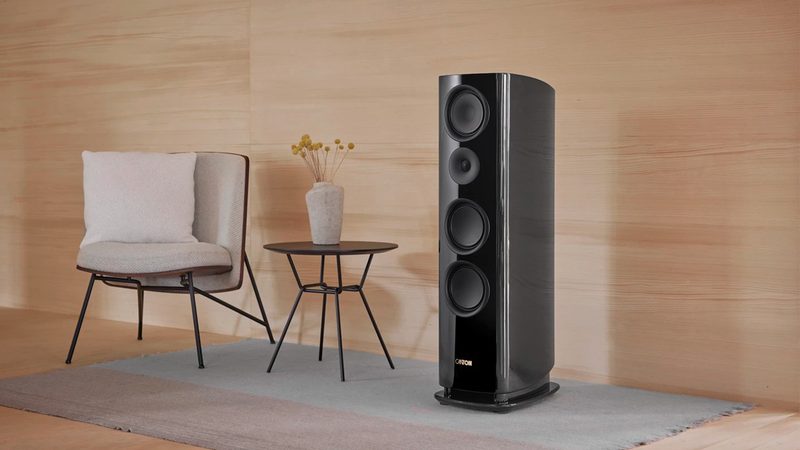
Canton Reference 3 black lacquered (pack of 2)


Overview
Fifty years of loudspeaker manufacturing in Weilrod, in Germany’s Taunus region: this is the technical foundation on which Canton has built its Reference 2023 range. The Reference 3, the second largest floorstanding model in this series after the Reference 2, incorporates all of the brand’s in-house technologies in a format standing 109 cm tall. At 42 kg per speaker, it has as much physical as acoustic presence in medium to large rooms.
Black diaphragms by molecular transformation
The BCT (Black Ceramic Tungsten) label refers to the process applied to the bass and midrange drivers. Canton converts 25% of the molecular structure of an aluminum cone into ceramic, then enriches the material with tungsten and metallic particles. The result is a diaphragm that darkens during manufacturing and combines low mass with high rigidity.
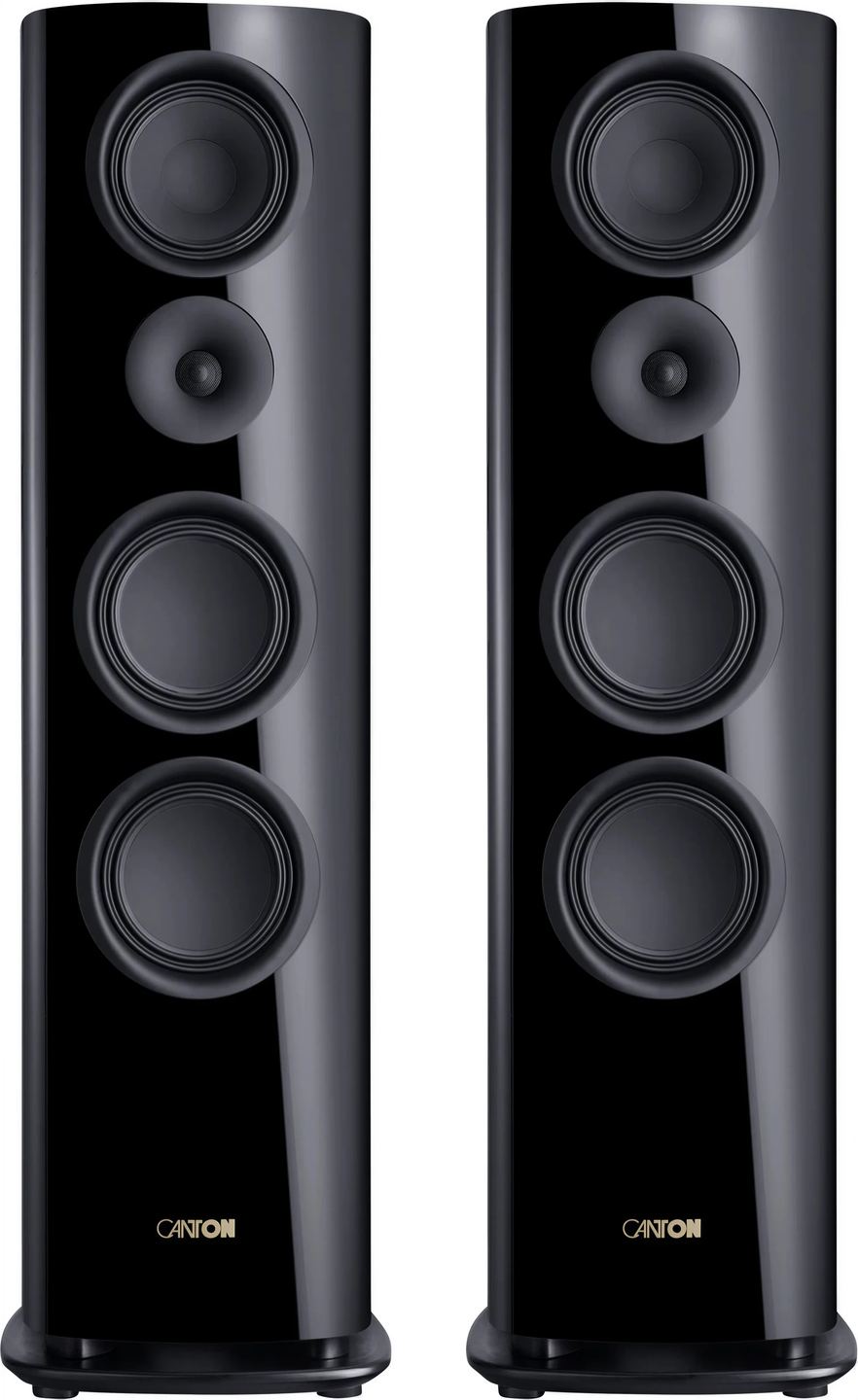
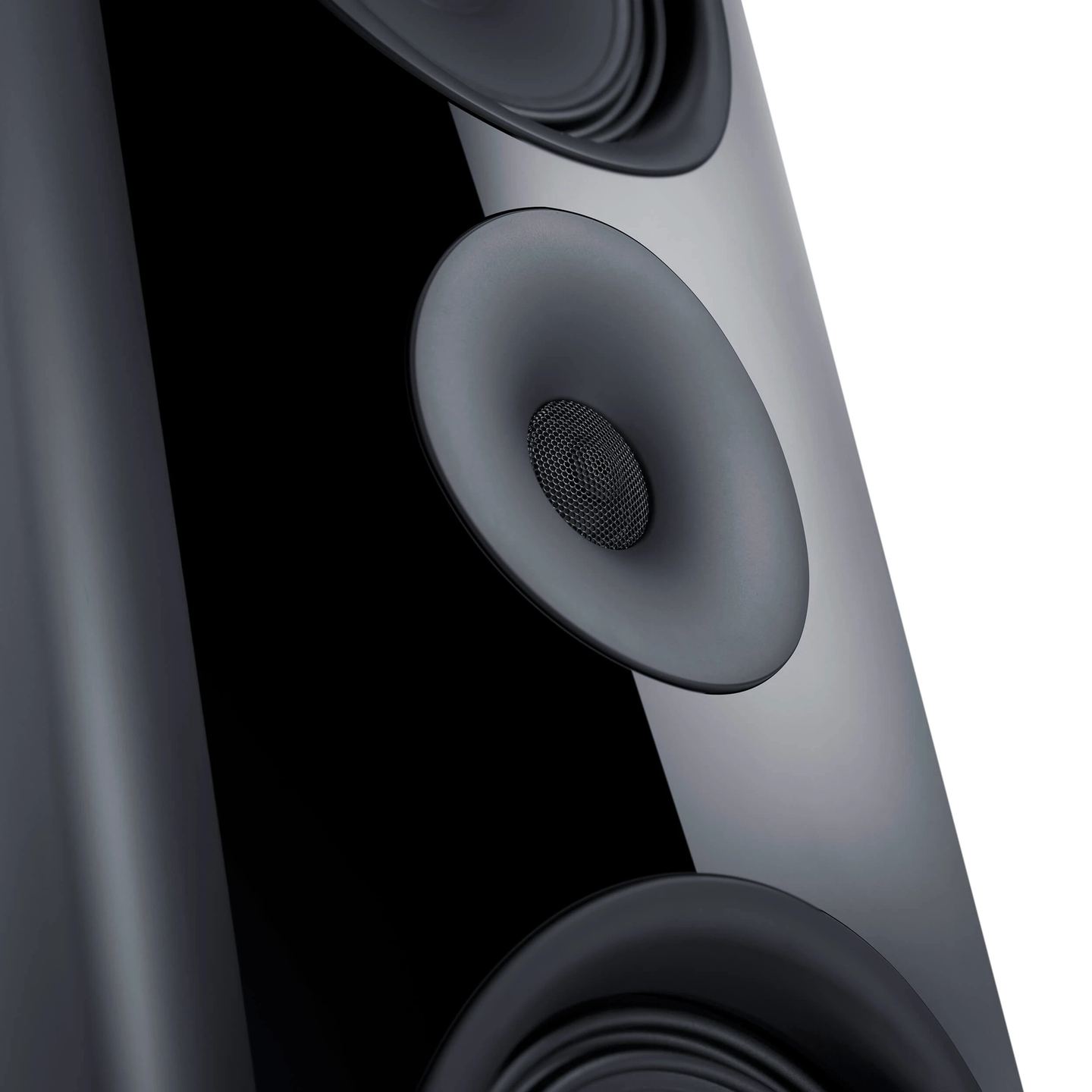
The two 192 mm woofers and the 174 mm midrange driver use this technology. The midrange benefits from an additional treatment called TCC (Triple Curved Cone), a cone geometry designed to stabilize the diaphragm and push resonance frequencies outside the useful bandwidth. The 25 mm tweeter, named BC, uses a black aluminum oxide ceramic dome.
The crossover frequency between bass and midrange is set at 180 Hz, and between midrange and treble at 3000 Hz. This layout gives the midrange an extended frequency band covering the critical area for localizing voices and instruments.
An edgeless cabinet, machined on a 5-axis mill
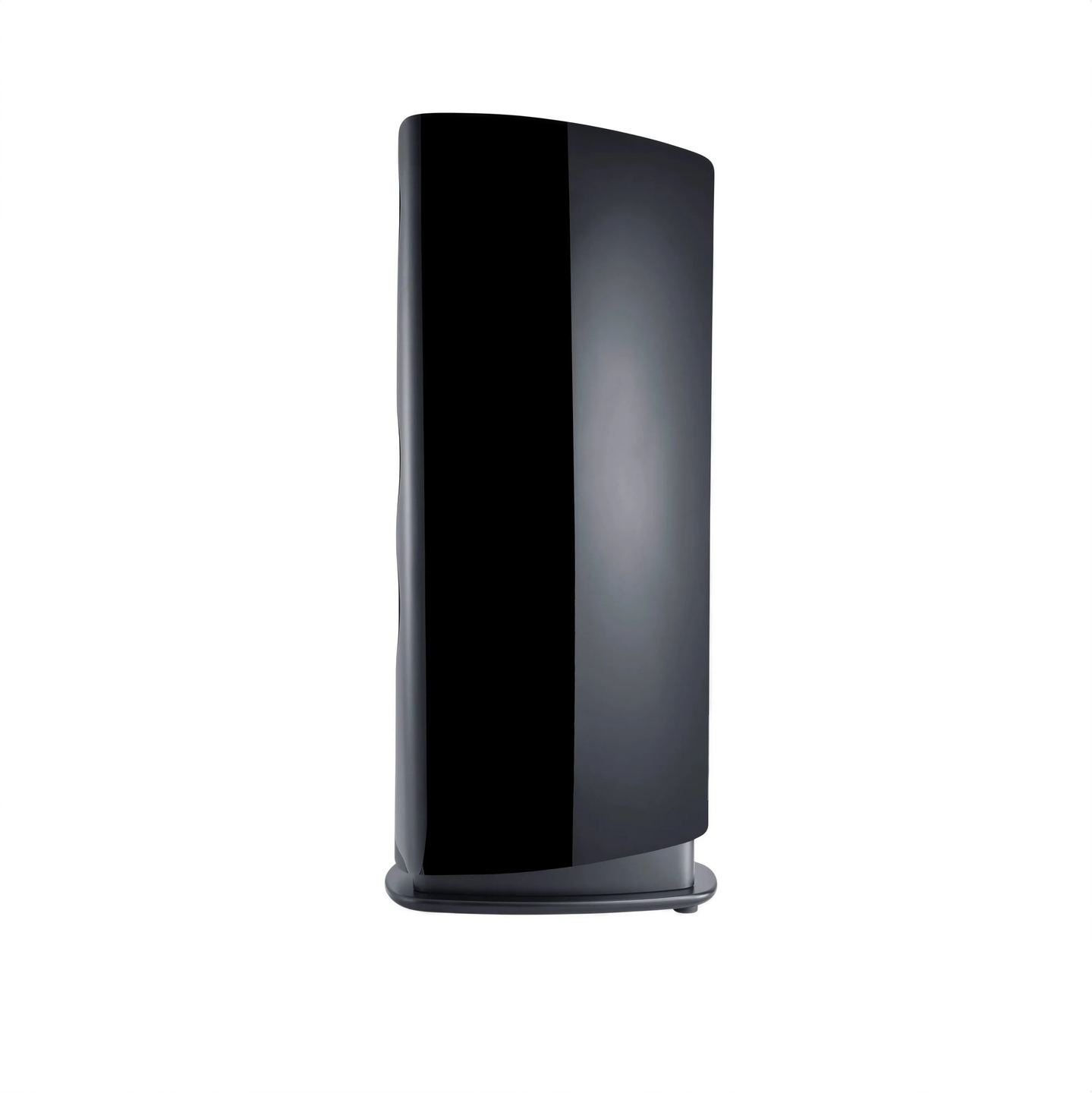
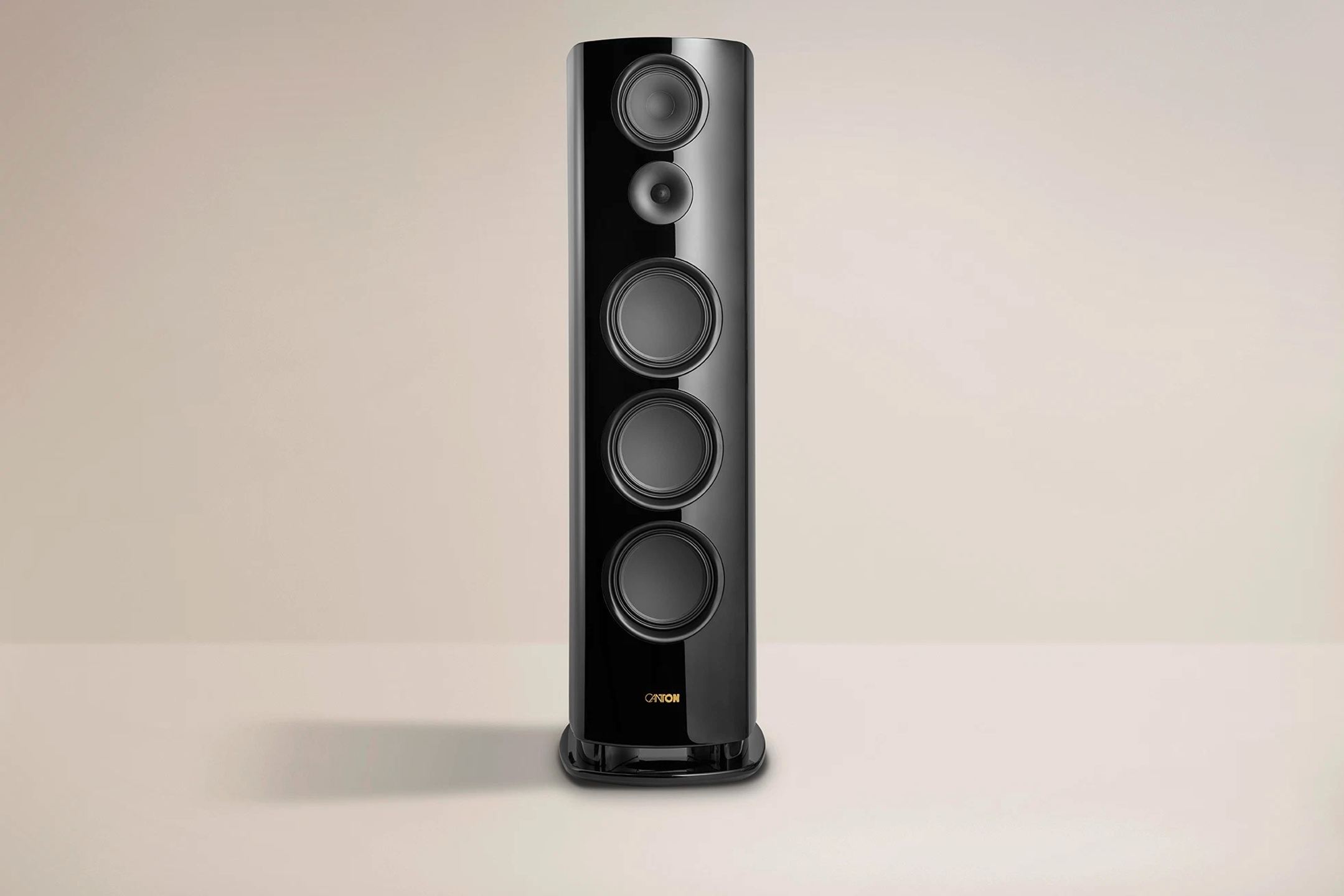
The Reference 2023 breaks away from the angular design of the previous K series. The cabinets feature curved side panels, a rounded top, and a front baffle with no sharp edges. This shape reduces the acoustic diffractions that typically color the sound of rectangular-box loudspeakers.
Canton machines the front baffles on a dedicated 5-axis CNC milling machine. The thickness of the front panel reaches 81 mm on some models in the range. The walls are made from multilayer laminate, reinforced by an internal bracing system calculated by computer simulation to eliminate standing waves.
Three finishes are available: piano black lacquer (12 coats of varnish, sanded and polished), matte satin white, and real walnut treated with a special sanding technique and a matte varnish.
The Bass-Guide integrated into the plinth
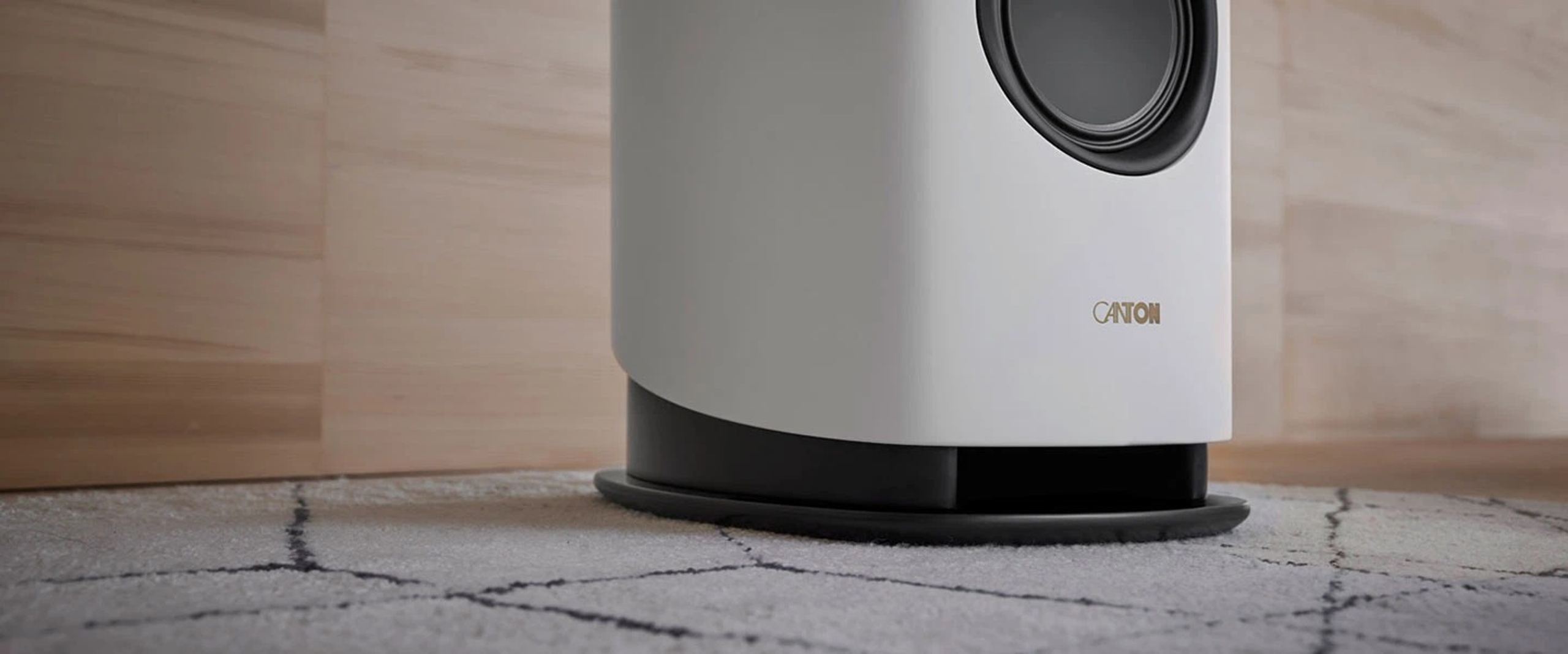
The Reference 3’s plinth is more than just a mechanical support. It incorporates Canton’s Bass-Guide system, a down-firing bass-reflex port that distributes low-frequency energy equally to the front and rear of the speaker.
This design has two practical consequences. It makes placement near rear walls easier (since the port is not directly facing them) and produces a more even bass dispersion in the room. The plinth rests on CNC-machined feet with PVD coating, decoupled from the cabinet by a “floating” construction.
The specified frequency response extends down to 20 Hz. The sensitivity of 88 dB for 2.83 V at 1 m, combined with a nominal impedance of 4 ohms, calls for an amplifier capable of delivering current. Canton specifies a continuous power handling of 300 W and 500 W peak.
Room Compensation adjustment and WBT terminals
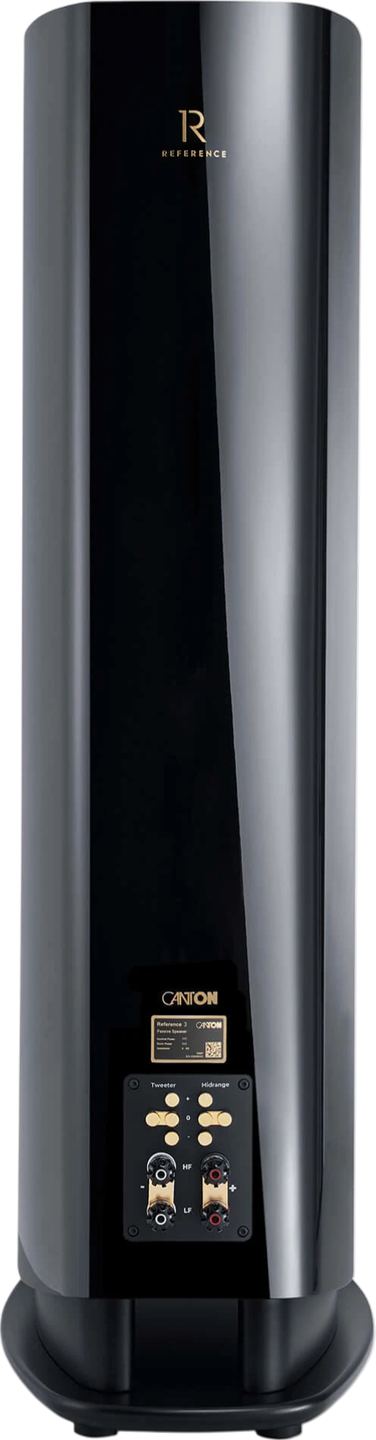
On the back, the terminal panel includes the Room Compensation (RC) function. Two switches allow you to adjust the midrange and treble level by ±1.5 dB in 1.5 dB steps. This function compensates for the acoustic characteristics of the listening room or adapts to personal preferences: a bit more treble for a very absorbent room, a bit less if the walls are reflective.
The WBT nextgen terminals support bi-wiring and bi-amping. Gold-plated copper bridges are supplied for single wiring. The quality of these connectors, made by German specialist WBT in Essen, remains a selling point for systems where contact quality matters.
Individual magnetic grilles
Each driver has its own acoustically neutral fabric grille, held in place by magnets. The asymmetrical mounting rings surrounding the drivers act as waveguides and help with sound dispersion in the mid and high frequencies. These rings allow the drivers to be flush-mounted in the front baffle, with no visible screws.
Position within the Reference range
The Reference 2023 series includes eight models: four floorstanders (Reference 2, 3, 5 and 7, from largest to smallest), a compact speaker (Reference 9), a center speaker (Reference Center), a passive subwoofer (Reference Sub), and the limited-edition Reference GS at the top of the range.
The Reference 3 occupies the second tier. It shares the BCT technologies, Bass-Guide and WBT terminals with its bigger sisters, but in a smaller cabinet volume than the Reference 2 (which uses 219 mm woofers). Compared to the Reference 5, it gains two larger woofers (192 mm versus 174 mm) and a greater cabinet volume.
Documentation
Technical specifications
Acoustic design
- Type: 3-way passive floorstanding speaker, bass-reflex
- Architecture: bass-reflex system with Bass-Guide technology ensuring even dispersion of low frequencies
- Drivers:
- 2 x 192 mm woofers with BCT (Black Ceramic Tungsten) cone
- 1 x 174 mm BCT midrange
- 1 x 25 mm BC tweeter with asymmetrical waveguide
- Cone technology: new-generation BCT offering maximum rigidity and minimal distortion
- Crossover frequencies: 180 Hz / 3000 Hz
Acoustic performance
- Frequency response: 20 Hz – 40000 Hz
- Power handling:
- Nominal: 300 W
- Music: 500 W
- Nominal impedance: 4 ohms
- Sensitivity: 88 dB (2.83 V / 1 m)
Technologies and construction
- BCT (Black Ceramic Tungsten) cones combining extreme rigidity and low mass
- Reinforced multi-layer cabinet effectively limiting resonances and coloration
- Curved cabinet shape optimizing sound dispersion and stereo imaging
- Internal bracing optimized by computer simulation
- Wave Surround 3.0 technology ensuring precise control of driver excursion
- Room Compensation adjustment: fine-tuning of mid and high frequencies (± 1.5 dB) according to room acoustics
Connectivity
- High-end WBT-nextgen™ binding posts
- Bi-wiring / bi-amping compatible
- Binding posts optimized for lossless signal transmission
Mechanical construction
- Decoupled plinth with floating design
- CNC feet with PVD coating
- Protective grille:
- Magnetic attachment
- Acoustically neutral fabric
Dimensions and weight
- Dimensions with plinth (W × H × D): 32 × 109 × 49 cm
- Dimensions without plinth:
- Width: 29 cm
- Depth: 46 cm
- Weight: 42 kg
Frequently asked questions
What type of amplifier should I use with the Reference 3?
The 4-ohm impedance and 88 dB sensitivity point towards amplifiers that are stable with low-impedance loads and can deliver at least 100 W into 4 ohms to fully exploit the dynamic potential. Quality solid-state amplifiers are a very good match. Tube amplifiers can be used if their 4-ohm output is properly rated.
How does the Room Compensation adjustment work?
Two switches on the rear change the midrange and treble levels to +1.5 dB, 0 dB or -1.5 dB. The neutral position (0 dB) corresponds to the reference setting. The plus and minus positions compensate for the room’s acoustics or tailor the sound to listening preferences.
Is the Reference 3 suitable for home theater?
The Reference range includes a center speaker (Reference Center) and a passive subwoofer (Reference Sub) that match both aesthetically and technically. Integration into a multichannel system is therefore straightforward. Its ability to handle high sound pressure levels without compression makes it well suited to dynamic movie soundtracks.
- Eco-contribution included in the sale price.
- Manufacturer reference: 04399
- GTIN / EAN: 4010243043999