The Ethernet cable that connects your router to your network player carries far more than music. Electromagnetic noise, ground loops, interference from household equipment: all these invisible forms of pollution travel with the signal all the way to the audio conversion stages. With the SI-1, Matrix Audio offers a radical answer to this problem by cutting any electrical link between the home network and the hi-fi system thanks to complete galvanic isolation via optical fiber.
Cut the electrical cord, not the data flow
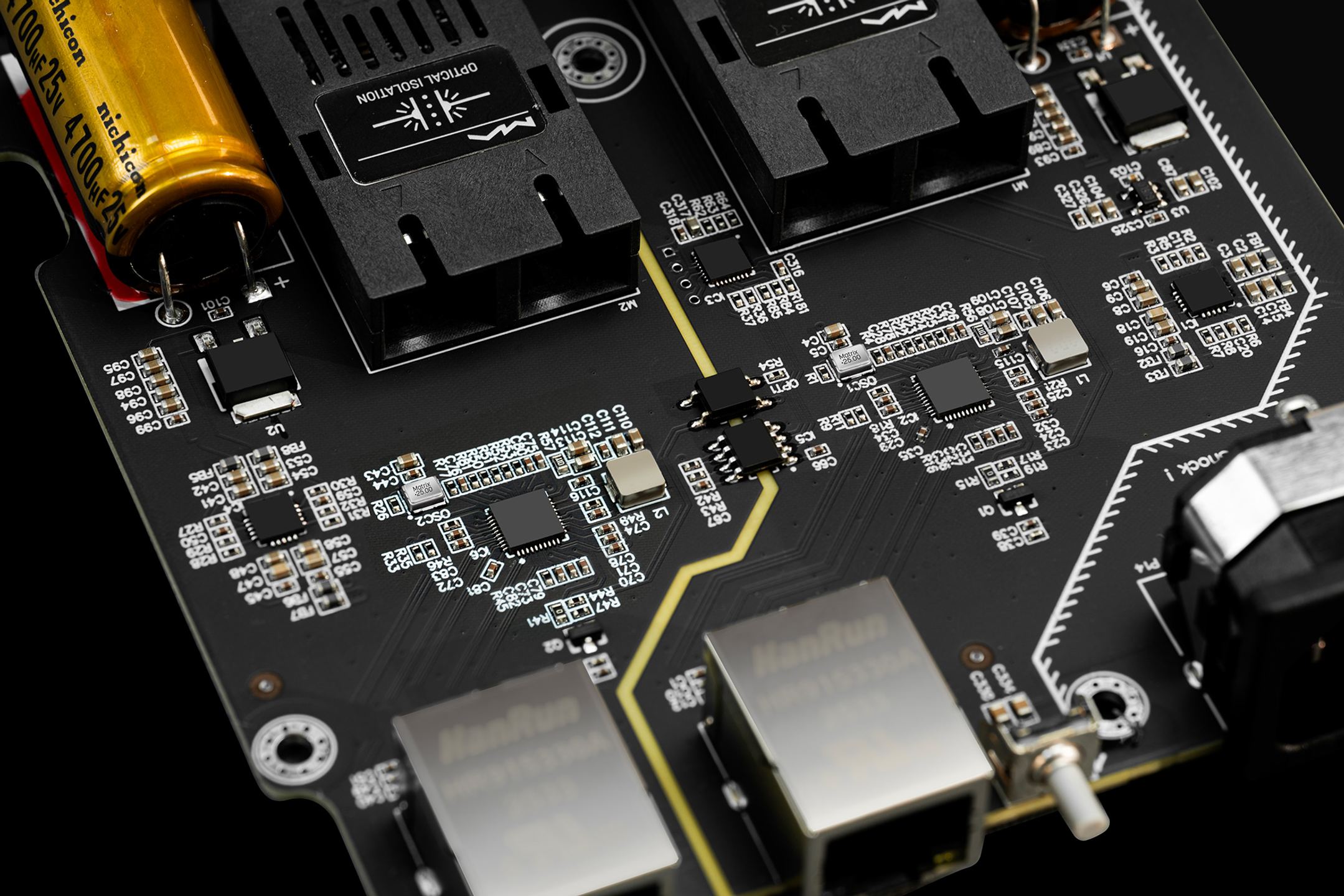
The SI-1 is based on an internal conversion of the Ethernet signal into an optical signal, followed by its reconversion into an electrical signal at the output port. This break in galvanic continuity physically prevents interference, electrical noise, and ground potential differences from propagating to connected audio equipment.
Inside the device, two separate optical channels handle data transmission and reception. This separation avoids crosstalk between upstream and downstream streams, a point often overlooked in passive isolators using magnetic transformers. The output port includes an additional insulating washer to reinforce the electrical separation between the two sections.
A power supply designed like that of a DAC
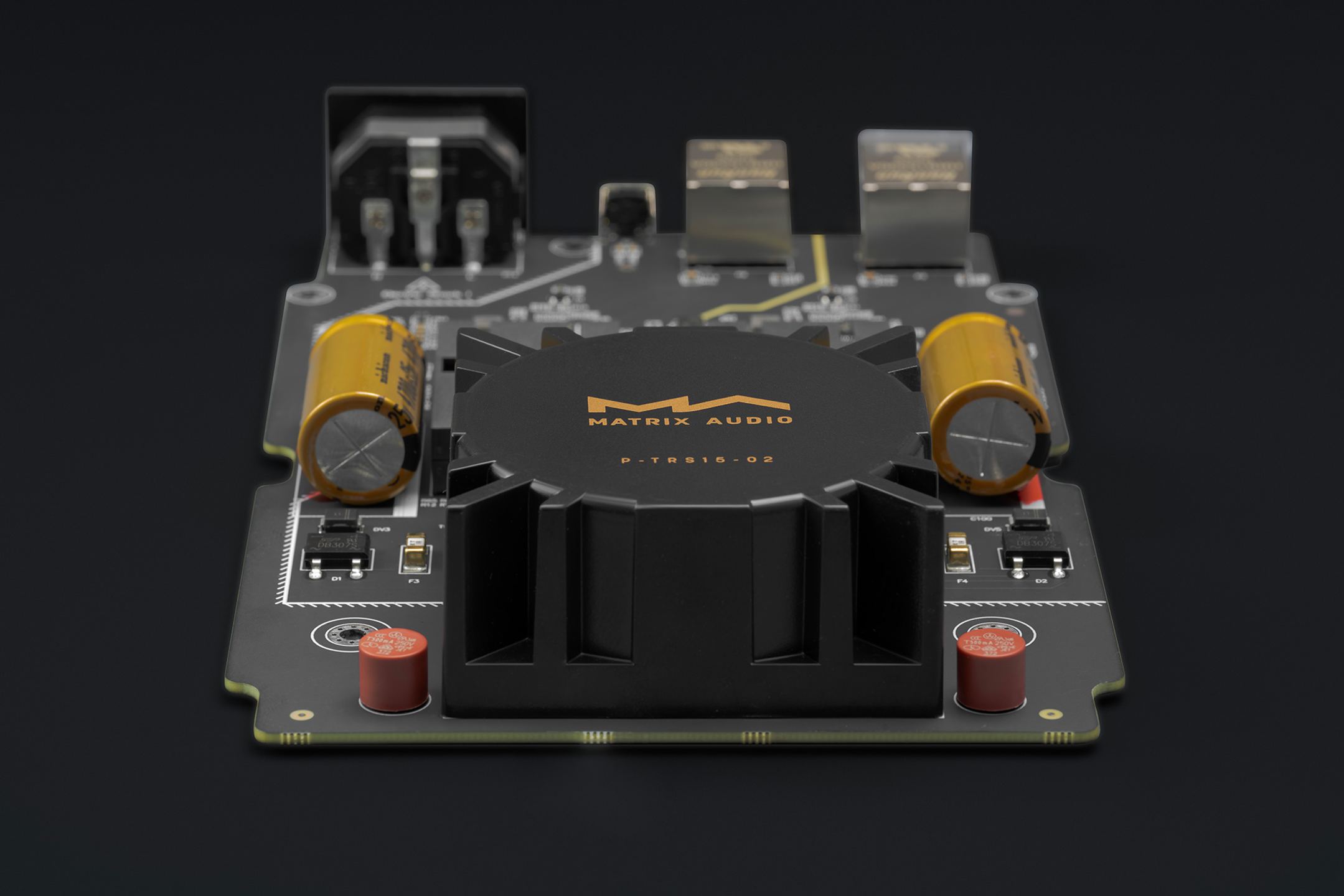
The SI-1 features its own internal linear power supply, an uncommon technical choice for this type of device. The dual-winding toroidal transformer is encapsulated in epoxy to limit mechanical vibrations and electromagnetic leakage. Several low-noise LDO (Low Drop-Out) regulators then power the optical circuits and clocks.
Two femtosecond clocks synchronize data transmission. Their precision is intended to reduce network jitter and timing errors that can affect downstream audio signal reconstruction, even if the streamer has its own reclocking system.
Matrix Audio recommends using a three-conductor power cable with a reliable ground connection. Without proper grounding, a slight tingling sensation may be felt when touching the metal chassis, a common phenomenon with devices using a linear power supply without grounding.
A compact format that hides its complexity
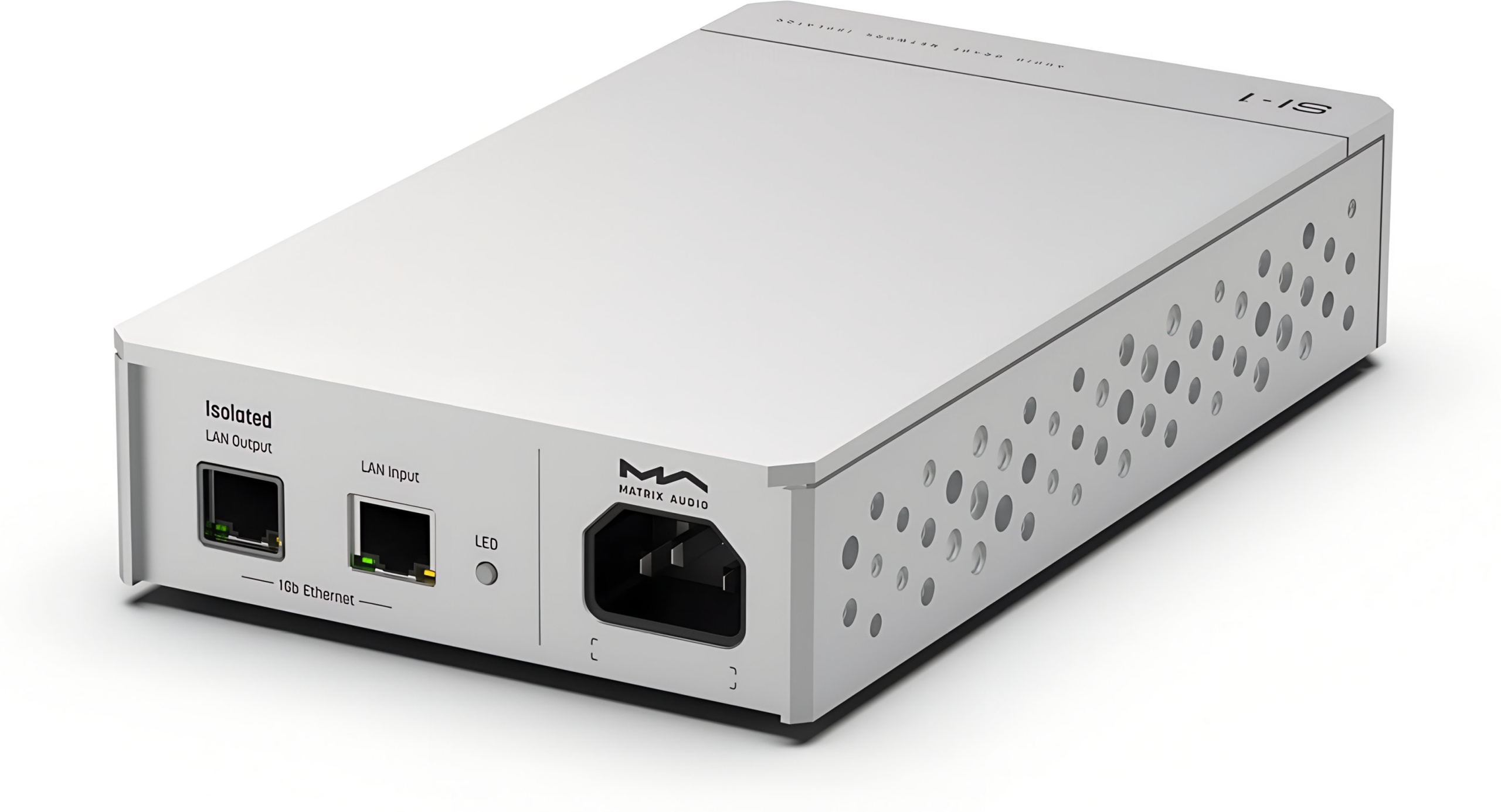
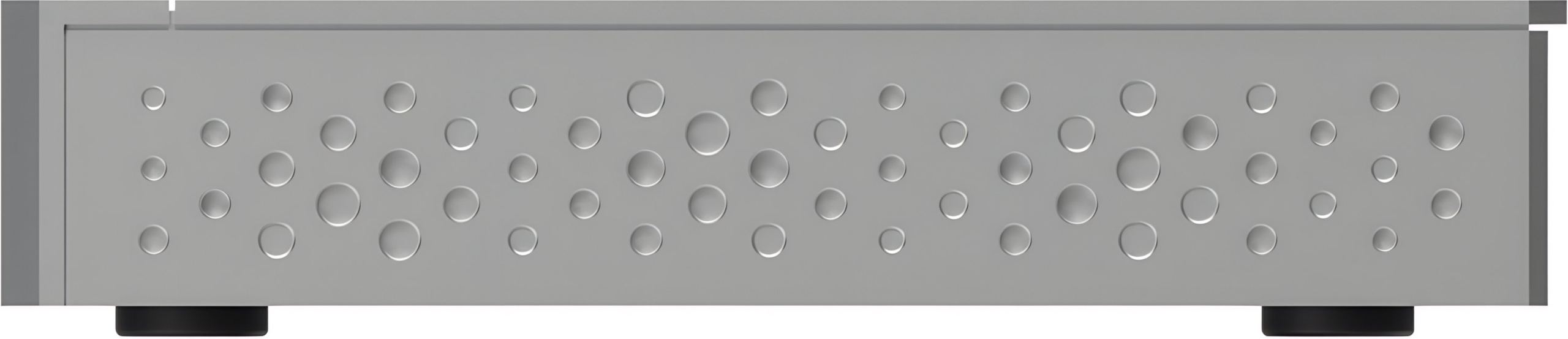
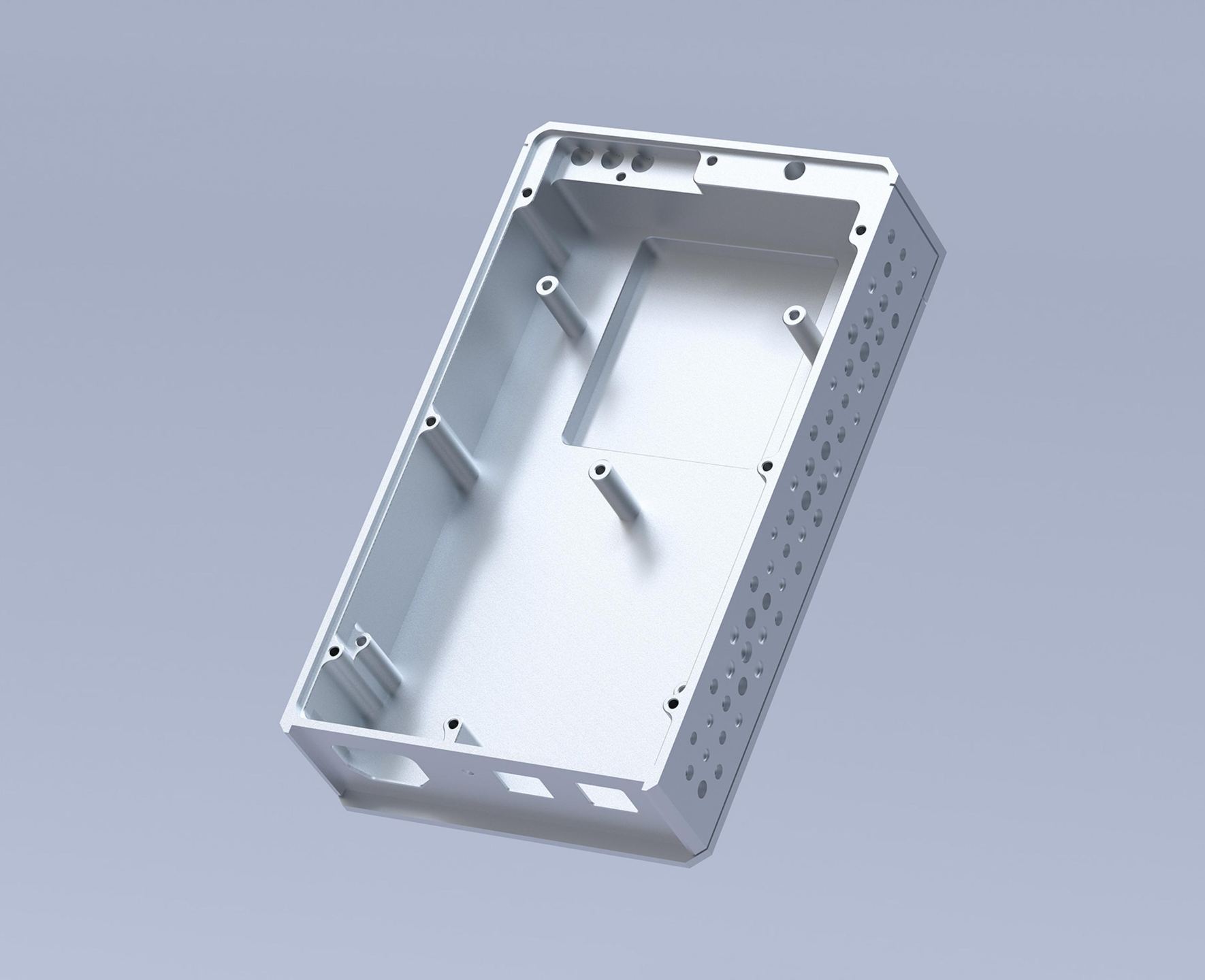
With dimensions of 120 × 205 × 44 mm and a weight of 1.54 kg, the SI-1 adopts the visual language of other Matrix Audio products: a one-piece CNC-machined aluminum chassis, straight lines, understated finish. The perforated sides ensure passive ventilation of the internal circuits. The manufacturer recommends leaving at least 5 cm of free space around the device and not obstructing the vents.
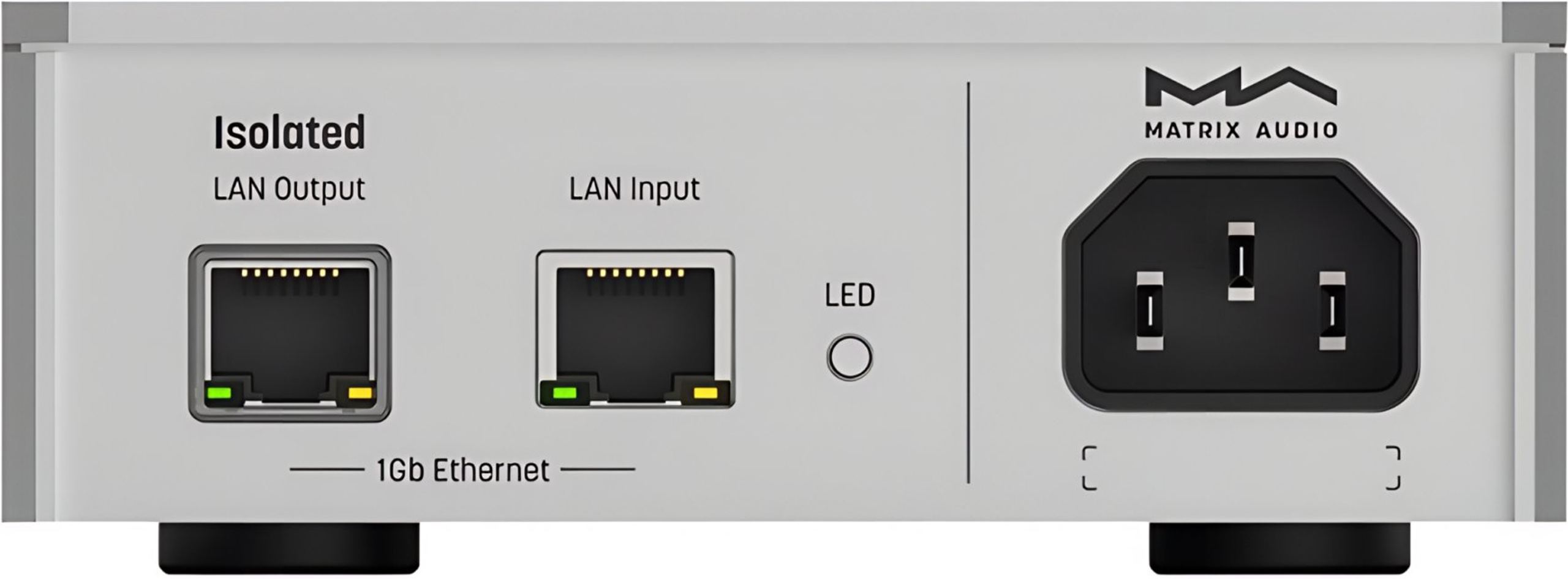
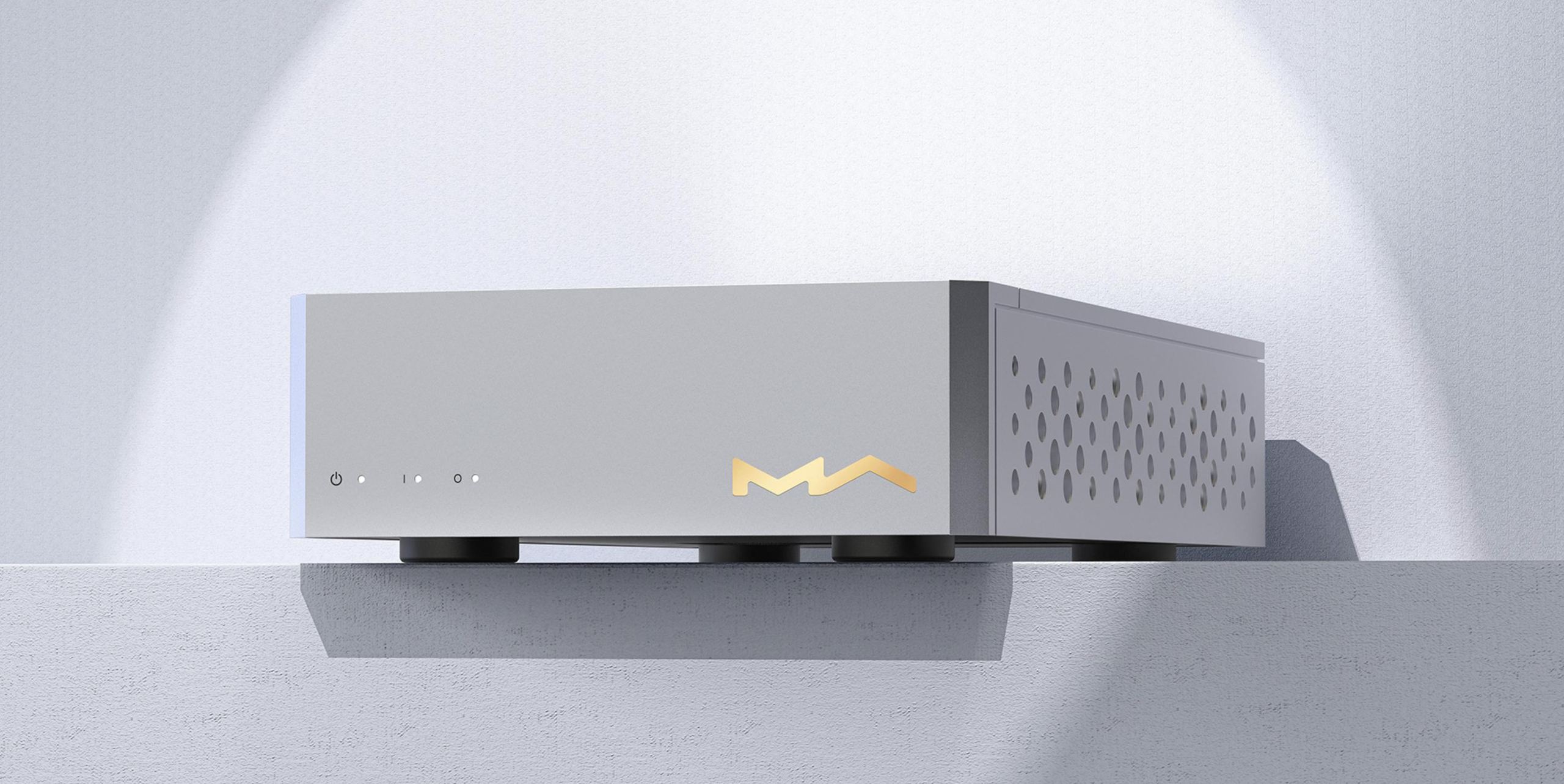
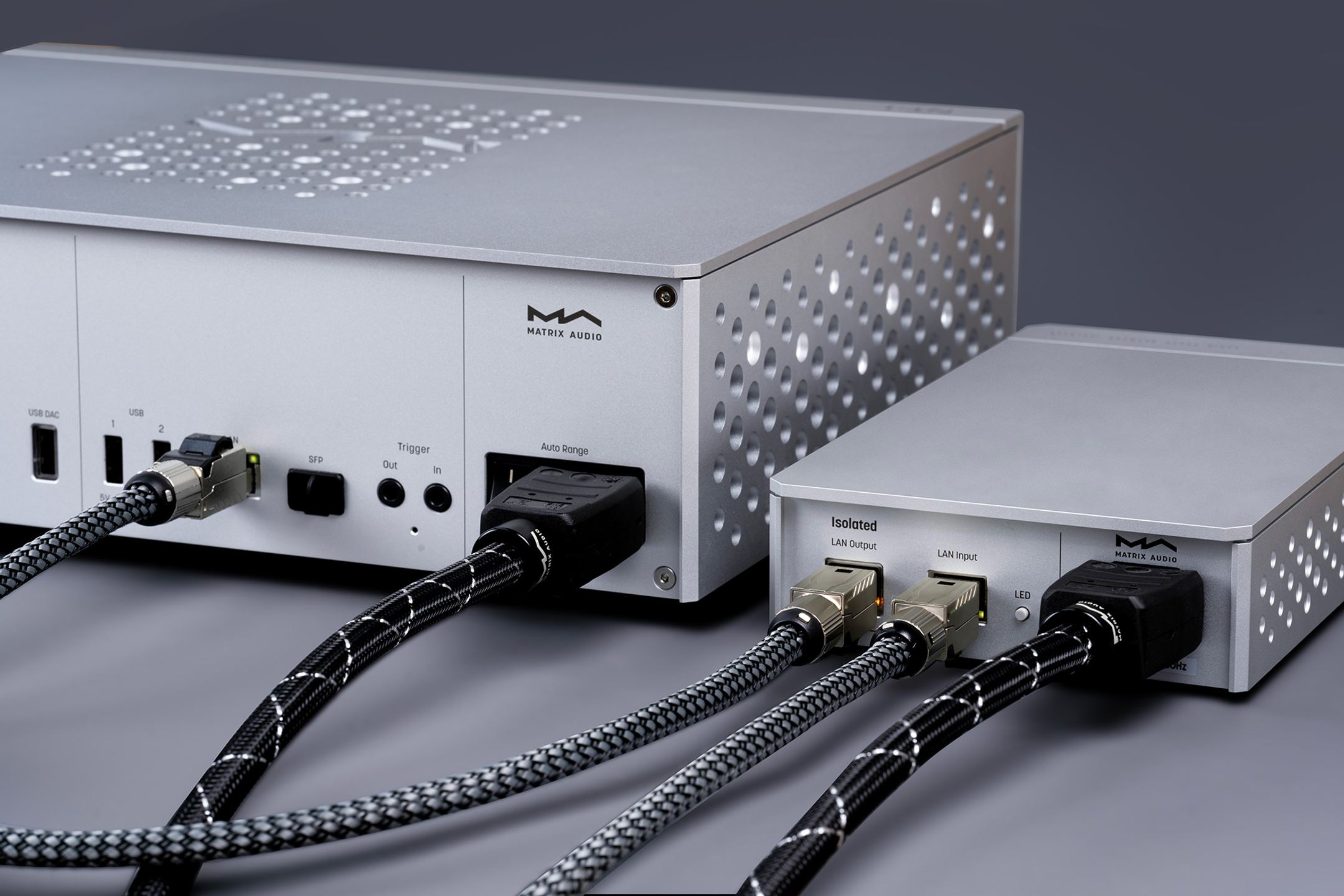
The front panel displays three LEDs: one for power, two for the connection status of the input and output ports. At the rear, each RJ45 port has two LEDs indicating connection speed and network activity. The green LED stays on continuously for a Gigabit connection, and turns off for 10/100 Mbps connections. The yellow LED flashes during data transfers. A button allows all rear LEDs to be turned off with a single press, a welcome detail in a listening room where any light source can be distracting.
Note the absence of an on/off button: the device operates as soon as it is plugged in. The chassis becomes slightly warm during operation (power consumption below 15 W).
Where should the SI-1 be placed in your setup?
Two main configurations emerge from Matrix Audio’s recommendations:
Directly before the network player or the DAC equipped with an Ethernet input. The SI-1 then isolates a single device from the rest of the home network. This is the simplest and most direct configuration.
Between the router (or a generic switch) and a dedicated audio switch such as the SS-1 or SS-1 Pro from Matrix Audio. The SI-1 then serves as an isolation point for the entire audio network, upstream from the other equipment. According to Matrix Audio, this position at the head of the audio chain delivers the best results.
The SI-1 works with any audio equipment featuring a wired Ethernet connection, regardless of brand: network players, music servers, connected DACs, NAS units. Network compatibility covers IEEE 802.3 standards up to Gigabit Ethernet (10/100/1000 Mbps).
Built-in electrical protection
Beyond audio isolation, the SI-1 protects connected equipment against electrical surges. The optical isolation blocks voltage spikes that could travel through the Ethernet cable during storms or disturbances on the electrical network. The manufacturer mentions protection against lightning, power surges, electrostatic discharges, and mains noise. For expensive audio equipment, this secondary function is not insignificant.
Switchable Ethernet port LEDs to limit light pollution
Performance
Maximum number of MAC addresses: 2000
Design and construction
One-piece CNC-machined aluminum enclosure for durability and shielding against electromagnetic interference
Controllable LEDs: LAN port indicators can be turned off to reduce light pollution
Dual optical channel with femtosecond clocks and linear power supply
Dimensions and weight
Width: 120 mm
Depth: 205 mm
Height: 44 mm
Weight: 1.54 kg
Included accessories
Power cable × 1
User manual × 1
Warranty card × 1
Frequently asked questions
Does the SI-1 require a break-in period before reaching optimal performance?
+
Matrix Audio does not specify an official break-in period. The device warms up slightly after a few hours of operation, and the circuits stabilize over time. As with any precision electronic equipment, a few days of continuous operation allow the components to reach their nominal thermal operating state.
Can the SI-1 be used with an SFP optical fiber connection at the input?
+
No. The SI-1 only has RJ45 ports for input and output. The optical isolation takes place inside the device. For an external optical fiber connection (SFP), you need to use the SS-1 or SS-1 Pro switches, which integrate SFP/SFP+ ports.
Does the SI-1 reduce network throughput?
+
The SI-1 supports Gigabit Ethernet (1000 Mbps) on both ports. No throughput reduction is imposed by the device itself. Audio streaming, even in high resolution, represents only a tiny fraction of this bandwidth.
Is a specific Ethernet cable required to connect the SI-1?
+
The SI-1 works with any standard Category 5e or higher Ethernet cable. The value of high-end audiophile cables downstream of the SI-1 depends on the sensitivity of the system and the user’s beliefs.
Can the SI-1 replace an audiophile switch?
+
No. The SI-1 isolates, it does not distribute. Only one device can be connected to its output. To feed multiple audio devices, a switch must be added downstream of the SI-1. Both can be used together: SI-1 for primary isolation, SS-1 Pro for distribution.
User reviews
Peter
The SI-1 is a great optical Lan isolator for streaming your music.I use it for cleaning the Lan signal to my Antipodes CX - EX streamer and server.Result was better then expected : denser, more refined, bigger soundstage, better bass and more musical.The aluminium case get a little bit hot, but that's normal for cooling.Price was great and shipment time ok.
Comment from 2 October 2026 — Experience from 21 September 2026
Imre
Excellent product, it significantly improved the sound quality in my system, larger soundstage, and more lifelike voices.
Comment from 16 September 2026 — Experience from 5 September 2026
Ed
Beautifully built, so very solid and easy to install. The SI-1 is connected directly between my router and my streamer. Strong musical improvement of the audio signal. Wider soundstage, blacker background, excellent instrument placement, and more detail. Best Ethernet filter I have ever had.
Beautifully built, so very solid and easy to install. The SI-1 is connected directly between my router and my streamer. Strong musical improvement of the audio signal. Wider soundstage, blacker background, excellent instrument placement, and more detail. Best Ethernet filter I have ever had.
Comment from 26 June 2026 — Experience from 14 June 2026
Automatically translated — Show original (Dutch)
Prachtig gebouwd, dus zeer solide en makkelijk te installeren. SI-1 zit direct aangesloten tussen mijn router en mijn streamer. Sterke muzikale verbetering van het geluidssignaal. Breder geluidsbeeld, zwartere achtergrond, uitstekende plaatsing van instrumenten en meer details. Beste ethernet filter wat ik ooit gehad heb.
Beautifully built, so very solid and easy to install. The SI-1 is connected directly between my router and my streamer. Strong musical improvement of the audio signal. Wider soundstage, blacker background, excellent instrument placement, and more detail. Best Ethernet filter I have ever had.
Eco-contribution of €0.08 included in the sale price.
To better understand our visitors, measure marketing effectiveness and personalise ads, we and our partners use cookies and mobile advertising identifiers on your device. This data makes it possible to display personalised and non-personalised ads and measure their performance. Some cookies, which are technically necessary, are exempt from consent. You can accept those that require your consent, refuse them by clicking “Reject”, or customise your choices via “More options”.
To find out how Google uses the data collected once you have given your consent, see Google’s Business Data Responsibility site (opens in a new window).
You can change or withdraw your consent at any time via the “Cookies” link. Your choices will apply on our site for 12 months.