Mofi Electronics StudioDAC
Specifications and features


MoFi Electronics StudioDAC: Digital-to-Analog Converter
When MoFi Electronics decided to venture into digital-to-analog conversion, the brand followed the same recipe that had proven itself with its turntables and phono preamplifiers: seek out a renowned engineer and design the product in the United States, in its own Michigan workshops. For the StudioDAC, it was Michal Jurewicz, founder and chief engineer of Mytek Audio, who designed the circuit. The result is a compact, understated DAC, handcrafted in America, supporting virtually all current high-resolution audio formats.
A Mytek-Designed Circuit, a MoFi Sonic Signature
MoFi Electronics has a tradition of entrusting technical design to recognized specialists in their field: Allen Perkins (Spiral Groove) for turntables, Tim de Paravicini (EAR) for the StudioPhono phono preamplifier, Peter Madnick for the MasterPhono. The StudioDAC continues this approach by drawing on Michal Jurewicz, a Polish engineer based in New York since the late 1980s, who worked at the Hit Factory and Skyline studios before founding Mytek in 1992. Jurewicz has been designing digital converters for over thirty years, first for professional recording (his early devices were used on sessions with David Bowie, Lou Reed, and Mariah Carey), then for home listening with the Brooklyn, Manhattan, and Liberty product lines.
An important distinction: Jurewicz designed the circuit, but MoFi took charge of the StudioDAC’s “voicing.” According to John Schaffer, president of MoFi Electronics, the process involved many hours of listening, adjustments, and fine-tuning to achieve a transparent and engaging sound. This division of roles between technical design and sonic character sets the StudioDAC apart from a simple rebadging exercise.
Conversion and Signal Processing
The StudioDAC is built around an ESS ES9038Q2M chip, a 32-bit stereo converter from ESS Technology’s SABRE series. This chip uses HyperStream II technology and incorporates a time-domain jitter eliminator. On paper, the ES9038Q2M boasts a dynamic range of 129 dB and a THD+N ratio of -120 dB. The measurements announced by MoFi for the assembled StudioDAC remain excellent, even if they fall short of the bare chip’s theoretical values: dynamic range of 115 dB (A-weighted), THD+N below 0.002%, signal-to-noise ratio above 114 dB, and crosstalk of -110 dB at 10 kHz. This gap is normal: real-world performance depends on the analog output stage, the power supply, and the overall circuit implementation.
Two elements deserve attention. The first is the low-noise precision clock, whose function is to reduce jitter — the micro-timing variations in the digital signal that can impair conversion fidelity. The second is the proprietary apodizing filter. Conventional reconstruction filters generate pre-ringing (a spurious oscillation before transients) and can harden high frequencies. An apodizing filter eliminates this pre-ringing at the cost of slightly more pronounced post-ringing, which in practice yields a more natural and less aggressive treble. This is a design choice that prioritizes long-term listening comfort.
Supported Formats and Connectivity
The StudioDAC accepts PCM streams up to 32-bit / 384 kHz, native DSD (DSD64 and DSD128 via USB), and DXD. It also supports MQA with full hardware decoding and rendering, which may appeal to Tidal subscribers with content encoded in that format (the relevance of MQA is debated in the audiophile community, but its presence takes nothing away from the DAC’s other capabilities).
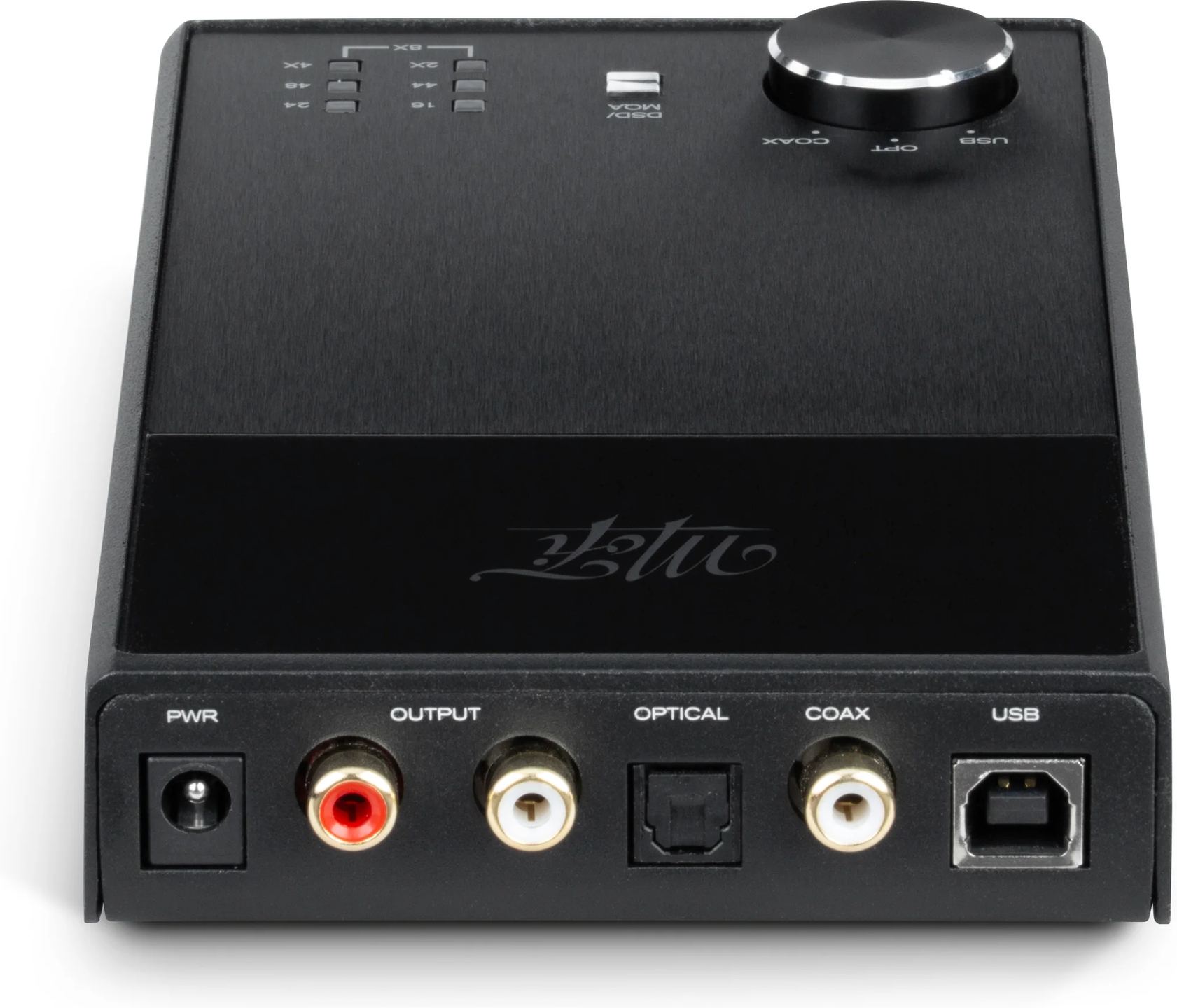
On the input side, three digital interfaces cover common use cases: USB 2.0 for connection to a computer or audio server (with high-resolution format support), coaxial S/PDIF and optical Toslink for network players, streamers, or other digital sources. The output is a pair of fixed-level analog RCA connectors (2.5 VRMS at 0 dBFS, 75 Ω impedance). No headphone output, no balanced XLR output, no volume control: the StudioDAC is a pure converter, designed to sit between a digital source and an amplifier.
Compact Form Factor and External Power Supply
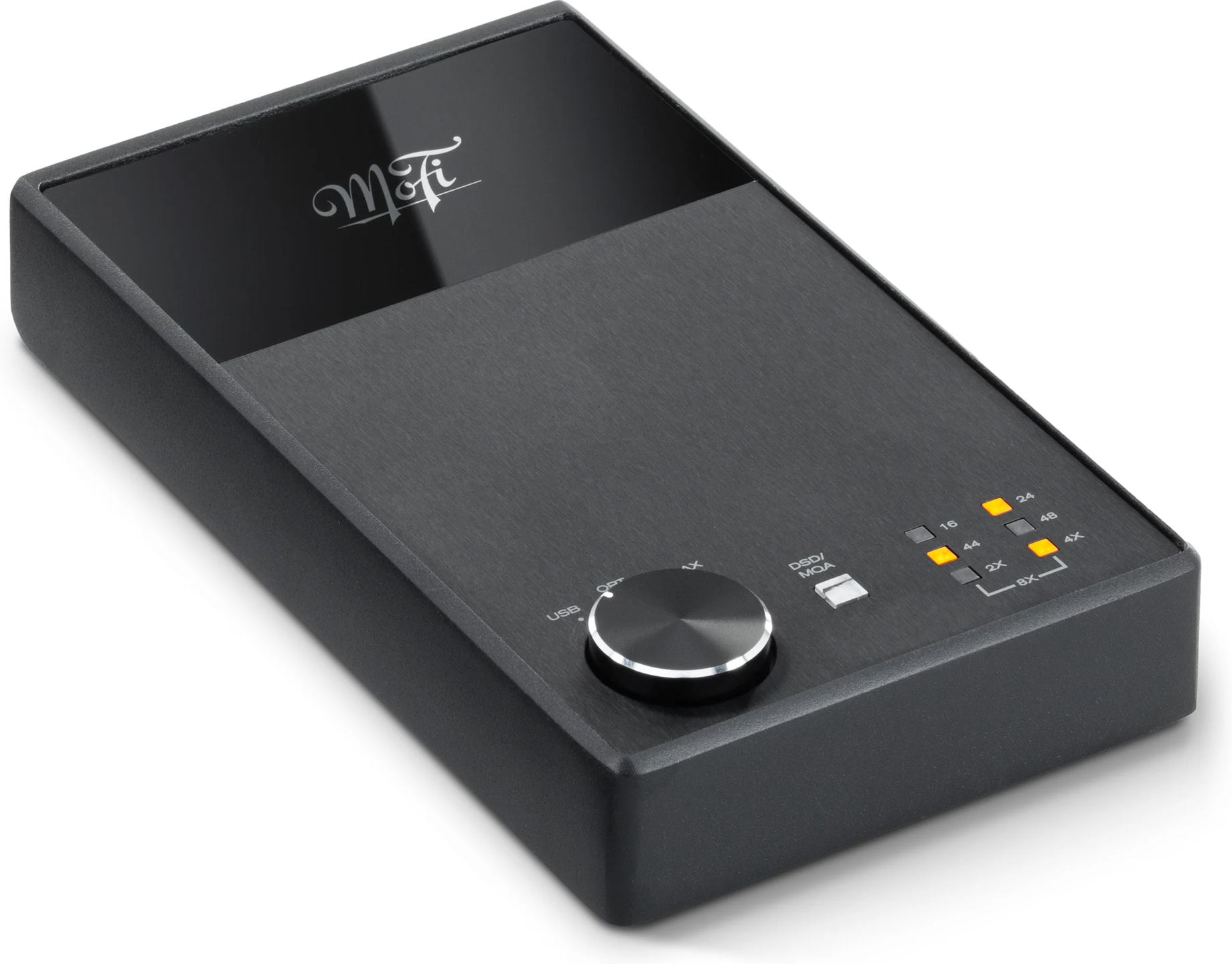
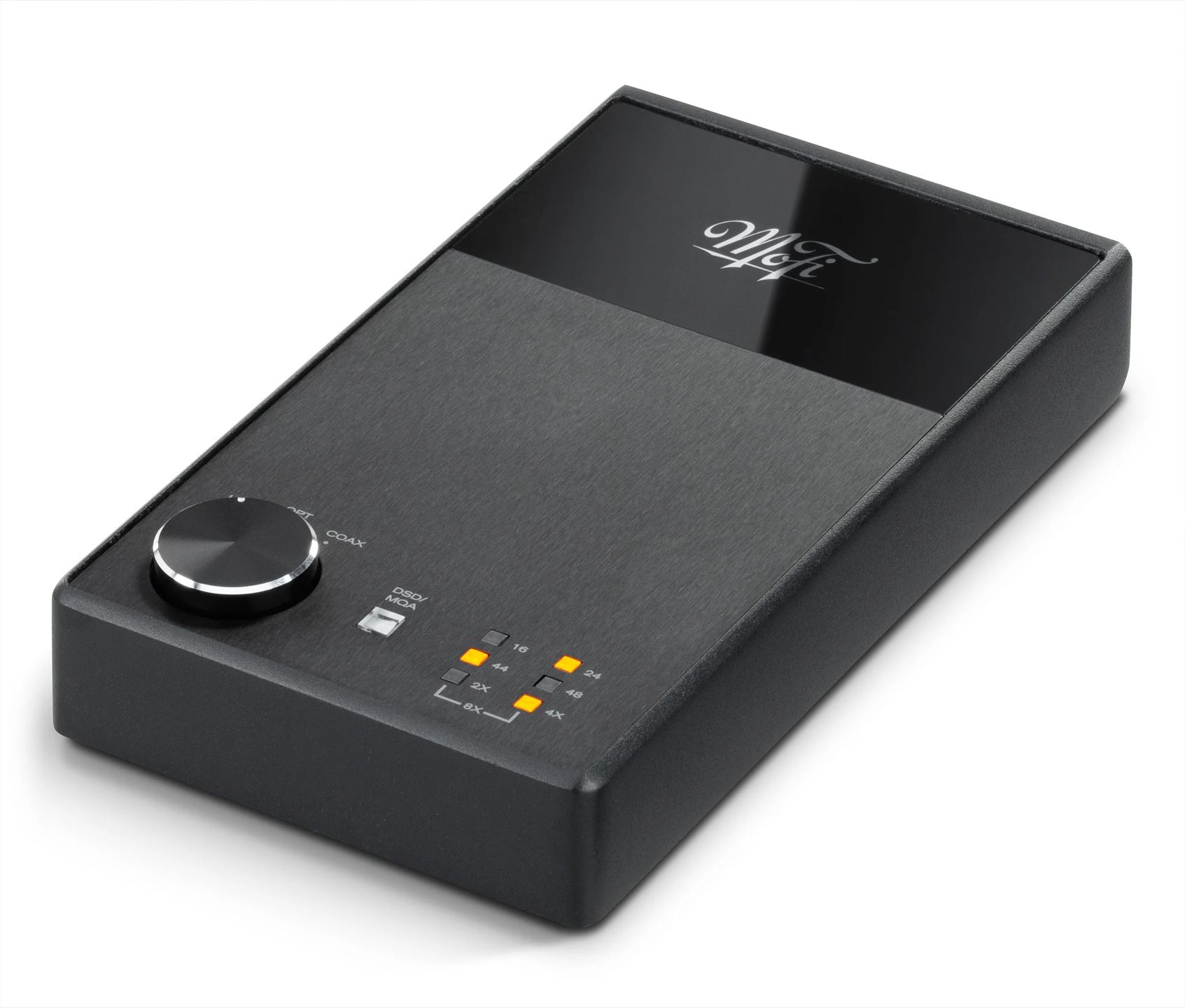
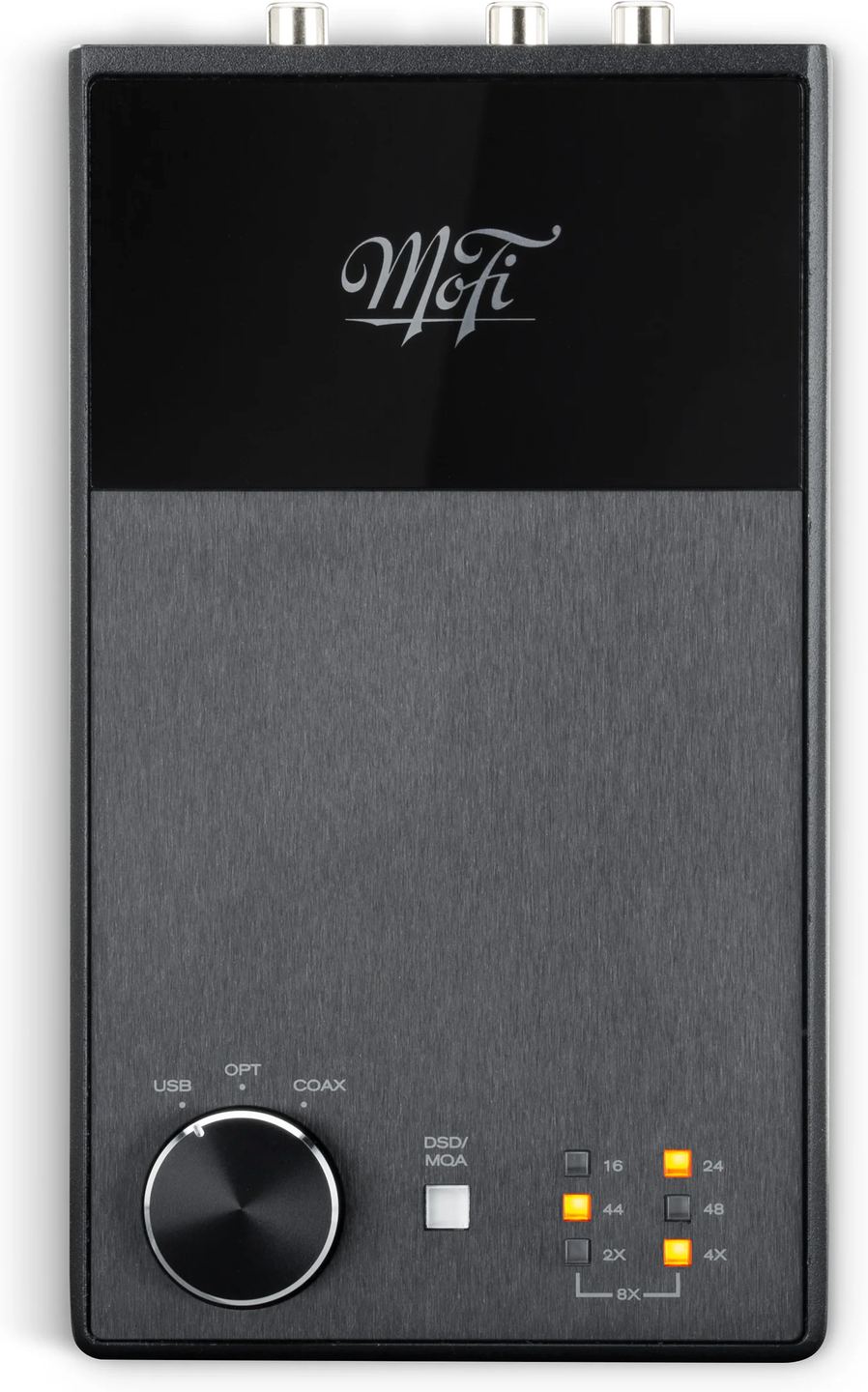
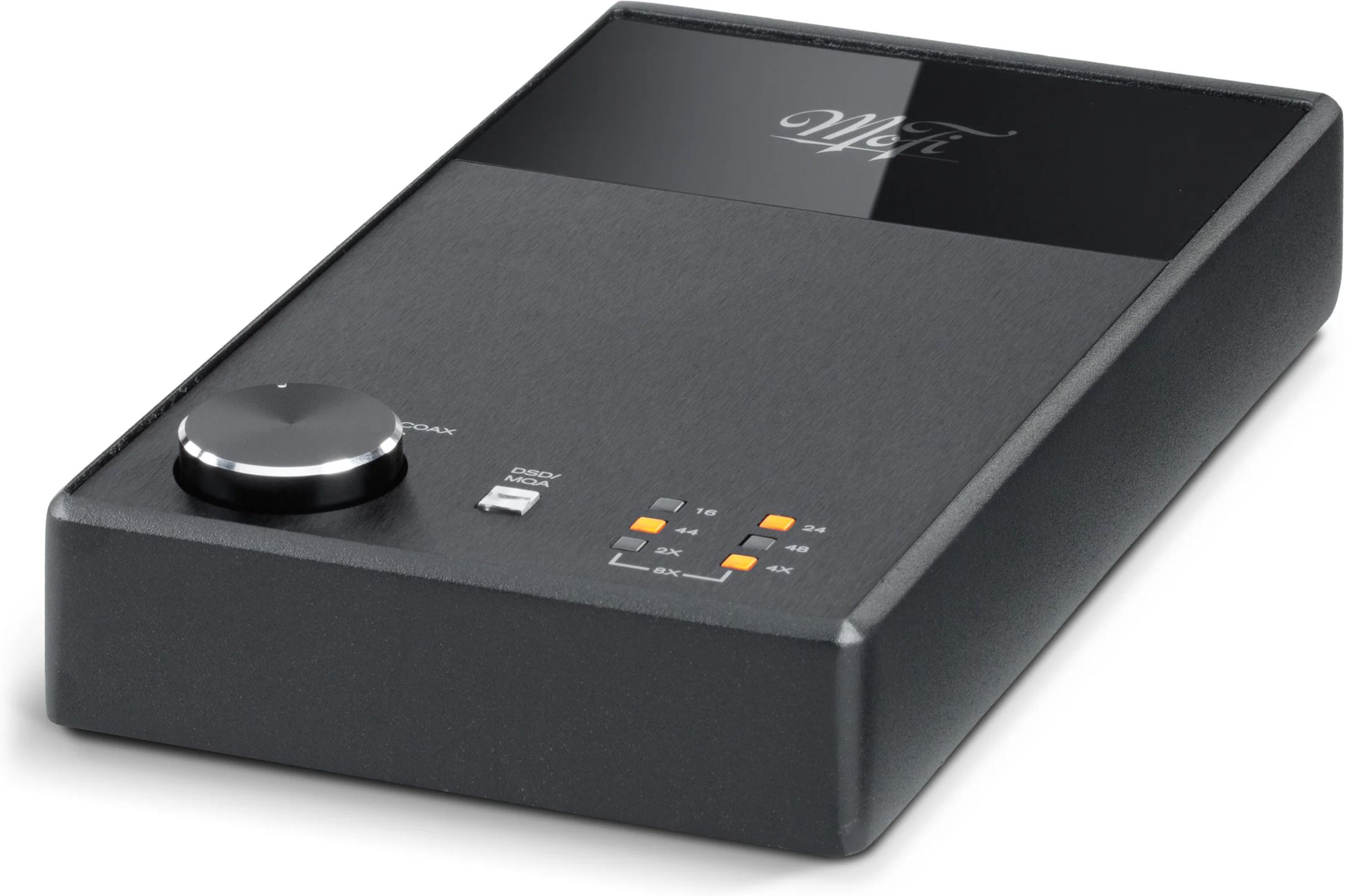
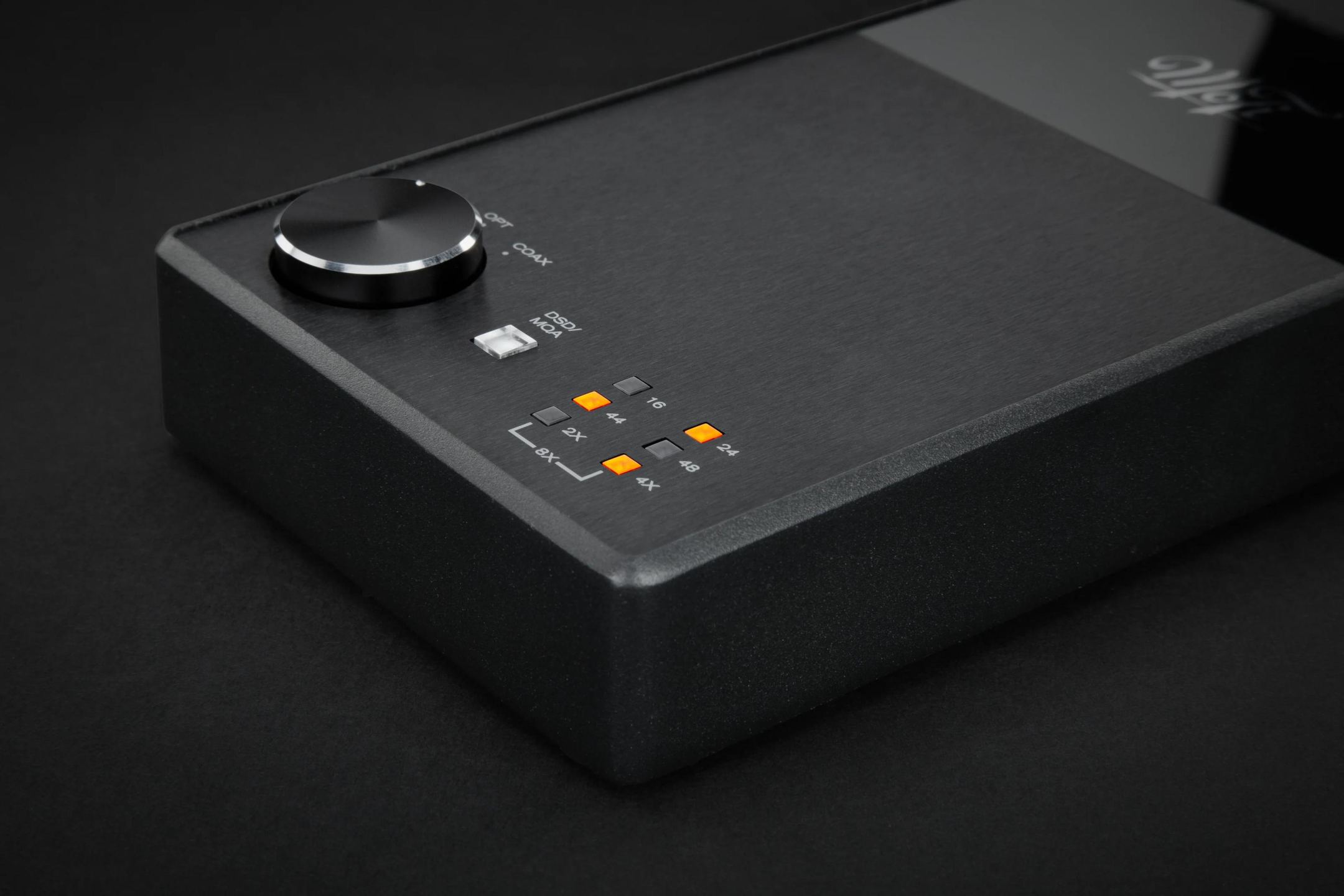
The enclosure shares the proportions of the StudioPhono, the phono preamplifier from the same range: a pocket-book form factor, discreet, that fits easily on a desk or into an existing system. The top panel features a rotary input selector and LED indicators that display in real time the format and resolution of the audio stream currently playing. This visual indication allows you to verify at a glance that playback is truly bit-perfect — meaning the signal reaches the converter without alteration or resampling by the operating system or software player.
The power supply is external: a 12 V / 3.3 A universal-input power adapter (100–240 V), connected via a 5.5/2.5 mm DC connector. Moving the power supply outside the main enclosure keeps electromagnetic interference away from the audio circuit. MoFi also mentions the possibility of replacing this power supply with a higher-performance model, an upgrade path for those who wish to go further.
Technical Specifications
Audio Technology
- ESS9038Q2M digital-to-analog converter
- Ultra-low-noise precision clock for maximum jitter reduction
- Proprietary apodizing filter eliminating digital artifacts (pre-echo, high-frequency harshness)
- Full hardware MQA decoding (decode and render)
- High-resolution audio processing without signal alteration
- Guaranteed bit-perfect playback on all inputs
- Architecture optimized for high-resolution streaming
- Design optimized for isolation from electrical interference
Supported Audio Formats
- PCM up to 32-bit / 384 kHz
- Native DSD via USB: DSD64, DSD128
- DXD
- MQA: full decoding and rendering
Connectivity
- Digital inputs
- USB 2.0 (high-resolution audio)
- Coaxial S / PDIF
- Optical Toslink
- RCA analog output (fixed level)
Compatibility
- High-fidelity audio streamers
- Network players
- Mac, PC computers, audio servers
- Hi-fi systems and external DACs
Analog Performance
- Frequency response: 20 Hz – 20 kHz (± 0.2 dB)
- Total harmonic distortion (THD+N): < 0.002%
- Dynamic range: 115 dB (A-weighted)
- Signal-to-noise ratio (SNR): > 114 dB
- Crosstalk: -110 dB at 10 kHz
- Output impedance: 75 Ω
- Output level: 2.5 VRMS at 0 dBFS
Power Supply
- Low-noise external power supply: 12 V DC / 3.3 A
- Universal input: 100 – 240 V AC
- Dedicated DC connector: 5.5 / 2.5 mm
User Interface
- Real-time LED indicators for audio formats and resolutions
- LED indicators confirming audio format
Sound Reproduction
- Ultra-transparent sound signature, without digital coloration
- Wide and precise soundstage
- Dynamics faithful to the original studio recordings
Frequently asked questions
Do I need to install a driver to use the StudioDAC via USB on a Mac or PC?
On macOS, the StudioDAC works natively without any additional driver, thanks to native USB Audio Class 2 support. On Windows, an ASIO driver may be required to access the highest resolutions (native DSD, PCM beyond 24-bit / 96 kHz).
Can the StudioDAC be used with a Sonos Port or a similar device?
Yes. Any device equipped with an optical (Toslink) or coaxial (S/PDIF) digital output can be connected to the StudioDAC. Conversion will then be handled by the StudioDAC rather than the device’s internal DAC.
What does hardware MQA decoding offer?
Hardware MQA decoding fully processes the MQA stream (decoding and rendering) without relying on software on the computer. MQA files and streams (notably on Tidal) are played back at their original resolution. For non-MQA content, this feature plays no role.
Can the external power supply be replaced?
Yes. The 5.5/2.5 mm DC connector and 12 V voltage are common standards. The supplied power adapter can be substituted with a higher-quality linear power supply, provided the specifications are met (12 V DC, 3.3 A minimum).
Can the StudioDAC serve as a preamplifier?
No. The RCA output is fixed-level (2.5 VRMS). There is no integrated volume control. A preamplifier or integrated amplifier with a line input is required downstream.
Does the StudioDAC support DSD256 or DSD512?
No. DSD support stops at DSD128 (via USB). The ES9038Q2M chip theoretically handles DSD256, but MoFi has limited support to DSD128 on this model.
- Eco-contribution included in the sale price.
- Manufacturer reference: 00032693